-
 Contact Us
-
 Re order
-
 Log in
-
 Cart 0
You have no items in your shopping cart.
Account Number on a Check: Where to Find It and Read It
You need your account number for a direct deposit form, a bill payment or a new check order, and the only thing in front of you is a check. The bottom of that check carries three runs of digits and a few odd symbols, and picking the wrong run means a rejected payment or a misdirected deposit.
This guide shows exactly where the account number on a check sits, how to tell it apart from the routing and check numbers, why business checks and deposit slips look different, and which checks never show your own account at all.
Quick Summary
The account number on a check is the middle group of digits in the line printed along the bottom edge. On most personal checks it sits to the right of the 9-digit routing number and to the left of the check number. It ends where the on-us symbol appears. Business checks often put the check number first, so read the symbols, not just the position.
Key points
- The bottom line is the MICR line. It is printed in magnetic ink so bank machines can read the routing number, account number and check number.
- The routing number always has 9 digits. The American Bankers Association set that format, so a 9-digit group framed by matching symbols is the routing number.
- The account number length varies by bank. The ACH file format allows up to 17 characters, and bank help pages we checked use anywhere from 8 to 14 digits.
- The on-us symbol closes the account number. Digits before it belong to the account field; digits after it are usually the check number.
- Business checks change the order. Many put the check number at the far left, in a field called the auxiliary on-us field.
- Some checks show someone else's account. A cashier's check, a money order or a bill pay check you were sent does not carry your account number.
| Number | Where it sits on a personal check | Length | What it identifies |
|---|---|---|---|
| Routing number | First group on the bottom line, between two transit symbols | Always 9 digits | Your bank or credit union |
| Account number | Middle group, ending with the on-us symbol | Varies by bank, up to 17 characters in ACH | Your specific account at that bank |
| Check number | Last group on the bottom line, and again in the top right corner | Short, and it matches the top right corner | The individual check |
Table 1. The three numbers on the bottom of a typical personal check. For the bank side of the line, see our ABA routing number guide.
Reordering checks and want the numbers printed exactly as your bank expects? Contact our team before you place the order.
In this guide
- Where is the account number on a check?
- What do the symbols on the bottom of a check mean?
- How many digits is an account number on a check?
- What is the difference between the routing and account number?
- Where is the account number on a business check?
- Which checks do not show your own account number?
- How do you find your account number without a check?
- Is it safe to share the account number on a check?
- How do you confirm the account number before ordering checks?
- Frequently asked questions
Where Is the Account Number on a Check?
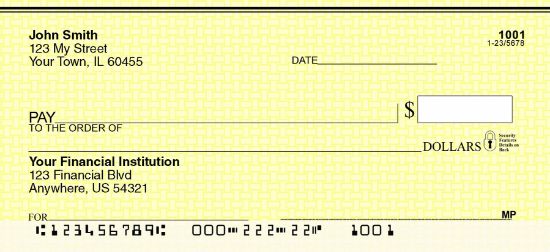
The account number on a check is printed along the bottom edge, in the middle of the MICR line. On a standard personal check, it comes right after the routing number and right before the check number. One large bank's help page describes it the same way: to the right of the routing number and to the left of the check number.
MICR stands for magnetic ink character recognition. The special ink and the E-13B typeface let sorting machines read the numbers even when a check is creased or stamped. Our MICR line explained guide covers the printing side in more depth.
How do you read the bottom of a check from left to right?
- Find the 9-digit group with a matching symbol on each side. That is the routing number.
- Move right to the next group. It runs until you reach the next symbol, the on-us symbol. That group is your account number.
- Read the last group. On a personal check, it matches the number in the top right corner. That is the check number.
- Ignore the blank space at the far right. That area is the amount field. It stays empty until a bank encodes the dollar amount after you write the check.
Can the account number and check number swap places?
Yes. On some checks the check number appears between the routing and account numbers, and many business checks lead with the check number. The quick test is to match digits: whichever group equals the number in the top right corner is the check number, and the remaining group that is not 9 digits long is the account number.
What Do the Symbols on the Bottom of a Check Mean?
The symbols on the bottom of a check are field markers. They tell bank equipment where one number stops and the next one starts, and they are not part of any number. The Unicode standard lists four of them for the E-13B MICR font: transit, on-us, amount and dash.
| Symbol name | Where you see it | What it tells you |
|---|---|---|
| Transit symbol | On both sides of a 9-digit group | The digits between the pair are the routing number |
| On-us symbol | Right after the account number, and around the check number on many business checks | The account field ends here |
| Amount symbol | Far right, only after a bank processes the check | The digits between the pair are the encoded dollar amount |
| Dash symbol | Inside some account numbers | A separator the bank uses inside the field; ask your bank whether to type it |
Table 2. How to read the field symbols in the MICR line. Unicode itself notes that the official symbol names do not describe their use well, so use position as your guide.
Should you type the symbols, dashes or spaces?
No. Online forms want digits only. Leave out every symbol and space. Treat dashes and leading zeros with care: some credit unions tell members to use only the digits before a dash, and some banks print extra zeros that the form may or may not need. When in doubt, compare with your online banking profile or call the bank.
How Many Digits Is an Account Number on a Check?
There is no single length for an account number on a check, because each bank sets its own format. The ACH file specification published by Nacha allows up to 17 characters in the account field. Help pages from US banks and credit unions we reviewed in October 2026 described account numbers of 8, 10 or 11, and 14 digits.
That variation is why "count the digits" only works for the routing number. A routing number is always 9 digits, made of three parts: a Federal Reserve routing symbol, an ABA institution identifier and a check digit, according to the American Bankers Association.
| Clue | Routing number | Account number | Check number |
|---|---|---|---|
| Length | Exactly 9 digits | Varies; often 8 to 14 digits | Short, and it matches the top right corner |
| Surrounding symbols | Transit symbol on both sides | Ends with the on-us symbol | Sometimes framed by on-us symbols on business checks |
| Matches something else on the check? | The fractional number in the top right area is a second form of it | No | Yes, the number in the top right corner |
| Changes from check to check? | No | No | Yes, it goes up by one |
Table 3. Four quick tests to tell the three numbers apart. The check number test is the most reliable when the order looks unusual.
Why does my account number look longer on the check than on my statement?
Some banks pad the check version with leading zeros, and some credit unions print a separate MICR account number that differs from the member number you log in with. Members sometimes report a failed direct deposit because they entered the member number instead. Use the number your bank says is for checks and electronic payments, which is usually the one printed on the check.
What Is the Difference Between the Routing and Account Number?
The routing number identifies the bank, and the account number identifies your account at that bank. Two customers at the same bank share a routing number but never share an account number. The ABA devised routing numbers in 1910, which is why the format is so uniform today.
Payments need both. A direct deposit form, an ACH debit authorization or a wire request asks for the pair together. Our routing number explainer shows how to verify the bank side, and our guide to setting up direct deposit with a voided check covers the form itself.
What is the fraction near the top right of a check?
It is the fractional form of the routing number. Regulation CC, Appendix A, says routing numbers appear in a fractional form and a nine-digit form, with the fraction generally in the upper right area of the check. It is a backup for the routing number, not part of your account number, so leave it out of any form.
Where Is the Account Number on a Business Check?
On a business check, the account number is still near the middle of the MICR line, but the check number usually moves to the far left. Bank MICR specification sheets call that left-hand spot the auxiliary on-us field, and some banks require the serial number to be encoded there on business-size checks.
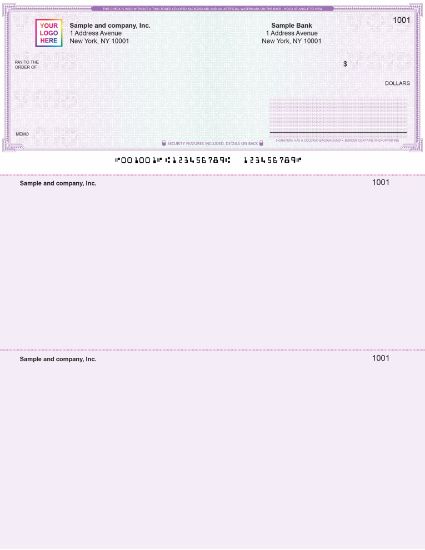
So a typical business check reads: check number framed by on-us symbols, then the routing number between transit symbols, then the account number ending with an on-us symbol. If you are used to personal checks, that layout can make the first group look like an account number. Use the top right corner test from Table 3.
Does a deposit slip show the account number?
Yes. A preprinted deposit slip carries your routing and account numbers on the bottom line, so the bank can credit the right account. Where a check would show a check number, a deposit slip may show a transaction code instead. Our guide on how to fill out a deposit slip walks through every field, and you can order matching business deposit slips.
Which Checks Do Not Show Your Own Account Number?
Any check drawn by someone else shows their account or their bank's account, not yours. Copying an account number from one of these into a form sends money to the wrong place, so check where the item came from first.
| Item | Whose account the bottom line shows | Use it to find your account number? |
|---|---|---|
| Your own personal or business check | Yours | Yes |
| Cashier's check you bought | The issuing bank's, since it is drawn on the bank | No |
| Paycheck or vendor check you received | The payer's | No |
| Check mailed by an online bill pay service | Often the bank's or the service's account | No |
| Money order | The issuer's | No |
| Counter or starter check from your bank | Usually yours, though your name may be missing | Yes, but confirm with the bank |
Table 4. Which items carry your account number. The OCC's HelpWithMyBank site explains that a cashier's check is drawn on the bank, not on your account. Related: what a cashier's check is.
Do counter checks have your account number?
Counter checks printed at a branch usually carry your routing and account numbers, but they may leave your name and address blank. Our page on counter checks covers when they are accepted.
How Do You Find Your Account Number Without a Check?
You can find your account number without a check through your bank's app, your statement or a call to the bank. These sources are also the safest way to confirm the number you read off a check.
- Online banking or the app. Many banks show the full number under account details, sometimes behind a "show" button.
- Your bank statement. The number usually appears near the top of a paper or PDF statement, though some statements mask part of it.
- A call to the bank. After verifying your identity, the bank can read it to you.
- A branch visit. Bring ID, and the teller can print a letter or a counter check with the number.
- A direct deposit form from the bank. Many banks offer a prefilled form with both numbers.
Is my debit card number the same as my account number?
No. The long number on a debit card is a card number that links to your account. It will not work in the account number field of a direct deposit or ACH form.
Is It Safe to Share the Account Number on a Check?
Sharing the account number on a check is normal for payroll, bill payments and paying vendors, but share it only with people and companies you trust. The Federal Trade Commission warns that a scammer can use your account number to create a check that takes money out of your account without your signature.
Every paper check you hand over carries the same details, which is why check fraud deserves attention. FinCEN reported 15,417 mail theft related check fraud reports between February and August 2023, tied to more than $688 million, with altered checks making up about 44 percent. Our check fraud prevention guide covers the wider picture.
- Confirm who is asking. Give your numbers only for payments you started or expect.
- Watch your account often. The CFPB says to contact your bank or credit union as quickly as you can if you spot an unauthorized check.
- Use indelible ink. The US Postal Inspection Service advises pens with indelible black ink to resist check washing; see our check washing guide.
- Ask about positive pay. Businesses can match issued checks against presented ones; see what positive pay is.
- Store checks securely. Keep unused checks locked away and shred voided ones you no longer need.
How Do You Confirm the Account Number Before Ordering Checks?
Confirm the account number before ordering checks by comparing it against a current check, a voided check or the bank's own record, digit by digit. A single wrong digit can cause returned items, so this step is worth the two minutes it takes.
- Use a recent check or the bank's record. Do not copy from a check written by someone else.
- Enter digits only. Leave out symbols and spaces, and follow your bank's guidance on dashes and leading zeros.
- Check the routing number separately. It must be exactly 9 digits.
- Review the proof. Read the MICR line on your order proof against your check before you approve it.
- Ask your bank about format rules. Some banks publish MICR specifications for business checks.
Our step-by-step guide on how to reorder checks online covers the rest of the order, and new companies can start with ordering checks for a new business.
Getting the Numbers Right on Your Next Check Order
Personal and business formats. We print personal checks and business checks with your bank details on the MICR line.
Matching deposit slips. Deposit slips carry the same routing and account numbers, so ordering them together keeps your records consistent.
A real person to ask. If a number on your old checks looks unusual, our team can help you work out what to send before printing.
About the Author
This guide is the Checkomatic team's work, written for people and businesses who print and use paper checks. Sources include the American Bankers Association's routing number policy, Appendix A of Regulation CC (12 CFR Part 229), the Nacha ACH file specification, the Unicode chart for MICR symbols, bank MICR specification sheets, the OCC's HelpWithMyBank site, and guidance from the FTC, CFPB, FinCEN and the US Postal Inspection Service.
This is general information, not legal or financial advice. Account number formats differ by bank, so confirm your numbers with your bank before you use them on a form or a check order.
Frequently Asked Questions
Is the account number the same as the check number?
Is the routing number always first on a check?
Can two people have the same account number?
Do savings accounts have an account number on a check?
What is the long number on the right side of a cleared check?
Can I use the account number on my check for direct deposit?
Should I include leading zeros from my check?
What does the on-us symbol mean?
Is it risky to post a photo of a check online?
What if my old checks show the wrong account number?
Accepted by the world’s leading banks