-
 Contact Us
-
 Re order
-
 Log in
-
 Cart 0
You have no items in your shopping cart.
Can a Minor Write a Check or Cash One? Rules to Know
A grandparent mails a birthday check to a 15-year-old. A 17-year-old wants to pay a team fee by check. A parent wonders if a young signature means anything. The answers split into two halves: what happens when a minor writes a check, and what happens when a minor receives one.
This guide covers both halves in plain English and marks the limits of what we could confirm. Your state and your bank decide most of this, so we point you to the right questions instead of guessing.
Quick Summary
There is no single yes or no. A minor can sign a check, and under the model Uniform Commercial Code (UCC) the signer is the one who is liable. But the right to enforce a check is subject to an infancy defense, so a business that takes a minor's check may be unable to collect. Whether a bank cashes or deposits a minor's check is the bank's call.
Key points
- Signing creates liability. UCC 3-401 ties liability on a check to a signature by the person or an authorized agent.
- Infancy is a defense. UCC 3-305 makes the right to enforce a check subject to it, even for a holder in due course.
- States set the age of majority. We verified Nebraska at 19, Alabama at 19 and a Mississippi definition of minor under 21.
- Bank policy varies. We found no national rule that tells a bank what to do with a minor's check.
- A stranger's check is a scam signal. The FTC calls a check from a stranger plus a request for money back a scam.
| Question | Short answer | Where it comes from |
|---|---|---|
| Can a minor sign a check? | Yes, but the infancy defense may apply | UCC 3-401 and 3-305 |
| Is a minor's check always unenforceable? | No, state contract law decides | "To the extent" wording in UCC 3-305 |
| Who sets the age of majority? | Each state | State statutes |
| Will a bank cash a minor's check? | Ask your bank | Bank policy, no national rule found |
Table 1. Quick answers on minors and checks, for general reading only.
Planning a first checkbook for a young adult? Message the Checkomatic team who can suggest a style after the bank approves the account.
In this guide
- Can a minor write a check under the UCC?
- What does the age of majority have to do with it?
- Who carries the risk when a minor's check is returned?
- Can a teen open a checking account?
- What can a minor do with a check made out to them?
- How do fake check scams target young people?
- How do you prepare before going to the bank?
- Frequently Asked Questions
Can a Minor Write a Check Under the UCC?
A minor can sign a check, but the signature may not be enforceable against them. The model UCC ties liability to the signature, and it also lets the signer raise a defense based on age. State law decides how far that defense reaches.
Is a check signed by a minor valid?
The check exists, and the signature counts as a signature. UCC 3-401 says a person is not liable on a check unless they signed it, or an agent signed for them. What the law does not promise is that the person who takes the check can collect.
What does the infancy defense mean in plain English?
"Infancy" is the legal word for being under the age of majority. UCC 3-305(a)(1)(i) makes the right to enforce a check subject to a defense of "infancy of the obligor to the extent it is a defense to a simple contract." Here "obligor" means the signer, and the check is treated like an ordinary contract. If state law lets a minor avoid an ordinary contract, the minor may be able to avoid the check.
Does the defense follow the check if it changes hands?
Yes. UCC 3-305(b) says a holder in due course, a legal label for a taker who meets certain good faith tests, still takes subject to the age defense. Passing the check along does not clean it.
Does a parent owe the money if a minor signs?
Not on the check itself. Under UCC 3-401, someone who did not sign, and did not authorize an agent to sign, is not liable on the instrument. An account agreement or other law could say more. See signing a check for someone else for when a signature binds the person it names.
What Does the Age of Majority Have to Do With It?
It decides who counts as a minor in the first place. Each state sets its own age of majority, so one teenager could be an adult in one state and a minor in another. Check your state's rule before relying on any general guide.
Is the age of majority 18 everywhere?
No. The Cornell Legal Information Institute's legal encyclopedia, last reviewed in November 2021, says most states use 18, with a few exceptions. We confirmed three exceptions in the state codes themselves.
| State | What the statute says | Source we checked |
|---|---|---|
| Nebraska | Persons under 19 are minors, and marriage under 19 ends minority | Neb. Rev. Stat. 43-2101, state legislature site |
| Alabama | Disabilities of minority end at 19 | Ala. Code 26-1-1, 2025 edition |
| Mississippi | "Minor" includes a person under 21 | Miss. Code 1-3-27, 2025 edition |
Table 2. Three verified state examples. Alabama and Mississippi were read in a published copy of the code, not on the legislature's own page.
Does a higher age mean no one can contract before then?
Not necessarily. Nebraska ends minority at 19, yet a separate subsection lets people 18 or older who are not wards of the state make binding contracts. For Mississippi we did not check other statutes on removing the disability of minority, so we cannot say what an 18-year-old there may do.
Who Carries the Risk When a Minor's Check Is Returned?
Often the person who accepted it. Because the infancy defense may let the minor avoid paying, the one holding the check may be unable to collect. That is why a business should think before taking a check from a young customer.
Returned items are explained in the bounced check guide and in what happens when a check bounces. Whether age changes what an account agreement allows is a state-law question we did not research.
What should a business do before taking a check from a young customer?
Businesses generally pick the payments they take, a point covered in do businesses have to accept checks. These steps lower the risk without assuming anything about the law.
- Ask a parent or guardian to pay. Their own check carries their own signature.
- Choose another payment method. A cashier's check or money order rests on the issuer's promise, not the young person's.
- Write down the facts. Note the date, payer, amount and what the payment was for.
- Ask a lawyer about larger amounts. State law decides how far the defense goes.
Can a Teen Open a Checking Account?
Sometimes, but we found no federal rule that settles it for checking accounts. The federal guidance we could confirm is about savings accounts and leaves the rest to state law and the bank. Ask what your bank offers for young customers.
What did federal guidance say about minors opening accounts?
Interagency youth savings guidance, dated 24 February 2015 with citations updated in November 2017, says "No federal law prohibits minors from opening savings accounts." That sentence covers savings accounts only, and we do not stretch it to checking. The guidance adds that the account contract is a state-law matter, that a minor's contract may be voidable, and that the bank decides whether a minor opens an account without an adult. See check types and terminology for unfamiliar terms.
What happens when a parent opens the account?
For identity checks, the bank treats the adult as the customer. The federal customer identification rule, 31 CFR 1020.100, includes an individual who opens an account for someone lacking legal capacity, such as a minor. Under 31 CFR 1020.220, the bank collects at least a name, date of birth, street address and, for a U.S. person, a taxpayer identification number.
Who can withdraw money from a joint account?
In most circumstances, either person, says the CFPB. It states that either person on a joint checking account can withdraw money from it and close it, that the account agreement matters, and that state law may offer some protection. Both people should know this before the first check is written.

What Can a Minor Do With a Check Made Out to Them?
A minor can hold it, but cashing or depositing it is up to the bank. We found no national rule that makes a bank accept or refuse it.
Can a minor cash a check alone?
Maybe, if the bank allows it. UCC 3-202 says negotiation is effective even if obtained from an infant, so a minor's endorsement is not automatically void. But rescission is allowed to the extent other law permits. A bank may weigh that in its own policy, and how to cash a check lists the usual steps.
What does the payee line tell the bank?
It names who the check belongs to. UCC 3-110 lets a payee be identified in any way and has no rule written only for minors. The exact words matter, and the bank decides what it accepts.
| Payee line example | What it signals | What to ask the bank |
|---|---|---|
| Jordan Lee | The young person is the payee | May Jordan endorse it, and must an adult come along? |
| Jordan Lee, a minor | The payee is known to be underage | Is an account in Jordan's name needed? |
| Pat Lee, as custodian for Jordan Lee | An adult is acting for Jordan | Where may this be deposited? |
Table 3. The names are made up for illustration. Bank rules for each version vary.
Can a parent endorse the check for a child?
It depends on the wording and the bank. UCC 3-402 says a representative is not liable if the signature unambiguously shows it is made on behalf of the person represented.
UCC 3-307 adds that a taker may be on notice of a breach of duty if a check payable to someone acting for another is deposited outside that person's account as such or the represented person's account. So moving a child's check into a parent's personal account can raise questions at the bank. See the endorsement guide for basic wording.
How Do Fake Check Scams Target Young People?
They send a real-looking check and ask for money back. The FTC says that if someone you do not know sends you a check and asks for money back, that is a scam. A young person who deposits it can lose the money sent and still owe the bank.
Why does the money look available if the check is fake?
Banks must make deposited funds available quickly, usually within a day or two. The FTC says a fake check can take weeks to discover, and the depositor must repay the bank. See check fraud scams.
How common are these scams?
The FTC's 2019 data, published in February 2020, showed more than $28 million lost to fake check scams, with a median loss of $1,988. Those in their twenties reported losing money at more than double the rate of people 30 and over. A July 2024 FTC alert describes fake "artist" offers on social media with the same pattern. See check fraud in 2026.
- Know the sender. The FTC advises depositing checks only from people you know and trust.
- Never send money back. A refund request from a stranger is the warning sign.
- Ask a trusted adult. A second pair of eyes helps before any deposit.
How Do You Prepare Before Going to the Bank?
Bring the check, the right people and a short list of questions. If a young person will write checks, make sure the bank has approved the account first.
Which six questions should you bring to the counter?
- Is a check made out to a minor accepted here?
- Does the minor need an account with you, and an adult on it?
- Is a parent or guardian's endorsement accepted?
- Is mobile deposit allowed for this check?
- Will the funds be held, and for how long?
- May the minor write checks on this account, and who is responsible for it?
Once the account is settled, read how to fill out a check for the line-by-line steps. A stub or a register builds a good habit, and check registers show how to track the balance.
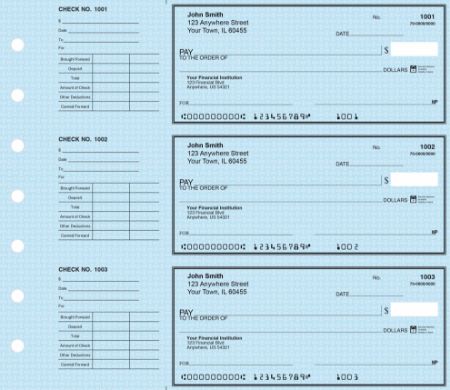
For a first checkbook
Adult-approved accounts only. Order checks once the bank has confirmed who may write on the account.
Styles to browse. See personal checks for everyday personal use.
A record from day one. Pick a style with a stub or pair it with a register.
Questions welcome. The Checkomatic team can help you choose a layout.
About the Author
Our team at Checkomatic compiled this guide from sections 3-110, 3-202, 3-305, 3-307, 3-401 and 3-402 of the model UCC, the interagency youth savings guidance, the federal customer identification rule, CFPB consumer pages, the FTC, and the Nebraska, Alabama and Mississippi codes.
This page is general information, not legal advice. States set their own age of majority and their own version of the UCC, and banks set their own policies for young customers, so ask a lawyer or your bank before you rely on it.
Frequently Asked Questions
Is a check written by a 16-year-old legally binding?
Can a 17-year-old cash a check without a bank account?
Can I deposit my child's check into my own account?
Who is responsible if a minor's check bounces?
Is the age to sign a check the same in every state?
Is a check from a stranger safe for a teenager to deposit?
Does a child's bank account create a credit report?
What does holder in due course mean?
Does a store have to take a teenager's check?
Can a minor open a bank account without a parent?
Accepted by the world’s leading banks