Quick Answer: The Check 21 Act is the 2004 federal law that transformed US check clearing from a physical paper routing process into an electronic image exchange system. It created the substitute check, made mobile deposit legally possible, and eliminated the multi-day check float that businesses once used for cash flow management. For businesses that write checks, Check 21's most practical implication is that your MICR line must be correctly encoded because most US banks now scan it optically. A check with an off-spec MICR line gets bounced to manual processing, adding days to clearing time.
What the Check 21 Act Is
The Check 21 Act, formally titled the Check Clearing for the 21st Century Act, is a US federal law signed by President Bush on October 28, 2003. Its provisions took effect exactly one year later on October 28, 2004. The law's purpose is stated directly in its title: to modernize check clearing for the 21st century by reducing the legal barriers that required physical paper checks to travel between banks.
Before Check 21, US banking law treated the physical paper check as the only legally valid instrument for check payment settlement. If a check drawn on a bank in Seattle was deposited at a bank in Miami, the physical paper document had to travel ; by courier, armored car, or air transport ; from Miami back to Seattle before the payment could settle. This was slow, expensive, and operationally fragile. A major weather event, a natural disaster, or even a large-scale flight disruption could delay clearing for thousands of checks simultaneously.
Check 21 solved this by creating a new legal instrument: the substitute check. A substitute check is a paper reproduction of a check's digital image that the law treats as fully equivalent to the original paper document. With substitute checks as the legal backstop, banks could exchange digital images of checks electronically across the country in seconds rather than routing physical paper documents across the country over days.
Check Clearing Before and After Check 21
How Check Clearing Worked Before 2004
Before Check 21, a US business payment by check went through a physical routing process that could take three to five days for checks crossing Federal Reserve districts:
- The payee deposits the check at their bank.
- The payee's bank sends the physical check to a Federal Reserve processing center.
- The Fed sorts the checks by the issuing bank's routing number and ships the physical paper to the appropriate Federal Reserve district.
- The physical check is transported to the issuing bank.
- The issuing bank debits the payer's account and the payment settles.
The physical transportation between steps 3 and 4 was the bottleneck. A check deposited in Boston against a bank in Los Angeles was physically flown across the country before the Los Angeles bank saw it. This took 2 to 3 business days under normal conditions and could take longer when travel was disrupted. After the September 11, 2001 attacks grounded all US flights, check clearing delays stretched to a week in some cases. That disruption accelerated Congressional support for Check 21, which passed two years later.
How Check Clearing Works After Check 21
After Check 21, the same Boston-to-Los-Angeles check clears differently:
- The payee deposits the check at their Boston bank, either in person, at an ATM, or via mobile deposit.
- The Boston bank scans both sides of the check and captures its MICR line data.
- The digital image is transmitted electronically to the Federal Reserve or directly to the issuing bank in Los Angeles.
- The Los Angeles bank verifies the image against the account, debits the payer's account, and the payment settles.
- The original paper check is held briefly and then destroyed, or returned to the account holder depending on the account agreement.
The entire process now takes 1 to 2 business days at most institutions. The physical check may never leave the state where it was deposited. For the complete guide to how long each method of check clearing takes under current Regulation CC rules, see how long do business checks take to clear in 2026.
| Factor | Before Check 21 | After Check 21 |
|---|---|---|
| Physical routing required | Yes ; paper traveled between banks | No ; digital images transmitted electronically |
| Typical clearing time | 2 to 5 business days | 1 to 2 business days |
| Legal instrument required | Original paper check only | Original check or substitute check (image) |
| Check float | 2 to 5 days ; usable for cash flow | Largely eliminated ; 1 to 2 days only |
| Disruption vulnerability | High ; weather, disasters, flight disruption | Low ; electronic transmission not weather-dependent |
| Mobile deposit | Not possible | Possible ; bank creates substitute check from photo |
What a Substitute Check Is and How It Works
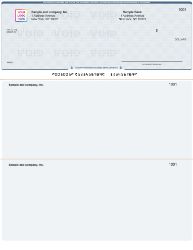
A business check from Checkomatic ; when deposited, this becomes the source for a substitute check image under the Check 21 clearing process.
The substitute check is the legal cornerstone of Check 21. Understanding what it is and what it is not clarifies how the law actually functions in practice.
What Makes a Substitute Check Legally Valid
Under Check 21, a substitute check is the legal equivalent of the original check if it meets four specific requirements:
- Accurate representation: The substitute check must accurately represent all information on both the front and back of the original check as it appeared at the time the original was scanned and truncated.
- Legal equivalence legend: The substitute check must bear the statement: "This is a legal copy of your check. You can use it the same way you would use the original check."
- MICR line conformance: The substitute check must include a MICR line containing all the information from the original check's MICR line. This is how the bank's automated systems read the routing number and account number from the substitute check.
- ANSI standards compliance: The substitute check must conform to ANSI X9.100-140 specifications for paper stock, dimensions, and format so it can be processed in the same automated systems that process original checks.
What Happens to the Original Check
Once a check is scanned and a digital image is captured, the original paper is said to have been "truncated." The original check is typically held for a short period ; often 30 to 90 days depending on the bank's policy ; and then destroyed. Some banks return original checks with account statements. Others provide image statements showing pictures of canceled checks. Whether you receive your original check back depends on your bank's account agreement, not on Check 21 itself, which does not require destruction of original checks.
Substitute Check vs Check Image vs Image Statement
These three are related but different. A substitute check is a paper document that meets the legal requirements above ; it is a physical reproduction of the check image that carries full legal equivalence. A check image is the digital file ; a TIFF or PDF scan of the front and back of the check ; that banks store and exchange electronically. An image statement is a paper account statement that shows multiple check images on the same page; the images on an image statement may be original checks or substitute checks, but the statement itself is not a substitute check. For proof of payment, all three serve the same legal purpose under Check 21.
For the complete glossary covering substitute checks, image replacement documents, and related Check 21 terminology, see check types and terminology: complete glossary guide.
How Check 21 Made Mobile Deposit Possible
Mobile deposit is the most visible consumer-facing result of Check 21, even though Check 21 itself predates smartphones by several years. The legal framework Check 21 created is what allows mobile deposit to work.
The Mechanism
When you photograph a check through your bank's mobile app, you are creating the initial digital capture of the check. Your bank takes that photograph, processes it to meet ANSI X9.100-140 specifications, and creates a substitute check ; a legal equivalent of the original check. That substitute check image is transmitted electronically through the clearing system. The original paper check you photographed has been functionally truncated at the moment of scanning, even though you still hold the physical paper.
Why You Must Void or Destroy the Original After Mobile Deposit
After a mobile deposit, your bank instructs you to write "VOID ; MOBILE DEPOSIT" on the front of the original check and hold it briefly before destroying it. This is not optional courtesy ; it is a necessary step in the Check 21 framework. The original paper check that was photographed is now the source document for a substitute check that has been legally presented for payment. If the original check were deposited again at a teller or ATM, the bank would potentially process a double payment. The "For Mobile Deposit Only" or "VOID" notation and the subsequent destruction of the physical check prevent this double presentment scenario.
Why Business Checks Need Correct Endorsement for Mobile Deposit
Business accounts have specific mobile deposit requirements beyond the check itself. The endorsement on the back of a business check deposited via mobile must typically include the authorized signature plus "For Mobile Deposit Only" or similar language as required by the depositing bank. Without the correct endorsement language, the mobile deposit may be flagged for review. For the complete guide to business check endorsement requirements, see check types and terminology: complete glossary guide.
What Check 21 Means for MICR Compliance on Your Business Checks
This is the most practical implication of the Check 21 Act for businesses that order and write checks. Before Check 21, banks used magnetic readers to read MICR lines ; the row of numbers at the bottom of every check. After Check 21 shifted clearing to electronic image processing, most large US banks moved to optical check scanners that read the MICR line visually from the check image rather than magnetically from the ink.
What This Means for Check Quality
Optical scanning places stricter requirements on MICR line quality than magnetic reading did. A MICR line that reads adequately under magnetic scanning might not reproduce clearly enough in a digital check image for optical character recognition to parse correctly. The consequences of a poorly printed MICR line under optical processing are:
- The automated scanner cannot read the routing number or account number from the image.
- The check is routed to manual processing where a bank employee reads the MICR line by eye and keys it in.
- Manual processing adds 1 to 3 business days to clearing time on top of the standard timeline.
- In some cases, a badly printed MICR line results in the check being returned to the depositing bank as unprocessable.
What ANSI-Certified MICR Means
ANSI E13-B is the US standard for MICR font and ink specifications. A check with an ANSI-certified MICR line has been printed to meet the ink density, font dimensions, and placement specifications that US bank scanners ; both magnetic and optical ; are calibrated to read. This certification is what separates a check that clears without delays from a check that gets bounced to manual processing.
Checkomatic has printed ANSI-certified MICR lines on every business check order from its Monroe, NY facility since 1997. Every batch goes through MICR reader verification before shipping. For the complete technical guide to MICR encoding and why it matters under Check 21 processing, see what is a MICR line: the tech behind every check.
How Check 21 Changed Check Float for Businesses
Check float was once a practical cash flow tool for small businesses. If a business had $3,000 in its checking account on a Friday but needed to pay a $4,000 vendor invoice, a business owner might write the check on Friday knowing that the check would not clear until Wednesday, by which time an expected payment from a customer would have arrived. This practice depended entirely on the 3 to 5 day clearing window that existed before Check 21.
Check 21 Eliminated Reliable Float
After Check 21 compressed clearing timelines to 1 to 2 business days, the 3 to 5 day float window closed. A check written on Friday might clear by Monday or Tuesday. The arithmetic of floating a check against expected future deposits no longer works when the clearing window is this short.
Check Kiting Is Now Faster to Detect
Before Check 21, check kiting ; deliberately exploiting the float period by writing checks against insufficient funds and depositing money before the checks cleared ; required the float window to work. Check 21's faster clearing made kiting schemes collapse faster and become detectable sooner by bank fraud systems. Writing a check you know your account cannot cover, and relying on float to cover it, is check kiting: a federal bank fraud offense under 18 U.S.C. 1344. The faster clearing under Check 21 means there is less time for the scheme to work before the bank detects the insufficient funds.
For businesses managing cash flow, the correct response to Check 21's elimination of float is accurate cash flow planning using a check register and accounting software rather than relying on clearing delays. For complete guidance on business checkbook management and register reconciliation, see check types and terminology: complete glossary guide.
Does Check 21 Affect Computer-Printed Business Checks?
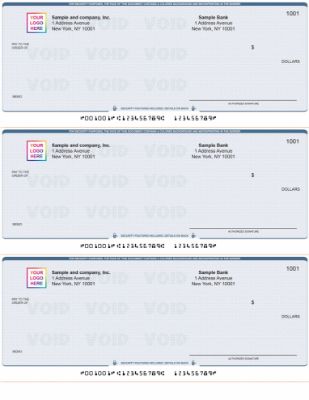
QuickBooks 3-on-a-page computer-printed checks ; fully legal and bank-accepted under the Check 21 Act framework.
Yes, in a positive way. The Check 21 Act is part of why computer-printed business checks from accounting software are fully legal and bank-accepted at every US institution.
Why Computer-Printed Checks Are Legal Under Check 21
Before Check 21, the legal framework for check clearing assumed that a check was a document produced by a financial institution or commercial printer. Computer-printed checks occupied an ambiguous position. The Check 21 Act, by establishing that the legal instrument for settlement is the digital image or substitute check rather than the physical paper, removed the ambiguity. A check printed by your accounting software on properly encoded check stock produces a digital image that is indistinguishable from an image of a preprinted check in the electronic clearing system. Both are processed identically.
What Your Check Stock Must Be for Computer-Printed Checks
For a computer-printed check to clear correctly under Check 21 electronic processing, the blank check stock it is printed on must:
- Have the MICR routing number and account number pre-printed in ANSI-certified magnetic ink (so your accounting software does not need to print the MICR line)
- Meet the paper dimension standards that bank scanners are calibrated for (8.5 x 3.5 inches for standard voucher business checks)
- Have security features embedded in the paper that reproduce correctly in a digital image scan without obscuring the MICR line
Check stock that does not meet these specifications can cause processing delays under Check 21 imaging even if it looks correct to the human eye. For a complete guide to computer-printed check stock requirements and how to choose the right format for your accounting software, see computer printable checks: how to choose and print them.
Expedited Recredit: Your Protection Right Under Check 21
Check 21 included a specific consumer protection provision for situations where receiving a substitute check causes a financial loss. This provision is called expedited recredit.
When Expedited Recredit Applies
Expedited recredit applies when:
- You received a substitute check rather than the original check.
- The substitute check caused a loss ; most commonly through an erroneous or duplicate debit against your account.
- The original check or a better copy of the check is needed to resolve a claim or dispute.
How to File an Expedited Recredit Claim
You must file the claim within 40 calendar days of receiving the relevant account statement or the substitute check itself, whichever is later. Contact your bank directly and describe the specific loss, the substitute check that caused it, and the amount of the loss. The bank must provisionally recredit your account within 10 business days of receiving your claim while it investigates. The bank has 45 days to complete its investigation and make the recredit permanent or reverse it with explanation.
Expedited Recredit for Business Accounts
Check 21 expressly provides expedited recredit rights for both consumer and business account holders who receive substitute checks. Business accounts that process high check volumes should designate someone in the accounting or AP function to monitor incoming substitute checks for discrepancies. Any discrepancy related to a substitute check should be flagged and reported within the 40-day window. After that window closes, you may lose the expedited recredit remedy and be limited to standard dispute resolution channels with your bank.
Check 21 and Business Check Fraud
Check 21 changed the fraud landscape for business checks in both directions. Some fraud methods became harder. Others became easier. Understanding both sides helps you protect your business.
What Check 21 Made Harder
Physical check interception and alteration became somewhat harder under Check 21 because checks spend less time in physical transit. A check that would have traveled by courier for three days pre-Check 21 now clears in one to two days, reducing the window for physical interception. Faster clearing also means altered checks reach the bank's verification systems faster, where fraud detection algorithms can flag anomalies in the check image itself.
What Check 21 Made Possible for Fraudsters
Check image fraud emerged as a new vector after Check 21. Because the bank processes a check image rather than the physical document, sophisticated fraudsters can attempt to manipulate the check image to alter amounts or payee details in the digital file before it reaches the clearing system. This is rare and technically difficult, but it is an attack vector that did not exist in the pre-Check 21 physical routing world.
Why Security Features Still Matter Under Check 21
The six physical security features on properly manufactured business check stock ; chemically sensitive paper, microprinting, void pantograph, UV fluorescent fibers, heat-sensitive ink, and genuine watermark ; serve a dual purpose under Check 21. They protect the physical check from alteration before it is scanned, and they reproduce in ways in the digital image that bank fraud detection systems recognize as authentic. A counterfeit check produced without these security features produces a check image that lacks the expected security feature signatures, which fraud systems flag. Positive pay adds the bank-side verification layer: the bank confirms every presented check against your issued check list before releasing payment. For both security features and positive pay, see are business checks safe: security features that actually matter and what is positive pay and how does it work.
What Customers Say About Checkomatic
All reviews below are published on checkomatic.com and reproduced verbatim. Source: checkomatic.com/quickbooks-starter-pack-product, 4.5 stars from 166 verified reviews.
"Been with them for 15 years. Always reliable, always good quality, good service. What more can you ask for?"
ATV Inc. | ★★★★★ 5/5 | April 5, 2024 | Source: checkomatic.com/quickbooks-starter-pack-product
"First time ordering and I am super impressed with the quality of the checks. No issues with delivery. I will be ordering again!"
TClinton | ★★★★★ 5/5 | April 9, 2025 | Source: checkomatic.com/quickbooks-starter-pack-product
"We use CheckoMatic for all of our check needs! They have great prices and we receive our products in a timely manner!"
CG's Tax Service | ★★★★★ 5/5 | September 18, 2024 | Source: checkomatic.com/quickbooks-starter-pack-product
"I got 500 checks for less than half of what the bank wanted for 200!"
VVA Voucher Checks (Vietnam Veterans of America) | ★★★★★ 5/5 | July 6, 2024 | Source: checkomatic.com/quickbooks-starter-pack-product
"ASJ Wilson Construction has been a client of checkomatic for some years now and they've never disappointed this company. Thank you checkomatic for all that you do."
ASJ Wilson Construction | ★★★★★ 5/5 | June 6, 2024 | Source: checkomatic.com/quickbooks-starter-pack-product
"Affordable and efficient. My go-to business check printer."
Doe | ★★★★★ 5/5 | January 24, 2025 | Source: checkomatic.com/quickbooks-starter-pack-product
Why Choose Checkomatic for Check 21 Compliant Business Checks
ANSI-Certified MICR on Every Order
Check 21 electronic processing requires a correctly printed MICR line. Every Checkomatic business check ships with an ANSI E13-B certified MICR line printed on a dedicated MICR printer, verified through a MICR reader before leaving the facility. Rejection rate at US banks is under 0.1 percent across monthly order volume. No guessing, no "MICR-compatible" label with inconsistent magnetic signal. Certified MICR, every order. For the technical guide to why MICR matters under Check 21, see what is a MICR line: the tech behind every check.
Standard Paper Dimensions for Optical Scanning
Every Checkomatic business check is manufactured to the 8.5 by 3.5 inch standard for business voucher format ; the dimension that US bank ATM scanners, mobile deposit apps, and teller scanning equipment are calibrated to read. Checks in non-standard dimensions confuse automated image cropping and trigger read errors that delay clearing. For all business check formats, see business checks and QuickBooks checks.
Security Features That Reproduce Correctly in Check Images
Checkomatic's security features are manufactured to reproduce correctly in the digital check image that banks exchange under Check 21. The microprinting appears correctly in high-resolution scans. The void pantograph activates correctly when a copy is made. The chemically sensitive paper reacts to washing attempts before the check is ever scanned. These features work in the pre-scan physical protection layer and in the post-scan image authentication layer. For the complete security feature guide, see are business checks safe: security features that actually matter.