-
 Contact Us
 -
 Re order
 -
 Log in
 -
 Cart 0
 You have no items in your shopping cart.
How Long to Keep Check Registers and Old Records
Most people use a check register for a few months, fill the last page and push it into a drawer. A year later nobody can say whether it is safe to throw out, whether the bank still has a copy, or what a tax notice would need to see.
This guide answers the question that comes after the register is full: how long to keep check registers, what to store with them and how to get rid of them safely. If you want to learn how to fill one in, our guide to how to set up and use a check register covers that side of it.
Quick Summary
Keep check registers for at least 3 years from the date you file the tax return they support, and longer if one of the IRS exceptions applies. Store them with the bank statements, check copies and deposit slips that back them up, label them by account and year, and shred them only after the time limit has passed.
- Follow the tax clock. The general IRS rule is 3 years from the filing date, and many people choose 7 years because it covers the other standard periods.
- Some situations run longer. The IRS lists 6 years when more than 25% of gross income was left out, 7 years for a bad debt or worthless securities claim, and no limit if no return was filed or the return was fraudulent.
- Businesses have an extra rule. Employment tax records must be kept for at least 4 years after the tax is due or paid, whichever is later.
- Keep the supporting records together. Bank statements, check copies, deposit slips and receipts prove what the register says.
- Do not rely on the bank alone. Federal rules require banks to keep many check records for five years, but the rules have exceptions and online statement history varies.
- Dispose of them safely. Confirm nobody still needs the records, then use a cross-cut shredder and clear any scanned copies you no longer need.
| Situation | Minimum time to keep records | Source of the rule |
|---|---|---|
| Usual personal or business return | 3 years from the date you file | IRS record-keeping guidance |
| Claim for credit or refund after filing | 3 years from filing or 2 years from payment, whichever is later | IRS record-keeping guidance |
| Income left out is more than 25% of gross income | 6 years | IRS record-keeping guidance |
| Loss from worthless securities or bad debt claim | 7 years | IRS record-keeping guidance |
| Employment tax records | At least 4 years after the tax is due or paid | IRS record-keeping guidance |
| No return filed, or a fraudulent return | Indefinitely | IRS record-keeping guidance |
Table 1. The IRS retention periods that decide how long to keep check registers and the records behind them.
Need a register that suits how you write checks? Contact the Checkomatic team and we will point you to the right check format for your account.
What is in this guide
- How long should you keep a check register?
- Which records should you keep with your check registers?
- Can you rely on your bank's records instead?
- How should you store old check registers?
- What should you do when a register is full?
- What if you lost your check register?
- How do you get rid of old check registers safely?
- Do business and payroll registers follow different rules?
How Long Should You Keep a Check Register?
Keep it for as long as the tax return it supports can still be questioned. The IRS says to keep records that support an item of income, deduction or credit until the period of limitations for that return runs out. For most returns, that period is 3 years from the date you file.
A check register is your own running record of payments, deposits and balances. It helps explain what each payment was for, which is why it belongs in the same pile as your tax paperwork and not in the bin once the last page is full.
What is the simplest rule to follow?
Pick one number and apply it to every register. Seven years is the number many households and small businesses choose, because it covers the 3 year standard period, the 6 year period and the 7 year period for bad debts. It only falls short for the open-ended situations, such as a return that was never filed.
Does a personal register need the same treatment as a business one?
The time limits come from the tax return, not from the type of account, so the same IRS periods apply. The difference is volume. A business writes more checks and usually has more to explain, so it is worth giving business registers a firmer filing routine. Our guide to checkbook management and reconciliation explains how a register fits into monthly reconciliation.
Which Records Should You Keep With Your Check Registers?
Keep the records that prove what the register says. A register on its own is your word. A register stored with the statements and copies behind it is a complete set that is easy to explain to an accountant, a lender or a tax authority.
| Record | What it shows | Store with the register? |
|---|---|---|
| Bank statements | The bank's own record of every cleared payment and deposit | Yes, filed by month |
| Check images or duplicate copies | Who was paid, how much and when the check was written | Yes |
| Deposit slips | What went into the account and which checks made up a deposit | Yes |
| Invoices and receipts | The reason for each payment | Yes, or filed by vendor with a note in the register |
| Voided checks | A check that was cancelled and should not clear | Yes, kept in sequence |
| Closing statement | The final balance on a closed account | Yes |
Table 2. The records worth storing alongside check registers, and what each one proves.
Voided checks deserve a special note. They should stay in the sequence so every check number is accounted for. Our guide to voided checks explains how to record them.
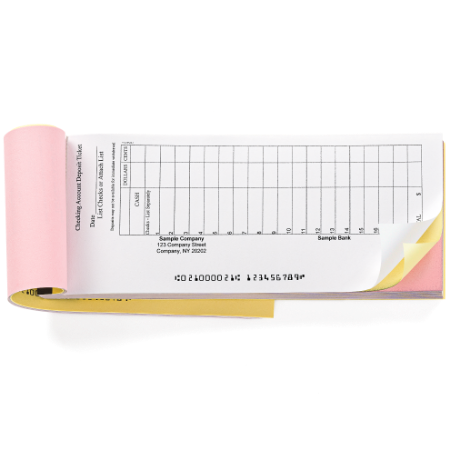
Deposit slips are easy to lose, and they matter when you need to prove which checks made up a deposit. A pad of business deposit slips with a carbon or duplicate copy keeps that record automatically.
Can You Rely on Your Bank's Records Instead?
Treat your bank's copy as a backup, not as your filing system. Federal record-keeping rules tell banks to keep the records they are required to keep for five years, and that includes copies of many checks. The same rules have exceptions, including checks for $100 or less, so you cannot assume the bank holds a copy of every check you wrote.
How far back do online statements go?
It varies by bank and by account, so check your own bank's policy rather than assuming. If your register is the only place you recorded why a payment was made, losing access to old statements leaves a gap that is hard to fill.
What should you download yourself?
Download every monthly statement as a PDF and save it with the register for that account and year. Do the same for the closing statement if you shut the account. This takes a few minutes a month and means you are never waiting on a bank to retrieve old records.
How Should You Store Old Check Registers?
Store them in one place, sorted by account and year, and in a form you can find in under a minute. The best format is the one you will actually use, so choose between paper, scans or both.
| Storage option | Best for | Watch out for |
|---|---|---|
| Binder or box on a shelf | Paper registers, check copies and statements in one place | Damp, fire and prying eyes |
| Scanned copies in cloud or local storage | Fast search and a backup if paper is lost | Unreadable scans and unprotected folders |
| Both paper and scan | Anyone who wants a backup of every year | Keeping the two sets in step |
Table 3. Three ways to store old check registers, and what to watch for with each.
Is a binder a good way to store check registers?
Yes, for paper records. A binder keeps a register, its check copies and the matching statements together and protects them from loose-page loss. Our guide to check binders and record storage explains the options for holding checks and records in one place.

How should you label each register?
Write the account nickname, the year and the first and last check number on the front. That is enough to find the right register fast. Avoid writing the full account number on the outside, because a binder on a shelf is easy for a visitor to pick up.
What Should You Do When a Register Is Full?
Close it out properly before you start the next one, so the balance carries forward without a gap. This takes a few minutes and prevents the most common start-of-book error, which is a balance that does not match the bank.
- Reconcile the last page against the latest bank statement and clear any differences.
- Write down the ending balance and the last check number used.
- Start the new register with that ending balance on the first line, marked as balance carried forward.
- Add the dates the old register covers to its cover or label.
- File the old register with its statements and check copies for the same period.
Our guide to reconciling a checkbook step by step walks through the reconciliation step in detail, including what to do if the numbers do not agree.
| Stage of the register | What to do | Where it lives |
|---|---|---|
| In use | Record every transaction as it happens | Beside your checkbook |
| Full | Reconcile, carry the balance forward, label it | In the filing system for that account |
| Account closed | Add the closing statement and note the closing date | With the last register for that account |
| Retention period passed | Confirm nobody needs it, then shred | Out of the filing system |
Table 4. The life of a check register, from the first page to the shredder.
What If You Lost Your Check Register?
You can rebuild it from your bank statements, and it is worth doing if the missing period falls inside a retention window. The statements are the bank's record, so they give you the dates, amounts and check numbers you need.
- Gather every statement for the missing period, including any online-only ones.
- List each check, deposit and fee in date order, with the check number where there is one.
- Match payees using your duplicate checks, check images or invoices.
- Work out a running balance from the last known good balance.
- Reconcile the result against the most recent statement to find gaps.
You will not recover notes you never wrote anywhere else, such as the reason for a payment. That is a good reason to scan each register before it fills, so a copy exists if the original goes missing.
How Do You Get Rid of Old Check Registers Safely?
Shred them, and only after the retention period has passed. A register lists who you pay, how much and when, which is exactly what someone needs to target an account. Putting one in the bin whole is an avoidable risk.
Run through this checklist first:
- The time limit has passed for every return that the register supports.
- No audit, dispute or fraud claim is open that involves the account.
- No lender or insurer has asked you to keep the records longer. The IRS itself says to check whether other parties need you to keep records for longer.
- Outstanding checks are settled. Our guide to managing outstanding checks explains why uncashed checks can create obligations under state unclaimed property laws.
- Scanned copies are handled too. Delete files you no longer need from every device and backup.
Do Business and Payroll Registers Follow Different Rules?
The same IRS periods apply to business returns, with one important addition. The IRS says to keep employment tax records for at least 4 years after the date the tax becomes due or is paid, whichever is later. A payroll register or the payroll section of a check register can fall under that rule.
If you run payroll, keep payroll registers with the pay stubs and tax filings they support. Our guide to payroll record retention sets out the payroll record rules in more detail.
For all business registers, keep one register per account, and file the old ones with your accountant's year-end package so everything for a given year sits together. Your accountant may also want registers kept longer than the IRS minimum, so ask before you set your own schedule.
Why customers choose Checkomatic for checks and records
A register with your checks. Personal check orders include a check register, so you can start recording from your first check. See personal checkbooks.
Copies that make record keeping easier. Duplicate and manual business check formats leave a copy of each payment behind, which makes a reconciliation faster.
A proof before every order ships. You review a digital proof of your check before it goes to print, which catches errors in names and bank details early.
Security features built in. Our check stock is ABA compliant and carries built-in security features, so the checks recorded in your register are better protected.
About the Author
This guide was produced by the Checkomatic content team, who work with check printing, check registers and record keeping for bank accounts every day. The retention periods are taken from IRS record-keeping guidance, and the bank record points from federal record-keeping rules for banks.
This article is general information and is not tax, legal or financial advice. Retention periods change and individual situations differ, so confirm the details with the IRS, your tax adviser or your bank before you discard any records.
Frequently Asked Questions
How long should you keep a check register?
Can you throw away a check register when the account is closed?
Do you still need old check registers if you bank online?
How long do banks keep copies of checks?
Is a bank statement better proof than a check register?
How should you label old check registers?
What do you do when a check register is full?
Can you shred old check registers yourself?
How do you rebuild a lost check register?
Do business check registers have to be kept longer?
Accepted by the world’s leading banks