Why Property Management Companies Have Unique Business Check Needs
A property management company occupies an unusual financial position: it handles money that belongs to other people. When a property manager collects rent from tenants on behalf of a property owner, those funds are held in trust. The property manager is not the beneficial owner of the money , the property owner is. This fiduciary relationship is what makes the check workflows of a property management company fundamentally different from those of most other businesses.
Because the property manager holds client funds, state real estate licensing and property management laws impose strict requirements on how those funds are maintained, accounted for, and disbursed. In virtually every state, a licensed property manager must:
- Maintain client trust funds completely separate from the company's operating funds
- Keep each property owner's funds identifiable and separately tracked, either in individual trust accounts per owner or in a pooled trust account with per-owner sub-ledgers
- Never use trust funds for operating expenses, even temporarily
- Disburse security deposits from a separate trust account designated for that purpose
- Provide each property owner with a monthly financial accounting of their property
Every one of these requirements has a direct impact on how business checks for property management companies must be structured, ordered, and managed.
Property Management vs HOA Management: Different Check Workflows
Property management and HOA management are frequently confused, but they involve distinct check workflows that should not be treated the same way.
| Factor | Property Management | HOA Management |
|---|---|---|
| Who they serve | Individual property owners (landlords) | Homeowners associations and condo boards |
| Incoming funds | Tenant rent payments, security deposits | Homeowner assessments |
| Key outgoing checks | Owner distributions, security deposit returns, maintenance AP | Operating expenses, reserve fund disbursements, vendor AP |
| Account structure | Separate trust account per owner (or pooled trust with sub-ledgers), plus security deposit trust, plus operating | Operating account plus reserve fund account |
| Governing rules | State real estate licensing laws, landlord-tenant statutes | State HOA statutes, community CC&Rs and bylaws |
For the HOA management check workflow, including reserve fund separation, dual-signature board authorization, and CAM reconciliation, see business checks for HOA management: complete guide. This guide focuses on the distinct property management workflow.
Owner Distribution Checks
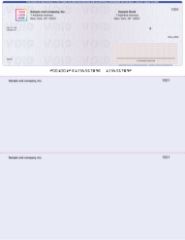
Check-on-top voucher checks from Checkomatic for property management owner distributions, with two stubs for owner and company records.
The owner distribution check is the most important outgoing check a property management company writes. It represents the culmination of the monthly management cycle: rent collected from tenants, expenses deducted, management fee applied, and the net balance disbursed to the owner.
What an Owner Distribution Check Must Show
The voucher stub attached to an owner distribution check should document the complete monthly accounting so the owner does not need to request a separate statement. At minimum, the stub should show:
- Property address or property identifier
- Management period (month and year)
- Gross rent collected from tenant(s)
- Management fee amount and percentage
- Maintenance and repair charges with individual line items or a reference to the attached statement
- Any other approved deductions (leasing fees, inspection fees, utility bills paid on behalf of owner)
- Net disbursement amount matching the check amount
This level of documentation satisfies the owner's expectation of transparency, supports your accounting records, and provides the data the owner needs for their own income tax preparation. The check-on-top voucher format provides two stubs: one for the owner as their monthly statement and one that stays in your files as the disbursement record. For the full check-on-top format range, see check-on-top business checks.
Which Trust Account Do Owner Distribution Checks Draw From
Owner distributions draw from the owner's trust account, not the property management company's operating account. The trust account holds the owner's funds in a fiduciary capacity. The check stock pre-printed for owner distributions must be pre-printed with the trust account's routing number and account number. Never use operating account checks to issue owner distributions, even if both accounts are at the same bank.
Security Deposit Return Checks
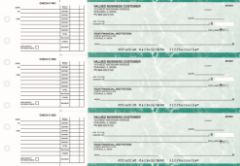
Manual AP checks from Checkomatic for property management security deposit returns, with stub documentation for deductions and net return amount.
Security deposit return checks are among the most legally sensitive checks a property management company writes. Every state has specific laws governing the timeframe within which a security deposit must be returned (typically 14 to 30 days after lease end), what deductions are permissible, and what documentation must accompany the return.
Security Deposit Trust Account Requirements
In virtually every state, security deposits must be held in a bank account that is completely separate from the property management company's operating account and completely separate from each owner's rental trust account. Commingling security deposit funds with other funds is a licensing violation in most jurisdictions and can result in license suspension, civil liability to the tenant, and in some states, automatic forfeiture of the right to make any deductions from the deposit.
The security deposit return check must draw from the security deposit trust account , not the operating account, not the owner's trust account. The check stock for security deposit returns must be pre-printed with the security deposit trust account's routing number and account number. Maintain a separate check number range for this account and a separate check register.
What the Security Deposit Return Check Stub Must Document
- Tenant name and property address
- Lease end date
- Original deposit amount
- Itemized deductions for damages, unpaid rent, or other permitted charges
- Net return amount matching the check
Some states require the itemized deduction list to be provided as a separate written notice accompanying the check. The stub provides the internal record while the separate notice satisfies the state statute requirement.
Vendor and Maintenance AP Checks
Property management companies write a significant volume of vendor and maintenance AP checks: plumbers, electricians, HVAC technicians, landscaping services, cleaning companies, pest control, general handymen, and property inspection services. These payments typically come from the owner's trust account (as approved maintenance expenses that reduce the owner's distribution) rather than the management company's operating account.
Tracking Maintenance Costs by Property
When a property management company manages multiple properties for multiple owners, each vendor payment must be traceable to the specific property it applies to. The check stub memo line or stub reference field should note the property address or property code so the payment can be allocated to the correct owner's account at month-end reconciliation. Without this tracking, the monthly owner statement cannot accurately show which maintenance costs were deducted from which owner's distribution.
1099-NEC for Maintenance Vendors
Property management companies must issue a 1099-NEC to any maintenance vendor who is an individual, sole proprietor, partnership, or LLC not taxed as a corporation and received $600 or more in payments during the calendar year. Collect a W-9 from every vendor before the first payment. The vendor AP check register is the source document for calculating annual totals per vendor at year end. For manual AP checks with stub documentation for property-level tracking, see manual 3-on-page accounts payable checks.
Operating Account Checks for the Property Management Company
Separate from all trust account activity, the property management company has its own operating expenses: office rent, software subscriptions (AppFolio, Buildium, Yardi), professional liability insurance, accounting services, staff payroll, marketing, and any other cost of running the management business. These payments come from the management company's operating account and have nothing to do with any owner's trust account.
The operating account check stock carries the management company's legal business name and operating bank account details. It is completely separate from all trust account check stock. Operating account checks are standard business AP checks, and for companies using accounting software, the computer voucher format that integrates with QuickBooks or the property management platform is the most efficient choice. See computer checks for the full range of software-compatible formats.
Multi-Property Check Account Management
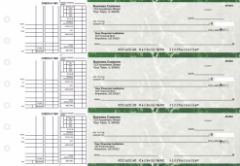
Multi-purpose manual checks from Checkomatic for property management companies handling multiple owner trust accounts with flexible stub documentation.
A property management company that manages 20 owner accounts has a minimum of 20 separate trust accounts plus a security deposit trust account plus its own operating account. At 23 or more accounts, ordering and managing separate pre-printed check stock for each account becomes a significant operational task.
Check Numbering Strategy for Multiple Accounts
Use non-overlapping check number ranges for each account so every check number in your records uniquely identifies both the account and the check. A practical system:
- Operating account: check numbers 1001 and up
- Security deposit trust: check numbers 5001 and up
- Owner trust accounts: 10001 and up, with each owner assigned a block (Owner A: 10001, Owner B: 10101, Owner C: 10201, etc.)
This system means any check number you see in your records immediately tells you which account it belongs to, which simplifies reconciliation and resolves discrepancies faster. For checkbook management and reconciliation guidance, see checkbook management: how to balance and reconcile.
Blank Check Stock for High-Volume Multi-Owner Operations
For property management companies managing a large number of owner accounts where ordering separate pre-printed check stock for each account is impractical, blank check stock with MICR encoding is an alternative. Blank check stock allows the management company to print the routing number, account number, and check number at print time using MICR-capable software and a MICR-compatible printer. For the full explanation, see what is blank check stock and when should you use it.
Property Management Software Check Formats
The check stock must match the print template of the property management software exactly. Ordering the wrong format produces checks with misaligned fields on every print run.
| Software | Check Format | Checkomatic Link |
|---|---|---|
| Yardi Voyager and Yardi Breeze Premier | Yardi check on top (pre-formatted) | Yardi check on top |
| AppFolio Property Manager | Check on top (voucher) | Check-on-top business checks |
| Buildium | Check on top (voucher) | Software compatible checks |
| No software (small PM company) | Manual multi-purpose or AP | Multi-purpose manual checks |
For the complete Yardi check workflow guide, including the difference between Yardi yCheck, CHECKscan, and physical AP check stock, see Yardi compatible checks: complete guide. For all software-compatible check formats, see accounting software compatible business checks.
Blank Check Stock for Multi-Owner Property Management Operations
When a property management company manages dozens of owner trust accounts, ordering and tracking separate pre-printed check stock for each account adds meaningful administrative overhead. Blank check stock is an alternative where the MICR line, including routing number and account number, is printed at the time of check production rather than pre-printed during manufacturing.
This requires MICR-capable printing software and a MICR-compatible printer, but it allows one check stock supply to serve multiple bank accounts by printing the correct account details at runtime. For the complete guide to blank check stock, its requirements, and when it makes sense for a property management operation, see what is blank check stock and when should you use it.
1099 Reporting and Check Recordkeeping for Property Managers
Property management companies face 1099 reporting obligations on two sides of the transaction:
1099-MISC for Property Owners
If a property management company collects rent and manages property on behalf of an owner, and the gross rent exceeds $600 in a calendar year, the company must issue a 1099-MISC to the property owner reporting the gross rent received. This applies even though the property manager is not the beneficial owner of the funds. The owner distribution check register, showing gross rent collected for each owner each month, is the source document for calculating the annual total per owner. Collect a W-9 from every property owner before beginning management. This is general information and not tax advice; confirm your specific obligations with your CPA.
1099-NEC for Maintenance Vendors
Any maintenance vendor who is a sole proprietor, individual, partnership, or LLC not taxed as a corporation and received $600 or more in payments during the year requires a 1099-NEC. The maintenance AP check register per property is the source document for calculating annual totals per vendor. A W-9 from every vendor before the first payment eliminates year-end scrambling for TINs.
Why a Clean Check Register Matters for 1099 Preparation
Property management companies that maintain clean, property-coded, reconciled check registers for each trust account can pull 1099 totals in minutes at year end. Companies that run all payments through a single check account without property coding spend days manually sorting through check registers to identify which payments apply to which owner and which vendor. For checkbook management best practices, see checkbook management: how to balance and reconcile.
Property Management Check Format Comparison
| Payment Type | Source Account | Best Format | Checkomatic Link |
|---|---|---|---|
| Owner distribution (rent disbursement) | Owner trust account | Voucher on top (computer or manual) | Check-on-top checks |
| Security deposit return | Security deposit trust | Manual AP with deduction stub | Manual AP checks |
| Maintenance / vendor AP | Owner trust account | Manual AP or computer voucher | Manual AP checks |
| Operating expenses (company) | Operating account | Computer voucher on top | Computer checks |
| Multi-owner (dozens of accounts) | Multiple trust accounts | Blank check stock with MICR | Blank check stock |
| Yardi AP workflow | Trust or operating | Yardi check on top | Yardi check on top |
Check Security for Trust Account Disbursements
ABA-compliant security features on every Checkomatic check, protecting property management trust account disbursements from check fraud.
Property management companies are specifically named as an elevated check fraud risk industry. Trust account checks, particularly owner distribution checks mailed to property owners each month, are attractive targets because they are predictable in timing, drawn on trust accounts that hold significant balances, and often mailed to the same addresses repeatedly.
Every Checkomatic business check includes six ABA-compliant security features at the base price on every order:
- Chemical-reactive paper: Stains visibly if washing solvents are applied, revealing alteration before the bank processes the check.
- Microprint signature line: Tiny repeating text that blurs on any photocopy, flagging counterfeits.
- Void pantograph: VOID appears clearly when the check is photocopied or scanned.
- Heat-sensitive ink: Disappears when pressed with a warm thumb, a bank teller authenticity test.
- Coin-reactive ink: Changes appearance when rubbed with metal.
- True watermark: Visible from both sides under light, absent from counterfeits.
For trust account checks mailed to owners and tenants, pairing check security features with positive pay through the company's bank provides the most complete protection. Positive pay matches every presented check against the company's issued check list before processing, stopping fraudulent checks even when they carry the correct account details. For the complete guide, see what is positive pay and how does it work and are business checks safe: security features that actually matter.
Check Envelopes for Mailing Owner Distributions and Security Deposits

Check envelopes from Checkomatic for mailing property management owner distributions and security deposit returns.
Property management companies mail checks regularly: owner distributions monthly to each property owner, security deposit returns to departing tenants, and maintenance payments to vendors who prefer paper checks. Check envelopes sized for standard business checks prevent folding that could damage the MICR line, and the security-tinted interior prevents the check amount and payee from being visible through the envelope. See check envelopes.
How to Order Business Checks for Your Property Management Company
What to Prepare Before Ordering
- Company legal name for operating account checks, exactly as it appears on the bank account
- Trust account names for each trust account (e.g., "[Company Name] , Client Trust Account , [Owner Name]" or "[Company Name] , Security Deposit Trust Account")
- ABA routing number and account number for each account separately. Do not order multiple accounts on one check stock order
- Starting check numbers using non-overlapping ranges for each account
- Check format matching your property management software's print template
- Company logo for operating account checks , black and white logo printing is free on every Checkomatic order
- Quantity , estimate 12 months of volume per account and order accordingly
Browse all formats at business checks. Standard orders ship from Monroe, NY in 3 to 5 business days.
What Customers Say About Checkomatic
All reviews below are published on checkomatic.com and reproduced verbatim. Source: checkomatic.com/quickbooks-starter-pack-product, 4.5 stars from 166 verified reviews.
"Been with them for 15 years. Always reliable, always good quality, good service. What more can you ask for?"
ATV Inc. | ★★★★★ 5/5 | April 5, 2024 | Source: checkomatic.com/quickbooks-starter-pack-product
"First time ordering and I am super impressed with the quality of the checks. No issues with delivery. I will be ordering again!"
TClinton | ★★★★★ 5/5 | April 9, 2025 | Source: checkomatic.com/quickbooks-starter-pack-product
"We use CheckoMatic for all of our check needs! They have great prices and we receive our products in a timely manner!"
CG's Tax Service | ★★★★★ 5/5 | September 18, 2024 | Source: checkomatic.com/quickbooks-starter-pack-product
"I got 500 checks for less than half of what the bank wanted for 200!"
VVA Voucher Checks (Vietnam Veterans of America) | ★★★★★ 5/5 | July 6, 2024 | Source: checkomatic.com/quickbooks-starter-pack-product
"ASJ Wilson Construction has been a client of checkomatic for some years now and they've never disappointed this company. Thank you checkomatic for all that you do."
ASJ Wilson Construction | ★★★★★ 5/5 | June 6, 2024 | Source: checkomatic.com/quickbooks-starter-pack-product
"Affordable and efficient. My go-to business check printer."
Doe | ★★★★★ 5/5 | January 24, 2025 | Source: checkomatic.com/quickbooks-starter-pack-product