-
 Contact Us
-
 Re order
-
 Log in
-
 Cart 0
You have no items in your shopping cart.
W-9 Before Paying a Contractor: What the IRS Says
You hired a plumber, a designer or a small crew, and the first invoice is on your desk. Before you write the check, someone asks whether you have their W-9 on file. It is a fair question, and the honest answer has two parts.
This guide separates what the IRS actually says from what careful payers do in practice. You will see when to ask, what to say, what to do if a contractor stalls, and how to record each check so tax time stays calm.
Quick Summary
The IRS pages we reviewed set no general rule that a W-9 must be in your hands before the first payment. You do need the contractor's taxpayer identification number (TIN) to file a 1099-NEC, and without one you generally must withhold 24 percent from payments. Asking before the first check is the simplest way to avoid that. Log the answer in your check register.
Key points
- No fixed deadline found. The IRS ties the first TIN request to the transaction, not to a calendar date.
- Missing TIN means withholding. The IRS calls it backup withholding, and the payer is responsible for it.
- The W-9 stays with you. The form says to give it to the requester and not send it to the IRS.
- Reporting starts at $2,000 in 2026. That applies to payments made after the end of 2025, and the figure may be indexed later, so track each total in your check register.
- Checks leave a paper trail. Match the payee name to the W-9 and note the status on the stub.
| Question | Short answer | Where it comes from |
|---|---|---|
| Is a W-9 required before the first payment? | No general deadline found; ask first anyway | IRS requester instructions and Publication 1281 |
| What if the contractor gives no TIN? | Generally withhold 24 percent | IRS Topic 307 |
| When does a 1099-NEC apply? | $2,000 or more on payments made after the end of 2025 | IRS 1099-NEC FAQ |
| Does the W-9 go to the IRS? | No, it goes to the payer | Form W-9, Rev. March 2024 |
| Do employees fill one out? | No, they are on payroll | IRS worker classification page |
Table 1. Quick answers to the main questions, from the IRS sources named. See business checks.
Paying several contractors by check? Talk to the Checkomatic team about a check layout with room for your own notes.
What is in this guide
- Do you need a W-9 before paying a contractor?
- How do you ask a contractor for a W-9?
- What if a contractor will not give you a W-9?
- Who counts as a contractor?
- What happens at 1099-NEC time?
- How does paying by check help your records?
- How do property managers handle contractor W-9s?
- How do project-based businesses handle subcontractors?
- Frequently asked questions
Do You Need a W-9 Before Paying a Contractor?
Not by any general IRS deadline that we could find, but you do need a TIN to report the payment or to avoid withholding. The IRS requester instructions for Form W-9 describe how to ask for a TIN. They do not say it must arrive before the first payment.
Is it illegal to pay a contractor without a W-9?
The IRS pages we read do not describe it as a violation by itself. The risk comes afterward: without a TIN you generally must start backup withholding, and a payer who fails to collect it may become liable for the uncollected amount, per the requester instructions.
Should you ask before the work starts or before the first check?
Ask before the work starts, and make the check wait for the form. Publication 1281 says the initial TIN request should happen when the transaction occurs, and a TIN is generally needed even for a one-time job. Asking at the quote stage also keeps your business check from being held up later.
How Do You Ask a Contractor for a W-9?
Send a short, polite request with a blank form and a date. Form W-9 is the IRS form a person uses to give a payer their correct TIN. The current version is Rev. March 2024, and the IRS page for it shows no recent developments as of its June 2026 review.
What should the request say?
Keep it plain and friendly, like this:
"Before we issue your first payment, we need a completed Form W-9 on file. Please add your legal name, tax classification and TIN, sign it and send it back. It stays in our records and is not sent to the IRS."
What is your checklist before the first check?
Work through these steps in order. This is a practical routine, not an IRS rule.
- Send the blank form with the quote or contract.
- Check it is complete. Name, classification, address, TIN and signature should all be there.
- Confirm the TIN format. A Social Security number looks like XXX-XX-XXXX, and an employer ID number like XX-XXXXXXX.
- File it with the vendor record, not in an email thread.
- Note it in your check register. A "W-9 on file" mark is enough.
- Then pay, using the payee name on the W-9.
How is a W-9 different from a W-4?
A W-9 gives a payer a contractor's TIN. A W-4 is the form an employee gives an employer so the right income tax is withheld from paychecks. If the worker is on your staff, skip the W-9 and see business checks for payroll.
What If a Contractor Will Not Give You a W-9?
If a payee gives no TIN when first asked, the IRS says the payer must begin backup withholding on reportable payments. Topic 307 and the backup withholding page both give the rate as 24 percent, and Publication 15 covers nonemployee compensation.
Here is a made-up example to show the arithmetic. It is an illustration, not an IRS figure. Suppose you owe a contractor $3,000 and have no TIN on file. See writing the business check for the net amount.
| Line | Amount in this example |
|---|---|
| Invoice total | $3,000 |
| Backup withholding at 24 percent | $720 |
| Amount on the check to the contractor | $2,280 |
| Amount you deposit with the IRS | $720 |
Table 2. A hypothetical backup withholding calculation. Record each line in your check register.
How do you report and deposit backup withholding?
You report it on Form 945 and deposit it separately from payroll taxes, according to Publication 15 and Publication 1281. The amount also appears in Box 4 on the contractor's 1099-NEC. See how payroll deposits work for the separate payroll side, and involve your tax professional early.
What else can happen with a TIN problem?
Each row below names the IRS source that describes it.
| Situation | What the payer does | IRS source |
|---|---|---|
| No TIN given when asked | Begin backup withholding right away | Publication 1281 |
| Contractor says TIN is applied for | The payee has 60 calendar days from your receipt of the certificate, then withholding begins | Requester instructions |
| IRS says the TIN is incorrect | Send a first B notice with a W-9 within 15 business days; withhold by 30 business days if none returns | Publication 1281 |
| Signed W-9 arrives later | Stop withholding within 30 calendar days of receiving it | Publication 1281 |
Table 3. How the IRS describes common TIN problems. Confirm the details with a tax professional.
Do penalties fall on the contractor too?
Yes. The form prints a $50 penalty for each failure to give a correct TIN, unless there is reasonable cause. It also prints a $500 civil penalty for a false statement with no reasonable basis that results in no backup withholding. Note any refusal in your check register.
Point a hesitant contractor to the form's own wording. See employee reimbursement checks for a related note on when 1099-NEC reporting applies.
Who Counts as a Contractor, and Who Does Not?
A contractor is generally someone you pay for services in your business who is not your employee. The IRS looks at behavioral control, financial control and the type of relationship. Staff you direct and pay through payroll are employees, so a W-9 is the wrong form.
| Payee | W-9 and 1099-NEC? | Note |
|---|---|---|
| Independent contractor, individual | Yes, W-9 and usually a 1099-NEC | If payments reach the threshold |
| Employee | No, use payroll forms | Check worker status if unsure |
| Corporation | Collect a W-9; reporting often does not apply | Attorneys' fees are an exception |
| Paid by credit or debit card | Not on your 1099-NEC | Reported by the card processor on Form 1099-K |
| Personal, non-business payment | Not reportable | Only business payments count |
| Non-US person | Usually a W-8 series form instead | Rules differ; ask a tax professional |
Table 4. Common payee types and the forms that usually apply. Based on the IRS 1099 instructions and worker classification page.
What if you are not sure whether someone is an employee?
Ask a tax professional. Form SS-8 asks the IRS for a determination, which can take at least six months. A sole proprietor with no staff is a common contractor, and our sole proprietor check guide covers how those owners pay and get paid.
What Happens at 1099-NEC Time?
You report contractor pay on Form 1099-NEC once the total reaches the threshold for the year. Many online guides still print the old figure.
| Payments made | 1099-NEC threshold | Note |
|---|---|---|
| Before 2026 | $600 | Older rule many guides still show |
| After December 31, 2025 | $2,000 | IRS 1099-NEC FAQ, reviewed October 16, 2026 |
| After December 31, 2026 | Subject to inflation indexing | Do not assume $2,000 stays fixed |
Table 5. The reporting threshold by payment year. IRS Notice 2025-62 links the change to Public Law 119-21.
Do you need a W-9 if you pay less than the threshold?
You may not need to file a 1099-NEC, but collecting a W-9 is still a smart habit, because totals can grow during the year. If you pay a contractor $1,500 in 2026, for example, no 1099-NEC is due on that amount alone. That figure is only an example, so track it in your check register.
When is the 1099-NEC due?
The statute sets January 31. A date that falls on a weekend generally moves to the next business day, so confirm the exact date for payments made in 2026 in the final IRS instructions. See check versus ACH payment if you also pay some contractors electronically.
Can you check that the name and TIN match?
Yes, the IRS offers TIN Matching for payers subject to the backup withholding rules. The interactive tool checks up to 25 name and TIN pairs, the bulk option up to 100,000, and e-Services registration is required, per the IRS page reviewed in June 2026. A verified match can help support reasonable cause, according to the requester instructions.
How long should you keep a W-9?
The IRS pages we read give no retention period for the W-9 itself and say only to keep it on file. The IRS does say to keep copies of information returns for four years if backup withholding was imposed. Ask your tax professional which rule fits, and store the form with your checkbook management files.
How Does Paying by Check Help Your Records?
A paper check puts the payee name, date, amount and check number in one place, and your register adds the rest. That makes it easy to match each payment to the W-9 you hold, though it is a habit and not an IRS requirement.
What should you write on the stub or memo line?
Many payers note the invoice number and a "W-9 on file" mark. Useful register columns are the payee name as on the W-9, invoice number, gross amount, any backup withholding and the W-9 date. These are habits, not IRS requirements. See check registers.
Write the check to the exact name on the form so your records and your 1099 line up.
How Do Property Managers Handle Contractor W-9s?
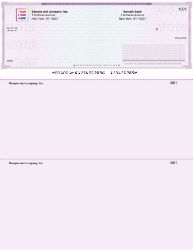
They treat each trade as a separate vendor with its own W-9 and payment total. A manager may pay plumbers, painters and landscapers from one account, and a clear register keeps those totals apart. Our page on checks for property management companies covers that workflow.
- One W-9 per vendor, collected when you add the trade to your list.
- One running total per vendor, watched against the reporting threshold.
- Stub notes with the building and invoice number.
How Do Project-Based Businesses Handle Subcontractor W-9s?
They collect the W-9 at onboarding, before the subcontractor is assigned to a job. Firms that pay many subcontractors against specific jobs need the paperwork to follow each job. Our staffing agency check guide includes an industry example of collecting W-9s before the first check.
- Onboard first, with the W-9 in the subcontractor package.
- Tag each check with the job on the stub.
- Review before year end for any vendor missing a form.
Checks that carry your paperwork notes
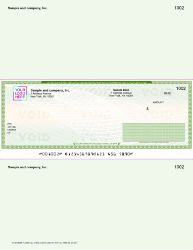
Room on the stub. Layouts with perforated stubs leave space for invoice and W-9 notes.
Software-ready stock. Check-on-top and check-in-middle layouts print from your accounting software.
Proof before you order. Review a digital proof so every field is right.
Questions welcome. The team can suggest a layout for your vendor workflow.
About the Author
This guide, written by the Checkomatic team for businesses that pay contractors by check, draws on Form W-9 (Rev. March 2024), the IRS Instructions for the Requester of Form W-9, Publications 15, 1099 and 1281, IRS Topic 307, the IRS 1099-NEC FAQ, IRS Notice 2025-62 and the IRS worker classification page.
This is general information, not tax or legal advice. Rules change, so confirm the current details with the IRS or a tax professional before you rely on them.
Frequently Asked Questions
Can I pay a new contractor first and collect the W-9 afterward?
Does the W-9 go to the IRS?
Is the backup withholding rate 24 percent?
Is the 1099-NEC threshold $600 or $2,000?
What if a contractor refuses to give me a W-9?
Do I need a W-9 from every vendor?
What is a B notice?
Can I accept a W-9 by email?
Does an employee fill out a W-9?
What should I put in the memo line of a contractor check?
Accepted by the world’s leading banks