-
 Contact Us
-
 Re order
-
 Log in
-
 Cart 0
You have no items in your shopping cart.
How Many Business Checking Accounts Can You Have?
You open a business checking account, and a few months later the money starts to blur together. Payroll, taxes, supplies and your own pay all come from one balance. So you ask the obvious question: can you open more than one, and how many is sensible?
This guide gives a plain answer based on federal sources, explains the rules that matter, and shows how to set up accounts without losing track of checks. It also covers a point most guides skip, which is how several accounts change the way you order and number checks.
Quick Summary
There is no federal limit that we found, so the number is set by your bank's policy and your needs. Most small businesses do well with two to four accounts, and checkbook management helps. Opening more at the same bank does not raise FDIC coverage, which stays at $250,000 for each depositor, bank and ownership category. See the sole proprietor checks guide.
Key points
- The limit is a bank decision. We found no federal law capping business checking accounts, so ask your bank about its own rules.
- Different purposes are not insured separately. The FDIC says accounts of one entity at one bank, such as operating and reserve, are combined.
- Sole proprietors are treated differently. Their business accounts count as the owner's single accounts at that bank.
- Separate accounts protect your records. IRS Publication 583 advises keeping a business checking account apart from personal money.
- Each account needs its own checks. Match the check series and account nickname to the account so the wrong one never pays a bill.
- Reconcile every account monthly. The IRS says to compare statements with your checkbook.
| Business stage | Suggested accounts | Why add the next one |
|---|---|---|
| Just starting | 1 business checking | Keeps business money apart from personal money |
| Steady income | 2: operating plus tax set-aside | Stops tax money from being spent by accident |
| First employee | 3: operating, payroll, tax | Makes payroll deposits easier to track |
| Several locations or projects | One per location or large project | Shows which unit makes or loses money |
Table 1. An illustrative growth path, not a rule. Your bank, your entity type and your accountant may suggest a different layout.
Setting up a new account? Talk to the Checkomatic team about checks for each one.
What is in this guide
- Is there a limit on business checking accounts?
- How many accounts do you really need?
- Are several accounts at one bank insured?
- What do you need to open another account?
- Why keep business and personal money apart?
- How do you manage checks across accounts?
- What are the downsides of too many accounts?
- Frequently asked questions
- More questions about business accounts
Is There a Limit on Business Checking Accounts?
We found no federal statute or rule that limits how many business checking accounts a company can hold. That is an absence of evidence, not a promise, so ask your bank. Each bank sets its own account policies and may cap accounts or require a minimum balance for each one.
Can you have accounts at more than one bank?
Yes, nothing we found prevents it. Many owners use a second bank for a reserve or a backup. Each bank will follow its own opening procedures.
Can a sole proprietor have more than one account?
Generally yes, subject to the bank. The FDIC notes that a sole proprietorship's accounts are treated as the owner's single accounts, so insurance is combined with any personal single accounts at the same bank.
How Many Accounts Do You Really Need?
Start with one, then add an account only when it solves a problem. A good reason is something you can name, such as taxes being spent or payroll being hard to track. A bad reason is simply that other owners have five.
| Account | Funded by | Pays out | Who needs check access |
|---|---|---|---|
| Operating | Customer payments | Bills, rent, supplies | Owner and bookkeeper |
| Payroll | Transfer from operating | Wages and payroll taxes | Owner only, or payroll provider |
| Tax set-aside | A fixed share of each deposit | Tax payments | Owner only |
| Owner draw | Planned transfer from operating | Your pay | Owner only |
Table 2. An illustrative account map. Funding shares and approval rules are for you and your accountant to decide.
Do you need a separate payroll account?
It is not required by anything we found in IRS Publication 15, which says federal tax deposits are made electronically. A separate account is still helpful, because trust fund taxes are money held for the government. The IRS can hold people with authority over those funds personally responsible if they willfully fail to pay, so many owners keep payroll visible. See doing payroll yourself.
Do you need a separate tax account?
No rule we found requires one. Some states have their own rules for sales tax or client funds, and we did not verify them, so check yours. A tax account is mostly a habit that keeps cash from being spent.
Are Several Accounts at One Bank Insured Separately?
No, if they belong to the same corporation, LLC or partnership. The FDIC standard maximum is $250,000, counted for each depositor at each insured bank within an ownership category. Accounts of one entity at one bank are combined, even if they have different purposes. See business checks.
| Account setup (illustration) | Balance | Insurance result at one bank |
|---|---|---|
| LLC operating account | $180,000 | Combined with the other accounts |
| LLC payroll account | $90,000 | Combined with the other accounts |
| LLC tax reserve | $60,000 | Combined with the other accounts |
| Total at one bank | $330,000 | $250,000 insured, $80,000 over the limit |
Table 3. Fictional round numbers to show how combining works under 12 CFR 330.11. Compare payment methods in check versus ACH payment.
How do you protect balances above $250,000?
The FDIC limit applies bank by bank, so spreading balances across separate insured banks is one option. Talk to your bank about its programs before you rely on any of them. Our article on writing a check from a savings account explains how reserve accounts differ from checking.
Are a sole proprietor's accounts insured differently?
Business accounts are added to the owner's other single accounts at that bank, up to the same $250,000 total. A sole proprietorship has no ownership category of its own. See check validity. This is why a sole proprietor with a large personal balance can reach the limit faster than expected.
What Do You Need to Open Another Business Account?
The Small Business Administration lists the usual items: an employer identification number (or Social Security number for a sole proprietorship), formation documents, ownership agreements and a business license. Banks may ask for more. Bring the documents for your entity type.
Why does the bank ask who owns 25% of the company?
Federal rules require banks to identify and verify the beneficial owners of legal entity customers when an account is opened. One prong covers any individual who owns 25% or more of the equity, up to four people. The other covers one individual with significant control, such as a president or managing member. See 31 CFR 1010.230 and our voided check guide.
Does a second account trigger the whole process again?
Less often now. A FinCEN order dated February 13, 2026 says banks no longer have to identify and verify beneficial owners every time an existing customer opens a new account. They must still do it at first opening, when facts raise doubt, and as their risk procedures require. Your bank may still ask for documents.
Do you still file a beneficial ownership report with FinCEN?
Not for U.S. companies. The FinCEN page, updated August 11, 2026, says they are exempt from beneficial ownership information reporting.
The final rule became effective on August 14, 2026. The bank rule above is separate and still applies when you open an account.
Why Keep Business and Personal Money Apart?
It keeps your records clean and protects the separation between you and your company. The SBA says mixing the two, known as commingling, can put personal assets at risk and may cost an owner the protection of the entity. IRS Publication 583 advises opening a business checking account when you start and keeping it separate from your personal account.
- Deposit all receipts. Mark the source of each deposit on the slip, such as income, personal funds or a loan.
- Pay expenses by check. It documents each payment, and Pub 583 advises avoiding checks payable to cash.
- Pay yourself on purpose. Write a check to yourself only for personal withdrawals.
- Keep the slips. Copies of deposit slips support your records. See check registers.
How Do You Manage Checks Across Several Accounts?
Give every account its own checks and make each one easy to tell apart. The check number is part of the MICR line, along with the routing and account numbers, so a check always points back to one account. Mix-ups happen when two accounts share the same look.
- Order checks per account. Each account needs checks printed with its own account details.
- Use different number ranges. For example, 1000s for operating and 5000s for payroll. This is a habit, not a rule.
- Name the account on the stub. A nickname such as "Payroll" helps staff pick the right book.
- Store checks separately. Lock up payroll and tax checks, and limit who can sign. See checkbook management.
- Consider positive pay. The OCC describes it as sending your bank a list of issued checks so it pays only matches. Read what positive pay is.
- Close accounts you no longer use. The OCC advises closing unneeded accounts instead of abandoning them.
How do you reconcile several accounts?
Do it monthly for each one. Compare the statement's deposits and cleared checks with your checkbook, list unrecorded items such as service charges, and update your records. The adjusted bank balance should match the adjusted checkbook balance, according to Publication 583.
Does paper checking still make sense?
For many small businesses it does, especially for payroll and vendors who prefer checks. Weigh the risks in check fraud in 2026. Where staff are reimbursed, see employee reimbursement checks.
What Are the Downsides of Too Many Accounts?
More accounts mean more fees, more idle cash and more work. We do not quote fee amounts, because they differ by bank. Use the list below to count what each extra account would cost you.
- Monthly fees. Add up fees for every account you keep.
- Minimum balances. Cash held to avoid fees is cash you cannot use elsewhere.
- Bookkeeping time. Each account needs a monthly reconciliation.
- Mistakes. More accounts raise the odds that a check is paid from the wrong one.
- Overdraft risk. Moving money late can leave an account short. See what happens with a bounced check.
Matching checks to each account
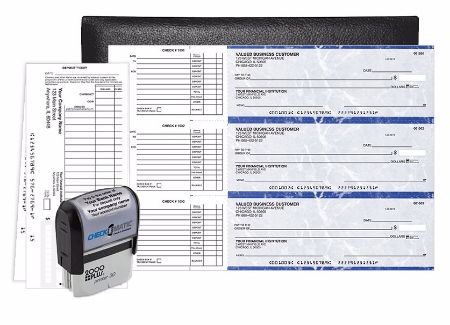
Starter packs to begin with. Get QuickBooks or manual packs for a new account, and add more when you grow. See business checks.
Details printed for each account. Your bank name, routing and account numbers are set for the account you choose.
Check the proof. A digital proof lets you confirm every detail before printing.
Security built in. ABA compliant check stock helps your bank process payments cleanly.
About the Author
Written by the Checkomatic team for owners deciding how to organize their business banking. It draws on the FDIC deposit insurance brochure, Federal Deposit Insurance regulation 12 CFR 330.11, the FinCEN customer due diligence order, the FinCEN beneficial ownership page, IRS Publications 15 and 583, and SBA guidance.
General information only, not legal, tax or financial advice. Bank rules, insurance limits and reporting rules can change. Confirm the details with your bank and an accountant before you restructure your accounts.
Frequently Asked Questions
How many business checking accounts can you have?
Can you have two business bank accounts?
Can you have business accounts at different banks?
Are multiple business accounts at one bank each FDIC insured?
Do I need a separate account for payroll?
What documents do I need to open a business checking account?
Why does my bank ask about owners with 25% or more?
Can a sole proprietor have a separate business account?
How do I keep check numbers straight across accounts?
Is it a problem to mix personal and business money?
Accepted by the world’s leading banks