How Many Checks to Order by Business Size
The most practical starting point for answering how many checks you should order is your business size and the number of checks you write per month. Every business is different, but these ranges apply to the majority of US small and medium-sized businesses.
| Business Type | Checks/Month | Annual Need | Recommended Order |
|---|---|---|---|
| Solo operator / freelancer | 5 to 10 | 60 to 120 | 100 to 150 |
| Small business, AP only | 20 to 30 | 240 to 360 | 250 to 400 |
| Small business, AP + payroll | 30 to 60 | 360 to 720 | 400 to 600 |
| Medium business, high AP | 60 to 150 | 720 to 1,800 | 600 to 1,000 |
| Property manager (multiple properties) | 40 to 100 | 480 to 1,200 | 500 to 1,000 |
| Non-profit / school / foundation | 10 to 30 | 120 to 360 | 150 to 400 |
| Construction / trades | 50 to 150 | 600 to 1,800 | 600 to 1,000 |
These ranges assume you are ordering one format at a time. If you use both voucher checks for payroll and 3-on-a-page for AP, calculate each separately and order them as separate batches with separate check number sequences. Mixing formats in a single order creates tracking and alignment confusion.
Quick Reference: Checks Needed by Monthly Volume
If you know roughly how many checks your business writes per month, this table tells you how many to order at once to cover 6 months, 12 months, and 18 months of supply.
| Checks/Month | 6-Month Supply | 12-Month Supply | 18-Month Supply |
|---|---|---|---|
| 5 | 30 | 60 | 90 |
| 10 | 60 | 120 | 180 |
| 20 | 120 | 240 | 360 |
| 30 | 180 | 360 | 540 |
| 50 | 300 | 600 | 900 |
| 100 | 600 | 1,200 | 1,800 |
| 150 | 900 | 1,800 | 2,700 |
How Check Format Affects Your Quantity Decision
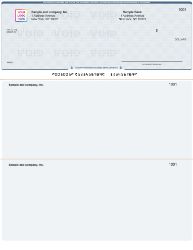
Voucher checks ; one check per page. Your monthly usage equals your monthly check count exactly.
The format you choose affects how quickly you go through a batch of check stock. Understanding this before placing an order helps you buy the right quantity the first time.
Voucher Checks (Check-on-Top)
One check per 8.5 by 11 inch sheet. If you write 30 checks per month, you use 30 sheets of voucher stock per month. The calculation is one-to-one: your monthly check count equals your monthly sheet count. Voucher format is the standard for payroll and accounts payable where a physical stub record is required per payment. For voucher format business checks, see QuickBooks checks and business checks at Checkomatic.
3-on-a-Page Checks (Standard Format)
Three checks per 8.5 by 11 inch sheet. If you write 90 checks per month, you use only 30 sheets of 3-on-a-page stock. The calculation is one-third: your monthly check count divided by 3 equals your monthly sheet count. This format is more paper-efficient for high-volume accounts payable runs. For 3-on-a-page format, see 3-on-a-page checks at Checkomatic.
Manual Checks (Handwritten)
Three checks per page with carbonless duplicate copies. The carbon duplicate creates an automatic paper record of every check you write. Manual checks are sold by the book or in individual sheets. If you write 10 to 30 checks per month by hand, a standard manual check supply covers your needs without requiring accounting software. For manual check formats, see manual checks at Checkomatic.
| Format | Checks/Sheet | Sheets for 300 Checks | Best For |
|---|---|---|---|
| Voucher (check-on-top) | 1 | 300 sheets | Payroll, AP with stubs |
| 3-on-a-page (standard) | 3 | 100 sheets | High-volume AP, no stubs needed |
| Manual (handwritten) | 3 (with carbon) | 100 sheets | No software, occasional payments |
For a full comparison of check formats and which situations call for each, see voucher checks vs wallet checks: when to use each.
How Many Checks to Order for Payroll
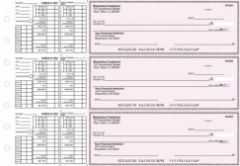
Payroll business checks from Checkomatic ; order quantity based on headcount and pay frequency.
Payroll is the most time-sensitive check use case. Running out of payroll checks before a pay date means employees do not get paid on time, which creates both a legal risk and an employee relations problem. The quantity calculation for payroll checks is more precise than for general AP checks.
Payroll Quantity Formula
Start with your employee headcount paid by check at each pay run. Multiply by the number of pay runs per year. Add 10 to 15 percent buffer for voided checks, new employees, and corrections.
- Weekly payroll, 5 employees: 5 x 52 = 260 checks per year. Order 300.
- Biweekly payroll, 10 employees: 10 x 26 = 260 checks per year. Order 300.
- Biweekly payroll, 25 employees: 25 x 26 = 650 checks per year. Order 750.
- Monthly payroll, 15 employees: 15 x 12 = 180 checks per year. Order 250.
The Payroll Reserve Rule
Always keep at least one full payroll run worth of checks in reserve before triggering a reorder. If you pay 10 employees biweekly, your reorder trigger is when you have 10 to 15 checks remaining, not when you have 25 remaining. The 25-check general rule is a floor; for payroll, build the trigger around your headcount.
For the complete guide to payroll check formats and compliance requirements, see business checks for payroll: the complete employer guide.
First-Time Order: What Quantity to Start With
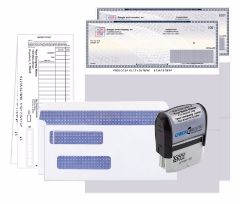
Checkomatic starter pack ; the right first order for new businesses getting their check supply set up.
The first order from any check supplier is different from a reorder. With a reorder, you already know the format works, the alignment is correct, and the quality meets your standard. With a first order, you are verifying all of these for the first time.
Why First Orders Should Be Smaller
Even with a supplier that pre-formats check stock to your software's print template, individual printer models vary. The margins on your specific printer may require a small alignment adjustment. If you order 500 checks and discover the alignment requires correction after running through 50 checks, you have wasted 50 sheets of security paper. Starting with a smaller quantity gives you the chance to confirm alignment on your specific printer before committing to a large batch.
Recommended First-Order Quantities
- New business, low volume (under 20 checks/month): Start with 100 to 150 checks.
- Existing business, switching suppliers: Start with 150 to 250 checks.
- New business, medium volume (20 to 50 checks/month): Start with 250 checks.
- Established business with confirmed format: Order 500 or more for bulk pricing.
For new businesses setting up their complete check-writing system for the first time, the starter kit bundle covers checks, deposit slips, double-window envelopes, and an endorsement stamp in a single order. See the business check starter kit at Checkomatic.
Bulk Pricing: When Ordering More Saves Money
Per-check cost decreases as quantity increases. The savings between a small order and a medium or large order are meaningful for businesses that use checks regularly.
How Bulk Pricing Works
Check printing has fixed production costs (setup, MICR encoding verification, security paper preparation) and variable costs (paper, toner, binding). The fixed costs are the same whether you order 50 checks or 500 checks. Spreading those fixed costs over a larger quantity lowers the per-check price at every tier above the minimum order. This means the per-check cost of a 500-check order can be 40 to 60 percent lower than the per-check cost of a 50-check order from the same supplier for the same format.
When to Take Advantage of Bulk Pricing
- After your first order confirms quality and alignment ; then move to larger quantities on reorders.
- When your business details (name, address, bank account) are stable for at least 12 months.
- When your monthly check volume is consistent enough to estimate 12-month usage reliably.
- When you have confirmed your accounting software and check format are correctly matched.
When NOT to Order in Bulk
- First order from a new supplier ; verify quality and alignment first.
- Your business is growing rapidly and you expect your details (name, address) to change.
- You are not sure which check format your software needs ; confirm format before ordering large batches.
- You have recently changed banks or are in the process of changing your legal entity name.
What Happens If You Order Too Few Checks
Running out of business checks creates a different problem depending on what you use them for.
Running Out During an AP Run
If you run out of checks mid-month during a vendor payment run, you have a few options: ACH transfer or wire for urgent payments (these take 1 to 3 business days), digital payment platforms for vendors who accept them, or a rush reorder that ships within 1 to 2 business days at additional cost. Missing vendor payment deadlines due to check supply issues can affect vendor credit terms and relationships.
Running Out Before Payroll
This is the highest-risk scenario. Running out of payroll checks before a pay date means employees do not receive payment on time. In states with strict payroll timing laws, late payroll triggers penalties even when the cause is a supply issue rather than intentional delay. Always maintain a one-full-payroll-run reserve above your reorder trigger.
The Rush Order Cost
Rush check orders are available at Checkomatic and ship within 1 to 2 business days. However, rush production costs more than standard production. Businesses that consistently run out of checks and reorder on rush terms pay more per check over time than businesses that manage their supply with planned reorders. The 25-check reorder trigger (described in the reorder section below) eliminates the need for most rush orders entirely.
What Happens If You Order Too Many Checks
Ordering too many checks creates a different but equally real problem: outdated stock.
When Check Stock Becomes Unusable
Pre-printed business checks carry your business name, address, ABA routing number, account number, and starting check number. If any of these change before you use up a large batch, the remaining checks are unusable. Banks reject checks with account information that does not match their records. You cannot handwrite corrections on pre-printed check stock.
The most common reasons check stock becomes outdated before it is used up:
- Business relocates to a new address
- Business changes its legal name (LLC restructuring, DBA change, acquisition)
- Bank changes routing number after a merger or acquisition
- Business switches banks entirely
- Business changes its account number (rare but occurs after fraud events)
The 18-Month Rule
A practical rule for how many checks to order at once: never order more than an 18-month supply. Most businesses can estimate their usage reliably over 18 months, and most business details remain stable over 18 months. At 24 months or more, the probability of a business detail change increases enough that the risk of wasted stock begins to outweigh the bulk pricing savings. Order 12 to 18 months of supply at a time for the best balance of savings and flexibility.
When to Reorder: The 25-Check Rule
Once you have your first order in hand and have confirmed everything works correctly, the next question is when to place the next order. The practical reorder trigger for most businesses is when you have approximately 25 checks remaining.
Standard production and shipping at Checkomatic takes 3 to 5 business days. Twenty-five checks at a volume of 3 to 5 checks per day gives you 5 to 8 business days of supply. This buffer is enough to cover the standard production window with a few days to spare. For businesses with concentrated check-writing periods (end of month AP runs, biweekly payroll), adjust the trigger higher. For businesses with irregular low-volume check writing, 15 checks remaining may be enough of a trigger.
For the complete reorder process including how to find your starting check number in QuickBooks Desktop, QuickBooks Online, and manual check binders, see how to reorder business checks online: step-by-step.
Common Check Quantity Ordering Mistakes
Mistake 1: Ordering the Same Format in Different Quantities for Different Accounts
If your business has two bank accounts and you use different check formats or check number sequences for each, order them as separate batches. Combining checks for two accounts into one order creates confusion during reconciliation. Keep each account's check stock in separate, clearly labeled storage.
Mistake 2: Calculating Quantity Based on Sheets Instead of Checks
If you use 3-on-a-page format and order 100 sheets, you have 300 checks. If you use voucher format and order 100 sheets, you have 100 checks. Confirm whether the supplier's pricing and quantity display is in checks or in sheets before placing the order. Most Checkomatic product pages list quantities in individual checks, not sheets.
Mistake 3: Not Ordering Enough Buffer for New Hires
Payroll check usage is predictable based on headcount, but headcount changes. If you plan to hire 5 new employees in the next 6 months, factor that into your payroll check order today. Running a larger payroll on a supply calculated for a smaller workforce means running short before your planned reorder date.
Mistake 4: Ordering a Large Batch Before Confirming Format
Ordering 500 checks before confirming your accounting software's format setting matches the physical stock is the most avoidable and most costly quantity mistake. Confirm the Check Style in your software's printer settings (Voucher, Standard, or Wallet) before placing any order. A format mismatch wastes the entire batch.
Mistake 5: Not Factoring in Void Rate
Every business voids some checks due to printer jams, writing errors, or checks that are spoiled during processing. A realistic void rate for most businesses is 2 to 5 percent of total check usage. Add this buffer to your quantity calculation. A business using 250 checks per year should order 265 to 275 to account for voids without running short.
What Customers Say About Checkomatic
All reviews below are published on checkomatic.com and reproduced verbatim. Source: checkomatic.com/quickbooks-starter-pack-product, 4.5 stars from 166 verified reviews.
"I got 500 checks for less than half of what the bank wanted for 200!"
VVA Voucher Checks (Vietnam Veterans of America) | ★★★★★ 5/5 | July 6, 2024 | Source: checkomatic.com/quickbooks-starter-pack-product
"Been with them for 15 years. Always reliable, always good quality, good service. What more can you ask for?"
ATV Inc. | ★★★★★ 5/5 | April 5, 2024 | Source: checkomatic.com/quickbooks-starter-pack-product
"First time ordering and I am super impressed with the quality of the checks. No issues with delivery. I will be ordering again!"
TClinton | ★★★★★ 5/5 | April 9, 2025 | Source: checkomatic.com/quickbooks-starter-pack-product
"We use CheckoMatic for all of our check needs! They have great prices and we receive our products in a timely manner!"
CG's Tax Service | ★★★★★ 5/5 | September 18, 2024 | Source: checkomatic.com/quickbooks-starter-pack-product
"ASJ Wilson Construction has been a client of checkomatic for some years now and they've never disappointed this company. Thank you checkomatic for all that you do."
ASJ Wilson Construction | ★★★★★ 5/5 | June 6, 2024 | Source: checkomatic.com/quickbooks-starter-pack-product
"Affordable and efficient. My go-to business check printer."
Doe | ★★★★★ 5/5 | January 24, 2025 | Source: checkomatic.com/quickbooks-starter-pack-product
Why Choose Checkomatic for Your Business Check Order
Quantity Options From 50 to 1,000+ With Bulk Pricing at Every Level
Checkomatic's check ordering allows you to select the exact quantity that matches your usage without being forced into fixed pack sizes. Bulk pricing reduces your per-check cost at higher quantities so you benefit from ordering the right amount for your volume. Browse all quantity options at business checks and computer checks for business.
Digital Proof Before Production on Every Order
Before any check prints, Checkomatic generates a digital proof for you to verify. Confirm your business name, address, ABA routing number, account number, and starting check number before anything goes to production. A proof verification step on your first order is the simplest way to avoid ordering too many checks with an error in them.
Rush Production for Urgent Needs
Rush production options ship within 1 to 2 business days for businesses that need checks quickly before a payroll date or an urgent AP run. Rush availability means that even if you run lower than planned on your check supply, same-week production is available. For the best ordering experience and guidance on the right quantity for your business, browse the full catalog at what is the best place to order checks online.