-
 Contact Us
 -
 Re order
 -
 Log in
 -
 Cart 0
 You have no items in your shopping cart.
How to Do Payroll Yourself: A Step by Step Guide
Most small business owners start doing payroll the same way: the first hire arrives, the first pay date is a week away, and nobody has told you which forms to collect or which taxes to hold back. The process looks intimidating, but it is a repeatable routine once you know the order of the steps.
This guide walks through that order. It covers what to set up before day one, how each paycheck is worked out, when federal payroll taxes are due, which forms you file and how to pay people by check. It also covers the point where handing payroll to a service starts to make sense.
Quick Summary
To do payroll yourself, get an Employer Identification Number, collect a Form W-4 and a Form I-9 from every hire, and work out each paycheck by withholding income tax, Social Security and Medicare. Then deposit those taxes with the IRS on schedule, file Form 941 each quarter, and send out Forms W-2 by January 31.
- Set up before the first paycheck. You need an EIN, a Form W-4 and a Form I-9 for every employee, plus your state registrations.
- Withhold three federal taxes. Income tax comes from the W-4, then 6.2% for Social Security and 1.45% for Medicare, and you pay a matching share as the employer.
- Deposits run on one of two schedules. Monthly or semi-weekly, set before each calendar year using your lookback period.
- Three federal filings matter most. Form 941 quarterly, Form 940 annually, and Forms W-2 and W-3 each January.
- New hires must be reported to your state. Federal law caps the deadline at 20 days after the hire date, and some states are faster.
- Keep records for at least 4 years. The IRS expects employment tax records to be available for review.
| Task | When it happens | Form or action |
|---|---|---|
| Get an EIN | Before your first hire | IRS online application |
| Collect withholding details | At hire | Form W-4 |
| Verify work eligibility | Employer section within three business days of hire | Form I-9 |
| Report the new hire | Within 20 days at the latest | State new hire report |
| Withhold and pay | Every pay date | Net pay by check or direct deposit |
| Deposit payroll taxes | Monthly or semi-weekly | IRS tax deposit |
| File the quarterly return | Each quarter | Form 941 |
| File annual returns | January 31 | Forms 940, W-2 and W-3 |
Table 1. The whole payroll cycle on one page, in the order you will meet each task.
Paying your team by check? Contact the Checkomatic team and we will point you to the right payroll check format for your software and your bank.
What is in this guide
- Can you really do payroll yourself?
- What do you need to set up before your first payroll?
- How does payroll work, step by step?
- How do you work out what to withhold?
- How do you pay employees by check?
- How do you deposit payroll taxes?
- Which forms do you file, and when?
- How long should you keep payroll records?
- What mistakes cost small employers the most?
- When should you use a payroll service instead?
Can You Really Do Payroll Yourself?
Yes, and plenty of small employers do. Nothing in the process requires a payroll company. What it requires is accuracy and deadlines: the right amount withheld on every pay date, the right taxes deposited on time and the right forms filed afterwards.
The work scales with the size of your team. With one or two employees in one state, payroll is usually a short routine each pay period plus a handful of filing dates a year. It gets heavier as you add people, states and benefits.
Before you decide, it helps to see the full list of what you are signing up for. The sections below cover it in the order it happens.
What Do You Need to Set Up Before Your First Payroll?
You need an EIN, a Form W-4 and a Form I-9 for each employee, and your state registrations. Get these done before the first pay date, because the work is much harder to untangle once checks have gone out.
| What you need | What it is for | Where it comes from |
|---|---|---|
| Employer Identification Number | Identifies your business for payroll taxes and filings | The IRS, directly |
| Form W-4 | Tells you how much federal income tax to withhold | Each employee completes it |
| Form I-9 | Confirms identity and work eligibility | Employee and employer each complete a section |
| State registrations | New hire reporting, state tax accounts, insurance rules | Your state agencies |
| Payroll bank account | Keeps wages and tax money separate from operating cash | Your bank |
Table 2. The five things to have in place before payroll day, and where each one comes from.
How do you get an Employer Identification Number?
You apply to the IRS directly, and the IRS says you can get an EIN for free in minutes by applying online. You need one if you have employees. If your business is an LLC, partnership or corporation, register it with your state before you apply.
What does Form I-9 require?
Every U.S. employer must complete a Form I-9 for every individual they hire, whether the person is a citizen or a noncitizen. Both you and the employee complete a section. Under the federal rule, you must examine the documents the employee presents and complete your section within three business days of the hire.
Do you have to report new hires?
Yes. Federal law requires employers to report each new hire to their state, and the report must be made not later than 20 days after the date of hire. Some states set a shorter window. Look up your state's new hire reporting rules on the day you make your first offer, not after the 20 days have gone.
What else does your state require?
Rules differ by state, so check three things with your state agencies before you pay anyone.
- State unemployment: whether you must register for a state unemployment account.
- State and local tax: whether you must withhold state or local income tax.
- Workers' compensation: whether you must carry coverage for your employees.
How Does Payroll Work, Step by Step?
Payroll runs as a loop. You repeat the same short sequence every pay period, and the deposits and filings sit on top of that loop on a calendar of their own.
- Choose a pay schedule and stick to it, such as weekly, every two weeks or twice a month. Check your state's rules on how often you must pay.
- Collect hours or confirm salary for the pay period, including any overtime.
- Work out gross pay for each employee.
- Subtract withholdings for federal income tax, Social Security and Medicare, plus state taxes and any deductions the employee has agreed to.
- Pay the net amount by check or direct deposit, with a pay stub showing how it was worked out.
- Set aside the taxes you withheld along with your own employer share, so the money is there on deposit day.
- Deposit the taxes on your schedule, then file the quarterly and annual returns.
- File the records so you can find any pay period again years later.
Step 6 is where new employers get caught. The tax you withheld is held for the tax authorities, so it should not sit in operating cash. Moving it into a separate account on every pay date is the simplest control there is.
How Do You Work Out What to Withhold From Each Paycheck?
You start with gross pay and take away the taxes and deductions that apply, and what is left is net pay. Our guide on how to calculate net pay for a payroll check walks through the five-step calculation in detail, so this section focuses on the federal taxes themselves.
What are the federal payroll tax rates?
Social Security and Medicare are shared between you and the employee. The IRS gives the current Social Security rate as 6.2% for the employer and 6.2% for the employee, 12.4% in total. The Medicare rate is 1.45% for each, 2.9% in total.
Social Security tax applies up to an annual wage base limit. That limit changes, so check the current figure in IRS Publication 15 each January rather than relying on last year's number.
| Tax | Withheld from employee | Paid by employer | Notes |
|---|---|---|---|
| Federal income tax | Yes, based on Form W-4 | No | You hold it and deposit it |
| Social Security | 6.2% | 6.2% | Applies up to the annual wage base limit |
| Medicare | 1.45% | 1.45% | Applies to all covered wages |
| Additional Medicare | 0.9% on wages over $200,000 | No | Begins the pay period wages pass $200,000 |
| Federal unemployment (FUTA) | No | 6.0% before credit | Applies to the first $7,000 per employee |
Table 3. Which federal payroll taxes come out of the employee's pay and which you pay on top as the employer.
How does federal unemployment tax work?
FUTA is paid by the employer only. The rate is 6.0% on the first $7,000 you pay each employee in the year. If you pay your state unemployment tax in full and on time, you can usually claim a credit of up to 5.4%, which brings the effective federal rate down to 0.6%. Your state wage base may differ from the federal one.
How does Form W-4 change the amount?
The employee's Form W-4 is what you use to work out federal income tax withholding. Two employees on the same salary can have different amounts withheld because their forms differ. Keep each signed form on file, and ask for a new one when an employee wants to change their withholding.
How Do You Pay Employees by Check?
You write or print a payroll check for the net amount and attach a stub showing how it was worked out. Paper checks work for every employee, including anyone without a bank account, and they need no direct deposit setup.
Direct deposit has its own appeal, and our comparison of payroll checks vs direct deposit sets out the trade-offs. Our guide to payroll business checks also explains when paper checks are legally required. Many employers offer both.
Can you write payroll checks by hand?
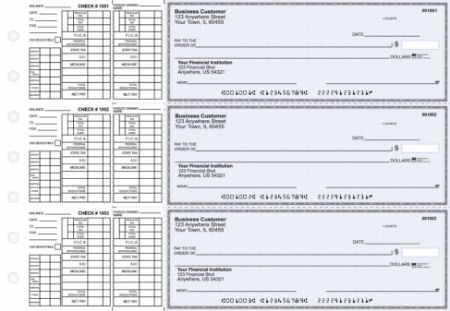
Yes. Manual payroll checks suit very small teams, where you work out each paycheck and write it by hand. The carbonless copy behind each check gives you a record without any software. The catch is that every amount is typed or written twice, so mistakes are easier to make.
Can you print payroll checks from your accounting software?
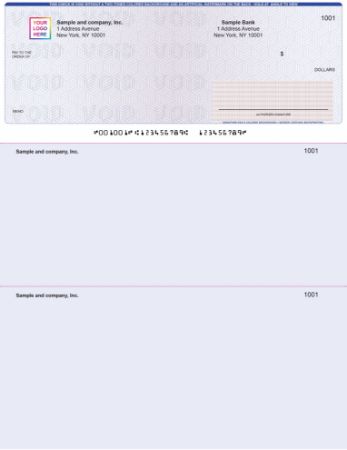
Yes, and it is the better route once you have more than a few employees. Your software works out the pay, fills in the check and prints the stub, which removes the double entry. You load compatible check stock into your printer, run a test page and print the full payroll run. Our guide to payroll check printing and stubs covers the steps.
Should payroll have its own bank account?
It is a good habit. A separate account means wages and withheld taxes are never mixed into day to day spending, and it makes reconciling each pay run much easier. Our payroll guide explains why payroll needs its own bank account.
How Do You Deposit Payroll Taxes?
You deposit the federal income tax and Additional Medicare tax you withheld, plus both the employee and employer shares of Social Security and Medicare. The IRS sets two deposit schedules, monthly and semi-weekly, and you must decide which one applies before the start of each calendar year.
Which deposit schedule applies to you?
It depends on your lookback period. A business that reported more than $50,000 of employment taxes in the lookback period is a semi-weekly depositor. Below that, you generally deposit monthly. Publication 15 explains how to find your lookback period, so read that section before your first deposit.
Can small employers pay with their return instead?
Sometimes. Publication 15 allows you to pay with a timely filed Form 941 instead of depositing when your total tax liability for either the current or the prior quarter is less than $2,500, as long as you did not incur a $100,000 next-day deposit obligation during the quarter. If you are unsure, depositing is the safer choice.
Which Forms Do You File, and When?
Three federal filings matter most. Form 941 reports each quarter, Form 940 reports federal unemployment tax once a year, and Forms W-2 and W-3 report what each employee earned. Your state will add its own returns.
| Form | What it reports | How often | Due date |
|---|---|---|---|
| Form 941 | Income tax withheld, Social Security and Medicare | Quarterly | Last day of the month after the quarter ends |
| Form 940 | Federal unemployment (FUTA) tax | Annually | January 31 |
| Form W-2 | Each employee's wages and withholdings | Annually | January 31, to employees and the SSA |
| Form W-3 | Transmittal summary for the W-2 copies sent to the SSA | Annually | Filed with Copy A of the W-2s |
Table 4. The federal forms an employer files, how often, and the deadline for each.
Is there any extra time on Form 941 or Form 940?
Yes, if your deposits were on time. Publication 15 says that if you made timely deposits in full payment of your taxes for the quarter, you may file Form 941 by the 10th day of the second month after the quarter ends. The IRS also says the Form 940 date moves from January 31 to February 10 when you deposited all FUTA tax when due.
How Long Should You Keep Payroll Records?
Keep all records of employment taxes for at least 4 years, according to the IRS. Those records should include your EIN, the amounts and dates of all wage payments, and each employee's name, address, Social Security number and occupation.
Pay stubs are part of that record. Our guide to payroll check stub fields shows what each stub should carry, and checkbook management covers keeping the register and check copies in order.
What Mistakes Cost Small Employers the Most?
Most payroll problems come from a small set of habits. Fixing them early is cheaper than correcting a quarter of returns later.
- Treating withheld taxes as spendable cash. That money is held for the tax authorities, not for running the business.
- Skipping the Form I-9. It applies to every hire, and it has its own three business day clock.
- Missing the new hire report. It is a separate state filing that is easy to forget.
- Using the wrong deposit schedule. Recheck your lookback period before each calendar year starts.
- Losing the paper trail. Four years is a long time to rely on memory.
- Weak controls on checks. Payroll check tampering and ghost employees are real risks, and our guide on check fraud covers the warning signs.
When Should You Use a Payroll Service Instead?
Do payroll yourself while it stays simple, and hand it over when the routine stops fitting in your week. There is no right headcount for the switch. It is more about how many things you have to track at once.
| If this describes you | A sensible choice | Why |
|---|---|---|
| A few employees in one state | Do it yourself | The routine is short and the filings are few |
| Hiring in more than one state | Consider a service | Each state adds its own registrations and returns |
| Deposit and filing dates keep slipping | Consider a service | Dates are easy to miss when payroll competes with the rest of your week |
| Offering benefits that change withholding | Consider a service | More deductions mean more places to go wrong |
| You want paper checks but not the math | Use software and print checks | Software handles the math while you control payment |
Table 5. A quick way to decide between doing payroll yourself and handing it over.
Whichever route you take, you will usually still need checks, stubs or both. If you are stocking up, our full range of business checks includes payroll formats for manual and computer use.
Why businesses choose Checkomatic for payroll checks
Formats that match how you run payroll. Manual payroll checks for hand written payroll and computer payroll checks for accounting software, so the layout fits the way you work.
A proof before every order ships. You review a digital proof of your check before it goes to print, which catches errors in names and bank details early.
Security features built in. Our check stock is ABA compliant and carries built-in security features, which matters when checks go to many different people.
About the Author
This guide was produced by the Checkomatic content team, who work with business check printing, payroll check formats and bank account details every day. The tax and filing points are drawn from IRS guidance, including Publication 15, and from federal law on new hire reporting and employment eligibility verification.
This article is general information and is not tax, legal or financial advice. Rates, wage limits and deadlines change, and state rules differ, so confirm the details with the IRS, your state agencies or a qualified adviser before you rely on them.
Frequently Asked Questions
Can you do payroll yourself?
What do you need to start doing payroll?
How much do you withhold from each paycheck?
How often do you have to deposit payroll taxes?
Which payroll forms do you file?
How do you set up payroll for the first time?
How long do you keep payroll records?
Do you have to report new hires?
Can you pay employees by check?
When should you switch to a payroll service?
Accepted by the world’s leading banks