-
 Contact Us
 -
 Re order
 -
 Log in
 -
 Cart 0
 You have no items in your shopping cart.
How to Endorse a Business Check for Deposit: Step-by-Step Guide
Endorsing a business check sounds simple. Flip it over, sign the back, hand it to a teller. But if your business name is abbreviated, if the check is made out to a DBA, if multiple people are authorized to sign, or if you are depositing by mobile app, there are real rules that can get a check rejected or held. Banks apply stricter standards to business checks than personal ones, and a wrong endorsement can delay funds by days or trigger an extended hold under federal banking regulations.
This guide covers everything your business needs to know about how to endorse a business check for deposit correctly, including endorsement types, who is authorized to sign, what to do when a bank rejects a check, and how an endorsement stamp can eliminate most endorsement errors for high-volume deposits.
What Does It Mean to Endorse a Business Check?
Endorsing a check means signing or stamping the back of it to transfer ownership of the funds from the payee to the bank. When a check is made out to your business, your signature (or your business's stamp) in the endorsement area tells the bank that you, as an authorized representative, are handing over that check and authorizing the deposit into your business account.
An endorsement is more than a formality. Under the Uniform Commercial Code (UCC), it is a legal transfer of the right to collect those funds. If no authorized person endorses the check, the bank can refuse to process it. If the wrong person endorses it, the business and that person may face legal liability.
Banks treat business check endorsements differently from personal check endorsements. Your bank must verify that the business name on the endorsement matches the account, that the signer has authority to deposit on behalf of the business, and that the check has not been altered. This is why the endorsement area, the business name used, and the information you write all matter.
Where Do You Endorse a Business Check?
Turn the check over. At one short end, you will see a shaded or marked area that reads "Endorse Here" or "Do Not Write, Stamp, or Sign Below This Line." That strip, typically 1.5 inches wide, is the endorsement area.
Write or stamp within the endorsement area only. Banks scan the back of checks during processing, and anything written outside the endorsement zone can interfere with the routing information on the MICR line and cause the check to be rejected or flagged for manual review.
If you are using a endorsement stamp, position it squarely within that strip so the full impression is captured cleanly without bleeding into the MICR area below.
Who Is Authorized to Endorse a Business Check?
Not everyone at your business can sign a business check for deposit. The authorized signers on a business bank account are the people the business officially designated when the account was opened or updated through a bank resolution or signature card. Typically, these are:
- The business owner or sole proprietor
- Partners listed on a partnership agreement
- Corporate officers listed in a banking resolution (CEO, CFO, President, Treasurer)
- Employees specifically added as authorized signers
- Bookkeepers or office managers granted check-depositing authority
If someone who is not an authorized signer endorses and deposits a business check, the bank may refuse the deposit. More seriously, that person may face personal liability for unauthorized endorsement under the UCC. Even if the deposit goes through, the business may have grounds to reverse the transaction if the endorser was not properly authorized.
If your bookkeeper or office manager handles deposits regularly, make sure their name and signature are on file with your bank as an authorized signer. This protects both the business and the employee.
For more detail on who can sign on behalf of a business, see our guide on who can endorse a business check.
What Are the Types of Business Check Endorsements?
There are four main types of endorsements used for business check deposits. Each one serves a different purpose, and choosing the wrong type can slow down your deposit or leave your funds exposed.
1. What Is a Blank Endorsement and When Should a Business Use It?
A blank endorsement is simply the signature of the authorized signer with nothing else written. This makes the check payable to the bearer, meaning anyone holding it could theoretically cash it. For a business, a blank endorsement is the least secure option.
Never sign a blank endorsement until you are standing at the bank counter or actively completing a mobile deposit. A pre-signed blank check that is lost or stolen can be cashed by anyone. If you must use a blank endorsement, sign it at the moment of deposit only.
2. What Is a Restrictive Endorsement and Why Should Businesses Use It?
A restrictive endorsement adds the phrase "For Deposit Only" along with the business name and account number. This is the most secure and most commonly recommended endorsement type for businesses. It limits the check to a single action: depositing into the named account. A thief cannot cash a check with a restrictive endorsement.
Note on account number privacy: some businesses choose to omit the account number from their endorsement stamp, especially for mobile deposits where check images are stored digitally. If you prefer not to print your account number on every check image, write or stamp "For Deposit Only" and the business name, then add the account number separately only when required by your bank. Check your bank's policy before deciding.
The endorsement stamp is the most practical way to apply a consistent, accurate restrictive endorsement on every check without writing by hand each time.
3. What Is a Special Endorsement and When Is It Used for Business Checks?
A special endorsement (also called a third-party endorsement or "pay to the order of" endorsement) transfers the check to a specific person or entity other than the original payee. For businesses, this is occasionally used when a check needs to be signed over to a vendor, partner, or another account.
Special endorsements are harder to process for business checks. Most banks require the original payee (your business) to accompany the transaction, and some banks refuse to accept third-party business checks entirely. If you need to endorse a business check over to someone else, contact your bank first to confirm they will accept it.
4. What Is an FBO Endorsement and How Does It Work?
An FBO (For the Benefit Of) endorsement is used when a check is held or managed on behalf of another party, such as a trust, a client account, or a benefit account. The endorsement format reads: "For the Benefit Of [Beneficiary Name]." The account holder signs, and sometimes the beneficiary must also sign depending on the bank's requirements. FBO endorsements are most common in financial services, legal, and property management contexts.
How Do You Endorse a Business Check for Deposit Step by Step?
Follow these steps every time you endorse a business check for deposit. A few minutes of care upfront prevents delays, holds, and rejected deposits.
Step 1: Review the front of the check first. Check the payee name, date, amount in numbers, amount in words, and signature. Confirm the amounts match. Confirm the date is current (checks older than 6 months may be considered stale-dated and refused). If there is any discrepancy, contact the check issuer before depositing.
Step 2: Match the payee name to your business account name. The name on the front of the check should match your business name on file with your bank. If it does not, see the DBA section below before proceeding.
Step 3: Determine the correct endorsement type. For standard deposits, use a restrictive endorsement (For Deposit Only + business name + account number). For mobile deposits, check whether your bank requires "For Mobile Deposit Only" specifically.
Step 4: Endorse the check in the correct area. Write or stamp within the endorsement strip on the back. Sign as an authorized signer. If using a stamp, press firmly and evenly for a clean impression.
Step 5: Deposit the check promptly. Do not leave endorsed checks sitting in a drawer. A restrictive endorsement limits misuse, but the sooner the check is deposited, the better.
Step 6: Keep records. For your own records, note the check number, amount, date deposited, and issuer. For mobile deposits, see the mobile-specific steps below.
How Do You Endorse a Business Check for Mobile Deposit?
Mobile deposit endorsements have specific requirements that differ from in-person deposits. Many banks now require a separate notation to prevent double deposits, where the same check is deposited twice (once by mobile and once in person).
What Should You Write for a Mobile Deposit Endorsement?
Most major banks require one of the following in addition to the standard endorsement:
- "For Mobile Deposit Only" written or stamped below the signature
- A checkmark in the "Mobile Deposit" checkbox if the check has one
- "For Mobile Deposit at [Bank Name]" in some cases
Check your specific bank's mobile deposit policy before depositing. Using only "For Deposit Only" without the mobile-specific notation may result in the deposit being rejected by the app or held for review.
What Should You Do with the Check After a Mobile Deposit?
After your mobile deposit is confirmed, do not immediately shred the check. Best practice is:
- Write the deposit date on the check once the deposit is confirmed.
- Store the check in a secure location for at least 30 days (some banks recommend 60 days) until the funds are fully cleared and verified on your statement.
- After 30 to 60 days with no issues, shred the check completely. Never simply throw it in the trash, as check washing fraud is a real threat. Check washing involves chemically altering the check to change the payee name or amount after the original check has been deposited.
For all deposit method options including ATM, mobile, and in-person, see How to Deposit a Business Check.
How Does Business Structure Affect Business Check Endorsement?
Your business structure determines who is legally authorized to endorse, and what name must appear on the endorsement.
Sole Proprietor
If you operate as a sole proprietor under your personal name, you sign your personal name. If you operate under a DBA (Doing Business As) trade name, see the DBA section below. In either case, your bank account name must match the endorsement.
Partnership
A check made out to the partnership should be endorsed with the partnership's legal name. The authorized signer is any partner listed on the bank account signature card. Multi-partner deposits may require two signatures depending on the partnership agreement and bank requirements.
LLC
Endorse using the LLC's legal name exactly as registered. The authorized signer is a member or manager listed on the business bank account. If the LLC has a separate trade name, see the DBA section below.
Corporation
Corporations must endorse using the corporate legal name, followed by the title of the authorized officer signing (for example: "[Corporation Name] by [Name], Treasurer"). Banking resolutions filed with your bank determine who is authorized to endorse.
What Is a DBA and How Does It Affect Business Check Endorsement?
DBA stands for "Doing Business As." Many businesses operate under a trade name that differs from their legal registered name. For example, a sole proprietor named Jane Smith might operate as "Jane's Bookkeeping Services."
What Happens If a Check Is Made Out to a DBA Name?
Under UCC §3-204(d), a payee can endorse a check using the name that appears on the check, their legal name, or both. In practice, banks typically want to see an endorsement that they can match to both the check and the account.
If a check is made out to your DBA name, the recommended approach is:
- Endorse the check using the DBA name exactly as written on the front.
- On the next line, sign your legal business name or your personal name as the authorized representative.
Always confirm with your bank how they want DBA endorsements formatted before depositing a large check. Some banks have specific DBA endorsement protocols.
What If the Check Has a Misspelled or Incorrect Business Name?
Clients and customers frequently write checks with minor spelling errors, abbreviations, or variations of your business name. "Smith's Consulting, Inc." may be written as "Smith Consulting" or "Smiths Consulting Inc."
How Do You Handle a Misspelled Business Name on a Check?
The standard technique is the double-sign method:
- First, sign or stamp the misspelled name exactly as it appears on the front of the check.
- Directly below, sign or stamp your correct legal business name.
This shows the bank that you are the intended recipient and you are aware of the discrepancy. Your bank may still ask for documentation connecting the two names (such as a DBA filing or business license), particularly for larger checks.
If the discrepancy is significant (completely wrong business name, wrong payee type), contact the check issuer and request a corrected check rather than attempting to deposit the original.
What Are the And vs. Or Rules for Checks Made Out to Multiple Payees?
Sometimes a check is made out to two payees. The word connecting them determines the endorsement requirement.
Check Made Out With "And" Between Two Payees
If a check reads "[Business A] and [Business B]" or "[Business Name] and [Individual Name]," both parties must endorse the check. One signature is not enough. If you cannot get both endorsements, the bank will not accept the deposit.
Check Made Out With "Or" Between Two Payees
If a check reads "[Business A] or [Business B]," either party may endorse and deposit it. Only one endorsement is required.
What If the Check Just Has Two Names With No Connecting Word?
Most banks treat an ambiguous multi-payee check (no "and" or "or" specified) as an "and" check, requiring both endorsements. When in doubt, get both signatures or contact your bank before depositing.
What Are the Most Common Business Check Endorsement Mistakes?
Even experienced bookkeepers make these errors. Here are the most common mistakes and how to avoid them.
Signing Outside the Endorsement Area
Any writing that bleeds below the endorsement strip can interfere with the MICR line on the back of the check and cause processing errors. Use a stamp that fits cleanly within the area, or practice your placement before committing to ink.
Using an Abbreviated Business Name
If your bank account says "Smith Consulting Group LLC" but you write "Smith Consulting" on the endorsement, the bank may reject the check or place a hold pending manual verification. Always match your account name exactly.
Endorsing Too Early
A signed check sitting in a drawer or briefcase is a risk. If it is stolen before deposit, a blank endorsement makes it negotiable by anyone. Endorse immediately before depositing, not when the check arrives.
Missing "For Mobile Deposit Only" on Mobile Deposits
Many bank apps will reject or hold a mobile deposit that lacks the mobile-specific endorsement text. Always check your bank's mobile deposit requirements.
Not Keeping the Check After Mobile Deposit
Destroying a check immediately after a mobile deposit removes your proof of the original instrument. Hold it for 30 to 60 days in case of any dispute.
Letting Unauthorized Employees Endorse Checks
An employee who is not listed as an authorized signer on your business bank account should never endorse a business check. Keep your authorized signer list current with your bank, and train staff on who is permitted to handle check endorsements.
Account Number Errors
Handwriting account numbers on every check by hand creates room for transposition errors. A single wrong digit can misdirect a deposit. An endorsement stamp with your account number pre-printed eliminates this risk entirely.
Can You Use an Endorsement Stamp Instead of a Handwritten Signature?
Yes, and for most businesses depositing more than a handful of checks per week, a stamp is the better option.
Why Do Businesses Use Endorsement Stamps?
A self-inking endorsement stamp applies your business name, account number, bank name, and "For Deposit Only" in a single press. It delivers a consistent, legible impression every time, eliminating the most common sources of endorsement errors:
- Name abbreviations that do not match the account
- Account number transposition errors from handwriting
- Illegible signatures that cause bank delays
- Inconsistent formatting across multiple authorized signers
- Writing outside the endorsement area
Banks recognize stamped endorsements as valid under the UCC, and many banks actually prefer stamps for business accounts because they are more consistent and easier to verify during processing.
For businesses handling high check volumes, the time savings alone are significant. Stamping 50 checks takes seconds. Handwriting the same information on 50 checks takes considerably longer and introduces 50 opportunities for error.
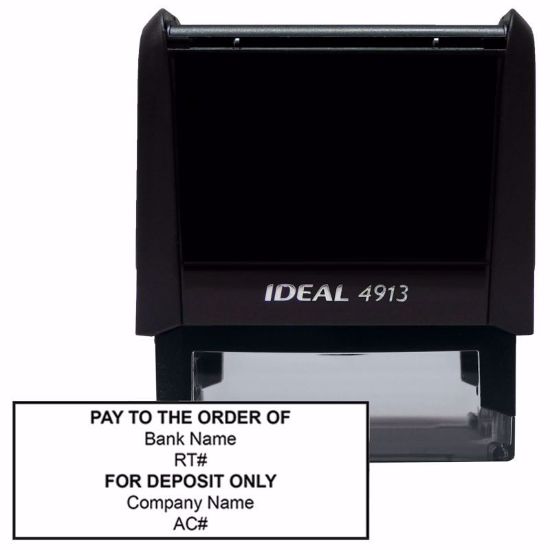
Checkomatic offers custom self-inking endorsement stamps built specifically for business check deposits. You choose the information to include, the stamp applies it cleanly every time. For businesses processing batches of checks regularly, see also check accessories including ink pads and replacement parts.
Learn the full process for putting your stamp to work: How to Use an Endorsement Stamp.
What Happens to Funds After You Endorse and Deposit a Business Check?
After you deposit a check, the bank does not release the funds instantly. Federal Regulation CC (Reg CC) sets the rules for funds availability.
How Long Does It Take for a Business Check to Clear?
For most business checks, banks must make the first $225 available by the next business day. The remaining funds are typically available within two business days for local checks and up to five business days for non-local checks.
What Is an Extended Hold and When Can a Bank Apply One?
Under Reg CC, banks can apply extended holds in certain situations, including:
- Deposits exceeding $6,725 in a single day (the threshold above which banks can extend availability)
- Checks from new accounts (accounts open less than 30 days)
- Repeatedly overdrawn accounts
- Checks where the bank has reason to suspect fraud or doubt collectibility
- Emergency conditions (such as computer system failures)
If a hold is placed, your bank must give you written notice stating the reason for the hold and when the funds will be available. Keep this notice for your records.
For more on deposit methods and how holds work, see How to Deposit a Business Check.
What Happens If the Bank Rejects a Business Check Endorsement?
A rejected endorsement is frustrating, but it is fixable. Here is how to handle it depending on the situation.
The Bank Returned the Check Because the Endorsement Is Incorrect
If there is still room in the endorsement area, add the missing information (such as the correct business name or "For Deposit Only") below your original endorsement and re-present the check. Make sure any addition is clearly written and does not overlap with the MICR line.
The Endorsement Area Is Already Full
If the endorsement area is full and you cannot add anything readable, do not try to write on other parts of the check. Instead, contact the check issuer and request a new check. Mark the original as void to prevent it from being used. This is the safest approach when the endorsement area is unusable.
The Bank Rejected the Check Because Names Do Not Match
If the business name on the check does not match your account name and the bank rejected it, use the double-sign method (see the misspelled name section above) and re-present. If the bank still rejects it, ask the issuer to reissue the check with the correct payee name.
The Check Is Too Old
Checks older than 6 months are typically considered stale-dated. Banks are not required to honor them. Contact the issuer and ask for a replacement check.
How Do You Endorse a Business Check: A Quick Reference Summary
Use this reference for your most common endorsement scenarios:
| Situation | What to Write / Stamp | Notes |
|---|---|---|
| Standard in-person deposit | For Deposit Only + Business Name + Account Number + Signature | Restrictive endorsement; most secure option |
| Mobile deposit | For Mobile Deposit Only + Business Name + Signature | Keep check 30-60 days after confirmation |
| DBA name mismatch | DBA Name (as on check) + Legal Business Name + For Deposit Only | UCC §3-204(d) allows both names; confirm with bank |
| Misspelled business name | Misspelled name first + Correct name below | Double-sign technique; bank may request proof |
| Two payees with "and" | Both parties must sign | One signature is not enough |
| Two payees with "or" | Either party may sign | Only one endorsement needed |
| High-volume batch deposit | Self-inking endorsement stamp | Most consistent, fastest method for multiple checks |
How Can a Business Streamline the Check Endorsement Process?
For businesses that deposit checks regularly, consistency is more than a convenience. Inconsistent endorsements are one of the leading causes of deposit delays and bank holds. A simple process reduces errors and keeps cash flow moving.
What Is the Best Way for a Business to Endorse Multiple Checks Quickly?
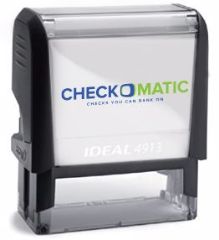
The most efficient approach for batch deposits is a self-inking endorsement stamp. Rather than handwriting your business name, account number, and "For Deposit Only" on every check, the stamp applies all of that information in a single press. A batch of 20 or 50 checks can be processed in minutes.
The stamp also creates a consistent impression that is easier for bank processing systems to read compared to varying handwriting styles from different employees.
What Information Should Be on a Business Endorsement Stamp?
A complete business endorsement stamp typically includes:
- The phrase "For Deposit Only" at the top
- Your business legal name as it appears on your bank account
- Your bank account number
- Optionally, your bank name and routing number
Checkomatic's endorsement stamps are fully customizable, so you include exactly the information your bank requires. Learn how to get your stamp set up correctly: How to Use an Endorsement Stamp.
What Are the Legal Rules Behind Business Check Endorsements?
Understanding the legal framework helps when you encounter unusual situations or disputes.
Business check endorsements are governed by Article 3 of the Uniform Commercial Code (UCC), which has been adopted in some form by all 50 U.S. states. Key provisions include:
- UCC §3-204(d): Allows a payee to endorse using the name shown on the instrument, the payee's legal name, or both. This protects businesses that receive checks made out to DBA names or slightly incorrect versions of their legal name.
- UCC §3-206: Defines what a restrictive endorsement (such as "For Deposit Only") means and limits negotiation of the check accordingly.
- Federal Regulation CC (Reg CC): Governs funds availability timelines after deposit. Banks must follow Reg CC rules on when to make deposited funds available, with the $6,725 threshold determining when extended holds can be applied.
For specific legal questions about check endorsement in your state or situation, consult a business attorney or your bank's compliance department.
What Should You Know About Check Endorsement Fraud?
Check fraud continues to be a significant issue for small businesses. Awareness of the most common schemes helps you protect your deposits.
What Is Check Washing and How Can Endorsement Protect Against It?
Check washing is a fraud technique where a criminal uses chemicals to remove the ink on a check and rewrite it with a new payee name or amount. The original check structure (including the MICR line and the signature) remains intact, making it appear genuine.
Protecting your business: Use pens with permanent, gel-based ink for anything written on a check. Stamps with fast-drying, bank-grade ink are more resistant to washing than standard ballpoint pen ink. A restrictive endorsement does not prevent check washing, but it limits what a fraudster can do with a washed check if it already has "For Deposit Only" stamped on the back.
If you suspect a check you received has been altered, do not deposit it. Contact your bank and the issuer immediately.
How Does Blank Endorsement Create Fraud Risk?
A check with only a signature on the back is essentially cash. Anyone who has access to that check can present it for payment. For business checks representing significant amounts, this risk is substantial. Always use a restrictive endorsement for business deposits.
Frequently Asked Questions
Does a business check need to be endorsed for deposit?
What happens if I forget to endorse a business check?
Can an LLC endorse a check without a signature?
Can I deposit a business check in an ATM without endorsing it?
What if the check is made out to my business but I have a personal account?
Do I need to include my account number on the endorsement?
How long is a business check valid before it becomes stale-dated?
Can two different people endorse the same business check?
Is an endorsement stamp legally binding for a business check?
Accepted by the world’s leading banks