-
 Contact Us
-
 Re order
-
 Log in
-
 Cart 0
You have no items in your shopping cart.
Paid in Full on a Check: What It Means and What to Do
You open the mail and find a check for less than the invoice, with the words "paid in full" written on it. Or you are the one about to write those words on a check you send. Either way, a few ink strokes on a small slip of paper may decide whether a debt is over.
This guide explains what the phrase means, when it can settle a bill, and when it is just a label. It covers what happens to the payer, the payee and a business that receives such a check, what to write on the memo line, and what to do if you cashed one by mistake.
Quick Summary
Paid in full on a check is a note that the sender offers this payment as the end of the matter. It does not always work. Under the model Uniform Commercial Code (UCC), it can end a claim only when the amount is genuinely disputed, the offer is made in good faith, the statement is easy to notice and the payee cashes the check.
Key points
- The words are an offer, not a receipt. A note on a check does not prove the full amount was paid.
- A real dispute is required. UCC 3-311 covers claims that are unliquidated or in bona fide dispute.
- Cashing the check can end the claim. That applies when the conditions are met, so read before you deposit.
- There is a second chance. The model text lets a payee repay within 90 days, with exceptions. See how to deposit a business check.
- States differ. New York, Oregon and Florida handle this differently from the model text.
- Put it in writing. A signed letter is clearer than a memo line alone.
| Who you are | What the words can do | Safest next step |
|---|---|---|
| Payer with a real dispute | May end the claim if the payee cashes the check | Send a signed letter with the check |
| Payer with no dispute | Unlikely to reduce what you owe | Pay the full bill and get a receipt |
| Payee, small business | Cashing may accept the offer | Pause before depositing |
| Payee, large organization | May be protected by a designated office | Route these checks to one person |
Table 1. How the words affect each side under the model UCC. This is general information, not legal advice.
Paying many invoices? Contact Checkomatic and our staff will match a check layout to your payables.
Jump to a section
- What does paid in full on a check mean?
- Does cashing a paid in full check settle the debt?
- What happens to the payer, the payee and a business?
- Do all states treat these checks the same way?
- What should you write on the memo line?
- What if you cashed one by mistake?
- How should a business record these checks?
- Frequently asked questions
What Does Paid in Full on a Check Mean?
It means the sender is offering the check as the final payment of a bill or claim. What counts is the situation behind the words and how the notice is made.
Is paid in full a legal term?
Not exactly. The law talks about a check "tendered as full satisfaction" of a claim, and lawyers call the result accord and satisfaction. That means two sides agree to settle an existing obligation in a different way, and the old obligation ends once the new one is carried out, as Cornell's Legal Information Institute describes it.
Does it prove the whole amount was paid?
No. If you need proof that a bill is closed, ask for a written receipt or payoff letter and keep your canceled check. The CFPB advises keeping records such as canceled checks when a debt is in question.
Does Cashing a Paid in Full Check Settle the Debt?
It can, but only when several conditions are met together. UCC 3-311 sets them out, and the payer has to prove them. If one is missing, the payee usually keeps the right to collect the rest.
| Condition | Plain English | Who must show it |
|---|---|---|
| Good faith tender (3-311(a)) | The payer was honest and dealt fairly | The payer |
| Disputed or unliquidated claim (3-311(a)) | The amount was genuinely in question | The payer |
| Payee obtained payment (3-311(a)) | The check was actually cashed or deposited | The payer |
| Conspicuous statement (3-311(b)) | The check or letter clearly says it is full satisfaction | The payer |
Table 2. The model UCC 3-311 conditions in plain words. Source: UCC 3-311 as published by Cornell's Legal Information Institute.
What counts as a bona fide dispute?
The statute text we read does not define the phrase, so a court decides each case. A typical example is a bill where the buyer says goods arrived damaged or work was incomplete. Wisconsin's Department of Financial Institutions explains that an undisputed, fixed debt is not settled by accepting a smaller payment.
What makes the statement conspicuous?
The UCC defines conspicuous as written or displayed so a reasonable person should notice it, and a court makes that call. Its examples include a heading in capital letters, contrasting type or color, and larger type. A tiny note squeezed into the memo line may not qualify.
What does good faith mean here?
UCC 1-201 defines good faith as honesty in fact and fair dealing under reasonable commercial standards. A payer who invents a dispute to pay less is not acting that way.
What Happens to the Payer, the Payee and a Business That Receives a Paid in Full Check?
Each side has a different job and a different risk. The payer must have met every condition. The payee must decide before depositing. A business that gets many checks needs a routine so the wrong person does not accept an offer by accident.
What happens to the payer?
If the conditions are met and the payee cashes the check, the claim is discharged and the payer owes nothing more on it. If they are not met, the payer may still owe the balance. The payer also carries the burden of proof, so keep copies of the check, the letter and the invoice trail.
What happens to the payee?
A payee who cashes the check may give up the rest of the claim. Words written beside the signature are not a safe fix either, so read about endorsing a check first.
The reason is UCC 1-308. It lets a party preserve rights by writing "without prejudice" or "under protest", but it says that rule does not apply to an accord and satisfaction. UCC 3-311 itself has no such wording either.
What if the payee is a business or other organization?
An organization has extra protection under UCC 3-311. If it sent a conspicuous statement, within a reasonable time before the payment, naming a person, office or place for disputed-debt communications, and the check did not arrive there, it keeps its claim. Even then, the claim can still be discharged if the person with direct responsibility for the debt knew the check was offered as full satisfaction.
| Role | Main risk | Main protection |
|---|---|---|
| Payer | Failing to prove a real dispute or a clear statement | A signed letter and a paper trail |
| Payee | Cashing the check and losing the balance | Pausing, then calling or writing first |
| Organization | A mailroom deposit that accepts an offer | A designated office notice and one reviewer |
Table 3. Risk and protection by role under the model UCC. Details depend on your state.
Do All States Treat These Checks the Same Way?
No. The UCC is a model law, and each state passes its own version. Before you rely on a notation, check your own state with your bank or a lawyer.
- New York. The state's official UCC listing shows no section 3-311, and a bar journal article says the state did not adopt the revisions that added it.
- Oregon. The 2025 edition of ORS 73.0311 turns on the payee agreeing in writing to take the amount as full payment.
- Florida. Florida Statutes 725.05 lets parties settle a debt by a written instrument, other than by an endorsement on a check for less than the full amount.
- Ohio, Washington, D.C. and Louisiana. Their codes carry the core phrases of the model text, including good faith, bona fide dispute and 90 days.
We did not review every state, so treat this list as examples. Whatever your state says, you control the way you issue the check. For tidy issuing habits on your side, read how to write a business check step by step.
What Should You Write on the Memo Line, and Why Is a Letter Stronger?
Use the memo line for a short reference such as an invoice number, and put the real settlement terms in a signed letter. The memo line is small and easy to miss. A letter has room to explain the dispute and can make the statement stand out.
What do you write if you really are settling a dispute?
Write a brief note on the check and repeat it in the letter. UCC 3-311 allows the statement to be on the instrument or in an accompanying written communication, so both places help. A plain version is "Full settlement of disputed invoice" plus the invoice number.
- Name the invoice or account. Use the number so nobody has to guess.
- Say what is disputed. Describe the problem in one or two plain sentences.
- State the amount enclosed. Match the number on the check.
- Say it is offered as full satisfaction. Use a heading or bold type so it is easy to notice.
- Sign and date it. Keep a copy of the letter and the check.
- Send it where the creditor asked. If the creditor named an office for disputes, use that address.
What do you write when you simply owe the whole bill?
Write the invoice or account number and nothing that sounds like a negotiation. The words "paid in full" on a check for the full amount are usually just a label, so also ask for a receipt. If a debt collector is involved, the CFPB advises getting any settlement plan and the collector's promises in writing before you pay, in guidance last reviewed in October 2026.
What Should You Do if You Cashed a Paid in Full Check by Mistake?
Act quickly and put your response in writing. The model UCC lets most claimants keep a claim by repaying the amount of the check within 90 days after it is paid, though not every payee qualifies and states may differ. Treat that date as a deadline and ask a lawyer about your state.
- Note the date. Write down when the check was deposited and when it was paid.
- Read what came with it. Look for a letter, an invoice note or a statement on the front or back.
- Ask whether the claim was really in dispute. If the bill was never disputed, the notation may not have worked.
- Decide whether to repay. Repayment must be an offer of the amount of the check within the 90-day window.
- Write to the payer. Explain that you did not accept the offer, and keep proof of what you sent.
- Get advice on big amounts. A lawyer can check your state's version of the rule.
The 90-day route does not help an organization that already sent a proper designated-office statement, because that organization has its own protection. The clock runs from when the check is paid, so it helps to know how long a check takes to clear.
What if the payer wants to pull the check back?
That is a separate question about stopping payment. Read how to stop payment on a check for how it works. If the check fails to clear, see the bounced check guide.
How Should a Business Record a Paid in Full Check?
Log it the day it arrives or goes out, and file the paperwork with it. Good records show what was disputed, what was offered and when.
- Record the dispute. Add a note to the check register that the payment was a settlement offer.
- Copy both sides. Keep an image of the front and back of the check.
- File the letter. Store it with the invoice and any emails.
- Flag the account. Mark the invoice as disputed, not closed, until the matter is resolved.
- Appoint one reviewer. Send these checks to one person before they go to the bank.
Checks built for clear payables
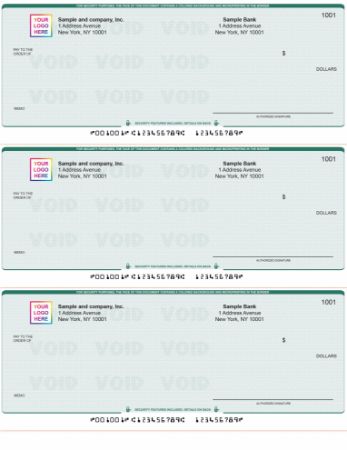
Memo line you can use. Each check has a memo line for the invoice number or a short note. See business checks.
Room for a record. Stub layouts give space to log why you paid.
A proof first. Review a digital proof before the order is made.
Ask first. Tell us how you pay vendors and we will point you to a fitting style.
About the Author
Prepared by the Checkomatic staff for readers who send and receive business checks, this article draws on UCC 3-311, 1-201, 1-308 and 3-104 as published by Cornell's Legal Information Institute, the institute's entries on accord and satisfaction and payment in full, CFPB guidance on debt collectors, and the published codes of New York, Oregon, Florida, Ohio, Washington, D.C. and Louisiana.
General information only, not legal advice. Each state adopts the UCC in its own way and the facts of your case matter, so check with your bank or a lawyer before cashing or sending a check marked paid in full.
Frequently Asked Questions
Can I cash a paid in full check and still ask for the rest?
Does crossing out the words paid in full cancel them?
Is a memo line note enough to settle a debt?
What does UCC 3-311 add to the rules about cashing checks?
Do I need a lawyer if I get a paid in full check?
Can a debt collector accept a paid in full check?
What if the check goes to the wrong office?
How do I prove a bill is closed?
Can I send paid in full checks for rent or medical bills?
Where should a business log a settlement check?
Accepted by the world’s leading banks