-
 Contact Us
 -
 Re order
 -
 Log in
 -
 Cart 0
 You have no items in your shopping cart.
What Is a Cashier's Check and How Does It Work?
Last updated: 14 October 2026
A cashier's check is the one payment instrument where the bank, not you, is on the hook for the money. That single difference changes who guarantees the payment, how fast the funds have to be released, and what happens when the check is lost or turns out to be counterfeit.
Quick Summary
A cashier's check is a check that a bank draws on itself. Under the Uniform Commercial Code, the drawer and the drawee are the same bank, so the bank pays from its own funds rather than from a customer's account. The buyer hands over the money up front, and the bank's own credit stands behind the payment.
Key points
- The bank is the payer. UCC 3-104(g) defines a cashier's check as one where the drawer and drawee are the same bank or branches of the same bank.
- Funds move before the check exists. The bank collects the money from you first, which is why the instrument carries the bank's guarantee.
- Next-day availability has three conditions. Regulation CC requires it to be deposited into a payee's account, in person to a bank employee, and with a special deposit slip if the bank asks for one.
- Available is not the same as verified. Released funds can still be clawed back weeks later if the check proves counterfeit.
- Losing one means a 90 day wait. UCC 3-312 makes a claim on a lost cashier's check enforceable only at the later of the day you assert it or the ninetieth day after the check's date.
| Question | Short answer |
|---|---|
| Who pays? | The issuing bank, from its own funds |
| Who signs it? | A bank employee, not the buyer |
| When are funds available? | Next business day when the three Regulation CC conditions are met, otherwise the second business day |
| Does it expire? | No fixed lapse date, but uncollected funds pass to the state under unclaimed property law |
| If it is lost? | Declaration of loss, then a 90 day wait under UCC 3-312 |
| Can it be faked? | Yes, and counterfeits are common enough that the FTC warns about them directly |
On this page
- What is a cashier's check in simple terms?
- How does a cashier's check work step by step?
- How do you get a cashier's check?
- When should you use a cashier's check?
- Cashier's check vs certified check vs money order
- How long does a cashier's check take to clear?
- Do cashier's checks expire?
- What happens if you lose a cashier's check?
- Can a bank refuse to pay a cashier's check?
- How can you tell if a cashier's check is fake?
- How do businesses use cashier's checks compared with company checks?
What Is a Cashier's Check in Simple Terms?
A cashier's check is a check written by a bank against its own account, payable to whoever you name. You pay the bank the full amount first, the bank moves that money into its own funds, and a bank officer signs the check. The recipient is relying on the bank's promise to pay rather than on yours.
That is the whole reason the instrument exists. A personal check is an instruction to your bank to pay if the money is there. A cashier's check removes the "if" by moving the obligation onto the bank before the check ever changes hands.
What Does UCC 3-104(g) Actually Say?
The Uniform Commercial Code defines a cashier's check as a check with respect to which the drawer and the drawee are the same bank, or branches of the same bank. In plain terms, the bank is writing the check and the bank is also the one who has to honor it.
This matters more than it sounds. Because the bank occupies both roles, there is no third party whose account could be short. The check is a direct obligation of the institution whose name is printed on it.
Who Signs a Cashier's Check?
A bank employee signs it, usually a teller or a branch officer with signing authority. Your name may appear on the check as the remitter, which records who bought it, but your signature is not what makes it good. Many banks require two signatures above a certain amount as an internal control.
How Does a Cashier's Check Work Step by Step?
The sequence is short, and every step exists to move the risk off the recipient and onto the bank. Here is what happens from request to payment.
- You request the check and name the exact payee. The bank will not issue a cashier's check made out to "cash" in most cases, because that would defeat the traceability the instrument is meant to provide.
- The bank takes the money. It debits your account or accepts cash, and the funds leave your control at that moment.
- The bank issues the check drawn on itself, signed by an employee, usually printed on security stock with features that make alteration obvious.
- You hand it to the payee, who deposits or cashes it.
- The payee's bank collects from the issuing bank through the normal clearing system.
The important consequence of step two is that the money is gone from your account immediately. If the deal falls through, you cannot simply stop payment the way you could on a personal check. You have to take the check back to the issuing bank and ask them to cancel and refund it.
How Do You Get a Cashier's Check?
You get one by visiting a branch of a bank or credit union where you hold an account, with the money available and the payee's exact name ready. Most institutions will not issue one over the phone, and the request has to be made by someone authorized on the account.
What Do You Need to Bring?
- Government-issued photo identification. The bank is putting its own name on the payment, so it verifies who is buying it.
- The exact payee name. Spelling errors are a common reason a recipient's bank rejects the check, and corrections usually mean reissuing it.
- Cleared funds in your account, or cash. Money that is still on hold will not usually be accepted as the source.
- The amount in writing if it is large, since some branches require a written request above internal thresholds.
Can You Get One Without an Account at That Bank?
Usually not. Most banks issue cashier's checks only to existing customers, because the institution has to collect and verify the money before it guarantees the payment. Some branches will sell one to a non-customer paying in cash, but that is a branch-level decision, not something you should plan around.
Can You Get a Cashier's Check Online?
Some banks let you order one through online banking and then mail it, which adds days to the timeline and introduces the risk of the check being intercepted. If the payment is time-sensitive, collecting it in branch remains the predictable route.
When Should You Use a Cashier's Check?
Use a cashier's check when the recipient needs certainty that the money is real and the amount is too large for the other party to accept a personal check. Property closings, vehicle purchases from private sellers, and court or escrow payments are the usual cases.
| Situation | Why a cashier's check fits | Worth considering instead |
|---|---|---|
| Private vehicle sale | Seller will not release the title on a personal check | Meeting at the buyer's bank to collect it together |
| Real estate closing | Settlement agents commonly require guaranteed funds | Wire transfer, where the closing agent prefers it |
| Security deposit on a lease | Landlord wants funds that will not be reversed | A regular personal check where the landlord accepts one |
| Paying a court or government body | Many will not accept personal checks at all | Money order for smaller amounts |
| Routine supplier payment | Rarely necessary | A printed business check from your own account |
Cashier's Check vs Certified Check vs Money Order: What Is the Difference?
The three instruments differ in who is legally obligated to pay. On a cashier's check the bank is both drawer and drawee. On a certified check the customer remains the drawer and the bank has accepted the check. A money order is prepaid and issued by a provider, typically with a lower maximum amount.
| Feature | Cashier's check | Certified check | Money order |
|---|---|---|---|
| Who is the drawer | The bank | The account holder | The issuing provider |
| Who is the drawee | The same bank | The bank that accepted it | The issuing provider |
| Source of funds | Bank's own funds | Customer account, earmarked | Prepaid by the buyer |
| Governing UCC section | 3-104(g) | 3-409(d), with the bank obligated under 3-413 | Not a UCC bank instrument |
| Typical use | Large, trust-sensitive payments | Large payments where the payer's identity matters | Smaller everyday payments |
There is a fourth instrument people run into and rarely recognize. A teller's check, defined at UCC 3-104(h), is a draft drawn by a bank on another bank, or payable at or through a bank. It behaves much like a cashier's check from the recipient's point of view.
For the full breakdown of certification, read our certified check guide, and for prepaid instruments see the money order guide. A wider glossary sits on our types of checks page.
How Long Does a Cashier's Check Take to Clear?
Regulation CC generally requires a bank to make the funds from a cashier's check available by the business day after the banking day of deposit. That fast availability is the reason the instrument is useful, and it is also the reason counterfeit versions are attractive to fraudsters.
What Are the Three Conditions for Next-Business-Day Availability?
This is the part most explanations leave out. Next-day availability under 12 CFR 229.10(c)(1)(v) is not automatic. The deposit has to meet all three of these conditions at once.
- It is deposited into an account held by a payee of the check. Depositing into an account where you are not the named payee does not qualify.
- It is deposited in person to a bank employee. An ATM or mobile deposit does not satisfy this condition.
- It is accompanied by a special deposit slip, if the bank requires one. Where a bank imposes that requirement, it must either supply the slip or tell customers how to get or prepare one, and keep it reasonably available.
What Happens If You Do Not Deposit It in Person?
If the deposit otherwise qualifies but is not made in person to an employee, the regulation allows the bank to make the funds available by the second business day after deposit instead. So a mobile deposit of a cashier's check can legitimately take an extra day.
Separately, availability rules and verification are two different things. The money being released on schedule tells you nothing about whether the check is genuine. Our guide on how long a check takes to clear covers the wider timelines.
Do Cashier's Checks Expire?
A cashier's check does not go stale on a fixed schedule the way a personal check does, because it is a direct obligation of the issuing bank rather than an instruction against a customer account. Banks do not simply stop owing the money after a set number of months.
What does happen is that funds left uncollected long enough are reported and turned over to the state under unclaimed property law. At that point the payee claims the money from the state rather than the bank. The practical advice is simple: deposit a cashier's check promptly, because tracing an old one is slow even though the money still exists.
What Happens If You Lose a Cashier's Check?
You file a declaration of loss with the issuing bank and then wait. Because the bank's own credit is behind the check, it cannot simply reissue on request without exposing itself to paying twice if the original surfaces in the hands of an innocent holder.
What Is a Declaration of Loss?
UCC 3-312 defines it as a statement made in a record under penalty of perjury. Delivering it also warrants that what it says is true. The declaration has to establish four things.
- You lost possession of the check, rather than still holding it somewhere.
- You are the remitter or the payee on a cashier's check, or the drawer or payee on a certified check.
- The loss was not a transfer by you and did not result from a lawful seizure.
- You cannot reasonably get the check back, because it was destroyed, its whereabouts are unknown, or it is held by someone unknown or who cannot be found or served.
Why Do You Have to Wait 90 Days?
Under UCC 3-312 the claim becomes enforceable at the later of two moments: when you assert it, or the ninetieth day after the date of the cashier's check. Until the claim is enforceable it has no legal effect, and the bank may still pay the check to someone presenting it.
Once the claim is enforceable and nobody entitled to enforce the check has been paid, the bank must pay the claimant. That is the point at which you get your money or a replacement.
What If Someone Else Cashes It After the Bank Pays You?
This is the risk the waiting period exists to manage. If a holder in due course presents the check after the bank has already paid your claim, you have to make the bank whole. Either you refund the bank if it pays the check, or you pay the holder in due course if the check is dishonored. The obligation follows you, not the bank.
Can a Bank Refuse to Pay a Cashier's Check?
A bank can refuse, but wrongful refusal carries consequences. UCC 3-411 entitles the person asserting the right to enforce the check to compensation for expenses and loss of interest caused by the nonpayment. Consequential damages are available too, but only where the bank refused after being told the particular circumstances that would cause those losses.
The bank keeps four defenses. Expenses and consequential damages are not recoverable where the refusal results from the bank's suspension of payments, from a claim or defense the bank reasonably believes is available against the person enforcing the check, from a reasonable doubt about whether the person demanding payment is entitled to enforce it, or from a legal prohibition on paying.
How Can You Tell If a Cashier's Check Is Fake?
You verify it by calling the issuing bank on a number you look up independently, never a number printed on the check itself. Counterfeit cashier's checks are convincing precisely because the format is standardized and the bank's name carries authority.
Why Does "The Funds Showed Up" Not Mean It Cleared?
Because availability and verification run on different clocks. The Federal Trade Commission's position is blunt: even when you see the money in your account, the bank can still take it back if the check later bounces, and it can take weeks to uncover a fake. Banks have to release funds quickly, while detecting a forgery depends on the check working its way back to the institution it claims to be drawn on.
The loss lands on the depositor. When the check ultimately bounces, the bank takes back the amount, which is how people end up negative after forwarding money they thought had cleared.
What Are the Most Common Cashier's Check Scams?
FTC reporting data shows the pattern clearly. In 2019 people reported more than 27,000 fake check scams, with reported losses topping 28 million dollars, and the median individual loss was 1,988 dollars against 320 dollars across all fraud types. Reports to the FTC rose from 14,017 in 2015 to 23,064 in 2019.
- Overpayment on an item you sold. The buyer sends a check for more than the price and asks you to refund the difference. Around 18 percent of 2019 reports involved a check received as payment for something sold online.
- Fake job or mystery shopping offers. About half of people reporting these scams said they had been offered a job or another way to earn money, and nearly half of those involved fake mystery shopping work.
- Urgency to forward funds. Any request to deposit a check and quickly send part of it onward is the defining signal, whatever story surrounds it.
People in their twenties were more than twice as likely as people aged 30 and over to report losing money to a fake check scam. If you handle payments for a business, our check fraud prevention guide covers the controls worth putting in place, and high security checks explains the features that make alteration harder to hide.
How Do Businesses Use Cashier's Checks Compared With Company Checks?
Most businesses use cashier's checks rarely and company checks constantly. A cashier's check means a trip to the branch and the money leaving the account immediately, which makes it unsuitable for payroll, suppliers, or anything on a schedule.
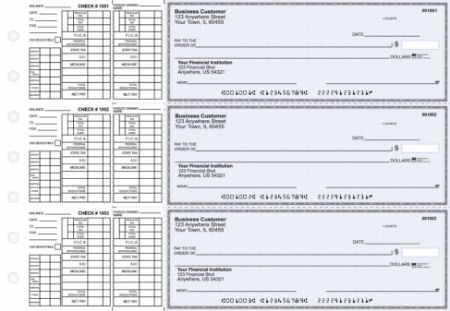
Printed company checks handle the routine work. They keep the payment on your own account, leave a stub or voucher for your records, and carry security features on the stock itself. A cashier's check earns its place only where the other side genuinely will not proceed without bank-guaranteed funds.
If you are setting up or reordering, our business checks range covers manual and computer formats, and blank check stock suits teams printing from accounting software. Before you deposit anything a customer hands you, it is worth knowing how to endorse a check correctly and how to cash a check without delays.
What to Do Next
If you needed a cashier's check for a one-off purchase, the work is done once you have confirmed the payee name and collected it in branch. If you found this page because your business keeps reaching for guaranteed funds, the better fix is usually a proper check supply on your own account.
Browse business checks for manual and computer formats, or start with types of checks if you are still deciding which format suits how you pay.
About the Author
This guide was produced by the Checkomatic content team, who work with business check printing, check security features, and payment formats every day. The legal points are drawn from the Uniform Commercial Code and Regulation CC, and the fraud data comes from Federal Trade Commission reporting.
This article is general information about payment instruments and is not legal or financial advice. Rules can vary by state and by bank, so confirm specifics with your own bank or adviser.
Frequently Asked Questions
Is a cashier's check the same as a certified check?
Can you get a cashier's check without a bank account?
How long does a cashier's check take to clear?
Do cashier's checks expire?
What happens if you lose a cashier's check?
Can a bank refuse to pay a cashier's check?
Does money appearing in your account mean a cashier's check is genuine?
Accepted by the world’s leading banks