What a Counter Check Is
A counter check is a temporary check printed on demand by a bank teller at a branch counter. The name refers to the bank counter where a teller serves customers in person. When an account holder needs to write a check immediately but does not have any personalized checks available, their bank may be able to print a counter check for them on the spot.
Counter checks are printed with the account holder's bank routing number and account number encoded in the MICR line at the bottom of the check. However, they are typically not pre-printed with the account holder's name, address, or other personalized identifying information that appears on a standard personalized check. The account holder writes all of this information in by hand when completing the check.
Counter checks are sometimes called temporary checks or demand checks. They are a valid negotiable instrument under UCC Article 3 and clear through the US banking system the same way personalized checks do. For a complete overview of the different types of checks used in US banking and their legal definitions, see types of checks: every check type and term explained.
How a Counter Check Works
A counter check functions as a payment instrument the same way any personal or business check does. The payer fills in the payee name, payment amount in numbers and words, date, and memo. The payer signs the check. The payee deposits it at their bank, which presents it to the payer's bank through the check clearing system. The payer's bank verifies the account and releases the funds.
The key technical element is the MICR line. Counter checks have the bank's routing number and the account holder's account number encoded in the MICR line at the bottom, in the same magnetic ink format that bank automated processing systems read. This is what allows a counter check to clear through standard bank processing alongside personalized checks. For the complete guide to what the MICR line contains and how bank processing reads it, see MICR line explained: the technology behind every check.
How to Get a Counter Check at Your Bank
Counter checks are available at bank and credit union branches that offer this service. Not all banks offer them. Availability depends on your specific bank's policies. The process at institutions that do offer counter checks is typically as follows:
- Visit your bank or credit union branch in person. Counter checks are generally not available through online banking, mobile banking, or ATMs because they require a teller to print them on demand using the branch's check printing equipment.
- Bring valid government-issued ID and your account information. The teller will verify your identity and access your account to retrieve your routing and account numbers for printing.
- Specify how many counter checks you need. Most institutions that offer counter checks will print a small number per request, often three to five, though policies vary.
- Pay any applicable fee. Counter check fees vary by institution and are discussed in the section below.
Because counter check availability varies by bank and by branch, it is worth calling your branch before visiting specifically for counter checks, to confirm they are available and to understand the current fee and quantity limit.
Counter Check Fees: What to Expect
Counter check fees are not standardized across US financial institutions. They vary by bank and credit union, and published fee schedules from US institutions show a wide range. The information below reflects fees published in institutional fee schedules; always verify current fees directly with your bank, as pricing changes.
Published Fee Examples From US Institutions
- Some institutions charge per check (for example, $1 to $2 per individual check), while others charge per sheet (for example, $2 to $3 per sheet of three checks).
- Some credit unions and banks provide a small initial batch of counter checks at no charge, particularly at new account opening, before moving to per-check fees for subsequent requests.
- Some institutions, including some large national banks, do not offer counter checks at all.
- Fee schedules reviewed from US credit unions as of 2025 show counter check fees ranging from $1 per check to $5 per sheet, depending on the institution.
Counter Check vs Starter Check: What Is the Difference
Counter checks and starter checks are related concepts that are sometimes used interchangeably, but they are not the same thing.
| Factor | Counter Check | Starter Check |
|---|---|---|
| When issued | Any time on demand when account holder runs out of personalized checks | When a new checking account is opened, before personalized check order arrives |
| Name pre-printed | Typically no | Often yes, or at least partially |
| Account holder | Existing account holder who has run out of checks | New account holder waiting for first check order |
| MICR line | Routing number and account number | Routing number and account number |
| Fee | Often charged per check or per sheet | Often provided at no charge for a small initial supply |
| Intended use | Emergency bridge payment | Temporary bridge until personalized checks arrive |
Both are temporary solutions designed to bridge a gap. Neither is a long-term substitute for personalized check stock. For the complete glossary of check types and terminology, see check types and terminology: complete glossary guide.
Counter Check vs Personal Check
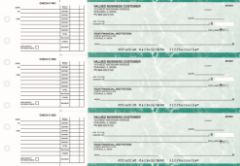
Personalized business checks from Checkomatic , pre-printed with your business name, address, and complete security features, in contrast to a counter check's minimal pre-printed information.
| Factor | Counter Check | Personalized Check |
|---|---|---|
| Pre-printed name | Typically no | ✅ Yes |
| Pre-printed address | Typically no | ✅ Yes |
| MICR routing and account | ✅ Yes | ✅ Yes |
| Sequential check number | Often no (may be written by hand or blank) | ✅ Yes |
| Security features | Varies by institution , often minimal | Full set: chemical-reactive paper, microprint, void pantograph, heat-sensitive ink, MICR encoding |
| Where obtained | Bank branch teller on demand | Ordered from check printer, delivered by mail |
| Legal validity | ✅ Valid under UCC Article 3 | ✅ Valid under UCC Article 3 |
| Cost | Per check or per sheet fee at branch; varies by institution | Per check cost decreases significantly with volume orders |
Counter Check vs Certified Check vs Cashier's Check
Counter checks, certified checks, and cashier's checks are all bank-related check instruments, but they serve very different purposes and carry very different payment guarantees.
Counter Check
A counter check is a personal check drawn on the account holder's checking account, issued as a temporary convenience. Payment depends on whether the account holder has sufficient funds when the check is presented. A counter check carries no payment guarantee beyond what any personal check carries. The bank does not verify or guarantee the funds at the time of issuance.
Certified Check
A certified check is a personal check on which the bank has verified that sufficient funds exist in the account and has set those funds aside to guarantee payment. The bank stamps or marks the check as certified. The account holder's own account is debited for the amount at the time of certification, not at the time the check clears. Certified checks carry a bank fee and are used for transactions where the payee needs assurance of funds before completing the transaction.
Cashier's Check
A cashier's check is drawn on the bank's own funds rather than the individual account holder's funds. The account holder pays the bank the face amount plus any fee, the bank deducts from its own account, and issues a check signed by the bank itself as the drawer. Cashier's checks carry the highest level of payment certainty of the three because the bank itself is obligated to pay, not the individual account holder. They are commonly required for large transactions such as real estate closings, vehicle purchases, and similar high-value payments.
For a complete guide to the types of checks used in different banking and payment situations, see types of checks: every check type and term explained.
Security Features on Counter Checks
The security features on a counter check depend on the check paper and printing equipment used by the specific bank branch. This varies by institution and is not standardized across US banking.
Personalized checks ordered from a certified check printer include a defined set of security features: chemical-reactive paper that stains visibly if altered with solvents, microprinting on the signature line that blurs on photocopies, a void pantograph that makes VOID appear when the check is copied, heat-sensitive ink, and ANSI E13-B certified MICR encoding. These features are built into the check stock at the printing stage.
Counter checks printed on demand at a bank branch may or may not include these features depending on the paper the branch uses. Most branches use pre-printed counter check paper with some basic security elements, but the specific features, their quality, and their consistency are not uniform across institutions. If you are accepting a counter check from someone else and have concerns about security, you can ask your bank about their verification process for checks with minimal pre-printed information.
For the complete guide to which security features matter most in personalized check stock, see are business checks safe: security features that actually matter.
Will Payees Accept a Counter Check?
A counter check is a legal negotiable instrument under UCC Article 3. There is no law that prevents a payee from accepting one. Whether a specific payee accepts a counter check is a matter of individual policy, not law.
In practice, acceptance depends on the payee. Some individuals, businesses, and institutions accept counter checks without issue. Others may have policies that require pre-printed identifying information on any check they accept, which a counter check typically does not have. If you are planning to use a counter check for a specific payment, it is worth confirming acceptance with the payee first, particularly for larger amounts or formal transactions.
The absence of pre-printed name and address on a counter check means the payee may ask for additional identification or choose to wait until funds fully clear before completing a transaction. This is a practical consideration, not a legal barrier.
Counter Checks and Direct Deposit Setup
A common reason people ask about counter checks is direct deposit setup. When an employer or a government agency asks for a voided check to set up direct deposit, they need a document showing your bank's routing number and your account number, which appears in the MICR line at the bottom of any check drawn on your account.
A counter check contains your routing number and account number in the MICR line, so it can serve the same function as a voided check for direct deposit setup. You would void the counter check the same way you would void any check: write VOID in large letters across the front and provide it to the party setting up the direct deposit. Alternatively, your bank may be able to provide a bank letter or a direct deposit form that contains the same routing and account information without requiring a physical check.
How Long Is a Counter Check Valid?
A counter check, like any personal check, is subject to the standard stale date rules under UCC Article 3. Banks are not required to honor checks presented more than six months after the date written on the check, and many banks will decline to process stale-dated checks as a matter of policy. Some banks have shorter internal stale date policies. The six-month period is a general banking convention based on UCC Article 3, not a universally mandatory rule, but it is the standard used by most US financial institutions.
If you write a counter check, it should be deposited by the payee within a normal timeframe. If you receive a counter check and do not plan to deposit it immediately, check with your bank about their specific stale date policy before depositing a check that is several months old.
When to Use a Counter Check vs Ordering Personalized Checks
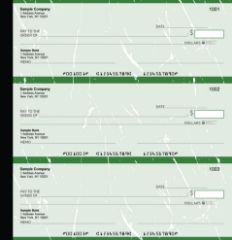
Personalized manual checks from Checkomatic , a ready alternative to counter checks, with your name, address, and security features pre-printed and available to write by hand whenever needed.
When a Counter Check Makes Sense
- You need to make a single urgent payment today and have no other checks available
- Your bank offers counter checks, the payee will accept one, and the fee is acceptable for the situation
- You need a voided check document for direct deposit setup and have no other checks at hand
- You are a new account holder and your initial personalized check order has not yet arrived
When Ordering Personalized Checks Makes More Sense
- You write checks regularly, whether for personal payments, vendor payments, or payroll
- The per-check cost of counter checks at your bank adds up relative to the cost of a personalized check order
- You want your checks to carry your pre-printed name, address, and full security features
- Your bank does not offer counter checks, or limits the quantity per visit
- You want checks that integrate with accounting software like QuickBooks for automatic record-keeping
For the complete guide to choosing the right check type and how to order, see order checks online: personal and business buyer guide. For cost and quantity guidance, see what is the best place to order checks online.
What Customers Say About Checkomatic
All reviews below are published on checkomatic.com and reproduced verbatim. Source: checkomatic.com/quickbooks-starter-pack-product, 4.5 stars from 166 verified reviews.
"Been with them for 15 years. Always reliable, always good quality, good service. What more can you ask for?"
ATV Inc. | ★★★★★ 5/5 | April 5, 2024 | Source: checkomatic.com/quickbooks-starter-pack-product
"First time ordering and I am super impressed with the quality of the checks. No issues with delivery. I will be ordering again!"
TClinton | ★★★★★ 5/5 | April 9, 2025 | Source: checkomatic.com/quickbooks-starter-pack-product
"We use CheckoMatic for all of our check needs! They have great prices and we receive our products in a timely manner!"
CG's Tax Service | ★★★★★ 5/5 | September 18, 2024 | Source: checkomatic.com/quickbooks-starter-pack-product
"I got 500 checks for less than half of what the bank wanted for 200!"
VVA Voucher Checks (Vietnam Veterans of America) | ★★★★★ 5/5 | July 6, 2024 | Source: checkomatic.com/quickbooks-starter-pack-product
"ASJ Wilson Construction has been a client of checkomatic for some years now and they've never disappointed this company. Thank you checkomatic for all that you do."
ASJ Wilson Construction | ★★★★★ 5/5 | June 6, 2024 | Source: checkomatic.com/quickbooks-starter-pack-product
"Affordable and efficient. My go-to business check printer."
Doe | ★★★★★ 5/5 | January 24, 2025 | Source: checkomatic.com/quickbooks-starter-pack-product