Quick Answer: A high security check is a business or personal check printed on specially manufactured paper with six built-in security features. These features prevent the most common types of check fraud: washing, photocopying, counterfeiting, and alteration. High security checks clear at all US banks the same way standard checks do. At Checkomatic, all six security features are included in the base price on every order. Most businesses that write checks regularly should use them.
What Is a High Security Check
A high security check is business or personal check stock manufactured with multiple built-in features that make the check extremely difficult to alter, counterfeit, or use in a fraud scheme.
Standard checks have the basics: your name, address, and account information printed on ABA-compliant paper with a MICR line at the bottom. They clear at any US bank. But standard check paper provides no resistance to the tools criminals use most often: chemical solvents that erase ink, scanners and color printers that reproduce checks, and physical alterations that change the payee name or amount.
A high security check adds six layers of protection directly into the paper and printing process. These features do not affect how the check is used or how it clears at the bank. They only activate when someone attempts fraud.
The term "high security check" is used interchangeably with "security check," "secure check stock," and "fraud-resistant checks." The underlying standard is the same: multiple features that address multiple fraud methods simultaneously.
The Six Security Features in a High Security Check
High security checks include six specific features. Each one targets a different fraud method. Here is what each feature does and why it matters.
1. Chemically Sensitive Paper
The paper reacts permanently when exposed to solvents like acetone, bleach, or lighter fluid. Criminals use these chemicals to erase ink during check washing. When the solvent touches chemically sensitive paper, it leaves a visible, irremovable stain. The attempted fraud becomes visible on the check itself. This is the most important feature for preventing check washing, which costs US businesses over $815 million per year.
2. Microprinting
Text printed at under one point size along the signature line or borders. It looks like a solid line to the naked eye. Under a magnifying glass, it reads as a repeated word or phrase. On any photocopy or scan, the microprinting degrades into an unreadable blur. A bank teller trained to check for microprinting can immediately identify a copy from an original. This feature specifically defeats photocopying and scanning fraud.
3. Void Pantograph
A hidden pattern in the check background that reveals the word VOID when the check is photocopied or scanned. The pattern is invisible on the original check but appears clearly on any reproduction. This feature defeats attempts to reproduce a legitimate check and pass the copy as an original. For more detail on how this works, see our guide to how QuickBooks checks prevent check washing.
4. UV Fluorescent Fibers
Colored fibers embedded in the paper during manufacturing that glow under ultraviolet light. Bank authentication equipment and handheld UV lights used by tellers can verify these fibers instantly. Standard copy paper and most printing substrates do not contain these fibers. Any attempt to reproduce the check on different paper fails the UV check. The fibers cannot be added to paper after manufacturing.
5. Heat-Sensitive Ink (Thermochromic Ink)
Ink printed in a specific area of the check that disappears when rubbed with a finger and reappears when the heat dissipates. This is a simple, instant verification step anyone can perform without equipment. A bank teller or business owner who rubs the heat-sensitive area and sees no reaction knows the ink is not genuine. This feature is difficult to replicate with standard printing equipment and provides a quick physical authentication step.
6. Genuine Watermark
A watermark embedded in the paper during manufacturing. It appears when the paper is held up to a light source. Surface-printed watermarks are different from genuine watermarks and do not have the same appearance under light. Genuine watermarks cannot be added to paper after the fact. Tellers trained in check authentication verify the watermark as part of the fraud screening process. For the full list of security features available on Checkomatic check stock, see the security features page.
Who Needs High Security Checks
Most businesses that write checks should use high security checks. The risk-benefit calculation is clear: At Checkomatic, high security checks include all six security features at the base price on every order.
You specifically need high security checks if your business fits any of these profiles:
You Mail Checks Regularly
Every check that goes into outgoing mail is a potential target. Check washing starts with theft from mailboxes. A check on standard paper can be washed and reused. A check on chemically sensitive paper destroys itself when washing is attempted. If your accounts payable cycle involves mailing vendor payments, you need high security checks.
You Write High-Value Payments
A $500 check and a $50,000 check are equally easy to steal. But criminals actively seek higher-value checks because the payoff is larger. High-value vendor payments, contractor payments, and equipment purchases deserve the extra protection of security-featured check stock.
You Are in a High-Risk Industry
Certain industries see disproportionately high rates of check fraud. Construction (large contractor payments), property management (multiple vendor relationships), nonprofits (limited internal controls), legal services (trust account checks), and healthcare (insurance and patient billing) are all high-risk categories. If your industry processes large check volumes with multiple payees, high security checks are a baseline precaution.
Your Bank Requires Them for Positive Pay
Positive Pay is a bank fraud prevention service that cross-checks each presented check against a list of checks you issued. Many banks require security-featured check stock as a condition of their Positive Pay enrollment. If you use or plan to use Positive Pay, confirm your bank's check stock requirements before ordering.
You Have Had a Fraud Incident Before
A business that has experienced check fraud once is more likely to be targeted again. Fraudsters share information about successful targets. Switching to high security checks after a fraud incident removes the vulnerability that was exploited and demonstrates reasonable care under UCC guidelines.
What Fraud Types High Security Checks Prevent
High security checks are specifically designed to defeat the most common check fraud methods. Here is how each feature maps to a specific threat.
Check Washing
Check washing is the most common physical check fraud method. A criminal steals a check, uses chemical solvents to erase the ink, writes a new payee and amount, and cashes it. Chemically sensitive paper makes check washing significantly more difficult to execute successfully. The solvent reacts with the paper before the ink is fully removed, leaving a visible, permanent stain that bank tellers are trained to identify as evidence of tampering. For a full guide to check washing and how security features stop it, see how QuickBooks checks prevent check washing.
Photocopying and Scanning
A criminal with access to a high-quality color copier or scanner can reproduce a check and try to cash the copy. Microprinting defeats this by degrading to an obvious blur on any copy. The void pantograph defeats it by displaying VOID on any reproduction. Both features activate automatically when copying is attempted.
Counterfeiting
A criminal creates a fake check using your routing number and account number , information visible on any check you write. UV fluorescent fibers make counterfeiting significantly harder because the fibers must be embedded during paper manufacturing , they cannot be added after the fact. Any UV scan that is part of a bank's authentication process will not find these fibers in paper that was not manufactured with them. The genuine watermark provides the same defense under light inspection.
Physical Alteration
A criminal receives a legitimate check and alters the payee name or amount using correction fluid, bleaching, or scraping. Heat-sensitive ink and chemically sensitive paper both make physical alteration visible. Any attempt to correct, bleach, or chemically alter the surface leaves permanent evidence.
Are High Security Checks Required by Law
High security checks are not required by federal law in most situations. However, two legal frameworks make them practically necessary for most businesses.
UCC Reasonable Care Standard
Under UCC (Uniform Commercial Code) Article 3, businesses are responsible for exercising reasonable care to prevent check fraud. If a check fraud investigation determines that a business used standard check stock without security features when security-featured stock was readily available, the business may be held partially or fully responsible for the fraud losses rather than the bank.
Using high security checks demonstrates reasonable care. It does not guarantee full recovery in every fraud case, but it significantly strengthens your legal position. A business that used security-featured check stock and still suffered fraud has a much stronger claim against the bank than one that used plain paper checks. For more on UCC liability and check security, see our guide on what are the most important features of checks.
Bank and Industry Requirements
Some banks require security-featured check stock as a condition of specific services, particularly Positive Pay enrollment. Some industries require it through internal compliance policies or client contract requirements. Always confirm your bank's check stock requirements directly. Requirements vary by institution and by the specific account type or service level you use.
High Security Checks With QuickBooks and Accounting Software
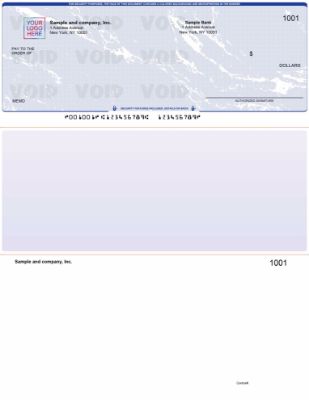
High security checks work with all major accounting software the same way standard checks do. The security features are in the paper and printing , they do not affect how QuickBooks or any other platform generates the check data or sends the print job to your printer.
QuickBooks-Compatible High Security Formats
Checkomatic offers high security check stock in all QuickBooks-compatible formats:
- Voucher (check on top): One check with two detachable stubs per page. Default QuickBooks payroll and AP format.
- 3-on-a-page: Three checks per sheet, no stubs. High-volume AP printing.
- Check in middle: For Sage 50 and Peachtree software.
- Manual checks: Pre-printed carbonless check books for handwritten payments.
All four formats include all six security features as standard. There is no "security upgrade" tier at Checkomatic. Every check order, regardless of format or quantity, uses the same security-featured paper stock.
For the full range of software-compatible high security check formats, see QuickBooks checks and computer checks for business.
What Customers Say About Checkomatic
All reviews below are published on checkomatic.com and reproduced verbatim. Source: checkomatic.com/quickbooks-starter-pack-product, 4.5 stars from 166 verified reviews.
"Been with them for 15 years. Always reliable, always good quality, good service. What more can you ask for?"
ATV Inc. | ★★★★★ 5/5 | April 5, 2024 | Source: checkomatic.com/quickbooks-starter-pack-product
"I got 500 checks for less than half of what the bank wanted for 200!"
VVA Voucher Checks (Vietnam Veterans of America) | ★★★★★ 5/5 | July 6, 2024 | Source: checkomatic.com/quickbooks-starter-pack-product
"ASJ Wilson Construction has been a client of checkomatic for some years now and they've never disappointed this company. Thank you checkomatic for all that you do."
ASJ Wilson Construction | ★★★★★ 5/5 | June 6, 2024 | Source: checkomatic.com/quickbooks-starter-pack-product
"We use CheckoMatic for all of our check needs! They have great prices and we receive our products in a timely manner!"
CG's Tax Service | ★★★★★ 5/5 | September 18, 2024 | Source: checkomatic.com/quickbooks-starter-pack-product
"First time ordering and I am super impressed with the quality of the checks. No issues with delivery. I will be ordering again!"
TClinton | ★★★★★ 5/5 | April 9, 2025 | Source: checkomatic.com/quickbooks-starter-pack-product
"Affordable and efficient. My go-to business check printer."
Doe | ★★★★★ 5/5 | January 24, 2025 | Source: checkomatic.com/quickbooks-starter-pack-product
Why Choose Checkomatic for High Security Checks
All Six Features Standard on Every Order
There is no security tier or upgrade fee at Checkomatic. Every check order includes all six security features: chemically sensitive paper, microprinting, void pantograph, UV fluorescent fibers, heat-sensitive ink, and genuine watermark. This applies to every format and every quantity, from a single box to a large bulk order.
In-House Manufacturing Since 1997
All high security checks are manufactured at Checkomatic's own facility in Monroe, NY. In-house production means consistent security feature quality on every check in every order. No third-party print vendors. Your banking information stays within a single controlled manufacturing environment.
ABA-Compliant MICR Pre-Verified
Every routing number is verified against the Federal Reserve E-Payments Routing Directory before production begins. High security checks from Checkomatic clear at any US bank without rejection. ABA compliance and security features are not a trade-off , every check delivers both.
50 to 70 Percent Below Bank Pricing
Banks charge a significant markup for security-featured check stock. Checkomatic's in-house manufacturing eliminates that markup. High security checks from Checkomatic cost 50 to 70 percent less than equivalent stock ordered through a bank. Browse all high security formats at business checks at Checkomatic. For a complete guide on finding the best check supplier, see what is the best place to order checks online.