-
 Contact Us
-
 Re order
-
 Log in
-
 Cart 0
You have no items in your shopping cart.
What Is a Remotely Created Check? A Guide for Businesses
You open your bank statement and find a payment you do not recall approving. The image shows a check, but the signature line holds a short sentence instead of a name. It may be a remotely created check, made by a payee after getting your permission.
These items are legal in many settings, yet they carry a different risk from the checks you write yourself. This guide explains what they are, how they differ from a signed business check, how to spot one, and what to do within the first day if you did not approve it.
Quick Summary
A remotely created check is a check that the payee, or the payee's agent, creates against your account. It has no signature from you, so the question is whether you authorized it. The rules shift some risk to the bank that deposits it, but you still need to review your statements and report problems quickly.
Key points
- No signature from you. Regulation CC defines it as a check that does not bear your signature, applied or purported to be applied.
- Business accounts are covered. The Federal Reserve's definition applies to consumer and non-consumer accounts alike.
- Not the same as a bank draft. A cashier's check or bank draft is issued by a bank, not by the payee.
- The depositing bank gives a warranty. It warrants that the account holder authorized the check.
- Not a general ban. The FTC rule that bars these items is limited to telemarketing payments.
- Act the same day. Call your bank, then follow up in writing, and read your account agreement for its deadline.
| Question | Short answer | Where the answer comes from |
|---|---|---|
| What is it? | A payee-created check with no account-holder signature | Regulation CC, 12 CFR 229.2 |
| Is it legal? | Not banned in general; barred for some telemarketing payments | Federal Reserve rule and FTC rule |
| Who vouches for it? | The bank that deposits or transfers it | 12 CFR 229.34(b) |
| How long do you have to report? | As soon as you see it; your agreement may set a limit | UCC 4-406 and your account agreement |
Table 1. Core answers in brief, offered as background only and not as legal advice.
Prefer to control every payment with your own signature? Talk to the Checkomatic team about a business check layout with a clear signature line.
Jump to a section
- What is a remotely created check?
- Is it the same as a demand draft or a bank draft?
- How is it different from a check you sign?
- Are remotely created checks legal?
- How can you spot one on your statement?
- Can Positive Pay or an ACH debit block stop one?
- What should you do if one is unauthorized?
- How long do you have to report it?
- Frequently asked questions
What Is a Remotely Created Check?
It is a check made by the person you are paying. Under the Federal Reserve's Regulation CC (12 CFR 229.2), it is a check that your bank did not create and that "does not bear a signature applied" by you, or purported to be applied by you. The rule's definition reaches checks drawn on business accounts as well.
Why does it have no signature?
The payee builds it from your bank details after you agree to the payment, often by phone, email or a web form. You never hold a pen. The Atlanta Fed notes that these items look like images of paper checks, which makes them hard to monitor. Our guide to the Check 21 Act explains how check images move.
What does "Authorized by Drawer" mean on a check?
It is a statement, commonly printed where the signature would go, that the account holder (the drawer) gave permission. Wording varies, and a 2008 OCC release describes items carrying text such as "no signature required." The words are only a claim.
Who uses these items?
The Atlanta Fed names bill payment, phone or internet purchases, and repaying a merchant after a returned check. The last follows a payment problem, so see what happens after a bounced check.
Is a Remotely Created Check the Same as a Demand Draft or a Bank Draft?
No. Other names for the same unsigned, payee-created item include demand draft, tele-check, payee-drafted check, preauthorized draft and signature-less check. A bank draft or cashier's check is a different instrument, because the bank itself issues it.
| Item | Who creates it | Signature from you? | Drawn on |
|---|---|---|---|
| Remotely created check | The payee or its agent | No | Your account |
| Check you sign | You or your staff | Yes | Your account |
| Cashier's check or bank draft | The bank | No, the bank signs | The bank's own funds |
| ACH debit | The payee starts it electronically | No paper at all | Your account, through the ACH network |
Table 2. Similar-sounding payment items compared by who creates them and whose money backs them.
The phrase "demand draft" causes most of the mix-ups, because it is also used for a prepaid draft issued by a bank. When someone mentions one, ask which meaning they intend. Read our pages on bank drafts and cashier's checks, or the check terminology glossary.
Is it the same as an eCheck or an ACH payment?
Not quite. The FTC's rule describes a remotely created payment order as one cleared through the check clearing system, while an ACH debit moves through a separate network. For costs and speed, read check versus ACH payment. Converting your own signed paper check is a separate topic, covered in converting a check to ACH.
How Is a Remotely Created Check Different From a Check You Sign?
The main difference is proof. A check you sign carries your signature, which shows you approved it. A remotely created check carries a claim that you approved it, and the payee decides when to create it.
| Feature | Business check you sign | Remotely created check |
|---|---|---|
| Who starts it | You, on your schedule | The payee, after you give permission |
| Signature line | Holds your signature or an approved stamp | Empty or holds an authorization statement |
| Check number | Comes from your own check stock and register | May not match your sequence |
| Proof you approved it | Your signature | The payee's record of your permission |
| Your control | You release each check | You rely on the payee to follow the agreed terms |
Table 3. A signed business check next to a remotely created check.
Our guide on how to write a business check covers the steps, and business check layouts show where the signature belongs. If you use a stamp, read about the signature stamp for checks first.
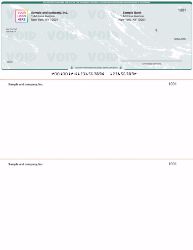
Are Remotely Created Checks Legal?
In general, yes. They are not banned across the board, and banks process them. The rules aim to limit harm: one puts a promise on the depositing bank, and another bars them for certain telemarketing payments.
What does the depositing bank promise?
Under 12 CFR 229.34(b)(1), a bank that transfers or presents one of these checks warrants that the account holder authorized its issuance. That is a warranty, which means a promise that can be enforced between banks. The Federal Reserve adopted it in its final rule at 70 FR 71218, effective 1 July 2006. The Board reasoned that a paying bank cannot compare a missing signature, while the first bank is better placed to screen depositors.
The Board also weighed a ban, because 35 state attorneys general had urged one. It said substantial research would be needed first. The warranting bank may defend itself by showing that you are barred under UCC 4-406 from raising the claim. For related fraud steps, see check validity and fraud prevention.
Does the FTC telemarketing rule apply to my vendor?
Maybe, so check. Under 16 CFR 310.4(a)(9), the FTC's Telemarketing Sales Rule bars creating a remotely created payment order as payment in telemarketing. The rule has exemptions, and we could not confirm how a business-to-business call is treated. Do not assume it protects you.
- The rule is narrow. It concerns payment in telemarketing, not every use.
- Regulators have acted. In 2008 the OCC announced restitution of over $150 million to more than 740,000 consumers after payment processors used these items through a national bank. See check fraud in 2026.
- Your protection is practical. Review your statements every month.
How Can You Spot a Remotely Created Check on Your Statement?
Look for a check payment you did not write. The signature line is the clearest clue, because the account holder's signature is missing. Pull the check image from your online banking and compare it with your records.
What should you look at on the image?
Work through these points in order.
- The signature line. A typed statement or a blank space is a flag.
- The check number. Your checks run in order, so a number you never issued deserves a question. Compare it with your check register.
- The payee. Match the name to an invoice or an agreement you made.
- The amount and date. Compare both with what you approved.
Our tips on checkbook management help you keep records that make this comparison fast.
Can Positive Pay or an ACH Debit Block Stop One?
We cannot promise that either does. As the OCC describes Positive Pay, you upload your issued-check list to the bank, which then pays only items that match it. How a particular service treats an item with no signature is a question for your bank.
Ask plainly: "If a check with no signature hits my account and is not on my issued list, what does your service do?" Our guide on Positive Pay explains the basic idea.
What about an ACH debit block?
A debit block is built for electronic debits. Whether it reaches a check item, or an item that began electronically, depends on your bank's setup, so ask. Keep reviewing your statements either way.
What Should You Do If a Remotely Created Check Is Unauthorized?
Call your bank the same day, then put the claim in writing. Delay can cost you, and your bank's own process governs, so treat these steps as a starting point.
- Gather the evidence. Save the check image, statement page and any invoice or contract.
- Call your bank today. Say you did not authorize the item and ask for the claims department.
- Send a written claim. Name the date, amount, payee and check number, and keep a copy.
- Ask about a signed statement. The Federal Reserve Banks' claim process asks for the customer's sworn statement, so ask whether your bank wants one for each item.
- Ask about the account. Your account number was used, so ask whether a new account is wise.
Should you rely on a stop payment alone?
No. A stop payment order aims at an item that has not been paid yet, as our guide on how to stop payment on a check explains. If the item already posted, you need an unauthorized item claim. Ask your bank which tool fits.
On who bears the loss, state law and your account agreement decide. Under UCC 4-401 a bank may charge only items that are properly payable, meaning authorized by the customer.
How Long Do You Have to Report an Unauthorized Remotely Created Check?
As soon as you find it. UCC 4-406 expects a customer to review statements promptly, and your account agreement may set a shorter period, so read yours.
| Clock | Who it binds | What it means for you |
|---|---|---|
| Prompt review under UCC 4-406 | You, as the customer | Failing to review can cost you if the bank proves loss from the delay |
| Outer limit in the uniform UCC text | You, as the customer | One year after the statement or items are made available; states vary |
| Your account agreement | You and your bank | May be shorter; one agreement we read sets 30 calendar days for most errors |
| Federal Reserve Banks adjustment window | Banks, not you | 90 calendar days from the cash letter date; it is not your deadline |
Table 4. Four different clocks. Only the first three can apply to you.
The 90 day figure is easy to misread. It sits in the Federal Reserve Banks' process for claims between banks, and your own deadline can be much shorter. Whether UCC 4-406 applies unchanged to an unsigned check is a point to put to a lawyer. If the item hit a payroll account, see business checks for payroll and tell your bank that day.
Keep your signature in the loop
A clear signature line. Business checks give you a defined place to sign and a record of what you released. See business checks.
Numbering options. Ask about numbering, so an unfamiliar check stands out against your register.
A proof before you print. Review the layout and your account details first.
Support for your workflow. Ask which layout suits your software.
About the Author
Our team wrote this piece for owners who pay vendors by check, and it relies on Regulation CC (12 CFR 229.2 and 229.34), the Federal Reserve's 2005 final rule, the FTC's Telemarketing Sales Rule, UCC sections 4-401 and 4-406, an OCC news release, Federal Reserve Banks' claim guidance and an Atlanta Fed article on these items.
This guide offers background only, not legal advice. States differ, banks set their own terms and deadlines, and we could not verify every point. Ask your bank or a lawyer about your own situation.
Frequently Asked Questions
Is a remotely created check the same as an eCheck?
Can an unsigned payee-created check become an ACH debit?
Is it safe to let a vendor draw a check on my account by phone?
Does an ACH debit block stop one of these items?
Does the FTC rule make every remotely created check illegal?
Who pays if one of these checks is unauthorized?
Will my bank ask for a signed statement for every item?
Why would a bank pay an item with no signature at all?
Does the Fed's 90 day window give me 90 days to report?
Should I switch accounts after an unauthorized item?
Accepted by the world’s leading banks