Three Reasons People Write Checks to Themselves for Deposit
Writing a check to yourself for deposit is more common than most people realize. There are three situations where it comes up regularly.
For more detail, see how to write a business check step by step.
Reason 1: Transferring Money Between Your Own Accounts at Different Banks
If you hold accounts at two different banks, transferring money between them electronically can take several days or require setting up a linked external account ; a process that itself takes several days the first time. Writing a check from your account at Bank A and depositing it at Bank B is often the faster alternative. You draw the check from one account and deposit it into the other. Both accounts are in your name. The transaction is legal and common.
Reason 2: Withdrawing Cash When a Debit Card Is Not Available
If your debit card is lost, frozen, or expired, writing a check to yourself and cashing it at the bank teller is a direct way to access your funds. You write the check to yourself, go to your bank branch, present the check and your identification, and receive cash over the counter. Some people also write the check payable to "Cash" for this purpose, though writing your own name is more secure because a check payable to cash can be cashed by anyone who finds it.
Reason 3: Depositing at a Branch Without an ATM or Mobile Deposit
Some credit unions, community banks, and regional institutions have limited ATM networks and require in-person deposits for checks drawn on outside institutions. Writing a check from your primary account and depositing it in person at a secondary institution is a practical workaround. It also creates a physical paper trail that both institutions record, which can be useful for bookkeeping purposes.
How to Write a Check to Yourself Step by Step
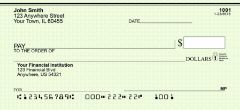
Checkomatic personal checkbooks ; for writing checks to yourself or any payee.
The process is identical to writing a check to anyone else. The only difference is that your own name goes on the payee line.
Step 1: Fill in the Date
Write today's date in the date field in the upper right area of the check. Use the month/day/year format. Do not post-date the check by writing a future date. Post-dating a check does not legally prevent a bank from processing it early in most US states, and if the funds are not in the account at the time of deposit, the check will bounce.
Step 2: Write Your Name on the Pay to the Order of Line
Write your full name exactly as it appears on the account you are depositing into. If your name on the receiving account is "John A. Smith," write "John A. Smith" on the payee line. Using a nickname or an abbreviation that does not match the name on file can cause the bank to delay or reject the deposit.
Step 3: Write the Dollar Amount in the Box
In the small rectangular box to the right of the payee line, write the numeric dollar amount. For example: 500.00. Write it clearly and start from the left edge of the box to prevent someone from inserting additional digits before your number.
Step 4: Write the Amount in Words on the Written Amount Line
On the line below the payee line, write the amount in words. For $500.00 write: Five hundred and 00/100. Draw a horizontal line from the end of your words to the printed "Dollars" text to fill the remaining space. Under UCC Article 3, if the numeric amount and the written amount conflict, the written amount controls. Get both right, but the written line is the legally binding one.
Step 5: Write a Memo (Optional but Recommended)
In the memo field in the lower left corner, write a brief description of the purpose. "Transfer to savings," "Account transfer," or "Withdrawal" are all appropriate. This note does not affect whether the check clears but makes your check register and bank statement easier to reconcile later.
Step 6: Sign the Front of the Check
Sign your name in the signature field in the lower right corner of the check. This is your authorization as the drawer ; the person authorizing the bank to release the funds. Without a signature, the check is not valid.
How to Endorse a Check Written to Yourself
Self-inking endorsement stamps from Checkomatic ; stamp "For Deposit Only" in one press.
Endorsing a check you wrote to yourself works the same way as endorsing any other check. The endorsement method you choose determines how securely the check is protected between the time you sign the back and the time it reaches the bank.
Use a Restrictive Endorsement
A restrictive endorsement is the safest option for any check you are depositing. In the endorsement area on the back of the check, write:
For Deposit Only to Account [your account number]
Then sign your name below that text. The phrase "For Deposit Only" tells the bank that the check can only be deposited, not cashed over the counter or transferred to a third party. Adding your specific account number directs the deposit to exactly one account. A check with a restrictive endorsement cannot be cashed by someone who finds it or steals it from the mail.
For Mobile Deposit
If you are depositing the check through your bank's mobile app, write:
For Mobile Deposit Only
Then sign below. This phrasing provides protection under Regulation CC against duplicate deposit liability. If a check bearing "For Mobile Deposit Only" is later presented again for deposit (either by mistake or intentionally), the indemnification language helps protect the bank and the depositor from the second deposit going through. Never use a plain signature without any restrictive language on a mobile deposit check.
Never Use a Blank Endorsement
A blank endorsement is just your signature with no additional text. Under UCC Article 3, a blank endorsement converts the check into a bearer instrument ; anyone who holds it can cash or deposit it regardless of whose name is on the front. A self-check with a blank endorsement that falls out of your pocket on the way to the bank can be cashed by whoever picks it up. Always add the restrictive text before signing. For the complete guide to all endorsement types, see how to endorse a check: every type and stamp explained.
How to Deposit a Check Written to Yourself
After writing and endorsing the check, you have three deposit options. Each has different timing for when funds become available.
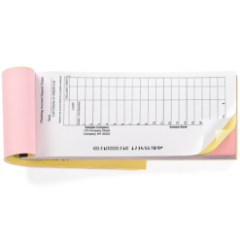
Pre-printed deposit slips from Checkomatic; account details already on the slip.
In Person at a Bank Teller
Hand the endorsed check to a teller along with a completed deposit slip. The teller verifies your identification and the check details, processes the deposit, and gives you a receipt. The first $225 is typically available the same business day. The remainder is usually available within one to two business days under Regulation CC. For the full guide to completing a deposit slip, see how to fill out a deposit slip: step-by-step guide.
ATM Deposit
Insert the endorsed check into your bank's ATM. The ATM images the check and processes the deposit. Availability is typically the same as teller deposits for checks under $225, though individual bank policies vary. Some banks hold ATM-deposited checks for one additional business day compared to teller deposits.
Mobile Deposit
Open your bank's mobile app, navigate to the deposit function, enter the amount, and photograph the front and back of the endorsed check. Funds from mobile deposits are often available within one to two business days for the first $225, with the remainder available within five business days at some banks. Mobile deposits on checks over $5,000 may face longer hold periods regardless of account history.
Check Kiting: The Risk You Must Understand
Check kiting is the illegal practice of writing a check from an account with insufficient funds, depositing it to create a temporary false balance, and then withdrawing or spending that false balance before the originating check is returned unpaid. It exploits the processing delay between when a check is deposited and when it fully clears.
Why This Matters for Self-Checks
Writing a check to yourself becomes check kiting when the account the check is drawn on does not have sufficient available funds to cover the amount. The pattern looks like this: you write a check from Account A for $2,000, deposit it in Account B, then spend from Account B before the check from Account A clears. Meanwhile, Account A is short and the check bounces. If this is done repeatedly with increasing amounts, it is a federal crime under 18 U.S.C. 1344 (bank fraud).
How to Stay on the Right Side
- Confirm available balance in the source account before writing the self-check.
- Do not spend funds from the deposit until the originating check has fully cleared the source account.
- Do not write self-checks back and forth between accounts to manufacture a temporary balance at either account.
- If you need to move money between accounts quickly, an ACH transfer is faster than a self-check and eliminates the float risk entirely.
Self-Check vs ACH Transfer: Which Is Faster for Moving Money
| Factor | Self-Check Deposit | ACH Transfer |
|---|---|---|
| Setup required | None; need a check and deposit access | Link external account first (3 to 5 days one-time) |
| Transfer speed | 1 to 5 business days for full availability | Same day or next day at most banks |
| Paper required | Yes; physical check needed | No; fully electronic |
| Float risk | Exists; check processes over 1 to 5 days | Minimal; both accounts update quickly |
| Best for | When ACH is not set up; cash withdrawal; emergency transfer | Regular inter-account transfers; recurring moves |
| Cost | One check from your supply | Usually free at most banks |
For regular inter-account transfers, ACH is faster and does not require a physical check. For emergency situations where ACH is not set up, writing a check to yourself remains a reliable option as long as the source account has sufficient funds.
How to Record a Self-Check in Your Check Register
Recording a self-check in your check register is the same as recording any other check you write. The key is doing it at the moment you write the check, not after the deposit clears.
In Your Physical Check Register
Enter the check number, today's date, the description ("Transfer to savings" or "Account transfer"), and the dollar amount in the Payment column. Calculate and update your running balance. The balance decreases by the check amount the moment you write it, even though the check has not yet been presented. Your register should always reflect what you have authorized to leave the account, not what has already cleared. For the complete guide to maintaining an accurate register, see check register: how to set up and use a checkbook ledger.
In QuickBooks or Accounting Software
Record the self-check as a check transaction from the source account with a memo of "Transfer to [destination account name]." On the receiving side, record the deposit when it posts. For business accounts, your bookkeeper may categorize this as an inter-account transfer rather than an expense. Check with your accountant on the correct category for your bookkeeping setup.
During Monthly Reconciliation
The self-check will appear on your source account's bank statement as a paid check and on your receiving account's statement as a deposit. During monthly reconciliation, match the check number and amount on both sides. Any gap between the date you wrote the check and the date it cleared is the float period. For the full reconciliation process, see checkbook management: how to balance and reconcile your account every month.
Common Mistakes When Writing a Check to Yourself
Mistake 1: Writing Your Name Incorrectly on the Payee Line
If the name you write on the payee line does not match the name on the receiving account, the bank may put a hold on the deposit pending identity verification. Write your name exactly as it appears on the account statement ; including middle initials or suffixes if they are part of the account name.
Mistake 2: Blank Endorsement Instead of Restrictive Endorsement
Signing the back without adding "For Deposit Only" first converts the check into a bearer instrument. If it is lost, stolen, or found, anyone can cash it. Always write "For Deposit Only to Account [number]" before signing.
Mistake 3: Depositing Before Confirming Available Funds
Available balance differs from account balance. A deposit you made yesterday may not yet be available. Pending transactions may reduce what you can draw from. Writing a self-check against unavailable funds creates an overdraft on the source account and potentially a check kiting flag.
Mistake 4: Not Recording the Check Immediately
Writing the check and depositing it without recording it in your register leaves your running balance wrong until the check clears. This creates reconciliation confusion and may cause you to accidentally write another check that overdrafts the account. Record it the moment you write it.
Mistake 5: Double-Depositing the Physical Check After Mobile Deposit
After a mobile deposit, keep the physical check but do not deposit it again. Double-depositing a check is fraud, even when accidental. Write "MOBILE DEPOSITED [date]" in pen across the front of the physical check after the mobile deposit confirms, so you do not accidentally deposit it again at an ATM or teller.
What Customers Say About Checkomatic
All reviews below are published on checkomatic.com and reproduced verbatim. Source: checkomatic.com/quickbooks-starter-pack-product, 4.5 stars from 166 verified reviews.
"Been with them for 15 years. Always reliable, always good quality, good service. What more can you ask for?"
ATV Inc. | ★★★★★ 5/5 | April 5, 2024 | Source: checkomatic.com/quickbooks-starter-pack-product
"First time ordering and I am super impressed with the quality of the checks. No issues with delivery. I will be ordering again!"
TClinton | ★★★★★ 5/5 | April 9, 2025 | Source: checkomatic.com/quickbooks-starter-pack-product
"We use CheckoMatic for all of our check needs! They have great prices and we receive our products in a timely manner!"
CG's Tax Service | ★★★★★ 5/5 | September 18, 2024 | Source: checkomatic.com/quickbooks-starter-pack-product
"I got 500 checks for less than half of what the bank wanted for 200!"
VVA Voucher Checks (Vietnam Veterans of America) | ★★★★★ 5/5 | July 6, 2024 | Source: checkomatic.com/quickbooks-starter-pack-product
"ASJ Wilson Construction has been a client of checkomatic for some years now and they've never disappointed this company. Thank you checkomatic for all that you do."
ASJ Wilson Construction | ★★★★★ 5/5 | June 6, 2024 | Source: checkomatic.com/quickbooks-starter-pack-product
"Affordable and efficient. My go-to business check printer."
Doe | ★★★★★ 5/5 | January 24, 2025 | Source: checkomatic.com/quickbooks-starter-pack-product
Why Choose Checkomatic for Personal and Business Checks
Personal Checks in Duplicate Format
When you write checks to yourself regularly for inter-account transfers, keeping accurate records matters. Personal checkbooks in duplicate format create a carbonless copy of every check you write at the moment you write it. The copy stays in the check register stub area automatically ; no separate entry needed. The duplicate records the check number, date, payee (your own name), and amount instantly. For personal checkbook options including duplicate formats, see personal checkbook at Checkomatic.
Business Checks for Business Account Transfers
Business owners who write checks between business accounts need checks that clear at all US banks without friction. Checkomatic's business checks are ABA-verified, MICR-encoded, and accepted at every major US financial institution. No alignment issues, no bank rejections. For all business check formats, see business checks at Checkomatic.
Pre-Printed Deposit Slips for the Receiving Account
When depositing a self-check in person, a pre-printed deposit slip speeds up the teller process significantly. Checkomatic's deposit slips arrive with your account number, bank name, and routing number already printed. You fill in only the date and amount. For deposit slips matched to your account, see business deposit slips.
In-House Manufacturing Since 1997
All checks manufactured at Checkomatic's own facility in Monroe, NY. Standard production ships in 3 to 5 business days. ABA routing numbers verified against the Federal Reserve E-Payments Routing Directory before every production run. SSL-encrypted checkout protects your banking information.