Contact Us
Re order
Log in
Cart 0 Jul 03, 2026
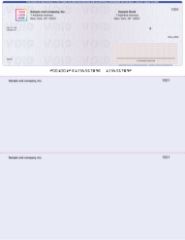
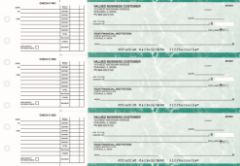
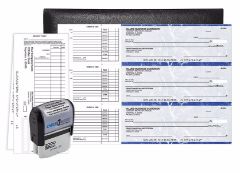
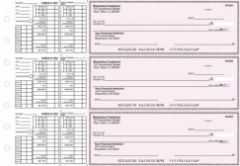
Checks Unlimited is a direct-to-consumer check printing service that sells personal and business checks online and through print mail advertisements. It positions itself as a lower-cost direct mail check printer and alternative to ordering checks through a bank, offering a catalog of personal check designs ranging from simple color backgrounds to themed illustrated checks, alongside business check formats and accessories.
Searches for "Checks Unlimited" are often made by people who received a mail offer from the company, who are looking to reorder from a previous Checks Unlimited account, or who are comparing check ordering options and want to understand what Checks Unlimited actually offers before committing. This guide answers all three use cases with accurate, current information.
Checks Unlimited was founded in the mid-1980s and claims to be the first major direct-mail check printer in the United States, meaning it pioneered the model of allowing consumers to order personal checks by mail rather than exclusively through their bank. It grew substantially over the following decades and now reports serving over 30 million customers.
Checks Unlimited is owned by Deluxe Corporation, one of the largest check printing companies in the United States. Deluxe Corporation also owns Designer Checks, which operates with nearly identical pricing and product structure to Checks Unlimited. Both brands are consumer-facing imprints of Deluxe's consumer check printing division. Deluxe Corporation is publicly traded on the New York Stock Exchange. Its revenue historically came predominantly from check printing, though the company has diversified significantly into financial technology services in recent years.
Being owned by Deluxe Corporation gives Checks Unlimited access to large-scale check printing infrastructure. Deluxe is a CPSA-certified manufacturer, which means its checks are produced on ABA-compliant security stock and meet the ABA compliant security standards required for acceptance at all US financial institutions. The Checks Unlimited brand sells Deluxe-produced checks under its own consumer-facing storefront and marketing operation.
Checks Unlimited is headquartered in Clarksdale, Mississippi, with operations coordinated through the broader Deluxe Corporation network.
Checks Unlimited offers approximately 250 personal check designs across several categories. The categories include classic checks featuring simple color backgrounds and safety patterns, special edition checks featuring illustrated themes, and a range of coordinating accessories.
Personal checks are available in two physical formats:
Duplicate checks at Checks Unlimited use carbonless paper manufacturing where alternating sheets of carbonless check paper and lighter plain paper are bound together. Writing on the original check transfers through the carbonless paper to the plain sheet beneath, creating a permanent numbered carbon copy record. The carbonless paper automatically records the check number, date, payee, and amount without requiring any additional step from the writer.
Beyond the check designs and formats, Checks Unlimited also offers checkbook covers, personalized address labels, and check registers as accessories that can be added to a personal check order.
Checks Unlimited offers business checks in two main categories: standard manual checks and high-security checks. The distinction is primarily the security level built into the paper stock.
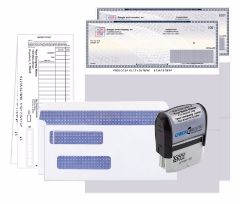
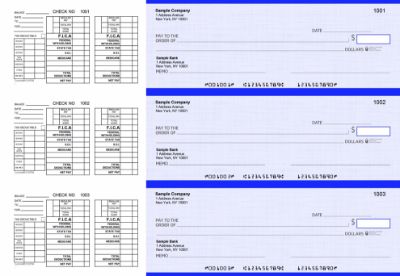
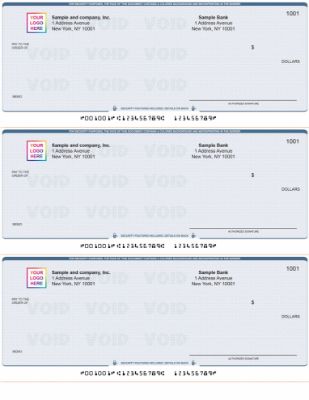
Manual checks are available in four styles: standard desk set, three-on-a-page accounts payable format, three-on-a-page payroll format, and voucher manual format. These are handwritten business checks with the company name and account information pre-printed at the factory.
High-security manual and computer check formats add a two-dimensional holographic foil security element above the baseline ABA security paper features. The computer check format is compatible with accounting software including QuickBooks, Quicken, and Peachtree (Sage 50).
The business check product line at Checks Unlimited allows some customization: font selection, design color choice, and the addition of a company logo are available on certain formats. Logo printing is an optional add-on rather than a standard included feature, which affects the total cost compared to manufacturers who include logo printing free on every order.
Checks Unlimited's listed pricing for personal checks starts at approximately $22.44 for one box of 80 single checks and $28.44 for one box of 80 duplicate checks. These prices include a per-box handling fee that the company now folds into the listed price, though this was not always the case and earlier orders often showed the handling fee as a surprise addition at checkout.
The per-check cost at Checks Unlimited's standard pricing works out to approximately 28 cents per single check at one box. Ordering four boxes reduces the per-check cost significantly due to bulk discount volume tiers. A four-box order of single personal checks can reduce the cost to around 18 to 23 cents per check depending on the design and any active coupon code applied. Even with volume pricing, Checks Unlimited's per-check cost tends to run higher than direct in-house manufacturers for equivalent ABA-compliant product.
Business check pricing is substantially higher. A box of voucher-style laser computer business checks from Checks Unlimited lists at approximately $92.44 for one box. That does not include shipping or the $12.50 per-order handling fee on business check orders. A reviewer who documented the checkout process found the total cost of one box of business checks reaching approximately $124 by the time shipping and handling were added, with no extras selected.
The total cost of an order from Checks Unlimited depends on whether you remove the pre-selected add-ons before completing checkout. This is the most frequent source of customer complaints about the company and the most important thing to know before placing an order.
For business check orders, a separate per-order check handling fee of $12.50 applies. This fee does not appear in the listed product price and is added at the checkout stage. On a single box of business checks priced at $92.44, the $12.50 handling fee adds roughly 14% to the base product cost before shipping is calculated.
SentryShield Pro, the company's check fraud and identity protection program, is pre-selected by default in the checkout cart at approximately $15.94 per year. Customers who do not want this service must actively remove it from the cart before completing the order. Clicking to remove it triggers a pop-up asking if you are sure you want to remove the protection, which some customers report feeling pressured by. If not actively removed, the SentryShield fee is added to the order total.
In-plant rush processing, which accelerates printing so checks are ready to ship within two business days, costs approximately $22.95 as an add-on for customers who need faster production. Standard processing timelines without this upgrade are longer than many competing direct manufacturers.
Tracking on shipping is not included in the free standard shipping option. Standard untrackable shipping offers no visibility into where the order is and carries a delivery window of up to 15 business days. Standard trackable shipping with order visibility starts at $9.95.
Checks Unlimited heavily uses promotional pricing, coupon codes, and tiered discounts as part of its marketing strategy. It sends promotional offers by mail to previous customers and current prospects, and coupon codes are available through various channels. Understanding how these offers work helps buyers evaluate whether the discount they see represents genuine savings.
The most common Checks Unlimited promotional structure offers a percentage discount, typically 35% to 50% off, when ordering a minimum of two to four boxes. The discount applies to the check product price. It generally does not apply to handling fees, shipping, or add-on services like SentryShield. A coupon that advertises "50% off" on a box of checks may reduce the check product price while leaving the per-order handling fee, shipping charges, and pre-selected add-ons unchanged, resulting in a total cost meaningfully higher than the headlined discount suggests.
First-time customer pricing is a separate offer that provides introductory-rate pricing on a first order. Once a customer has ordered once, they are moved to standard pricing for subsequent orders and become eligible for reorder-specific promotional codes instead. Buyers who have seen an especially low price in a first-time mail offer and are researching what repeat ordering costs should expect standard pricing, not the introductory rate, on reorders.
Reorder coupon codes are mailed to existing customers and can be entered online during the reorder process. These typically offer meaningful discounts on four-box orders but require the minimum quantity commitment to activate the full percentage off.
Checks Unlimited offers four shipping and delivery options:
The ship date depends on when in-plant processing completes. Standard processing can take several additional business days before the order is handed to the carrier. In-plant rush processing, available as a paid add-on at approximately $22.95, guarantees the order is ready to ship within 2 business days after verification.
For buyers who need checks in a reasonable timeframe without paying for multiple rush services, the standard untrackable free shipping option carries a real risk of a lengthy wait. Third-party review sites and customer accounts suggest actual delivery on the standard option can approach or exceed 15 business days in some cases, particularly during high-volume periods.
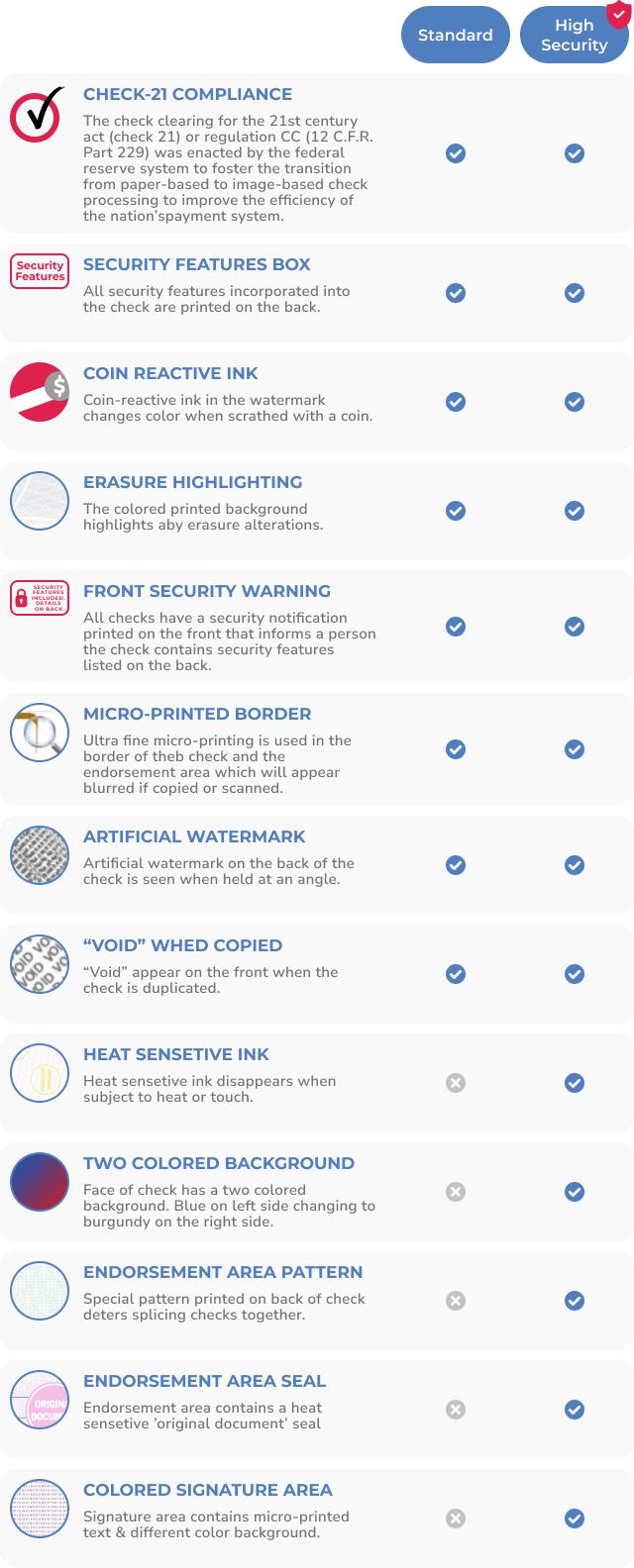
Checks Unlimited checks, as products of Deluxe Corporation, are produced on ABA-compliant check security paper and carry the standard security features required for banking compatibility. These include chemically reactive paper that reacts to washing solvents used in check alteration attempts, genuine watermarks embedded in the paper fiber during manufacturing, microprinting along the signature line, heat-sensitive thermochromic ink that disappears when rubbed, void pantographs that reveal VOID when the check is photocopied, and UV-reactive fluorescent fibers.
The high-security check tier at Checks Unlimited adds two-dimensional holographic foil, a security feature that creates an additional visual verification element on the check face. The holographic foil is difficult to replicate without specialized equipment and provides a visible verification point that goes beyond standard ABA security paper features.
Standard Checks Unlimited personal checks do not include the holographic foil; they carry the baseline ABA security paper features. This is the same security level as most third-party personal check manufacturers who use ABA-compliant stock, including Checkomatic. The security difference between standard and high-security Checks Unlimited checks is the addition of the foil tier, not a difference between Checks Unlimited and competing ABA-compliant manufacturers at equivalent price points.
SentryShield appears pre-selected in the Checks Unlimited checkout cart and is one of the most discussed elements in customer reviews. Understanding what it covers, and what it does not cover, helps buyers make an informed decision about whether to keep or remove it.
SentryShield is a check fraud recovery and identity protection program, not a check security feature. It provides financial coverage for losses resulting from unauthorized check use and identity restoration services if a customer's identity is compromised. The program costs approximately $15.94 per year.
SentryShield does not add any security features to the checks themselves. The checks ship with whatever security paper they were ordered on regardless of whether SentryShield is active. The program covers what happens after a fraud event, not what prevents one. The ABA security paper features in the checks provide the prevention layer. SentryShield provides a recovery layer.
For buyers whose primary concern is check paper security, SentryShield is redundant with the protection already built into ABA-compliant check stock. For buyers who want financial coverage for any fraudulent check use, the program's terms and limitations should be reviewed carefully before the annual fee is accepted at checkout.
Similar programs are offered by multiple check manufacturers and under different names. EZShield is another common version offered through various check ordering channels. The principle is the same: a paid annual subscription for check fraud recovery coverage, pre-selected at checkout as a default, requiring active opt-out to remove.
Customer reviews of Checks Unlimited present a mixed picture that divides along two lines: customers who received their checks without incident and found the product acceptable, and customers who encountered customer service difficulties, billing problems, or checkout experience issues.
Positive reviews typically note that the checks arrived in reasonable time (for orders with trackable shipping), the print quality was acceptable, and the design selection met the buyer's expectations. Some long-term customers report consistent positive experiences over multiple reorder cycles.
Negative reviews, which make up a significant portion of third-party review site ratings including a Trustpilot rating that has hovered around 1.9 out of 5, cluster around several recurring themes. Multiple reviewers report not receiving their order and being unable to reach customer service to resolve it. Others describe being charged the full price despite entering a discount code, with no response to follow-up emails. Some report surprise handling fee additions that were not clearly disclosed during the ordering process. A recurring complaint involves the SentryShield subscription being included in the order total without the buyer realizing it was pre-selected.
The Better Business Bureau gives Checks Unlimited an A+ rating based on its responsiveness to formal complaints filed through the BBB platform, which differs from the general customer review picture on independent review sites. A+ BBB ratings reflect complaint resolution history rather than overall customer satisfaction scores.
The picture for business check customers is particularly concerning in third-party reviews. Multiple small business owners report long wait times, difficulty confirming order status on untrackable shipments, and challenges getting reimbursed for incorrect orders.
Both Checks Unlimited and Checkomatic sell ABA-compliant checks accepted at all US banks. The differences lie in pricing transparency, turnaround, customization inclusions, and the manufacturer model.
Checks Unlimited is a branded consumer storefront owned by Deluxe Corporation. Deluxe fulfills the orders through its corporate printing infrastructure. Checkomatic is an independent in-house manufacturer based in Monroe, NY since 1997. That Monroe NY facility is where every Checkomatic check is produced. When you order from Checkomatic, your check goes from our production floor to your mailbox with no parent company intermediary, no subsidiary branding layer, and no fulfillment vendor in between. In-house manufacturing means direct accountability and consistent quality control on every batch.
Checkomatic's pricing does not include hidden per-order handling fees. The price you see for a personal or business check order is the product price. There is no separate $12.50 handling fee added at checkout for business check orders. There are no pre-selected add-on programs requiring active opt-out. You decide what you want, add it to the order, and see the total. Our full guide to cheap checks online covers the per-check cost math in detail.
Checkomatic includes free black and white logo printing on every personal and business check order with no setup fee and no add-on charge. Checks Unlimited offers logo printing as an optional paid feature on business check formats. For businesses that want their logo on their checks, the difference in total cost between the two options is meaningful across multiple reorder cycles.
Checkomatic's standard turnaround is 3 to 5 business days from proof approval, with rush delivery available at checkout for faster shipping. Checks Unlimited's standard untrackable shipping option carries a delivery window of up to 15 business days. Buyers who choose Checks Unlimited's free shipping and do not add in-plant rush processing should expect a significantly longer wait than they would experience with a standard Checkomatic order.
Checks Unlimited focuses primarily on personal check designs, with a business check offering that is narrower than its personal check catalog. Checkomatic offers the full range of check types a business or individual needs from one manufacturer: personal checkbooks, top stub checks, deskset checks, QuickBooks-compatible checks, computer business checks in all four layouts, manual business checks in all formats, blank check stock in all layouts including Z-fold pressure seal, and check accessories including deposit slips, check envelopes, 7-ring binders, and self-inking stamps.
Checkomatic's catalog covers every check format a personal or business account requires, all produced in-house and sold direct at manufacturing cost with no bank markup and no per-order handling fees.
Checkomatic has manufactured checks in Monroe, NY since 1997. Every order ships on ABA-compliant security stock with all six standard fraud deterrent features included at no extra charge. There are no tiered security levels for personal checks: every personal check ships with the same full security paper baseline.
Free black and white logo printing is included on every order, personal or business, with no setup fee. Color logo printing is available for a small additional charge. No coupon code is required to access the base price, and no handling fee is added at checkout. The price shown is the price charged.
Every order includes a digital proof step before production begins. You verify your routing number, account number, name, address, logo, and check number sequence before any paper is printed. Standard orders ship 3 to 5 business days from proof approval, with rush delivery available for faster turnaround.
For businesses, the full manual and computer check range, blank stock, and accessories all ship from the same Monroe, NY manufacturer under one account. Check reorder is as simple as updating the starting check number and approving a new proof. No phone orders required, no separate business check service line to call.
Start your order at checkomatic.com. For more on the ordering process, see our how to order checks online guide. For the full picture on check security features, see our check stock paper guide and our check fraud prevention guide.
Checks Unlimited is a Deluxe Corporation brand that has been selling direct-mail personal and business checks since the mid-1980s. Its checks are ABA-compliant and bank-accepted. Its personal check catalog of approximately 250 designs is narrower than many competitors. Its business check pricing, when totaled at checkout with handling fees, shipping, and pre-selected add-ons, runs significantly higher than the listed product price suggests.
Customer review sentiment on independent platforms including Trustpilot skews negative, with recurring complaints about customer service responsiveness, surprise charges, and delivery delays on the free standard untrackable shipping option. Positive reviews tend to come from customers whose orders arrived without issue and who found the design selection adequate for their needs.
For buyers seeking ABA-compliant checks at direct manufacturer pricing, free logo printing, a 3-to-5-day standard turnaround, and a complete range from personal checks through business checks and blank stock, Checkomatic offers all of these without the Checks Unlimited handling fees, pre-selected add-ons, or 15-business-day standard shipping window.
Checks Unlimited is owned by Deluxe Corporation, one of the largest check printing companies in the United States. Deluxe Corporation is publicly traded and also owns Designer Checks, which operates with nearly identical pricing and product structure to Checks Unlimited. Both brands are consumer-facing imprints of Deluxe's check printing division. Checks Unlimited operates from Clarksdale, Mississippi, and the company has been in the direct-mail check business since the mid-1980s.
Checks Unlimited lists personal single checks starting at approximately $22.44 for a box of 80 checks. At checkout, the total includes the handling fee that is now folded into the listed price for personal checks, plus shipping if you choose tracked delivery over the free standard untrackable option. For business checks, the listed price does not include the $12.50 per-order handling fee applied at checkout, and a box of computer business checks that lists at $92.44 can reach approximately $124 when handling and basic trackable shipping are added. Pre-selected add-ons like SentryShield increase the total further if not actively removed before checkout.
Yes. Checks Unlimited checks are produced by Deluxe Corporation on ABA-compliant security stock and are accepted at all US banks and credit unions. The standard security paper includes chemically reactive paper, microprinting, heat-sensitive ink, watermarks, void pantographs, and UV-reactive fluorescent fibers. The high-security check tier adds two-dimensional holographic foil as an additional deterrent. Standard personal checks from Checks Unlimited carry the baseline ABA security features, which is the same level as any other CPSA-certified manufacturer's standard personal checks at equivalent price points.
SentryShield is a check fraud recovery and identity protection subscription pre-selected by default in the Checks Unlimited checkout cart at approximately $15.94 per year. It provides financial coverage for losses from unauthorized check use and identity theft restoration services, but it does not add any physical security features to the checks themselves. Customers who do not want the service must actively remove it from the cart before completing the order. Clicking to remove it triggers a pop-up prompt encouraging you to reconsider. The underlying check paper security features ship regardless of whether SentryShield is active.
Both companies sell ABA-compliant checks accepted at all US banks. The main practical differences are: Checkomatic has no per-order handling fees; free black and white logo printing is included on every Checkomatic order at no charge; Checkomatic's standard turnaround is 3 to 5 business days vs up to 15 business days on Checks Unlimited's free standard shipping; and Checkomatic's checkout has no pre-selected add-on subscriptions requiring active opt-out. Checkomatic also offers a broader range of business check formats, blank check stock, and accessories from a single in-house manufacturer in Monroe, NY.
Jul 03, 2026
There's a specific kind of stress that hits when you go to write a check and realize you've only got one or two left, and something is due this week. This isn't a full ordering guide. It's a triage plan: what to do in the next ten minutes, what to use as a stopgap while new checks are in production, and how to actually get checks fast without missing your deadline.
Running critically low on checks usually gets noticed at the worst possible time, right when you're about to use one. The good news is that a payment deadline this week is almost never a real emergency, because there are stopgap payment methods that buy you the few days a rush check order needs to arrive.
Before doing anything else, check the actual due date on the payment you're worried about. Most bills, rent payments, and invoices have a few days of practical flexibility even if the stated date is tomorrow. Knowing your real deadline tells you whether you need an emergency stopgap today or just a rush check order this week.
If the payment can't wait for a rush order to arrive, these options work without a physical check:
None of these are ideal long-term, but any one of them removes the time pressure so you can order your new checks properly instead of panicking through checkout.
Once the immediate payment is handled, place your check order with both a production rush and expedited shipping selected. Choosing only one of the two is the most common mistake people make when they're in a hurry, and it's the reason rush orders sometimes still arrive slower than expected. See our full guide to ordering checks online if this is your first time.
Order before the printer's daily cutoff, typically early-to-mid afternoon Eastern time. Carrier cutoffs work the same way. FedEx, for instance, only guarantees next-day arrival on shipments handed off before that specific location's deadline, and missing it pushes delivery to the following business day even on an overnight label. Have your routing number, account number, and starting check number ready so there's no follow-up verification email adding a day to your order. If this is your first order with a given printer, expect that verification step regardless of how fast you order, since it's how they confirm your bank details before printing.
One more thing worth knowing if you're stressed about a physical checkbook feeling old-fashioned: paper checks are still fully legal tender. Federal law under the Check Clearing for the 21st Century Act treats a check as valid whether it's processed as a physical original or converted to an electronic image by the bank. A new checkbook arriving in a few days is not a legal gap, just a supply one.
Reorder when you're down to about ten checks left, not when you're down to your last one. Most printers store your previous order details, so a reorder takes a few clicks rather than a full new setup. Setting a calendar reminder at the halfway point of a checkbook is a small habit that removes this entire situation from your life going forward.
Checkomatic has manufactured checks in-house from its Monroe, NY facility since 1997, which keeps rush timelines realistic rather than aspirational. Standard production runs 3 to 5 business days, and rush orders placed before 3:00 PM EST, Monday through Thursday, typically ship in 2 to 3 business days after verification, with next-day delivery available when you combine a production rush with expedited shipping. Full shipping and handling details are available at checkout.
Reordering is built to be quick: your previous order details are kept on file, so updating a starting check number and confirming details takes a few minutes rather than a full new setup. Whether you need personal checks or business checks, every order includes free black-and-white logo printing and ships ABA-compliant with full security features as standard. Orders over $150 ship free.
Use a cashier's check, money order, ACH transfer, or a payment app if the recipient can accept it. These cover the days it takes for a rush check order to arrive.
With rush production and expedited shipping selected together, most orders ship in 2 to 3 business days after verification.
Often yes, if you call ahead and explain new checks are already in production. Most people are more flexible than the stated due date suggests.
Reorder around ten checks remaining, not your last one. That gives you a comfortable buffer even without rushing.
No. Most printers keep your previous order on file, so reordering just means confirming your details and updating the starting check number.
Running low on checks with a payment due feels urgent, but it's rarely a real emergency once you know the stopgaps available while a rush order is in production. Handle the immediate payment with a cashier's check, transfer, or payment app, then order your new checks with both a production rush and expedited shipping selected. And next time, reorder at ten checks left instead of one, so you're never back in this position again.
Jul 03, 2026
Most people don't think about personal checks until the checkbook is down to its last few pages and rent is due next week. Even in a mostly digital world, checks are still the default way plenty of landlords, contractors, and small local businesses expect to get paid. This guide covers why personal checks still matter, which format actually fits how you use them, and how to get a new checkbook fast without paying for rush shipping you didn't need to.
A personal check is drawn on your individual bank account rather than a business account. They're smaller than business checks, generally 6 x 2¾ inches versus 8.5 x 3.5 for business formats, and they carry your name and address rather than a company logo, though a logo can usually still be added.
Personal checks still get regular use for rent payments to independent landlords, HOA dues, babysitters and tutors, contractors who don't take cards, and gifts where a check feels more personal than a transfer. If any of those come up in your life, it's worth having a small stock on hand rather than scrambling every time you're down to a handful.
Wallet checks are the compact, three-to-a-page format most people picture when they think of a checkbook. They're easy to carry and cover most everyday needs. See wallet check options.
Deskbook or duplicate checks include a carbonless copy behind each check, which is useful if you want a paper record without relying on your bank's online statement. Browse Secretary Deskbook checks.
Top stub checks keep a small register attached to each check so you can log the payment as you write it, a good fit if you like tracking balances by hand. See Personal Top Stub checks.
None of these differ in security or bank acceptance. The choice comes down to how you personally like to write and track payments.
Standard production for personal checks typically runs 3 to 5 business days once your bank details are verified. That's the print-and-prepare time, separate from shipping. If you're not in a hurry, standard shipping on top of that adds another few days depending on your location.
If you are in a hurry, rush production plus expedited shipping is what actually gets checks to your door fast, not one or the other. On Checkomatic's Top Stub personal checks, expedited shipping is a flat $20 fee rather than a percentage of your order, which is worth checking before you assume rush shipping will be expensive. Fees can vary by format, so confirm the exact charge for your specific check style at checkout.
If you still have a handful of checks left and just want to reorder before you run out completely, standard shipping is almost always fine. Save the rush fee for when you're already down to your last check or two and have a payment due this week.
Having this ready before checkout means there's no follow-up verification email adding an extra day.
Banks are rarely the cheapest place to reorder, even for personal checks. They resell stock printed by a third party and add a markup on top.
| Source | 150 Personal Checks |
|---|---|
| Checkomatic (direct) | Under $15 |
| Bank | $25 - $40 |
Source: Checkomatic pricing guide, checkomatic.com/personal-checks-vs-business-checks.
Checkomatic has manufactured personal checks in-house from its Monroe, NY facility since 1997, offering wallet, deskbook, and top stub formats with free black-and-white logo printing on every order. Standard shipping runs 3 to 5 business days, and rush delivery options are available when you need a checkbook sooner, including an economical expedited option for orders that need to move fast without paying a premium.
Every personal check ships ABA-compliant with the same security features used on business stock, including advanced anti-fraud protections, and orders over $150 ship free. Checkomatic also matches any lower advertised price for the same specification, so getting checks fast doesn't mean paying more for them.
Order directly from a manufacturer like Checkomatic rather than your bank. You get the same ABA-compliant security at a lower price, since your bank resells checks printed by a third party and adds its own markup.
Standard production runs 3 to 5 business days. With rush production and expedited shipping selected, most orders arrive noticeably faster.
No. Any verified direct printer can produce personal checks using your routing and account number.
They're all equally secure and bank-accepted. The difference is format: wallet checks are compact, deskbook checks include a carbonless copy, and top stub checks include an attached register for tracking.
Only if you're close to running out. If you still have several checks left, standard shipping is usually enough time to reorder comfortably.
Yes. Black-and-white logo printing is typically included at no charge, with color printing available for a small additional fee.
Personal checks are easy to forget about until you're nearly out, but fast delivery is straightforward once you know the difference between production time and shipping time. Pick the format that matches how you like to track payments, have your bank details ready before checkout, and only pay for rush shipping when you're genuinely close to running out. A little planning ahead means you'll rarely need to rush at all.
Jul 03, 2026
A business running low on checks isn't a minor inconvenience. Payroll has a date attached to it, vendors expect payment on terms, and a delayed check can strain a relationship you've spent years building. This guide covers what actually affects business check delivery speed, how to pick a format that won't create printing problems down the line, and what to check before you place an order under time pressure.
Business checks move slower through the supply chain than personal checks in most cases, simply because there's more to verify. Printers confirm your business name, your account details, and often your accounting software format before anything goes to press. That verification step is the single biggest variable in how fast your order actually ships, more than the shipping method you choose at checkout.
A few patterns come up repeatedly with business buyers:
None of these are dealbreakers, but each one adds a day if it's caught after you've submitted the order rather than before.
Manual business checks are handwritten. There's no software formatting to verify, which means fewer opportunities for a mismatch to slow things down. They're a reasonable choice if your business writes a small volume of checks and doesn't run payroll through accounting software.
Computer checks are formatted to be filled in automatically by software like QuickBooks, Xero, or Sage during a print run. They're faster to use once you're set up, but the initial order takes slightly longer to verify since the printer needs to confirm your software and template match before production. Once that template is on file, reorders move quickly because the formatting work is already done.
If your business runs AP or payroll through accounting software and prints checks in volume, computer checks formatted correctly the first time will save you far more time over a year than the extra day it takes to verify the initial order.
Business checks get targeted for fraud more often than personal checks, and paper checks moving through the mail are a real point of exposure. The U.S. Postal Inspection Service reports that its inspectors recover more than $1 billion in counterfeit checks and money orders every year, much of it tied to stolen checks that were altered after leaving the mailbox. That is the reason high-security features like microprinting, heat-sensitive ink, and chemically reactive paper exist on business check stock. They make a stolen check materially harder to alter, which is worth confirming is standard on your order rather than an upgrade you have to ask for.
Place your order before the printer's daily cutoff, typically early-to-mid afternoon Eastern time. Select both a production rush and an expedited shipping method; choosing only one won't get you fast delivery. Double-check your routing number against a voided check or your bank's app rather than typing it from memory, since a mismatched number is the single most common cause of a stalled rush order. If you're ordering computer checks for the first time, confirm your software's exact version so the print template lines up correctly on the first run.
Speed is not the only thing you gain by ordering direct. Your bank does not print checks itself, it resells stock from a third-party printer and adds a markup on top.
| Order Size | Checkomatic (Direct) | Bank | Intuit Market |
|---|---|---|---|
| 250 voucher checks | $35 - $55 | $70 - $130 | $85 - $130+ |
| 500 voucher checks | $50 - $85 | $120 - $180 | $300+ |
Source: Checkomatic direct and bank pricing per Checkomatic's published pricing guide. Intuit Market pricing verified independently against intuitmarket.intuit.com and third-party pricing reviews, July 2026.
Pricing generally runs 30 to 50 percent under Deluxe for the same format and quantity, and stays competitive with Costco at lower volumes.
Checkomatic has manufactured business checks in-house from its Monroe, NY facility since 1997, working through every accounting software variation, format edge case, and bank compliance requirement the market has produced along the way. Standard production runs 3 to 5 business days, and rush orders placed before 3:00 PM EST, Monday through Thursday, ship in 2 to 3 business days after verification.
Checks are compatible with QuickBooks, Xero, Sage, Quicken, and over 500 accounting platforms, and custom formatting for less common software is handled at no extra charge. Every order includes free black-and-white logo printing and ships ABA-compliant with heat-sensitive ink, microprinting, and chemically reactive paper as standard, not as an upgrade. Orders over $150 ship free, and Checkomatic matches any lower advertised price for the same specification. Full shipping and handling details are available for exact timelines.
With rush production and expedited shipping selected before the daily cutoff, most business orders ship in 2 to 3 business days after verification.
Slightly, on the first order, since the printer verifies your software format before printing. Reorders move at the same speed as manual checks once the template is on file.
A mismatched routing number or an unconfirmed accounting software version are the two most common causes of a stalled order.
Yes. Submit each account's routing and account number separately and confirm which checks are drawn against which account before finalizing the order.
If you operate under a DBA and the account is registered that way at your bank, the checks should reflect the DBA name to avoid deposit issues down the line.
Business check delivery speed depends less on the carrier and more on getting your bank details, software format, and business name right on the first submission. Manual checks avoid software verification delays entirely, while computer checks take a day longer upfront but save time on every reorder after that. Confirm your routing number, pick the right format for your software, and select both a production rush and expedited shipping if payroll or a vendor payment is on the line.
Jul 03, 2026
Ordering business checks online is simple once you know the exact sequence, but it's easy to lose a day or two by getting one field wrong at checkout. This is a step-by-step walkthrough of the actual ordering process, from picking a format to selecting the right rush options, written for the business owner or office manager who wants to get this done correctly the first time.
Business checks require more setup than personal checks because there's usually a company name, a logo, and sometimes accounting software formatting involved. None of that makes the process slow on its own. What makes it slow is submitting incomplete or mismatched information and triggering a verification back-and-forth that could have been avoided.
Decide between manual and computer checks before anything else, since this determines what information you'll need next.
Manual business checks are handwritten, with no software involved. If your business writes a low volume of checks by hand, this is the simpler, faster-to-verify option. See manual business check formats.
Computer checks are formatted for accounting software like QuickBooks, Xero, or Sage to fill in automatically during a print run. These take slightly longer to verify on a first order because the printer needs to confirm your exact software and template, but every reorder after that moves quickly since the formatting is already on file. Browse computer check formats or the full accounting software compatibility list.
Have these ready before you open the order form:
Typing your routing number from memory is a common source of delay. Pull it from a voided check or your bank's app instead.
Every check has a line of numbers along the bottom printed in magnetic ink, called the MICR line, which is how banks' sorting equipment reads the routing number, account number, and check number. The Federal Reserve Board confirms this magnetic ink requirement predates modern check processing and still applies today regardless of how fast an order moves. A rush order does not skip this step. It just moves through the same accuracy check faster, which is exactly why getting your routing and account numbers right the first time matters more on a rush order than a standard one.
Choose your layout (check-on-top, check-in-middle, check-on-bottom, or three-on-a-page, depending on what your printer offers), background color, and logo placement. Free black-and-white logo printing is standard with most direct printers, with color available for a small additional fee. This step doesn't affect delivery speed, so take the time to get it right rather than rushing past it.
This is the step people get wrong most often. A production rush without expedited shipping still leaves your checks sitting for however long standard shipping takes, and expedited shipping on a standard production order just gets a slowly-printed check to you fast, which doesn't help either. If you need business checks quickly, select both a rush production option and an expedited shipping method at checkout, and place the order before the printer's daily cutoff, typically early-to-mid afternoon Eastern time.
After you submit, most printers send a confirmation and, on first orders, a verification step to confirm your bank details match your account before anything goes to print. Respond to that email quickly if it arrives. It's a standard fraud-prevention step, not a sign something went wrong, but it does pause production until you confirm.
Standard production for business checks typically runs 3 to 5 business days. With rush production and expedited shipping selected together, 2 to 3 business days after verification is realistic at most direct printers. First orders usually take slightly longer than reorders because of the verification step, so if you're on a hard deadline, order a day earlier than you think you need to.
Ordering direct is not just faster, it is also the cheaper path in almost every case. Your bank does not print checks itself. It resells stock from a third-party printer and adds a markup on top.
| Order Size | Checkomatic (Direct) | Bank | Intuit Market |
|---|---|---|---|
| 250 voucher checks | $35 - $55 | $70 - $130 | $85 - $130+ |
| 500 voucher checks | $50 - $85 | $120 - $180 | $300+ |
Source: Checkomatic direct and bank pricing per Checkomatic's published pricing guide. Intuit Market pricing verified independently against intuitmarket.intuit.com and third-party pricing reviews, July 2026.
Pricing generally runs 30 to 50 percent under Deluxe for the same format and quantity, and stays competitive with Costco at lower order volumes.
Checkomatic has manufactured business checks in-house from its Monroe, NY facility since 1997, offering computer checks, manual checks, and QuickBooks-compatible formats across more than 500 accounting platforms. Standard production runs 3 to 5 business days, and rush orders placed before 3:00 PM EST, Monday through Thursday, ship in 2 to 3 business days after verification, with next-day delivery available when a production rush is combined with expedited shipping. See full shipping and handling terms.
Every order includes free black-and-white logo printing, custom formatting for less common software at no extra charge, and full ABA-compliant security features as standard rather than a paid add-on. Orders over $150 ship free, and Checkomatic matches any lower advertised price for the same specification.
Your legal business name, address, bank routing and account number, starting check number, and your accounting software details if ordering computer checks.
The printer needs to confirm your exact software and version so the print template lines up correctly before running your order.
Yes. Selecting only one of the two will not get you the fastest possible delivery time.
The order will pause for verification until it's corrected, which is the single most common cause of a delayed business check order.
Yes. Once your bank details and software format are verified and on file, reorders skip most of the verification delay from the first order.
Ordering business checks online with fast delivery comes down to picking the right format, having accurate bank and business details ready, and selecting both a production rush and expedited shipping together rather than one or the other. First orders take a little longer because of standard bank verification, so build in an extra day if you're working against a hard deadline. Get those details right the first time, and every reorder after it will be faster still.
Jul 03, 2026
<p>Running low on checks is one of those problems you don't notice until it's urgent. Payroll is due Friday, a vendor wants a paper check, and your last checkbook has three checks left in it. The good news is that ordering checks online is faster than most people expect, as long as you know where to order and what "fast" actually means at each source. This guide walks through your three main options, realistic timelines for each, and exactly what to have ready before you click order.</p>
<h2>Where You Can Order Checks Online</h2>
<p>You have three real paths when you need checks, and each one trades speed for something else.</p>
<h3>Your Bank</h3>
<p>Ordering through your bank is the path of least resistance because they already have your account on file. The trade-off is turnaround. Bank orders route through a third-party vendor, usually Deluxe or Harland Clarke, and typically take 7 to 14 days to arrive. Customization is also limited to whatever templates your bank offers.</p>
<h3>A Direct Check Printer</h3>
<p>Companies that manufacture checks in-house, rather than reselling someone else's stock, tend to move faster because they control their own production line. Standard timelines here run 3 to 7 business days depending on the printer, with rush options that can cut that down to 2 to 3 days after your bank information is verified.</p>
<h3>Big-Box Retailers and Marketplaces</h3>
<p>Retail check programs (the kind you'll find through office supply chains or big online marketplaces) usually fall somewhere between the two, often 7 to 14 days, since they're batching orders through a print partner rather than running their own presses.</p>
<h2>How Fast Is "Fast" When You Order Checks Online</h2>
<p>"Fast delivery" gets used loosely across the check-printing industry, so it helps to separate the two clocks that are actually running.</p>
<p><strong>Production time</strong> is how long it takes the printer to verify your bank details and physically print your checks. <strong>Shipping time</strong> is how long the carrier takes to get that package to your door once it leaves the plant. A printer advertising "next-day delivery" is usually referring to shipping speed on an order that's already been rushed through production, not a same-day print-and-ship.</p>
<p>Standard production across most reputable direct printers runs 3 to 5 business days. Add rush production and expedited shipping together, and 2 to 3 business days total is realistic for most orders. True next-day delivery is possible but depends on your cutoff time and where the plant ships from.</p>
<h3>A Simple Way to Calculate Your Real Delivery Window</h3>
<p>Your total delivery time comes down to three numbers added together: verification time, production time, and shipping time. Verification only applies to first-time orders and usually adds 0 to 1 day. From there, standard production (3 to 5 days) plus standard shipping (1 to 5 days depending on method) gives you your full window. Swap in rush production (2 to 3 days) and expedited shipping, often next-day, and the same math gets you a much shorter total. Working it out this way, instead of trusting a single "fast delivery" headline, is the most reliable way to know what to actually expect.</p>
<h3>Rush Cutoff Times Matter More Than the Marketing</h3>
<p>Every printer sets a daily cutoff, usually early-to-mid afternoon Eastern time, after which your order rolls to the next business day automatically. Major carriers work the same way. FedEx only guarantees next-day arrival when a shipment is handed off before that specific location's cutoff, and cutoffs vary by facility rather than following one national deadline. If you're ordering under time pressure, place your order in the morning, confirm the cutoff in your own time zone (an afternoon Eastern cutoff can land much earlier on the West Coast), and select both a production rush and an expedited shipping method at checkout. Skipping either one and expecting fast delivery is the most common mistake first-time rush buyers make.</p>
<h2>What You Need Before You Order</h2>
<p>Have this ready before you start the checkout process so verification doesn't add an extra day:</p>
<ul>
<li>Your bank name and routing number</li>
<li>Your account number</li>
<li>The starting check number you want to use</li>
<li>Your name or business name exactly as it appears on your account</li>
<li>A logo file, if you want one printed (most printers include black-and-white logo printing at no charge)</li>
<li>Your accounting software name, if you're ordering computer checks that need to match a specific print template</li>
</ul>
<p>Missing any of these won't stop your order, but it will trigger a follow-up verification email, which adds time you don't have if you're already tight on checks.</p>
<h2>Step-by-Step: Ordering Checks Online for Fast Delivery</h2>
<ol>
<li>Pick your format (<a href="https://www.checkomatic.com/personal-checkbook">personal</a>, <a href="https://www.checkomatic.com/manual-business-checks">manual business</a>, or <a href="https://www.checkomatic.com/computer-checks">computer checks</a> formatted for software like <a href="https://www.checkomatic.com/quickbooks-checks">QuickBooks</a>).</li>
<li>Enter your banking details exactly as they appear on your account.</li>
<li>Upload your logo if you want one printed.</li>
<li>Select a production rush option if you need checks in under a week.</li>
<li>Choose an expedited shipping method at checkout. Production rush alone won't get you fast delivery without it. See <a href="https://www.checkomatic.com/shipping">shipping and handling details</a> for exact timelines.</li>
<li>Confirm your shipping address is a physical street address, not a P.O. box. Some carriers can't deliver tracked packages to boxes.</li>
<li>Watch for a verification email and respond quickly if one arrives.</li>
</ol>
<h2>What Fast Delivery Actually Costs You</h2>
<p>Speed and price are not the same trade-off people assume. Ordering direct is usually both faster and cheaper than going through your bank, since your bank is reselling checks printed by a third party and adding its own markup on top.</p>
<table border="1" cellpadding="8" cellspacing="0">
<thead>
<tr><th>Order Size</th><th>Checkomatic (Direct)</th><th>Bank</th><th>Intuit Market</th></tr>
</thead>
<tbody>
<tr><td>250 voucher checks</td><td>$35 - $55</td><td>$70 - $130</td><td>$85 - $130+</td></tr>
<tr><td>500 voucher checks</td><td>$50 - $85</td><td>$120 - $180</td><td>$300+</td></tr>
</tbody>
</table>
<p><em>Source: Checkomatic direct and bank pricing per Checkomatic's published pricing guide. Intuit Market pricing verified independently against intuitmarket.intuit.com and third-party pricing reviews, July 2026.</em></p>
<p>Pricing generally runs 30 to 50 percent under Deluxe for the same format and quantity, and stays competitive with Costco at lower volumes.</p>
<h2>Why Choose Checkomatic for Fast Check Delivery</h2>
<p>Checkomatic has manufactured checks in-house from its Monroe, NY facility since 1997, which is the reason its timelines beat most resellers. Standard production runs 3 to 5 business days, and rush orders placed before 3:00 PM EST, Monday through Thursday, typically ship in 2 to 3 business days after verification, with next-day delivery available when you combine a production rush with expedited shipping at checkout.</p>
<p>Every order includes free black-and-white logo printing, checks ship ABA-compliant with full security features as standard rather than as a paid upgrade, and orders over $150 ship free. Checkomatic also backs every advertised price against competitors, so speed doesn't come at a markup.</p>
<h2>FAQs</h2>
<h4><strong>What is the best company to order checks from?</strong></h4>
<p>Look for a direct manufacturer, not a reseller. Direct printers like Checkomatic skip the bank markup, ship faster with a clear rush cutoff, and include free logo printing and full ABA-compliant security as standard, not an upgrade.</p>
<h4><strong>Where is the best place to order checks online for cheap?</strong></h4>
<p>Direct printers beat both banks and Intuit Market on price for the same specification. Checkomatic runs 250 voucher checks at $35 to $55 versus $70 to $130 through a bank, with no setup fees.</p>
<h4><strong>How long does it take to order checks online?</strong></h4>
<p>Standard production runs 3 to 5 business days at most direct printers. Add rush production and expedited shipping, and 2 to 3 days total is typical.</p>
<h4><strong>Can I get checks the next day if I order online?</strong></h4>
<p>Yes, if you order before the printer's daily cutoff and select both a production rush and expedited shipping. Neither option alone gets you next-day delivery.</p>
<h4><strong>Is it safe to order checks online?</strong></h4>
<p>Yes, with a verified printer using SSL encryption and bank-grade security. Avoid unknown suppliers with no operating history or reviews.</p>
<h4><strong>Do I need my bank to order checks?</strong></h4>
<p>No. Any reputable direct printer can produce checks using your routing and account number without your bank's involvement.</p>
<h4><strong>Why do some check orders need extra verification?</strong></h4>
<p>Printers confirm your bank details match your account before production to prevent fraud. This usually adds a day on first orders only.</p>
<h2>Conclusion</h2>
<p>Fast check delivery comes down to picking the right source and understanding that production speed and shipping speed are two separate things you need to select together. A direct printer with in-house manufacturing, a clear rush cutoff, and expedited shipping will consistently beat your bank or a big-box retailer on turnaround. Have your bank details ready, order before the cutoff, and choose both a rush and expedited shipping option if you're on a deadline.</p>
Jul 02, 2026
Custom checks are personal or business checks printed with personalized elements beyond the standard name, address, and account information. The customization can include your business logo or personal mark, a specific background color or design pattern, a choice of custom font style, and optional additional lines for phone numbers, secondary addresses, or professional credentials.
The design elements appear in the upper portion of the check face, above and around your name and address. The functional banking fields, including the payee line, amount box, date field, memo line, signature line, and MICR line at the bottom, remain in their standard positions. Custom checks are fully bank-compatible. The design is printed on top of the same ABA-compliant security stock used for plain checks, so the fraud protection properties of the paper are unchanged.
When people search for "designer checks," "personalized checks," or "custom checks with logo," they are asking about the same product category. The difference between custom personal checks and custom business checks lies in what is being personalized and why, not in the underlying product structure.
The reasons people personalize their checks split roughly into two groups: identity expression and professional branding.
For personal check buyers, customization is about making a routine financial tool reflect something about themselves. A color that feels right. A font that matches their sensibility. A logo or mark from a personal project, a farm, a side business, or a creative practice. Personal checks are handed to landlords, contractors, charities, family members, and friends. For many buyers, what that check looks like is a small but genuine expression of who they are.
For business check buyers, customization is about brand consistency and professional presentation. A business check carrying the company logo, brand colors, and business name sends the same visual message as a letterhead, a business card, or a website header. Every vendor payment, contractor payment, and payroll check bearing the company logo reinforces brand identity across every financial interaction the business has. It signals that the business is organized and established, which matters in vendor relationships, client trust, and general professional perception.
There is also a practical motivation on the business side. A custom check with your logo is harder to counterfeit convincingly than a plain blue check, because the logo adds a visual element that a fraudster would need to replicate accurately. This is separate from the security paper features and adds an additional visual verification layer.
Logo printing is the most impactful customization available for both personal and business checks, and Checkomatic's approach to it is a direct contrast to what banks and many competitors offer.
Free black and white logo printing is included on every Checkomatic personal and business check order with no setup fee and no per-order logo charge. You submit your logo file at checkout, and it prints in solid black on every check in the batch. This works extremely well for logos built around strong typography, clean line art, or high-contrast icons. A black logo on a white or colored check background can be visually striking and entirely professional.
Color logo printing reproduces your logo in its original colors. This matters most for brands where color is integral to recognition, such as logos using specific brand colors that represent the company's identity across all materials. Color logos also work better for logos with gradients, photographic elements, or multiple color zones that lose meaning when converted to black and white. Color logo printing is available from Checkomatic for a small color logo fee per order. There is no setup charge for color printing either.
Banks do not offer logo printing on personal or business checks at all. Most charge $20 to $35 per box for plain checks with no customization beyond name, address, and starting check number. Competitors that do offer logo printing often charge a separate setup fee ranging from $5 to $20 per design in addition to the per-order price. Checkomatic's free black and white logo printing on every order, with no setup fee, is one of the clearest ways the direct manufacturer model translates to tangible value for the buyer.
Color and background selection is where personal and business check customization feels most like design. The choice of check color affects the overall visual impression of the finished check, and the background style determines the texture and pattern behind your information.
Checkomatic's personal checkbooks are available in multiple colors. Blue checks are the standard and most common choice, familiar from bank-issued checks. Burgundy checks have a traditional feel. Green checks create a fresh look. and broadly professional in appearance. Burgundy has a traditional, slightly formal feel and works particularly well with black printing. Green creates a fresh, distinctive look that stands out without being casual.
The personal check color you choose applies to the overall check background tone. It is not an ink color but a paper or background color. Your name, address, and banking information print over it in black regardless of which background color you select.
Beyond solid color, personal checkbooks at Checkomatic offer multiple background styles that add visual texture without affecting the check's readability or security. The available background categories include:
Business checks, including computer checks and manual business checks, are available across multiple color backgrounds. The full range across Checkomatic's business check catalog includes blue, burgundy, gold, green, brown, gold checks, green-blue, and blue-red, with specific availability depending on the check format. Business check color selection works differently from personal checks because many businesses want their check color to align with their brand palette.
Choosing a business check background color that contrasts well with your logo and brand name is important for readability. A dark logo on a dark background reduces legibility. A light logo on a light background has the same problem. When in doubt, the digital proof step before production lets you see the combination of your logo and your chosen background color before any check is printed.
Personal check personalization covers the information fields and the visual design separately. Both layers are available for customization, and the choices you make in each affect the finished check independently.
Every personal check order from Checkomatic allows you to customize your name and address exactly as you want them to appear. This includes formatting choices: whether to include both first and last name or initials, whether to list a business name alongside or instead of a personal name on a personal account, the street address format, whether to include a phone number or email address, and how to handle apartment or suite numbers. These fields print on the check exactly as you enter them.
You also set your starting check number, which continues from wherever your previous checkbook ended. The sequential check number prints in the upper right corner of each check and in the MICR line at the bottom.
Beyond information fields, personal check visual customization includes the background color and style from the available categories above, black and white logo printing at no charge, color logo printing for a small additional fee, and font choices where the ordering platform provides them. Some formats also allow additional signature lines for accounts with multiple authorized signers.
Business check customization serves a different purpose from personal check personalization. The goal is not primarily aesthetic expression but brand consistency, professional presentation, and practical workflow integration.
Business checks print your company name, business address, and optionally a phone number or website URL in the upper portion of the check face. The company name should match the name on your bank account, because banks may flag discrepancies between the name on a check and the name on the account it draws from. Additional contact lines give vendors, employees, and clients the information they need to reach you if a payment question arises.
Logo placement on business checks typically appears in the upper left corner, which is the most visible position and mirrors standard business document formatting like letterheads and invoices. The logo prints in the space between the top of the check face and your business name, or in a dedicated logo zone depending on the check format.
For businesses with strong visual brand guidelines, aligning the check's logo, color, and information layout with other company materials creates a consistent identity across all financial documents. A vendor receiving a check with your company's recognizable logo sees the same identity they see on your invoices, website, and marketing materials. That consistency communicates professionalism and organizational maturity.
Choosing a check background color that complements your brand color palette strengthens the visual consistency effect. A company whose primary brand color is burgundy or deep red might choose the burgundy check background. A company with green branding might choose the green background option. The check color does not need to be an exact brand color match; it should be compatible with the logo and readable in print.
Business checks can include one or two additional signature lines for accounts that require dual authorization on checks above a certain amount. Many small businesses and nonprofits require two authorized signatures on checks over a defined threshold as an internal control. Having a second signature line pre-printed on the check formalizes this requirement and makes it visible to payees and auditors.
The quality of your logo on a custom check is almost entirely determined by the file you submit. This is the most common source of disappointment in custom check orders, and it is entirely preventable with the right file preparation.
Vector graphics, including files in AI (Adobe Illustrator), EPS, or vector-embedded PDF format, define shapes and lines mathematically rather than as a grid of pixels. This means they scale to any size without losing sharpness. A vector logo printed on a check face, which is typically around 3 inches wide by 1 inch tall for the logo zone, will be perfectly crisp whether the original file was intended for a business card or a billboard. If your logo was created by a graphic designer, you almost always have a vector version. Ask for the AI or EPS file rather than a JPG or PNG export.
If a vector file is not available, a high-resolution PNG with a transparent background is the best raster alternative. The critical specification is resolution: 300 DPI (dots per inch) at the intended print size. The check logo zone is typically about 1.5 inches by 0.75 inches. A PNG file intended for this size at 300 DPI should be at least 450 by 225 pixels. Most logos exported from design tools at screen resolution (72 or 96 DPI) are far smaller than this and will print blurry or pixelated.
Avoid submitting JPG files for logos with text or hard edges. JPG compression creates artifacts at color boundaries, particularly around text, which become visible in print. PNG preserves clean edges and is the correct format for text-based or icon-based logos when a vector is unavailable.
For free black and white logo printing, submit your logo in true black and white rather than grayscale. A logo submitted in grayscale (with shades of gray between black and white) may print with lighter gray areas that reduce visibility on a colored check background. Converting to true black and white by adjusting the contrast and removing gray tones before submission produces a cleaner, bolder result in the printed check.
This is the section most custom check guides skip entirely, and it is one of the most practically important things to understand before placing an order. Several categories of images and logos cannot be printed on checks regardless of what is submitted.
Any photograph, illustration, artwork, or design you did not create yourself is protected by copyright unless it is in the public domain or you hold a license to use it commercially. This includes stock photography, images downloaded from the internet, scanned book or magazine images, and any artwork commissioned from an artist where you did not explicitly purchase the copyright. Submitting a copyrighted image to a check manufacturer without permission exposes both the buyer and the manufacturer to copyright infringement liability. Reputable manufacturers including Checkomatic will reject orders containing images they identify as potentially copyrighted.
Sports team logos from the NFL, MLB, NBA, NHL, and college athletics programs are trademarked property of the respective organizations and their licensing partners. Entertainment characters from Disney, Marvel, DC, Pixar, Nintendo, and similar companies are similarly protected. These logos cannot be printed on custom checks unless the check manufacturer holds a licensing agreement with the rights holder. No agreement means no print, regardless of how the logo is submitted. Buyers who want themed checks featuring licensed property need to purchase from manufacturers who hold those specific licenses.
Photographs of identifiable individuals, including celebrities, public figures, and private persons, cannot be used on checks without written consent from the person depicted. This applies regardless of whether the photograph itself is otherwise permissible to use. Using someone's likeness on a check without their written consent creates right-of-publicity liability in most US states.
US government seals, military insignia, federal agency logos, and imagery that resembles currency or official government documents cannot be reproduced on checks. Reproduction of currency imagery in particular is regulated under federal law. Images that could cause a check to be confused with a government or official financial document are also excluded.
Your own business logo, created by you or a designer working for your business, is always safe to submit. Original personal photography you took yourself is safe. Public domain artwork (typically works published before 1928 in the US, or works with explicit public domain dedications) is safe. Abstract patterns or geometric designs you created are safe. When in doubt, original creation is the cleanest path.
No. This question comes up consistently for custom and designer checks, and the answer is unambiguous.
The security features of a check are properties of the paper, not properties of what is printed on it. ABA-compliant check security stock contains chemically reactive paper that reacts visibly to washing solvents, genuine foundry watermarks embedded in the paper fiber during manufacturing, microprinting along the signature line, thermochromic heat-sensitive ink, void pantographs that cause the word VOID to appear when the check is photocopied, and UV-reactive fluorescent fibers. All of these are manufactured into the paper before any printing occurs.
Adding a logo, changing the background color, or applying a marble or safety pattern to the check face does not interact with these paper security features in any way. The security paper is printed on after the paper is manufactured. The design is applied in the same printing process as the name, address, and account information. All of it sits on top of the security paper foundation.
A custom check from a CPSA-certified manufacturer on ABA-compliant security stock carries exactly the same fraud protection as a plain check on the same stock. The check is not less secure because it has a logo on it.
When ordering custom checks from any manufacturer, confirm that the product is printed on ABA-compliant security stock. The CPSA padlock icon on the ordering page is the clearest signal that the manufacturer meets Check Payment Systems Association security standards. All Checkomatic checks, regardless of color, background style, or logo configuration, ship on ABA-compliant security stock with all six standard fraud deterrent features as part of every order.
Every personal check format Checkomatic offers supports full customization, including logo printing, color selection, and background style. The format choice determines the physical structure of the checkbook, not the extent of customization available.
Every business check format at Checkomatic supports logo printing, color selection, and full business information customization. The format choice is driven by your accounting software or workflow, not by customization constraints.
Computer checks print through accounting software and need to match the software's print template. All four computer check layouts at Checkomatic support logo printing and color backgrounds:
Manual business checks are handwritten rather than printer-filled. Every manual format at Checkomatic includes free black and white logo printing with your business name pre-printed at the factory:
Checkomatic's QuickBooks checks are formatted for QuickBooks Desktop and QuickBooks Online templates with full logo and color customization. The QuickBooks starter pack includes a sample batch for template alignment verification before committing to a full customized order.
Custom checks work best as part of a coordinated set of financial documents. Several Checkomatic accessories can be ordered alongside custom checks to create a consistent branded presentation across all your financial materials.
Business deposit slips can be ordered with your account information pre-printed, ensuring consistent and accurate deposit documentation. For businesses making regular deposits, pre-printed deposit slips eliminate handwriting errors and speed up the deposit process at the branch or ATM.
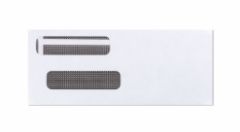
Double-window check envelopes display both the payee name and your return address through the windows when a business check is folded correctly. This eliminates manual addressing of outgoing check envelopes and creates a complete mailing package that carries your professional identity from the envelope exterior through to the branded check inside.
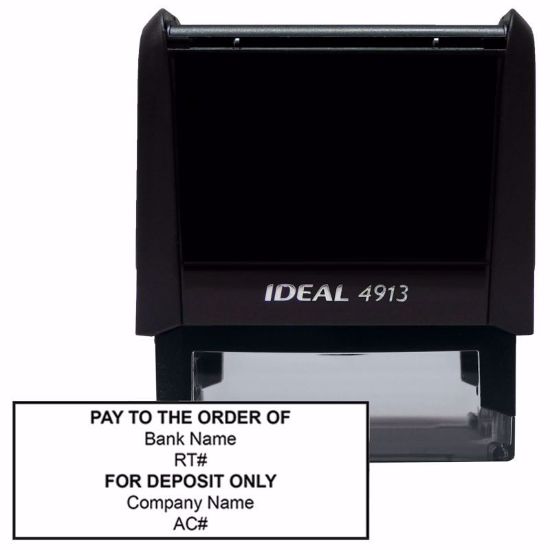
Self-inking endorsement stamps for endorsement, signature, and address applications extend the custom element to the operational side of check handling. An endorsement stamp with your business name and account number creates a consistently branded check deposit process that matches the quality of the custom checks you are issuing.
7-ring check binders store and organize custom manual business check stock in a professional, secure format. A well-organized check binder with your custom checks inside creates a professional impression when check books are handled in front of clients, vendors, or auditors.
Ordering custom checks from Checkomatic follows the same process as any check order, with the logo submission and design selection steps integrated into the checkout flow.
Start by selecting your check format from the personal or business check range. Choose your background color and style during the format selection step. Enter your name or business name, address, and any additional information lines. Set your starting check number. Enter your routing number and account number from the MICR line of an existing check.
At the logo step, upload your logo file in the highest-quality format you have: vector files (AI, EPS, vector PDF) first choice, high-resolution PNG second choice, JPG as a last resort. Indicate whether you want free black and white printing or color logo printing. If you want color, the small additional fee is applied at checkout.
Before approving production, review the digital proof carefully. The proof shows your logo placement, your chosen background color and style, all information fields, and the MICR line at the bottom. Verify your routing number and account number digit by digit before approving. Verify your business or personal name spelling, your address, and your logo appearance. Once approved, production begins and corrections require a new order.
Standard orders ship in three to five business days from proof approval. Rush delivery is available at checkout if you need the checks faster.
For our full guide to the ordering process step by step, see our how to order checks online guide. For the pricing picture, see our cheap checks online guide covering direct manufacturer pricing vs bank markup.
Checkomatic has manufactured personal and business checks in Monroe, NY since 1997. That Monroe NY facility produces every check in-house with full in-house manufacturing control. The free logo printing on every order is not a promotional offer or a tier benefit. It is the standard product. No setup fee, no design review charge, no minimum order for logo printing. Every check order ships with your logo applied as part of the base price.
Most check manufacturers treat logo printing as an add-on. Checkomatic includes it free. Submit your logo file at checkout, and it prints on every check in the order with no additional charge. This applies to personal checks, business checks, QuickBooks checks, manual checks, and every other format in the catalog.
Color logo printing is available for a small additional fee per order. No design setup charge. No color separation fee. Submit the color file at checkout, indicate color printing, and the fee is applied at the order total step. There is no per-check color charge; the fee applies to the order batch regardless of quantity.
Personal and business check customization at Checkomatic includes multiple background colors and style categories including marble, safety, prismatic, and diamond textures. The combination of color background, background style, and logo creates a genuinely personalized check without requiring a graphic design engagement.
Every custom check order includes a digital proof before production. You see exactly how your logo, background color, and information layout will appear on the finished check. Approve only when everything looks correct. This proof step is especially important for custom checks because the logo placement and color combination need visual confirmation before a full batch prints.
Custom does not mean less secure. Every Checkomatic check, regardless of design configuration, ships on ABA-compliant security stock with all six fraud deterrent features as standard. The CPSA certification applies to every format in the catalog. Your customized logo check has the same security properties as any check produced by a bank's fulfillment vendor.
Start your custom check order at checkomatic.com. For personal check options, see the personal checks range. For business check options, see the business checks range. For a comparison of personal vs business check types, see our personal checks vs business checks guide.
Custom checks are standard checks with your logo, your color choice, and your background style applied. They process at every bank identically to plain checks. The security paper beneath the design is ABA-compliant and carries all six standard fraud deterrent features regardless of what is printed on top of it.
Checkomatic includes free black and white logo printing on every order with no setup fee. Color logo printing is available for a small additional charge. Background options include marble, safety, prismatic, and diamond textures across multiple color choices. The digital proof before production lets you confirm exactly how the finished check will look before any paper is printed.
The main constraints on custom check design are copyright and trademark: images you did not create yourself, licensed sports and entertainment logos, and images of other people without consent cannot be printed. Original business logos and personal photography are always safe to submit.
Yes. Custom check designs are printed on the same ABA-compliant security stock as standard plain checks. The design, whether a logo, a color background, or a marble pattern, sits on top of security paper that already contains chemically reactive paper, microprinting, heat-sensitive ink, void pantographs, genuine watermarks, and UV-reactive fluorescent fibers. None of these features are affected by the addition of a custom design. A custom check from a CPSA-certified, ABA compliant manufacturer like Checkomatic carries identical fraud protection to a plain check on the same paper grade.
Vector files, including AI, EPS, or vector-embedded PDF formats, produce the sharpest results because they scale to any size without losing quality. If a vector file is not available, a high-resolution PNG with a transparent background is the best alternative. The minimum useful resolution for raster logo files is 300 DPI at the intended print size. Submitting high resolution files ensures sharp, clear printed results. Files below this threshold produce blurry results. Logos submitted at screen resolution (72 or 96 DPI) will print blurry. Black and white logos should be submitted in true black and white rather than grayscale for the cleanest printed result, particularly for free black and white logo printing.
No. Copyrighted images require explicit written permission from the copyright holder before they can be printed on checks. Licensed images and intellectual property, including sports team logos (NFL, MLB, NBA, NHL, and college teams) and entertainment characters, cannot be printed unless the manufacturer holds a licensing agreement. Images of identifiable individuals without their written consent are also excluded. Original business logos and personal photography you took yourself are always safe. Original artwork you created or commissioned with full copyright ownership is safe.
No. The logo and background design appear in the upper portion of the check face and do not interact with any functional banking field. The MICR line at the bottom of the check, carrying your routing number, account number, and check number, is encoded in magnetic ink regardless of what is printed above it. Bank processing equipment reads the MICR line magnetically and does not interact with the design area at all. A check with a full-color business logo processes identically to a plain check, as long as the MICR line is correct.
Free black and white logo printing, included on every Checkomatic order at no charge, reproduces your logo in solid black on the check background. This works well for logos built around clear line art, strong typography, and high-contrast icons. Color logo printing reproduces your logo in its original colors, which matters most for brands where color is central to visual identity. Color logo printing is available from Checkomatic for a small additional fee per order. Neither option carries a setup fee or design review charge.
Jul 01, 2026
When your business receives a check, three things have to happen before that money reaches your account. The back of the check needs an endorsement. That endorsement needs to match your account details. And it needs to be consistent across every check in the batch, because a missed character or inconsistent account number causes deposit processing errors.
An endorsement stamp solves all three requirements at once. It is a custom stamp pre-configured with your business name, bank name, account number, and endorsement text, designed to imprint all of that information on the back of a check in a single impression lasting under a second. Instead of handwriting the same four lines on every check before depositing, you press a stamp and move to the next one.
Endorsement stamps are primarily used on the back of check for deposit into your account. Specifically, the endorsement area on the back of incoming checks receives the stamp impression. They are also called bank deposit stamps, check deposit stamps, or deposit only stamps. All of these terms refer to the same product: a custom stamp that provides a fast, consistent, bank-acceptable endorsement on check backs before deposit.
The endorsement stamp sits alongside your other check-related tools. Businesses that receive checks regularly use endorsement stamps alongside their business deposit slips and check binders to process incoming payments accurately and efficiently.
Before getting into the stamp itself, it helps to understand what an endorsement is and why the type of endorsement matters. US commercial law, specifically Uniform Commercial Code Article 3, recognizes four main types of check endorsement. The type you use on an incoming business check determines who can negotiate it and under what conditions.
A blank endorsement is a signature alone, with nothing else written. A check endorsed this way becomes payable to the bearer, meaning anyone who has the check can cash or deposit it. A blank-endorsed check that is lost or stolen is essentially as easy to misappropriate as cash. Most financial experts and banks advise businesses against using blank endorsements because the risk exposure is significant, especially for high-value checks or checks transported between your mailroom and bank branch.
A restrictive endorsement places a condition on how the check can be negotiated. The most common restriction is "FOR DEPOSIT ONLY" combined with an account number. A check bearing a restrictive endorsement can only be deposited into the designated account. It cannot be cashed at a teller window, signed over to a third party, or deposited into a different account. This is the standard and recommended endorsement type for business check deposits, and it is what an endorsement stamp produces.
A special endorsement, also called an endorsement in full, transfers the check to a named third party: "Pay to the order of [name]" followed by the endorser's signature. This type is used when a business or individual wants to sign a received check over to another party rather than depositing it. It is uncommon in standard business banking operations.
A qualified endorsement includes the phrase "without recourse," which limits the endorser's liability if the check is later dishonored. This type is primarily used by financial institutions and professionals who negotiate checks on behalf of clients. It is rarely used by standard business depositors.
For almost every business's incoming check processing, a restrictive endorsement via a custom endorsement stamp is the correct choice. It is what banks expect, what protects your deposits, and what the stamp is specifically designed to provide.
The deposit protection that a restrictive endorsement provides is more significant than most people realize, and it is the main reason using an endorsement stamp matters beyond simple efficiency.
Under UCC 3-206 (UCC Section 3-206), a bank that takes a check in violation of a restrictive endorsement is liable to the endorser. If a check stamped "FOR DEPOSIT ONLY [account number]" is deposited into a different account, cashed, or otherwise handled contrary to the restriction, the bank bears liability for the resulting loss. Without a restrictive endorsement, the depositor bears a much greater share of the fraud risk.
In practical terms: if your incoming check pile is stolen before deposit and a check has only a blank endorsement (or no endorsement at all), that check is negotiable. Someone can take it to a bank and cash it or deposit it. If that same check has a restrictive endorsement with your account number stamped on the back, it can only go into your account. The thief cannot do anything useful with it. The stamp turns a negotiable instrument into something that only benefits you.
This is why financial advisors, accountants, and bank compliance officers consistently recommend endorsing incoming business checks with a restrictive stamp as soon as they arrive, before they are sorted, filed, or transported. The moment a check arrives in your mailroom is the moment it should be stamped. Do not wait until you are ready to make the deposit. Stamp first, sort second.
The standard format for a business check endorsement stamp is a five-line block of text in capital letters with no punctuation. Every line should appear in exactly this order, following the format most US banks accept without issue:
Each element serves a specific purpose. "PAY TO THE ORDER OF" on the first line signals that this is an endorsement directing payment. Your bank name on the second line identifies the financial institution where the deposit should go. "FOR DEPOSIT ONLY" on the third line creates the legal restriction that protects the check from being cashed or redirected. Your business name on the fourth line identifies the account holder. Your account number on the fifth line directs the deposit to the specific account.
Some banks and stamp manufacturers use a slightly different order, placing the account number earlier or combining lines. Some formats include the bank's routing number, though this is less common on endorsement stamps than on deposit slips. The most universally accepted format is the five-line version above. If your bank has specific endorsement stamp requirements, request their preferred format before ordering a custom stamp.
One format variant worth knowing: some businesses prefer to omit "PAY TO THE ORDER OF" and use a simpler format:
Both formats are widely accepted. The shorter format works well on smaller stamp sizes where line count is limited. The longer format with "PAY TO THE ORDER OF" is traditional and more common in formal business banking contexts.
Endorsement stamp text should always appear in capital letters. No periods, commas, or other punctuation. The lack of punctuation is a convention that dates to early banking automation, and it remains the standard because it reduces the chance of optical character recognition errors in check processing systems.
Three physical stamp technologies are available for check endorsement: self-inking stamps, pre-inked stamps, and traditional rubber stamps with a separate ink pad. Each has real practical differences for business use.
Self-inking stamps are the most popular choice for business check endorsement and the format Checkomatic sells. The stamp housing contains a spring-loaded impression plate attached to an integrated ink pad. When you press the stamp face down onto the check, the plate swings through the ink pad and then stamps the paper in a single motion. When you lift the stamp, the plate resets and re-inks automatically for the next impression.
The practical advantages over alternatives are significant. There is no separate ink pad to manage, knock over, or dry out between uses. The impression is consistent on every use because the plate always contacts the same ink pad at the same pressure. Self-inking stamps typically produce 5,000 to 50,000 impressions per pad fill before needing re-inking. The ink is contained inside the housing, so there is no smearing from open pad exposure between uses. Most self-inking stamps are rated for thousands of impressions before requiring a refill, making them durable enough for daily business use across years of service.
The standard impression area for a business check endorsement stamp is approximately 2 3/8 inches by 7/8 inches. This size fits within the endorsement area on the back of a standard business check (the 1.5-inch zone at the left end of the back) while leaving room for the stamp text across five or six lines. Checkomatic's self-inking custom stamps are built with this endorsement area in mind and are designed to produce a minimum of 1,000 clean impressions per ink pad fill.
Pre-inked stamps embed ink directly into a porous polymer or foam impression plate rather than using a separate pad. The ink disperses gradually through the plate material with each impression. Pre-inked stamps typically produce sharper, more detailed impressions than self-inking stamps because there is no ink-pad-to-plate transfer step. The impression comes from a consistent ink concentration in the plate material itself.
Pre-inked stamps tend to be more compact than self-inking versions because they do not need space for a separate pad housing. They also apply with less pressure, which some users prefer. Re-inking requires adding liquid stamp ink directly to the plate, which is less intuitive than replacing or refilling an ink pad.
For standard business endorsement use, both self-inking and pre-inked produce excellent results. Self-inking is more common in business environments because the re-inking process is simpler and replacement pads are widely available. Pre-inked is preferred by users who want the finest impression quality.
Traditional rubber stamps consist of a rubber or photopolymer impression plate mounted on a wood handle, plastic, or foam handle. They require a separate ink pad. The user inks the stamp by pressing it against the pad before each impression, then pressing it onto the check. There is no self-contained mechanism: inking and stamping are two separate steps for every impression.
Traditional stamps cost less upfront than self-inking or pre-inked options. But the two-step process is slower per check, the open ink pad dries out if not covered, and impression consistency depends on how the user inks the stamp each time. For businesses processing a high volume of incoming checks, the efficiency difference between a self-inking stamp and a traditional rubber stamp adds up quickly across thousands of check endorsements per year. For low-volume users who only endorse a few checks per week, a traditional stamp can work adequately at lower cost.
Using an endorsement stamp correctly takes under a minute to learn and the same half-second per check to execute. The process is consistent regardless of stamp type.
Locate the endorsement area on the back of the check. On a standard US check, the endorsement area is the short end of the check back, typically marked with a line and the text "Endorse here" or "Do not write, stamp, or sign below this line." The endorsement area is generally the 1.5-inch zone at one end of the check back. Some checks indicate this area in gray or with printed lines. Your stamp impression must fall within this zone.
Orient the check so the endorsement area faces you. Position the stamp so the impression plate will land fully within the endorsement area without extending over the boundary lines. The stamp text should be readable when the check is held with the front face up and the endorsement area at the top left.
For a self-inking stamp, press down firmly and evenly, then release. The impression happens automatically as the plate passes through the ink pad during your press. Lift straight up rather than rocking or sliding the stamp, which can blur the impression.
Check the impression after the first stamp on a new batch. The text should be crisp, black (or your ink color), and fully readable. All five lines should be visible. If the impression is faint, the ink pad may need refilling. If any lines are missing, the stamp may not have applied with even pressure.
Stamp the check as soon as it arrives, before it moves anywhere in your office. Every second a check spends without a restrictive endorsement is a window of vulnerability. Stamp incoming checks at the point of receipt, not at the point of deposit preparation.
Mobile deposit, also called remote deposit capture, has become a standard banking feature. Businesses and individuals use their phone's camera to photograph the front and back of a check and submit the images through a banking app. The convenience is real, but most banks have specific endorsement requirements for mobile deposits that differ from the standard in-person deposit endorsement, and many businesses are not aware of this distinction.
Most major US banks now require checks submitted via mobile deposit to include an additional endorsement notation beyond the standard "FOR DEPOSIT ONLY" text. Common requirements include adding "FOR MOBILE DEPOSIT ONLY" or "FOR REMOTE DEPOSIT ONLY" or "FOR MOBILE DEPOSIT AT [BANK NAME] ONLY" on a separate line below your standard endorsement. Some banks require just this phrase plus your account number, without the full five-line standard format.
This additional requirement exists because mobile deposit fraud involves submitting the same check to multiple banks using different photos. The "FOR MOBILE DEPOSIT ONLY" notation, when combined with your account number, ties the check specifically to one deposit channel at one institution, making it harder to submit the same check multiple times.
Banks including Chase, Bank of America, Wells Fargo, and others have published their mobile endorsement requirements in their mobile banking terms. Requirements change periodically. Before using your standard endorsement stamp for mobile deposits, check your specific bank's current mobile deposit endorsement policy. If your bank requires additional language, you may need a second custom stamp with the mobile-specific endorsement text, or a multi-line stamp that includes both the standard format and the mobile notation.
For businesses that split their deposits between branch and mobile, having two stamps, one for standard in-person deposits and one for mobile, is the cleanest solution.
A signature stamp reproduces a specific person's signature as a pre-set impression rather than an endorsement text. It is used on the front of outgoing checks where the authorized signer's signature is required, on invoices, on contracts, and on any document where a handwritten signature would otherwise be needed.
Checkomatic's self-inking custom stamps include signature stamp options. To order a signature stamp, you provide an image of your signature (typically a JPG or PNG file) and Checkomatic produces a custom stamp that reproduces that signature impression each time it is pressed. The stamp can be used by authorized staff to sign checks on behalf of the account holder without requiring the signer's physical presence for every transaction.
Signature stamps are particularly practical for businesses that print high volumes of payroll or accounts payable checks and need an authorized signature on each one. Rather than requiring the authorized signer to hand-sign hundreds of checks per payroll run, a signature stamp handles the signing step in the same time it takes to process a deposit batch with an endorsement stamp.
The legal and liability aspects of signature stamps deserve attention. The account holder is responsible for all checks signed with their stamp, regardless of who actually applied the impression. If an unauthorized staff member uses the stamp, the account holder bears liability for those transactions. Signature stamps should be stored securely, access should be limited to specifically authorized personnel, and their use should be tracked. Most banks do not verify individual check signatures during routine processing, but a disputed check requires proof that the signature was authorized.
For businesses that also print checks through QuickBooks or other software, signature stamps pair naturally with QuickBooks-compatible business checks and check-on-top business checks in a complete payroll and AP workflow.
An address stamp is a custom stamp pre-set with your business name, address, and optionally a phone number or website. It is used as a return address label substitute on outgoing envelopes, on check mailings, on invoices, and anywhere a return address is required without printing.
Checkomatic's custom stamp offering includes address stamps alongside endorsement and signature options. An address stamp eliminates the need to handwrite or print address labels on routine business mailings. For businesses that mail checks regularly, an address stamp on the envelope exterior and an endorsement stamp on the check back together create a complete mailing workflow that requires no handwriting and no label printing.
Address stamps work particularly well alongside double-window check envelopes. The double-window envelope displays both the payee address through the front window and your return address through the second window when the check is folded correctly. For check mailings using double-window envelopes, no address stamp is needed on the envelope because the check itself provides both addresses through the windows. An address stamp is most useful for non-check business mailings: invoices, contracts, correspondence, and any envelope that does not carry a self-displaying check.
Banks have guidelines about where and how endorsements must appear on check backs. These guidelines are not always published explicitly, but understanding the standard constraints helps you choose the right stamp size and use it correctly.
The Federal Reserve and banking industry standards designate the back of a check as having specific zones. The endorser's area, the zone where you apply your endorsement stamp, runs across approximately the first 1.5 inches from the trailing edge of the check (the left end when the check front is face-up and right-side up). The remaining area on the back is reserved for bank processing marks.
The standard business endorsement stamp impression area is approximately 2 3/8 inches wide by 7/8 inches tall. This fits comfortably within the endorsement area on standard business checks (which are 8.5 inches wide) and on personal checks (which are smaller). The impression produces up to six lines of text in a compact, legible block.
If the stamp impression extends beyond the endorsement area into the bank's processing zone, it can obscure routing or processing information added by banks during clearing, which can delay or reject the deposit. Using a stamp sized for the endorsement area and positioning it correctly prevents this problem. The standard 2 3/8 x 7/8 inch impression area is specifically designed to stay within bounds.
One practical note: the endorsement area is at the short end of the check, not the long side. Orient the stamp so the text runs parallel to the short end, not parallel to the long edge of the check. The most common orientation error is stamping on the wrong axis, producing text that runs the wrong way relative to the check's orientation during bank processing.
Self-inking stamp maintenance is minimal but necessary. When impression quality begins to fade, lighten, or show uneven ink distribution, the pad needs re-inking or replacement. Waiting too long causes impressions that are too faint to read clearly, which banks can reject or request re-endorsement on.
Most self-inking stamps use an ink pad that sits inside the housing behind the impression plate. The pad can be re-inked by adding stamp ink drops directly to the pad material, or by replacing the pad entirely with a compatible replacement unit. Stamp ink for self-inking pads is available in black, blue, and red. Black is the standard and most widely accepted color for endorsement stamps. Some banks specify black ink on endorsements, so use black unless your bank has confirmed that another color is acceptable.
Pre-inked stamps are re-inked by adding liquid ink directly to the impression plate surface. The plate absorbs the ink gradually. Over-inking a pre-inked stamp causes smearing on the first few impressions after a refill, so apply re-inking liquid sparingly and allow a few impressions on scrap paper before returning to checks.
Store stamps face-down or in a closed position to prevent the ink pad or impression plate from drying out when not in use. Avoid leaving stamps in direct sunlight or in hot areas like a car dashboard, as heat degrades the ink pad material and dries the ink faster. With proper storage, a quality self-inking stamp can remain functional for years between pad replacements.
Any business that receives checks regularly benefits from an endorsement stamp. The efficiency gain and fraud protection become more valuable as check volume increases, but there is a practical threshold below which the stamp pays for itself almost immediately.
A business receiving ten or more checks per week is a clear candidate. At ten checks per week, that is 520 checks per year. Handwriting four to five lines on 520 checks takes meaningfully more time than stamping 520 checks. The stamp pays for itself in the first month in staff time saved.
Property managers collecting rent checks, medical practices collecting patient payments, contractors receiving progress payment checks, retailers accepting check payments, professional service firms collecting client fees, landlords with multiple tenants, and nonprofit organizations processing donation checks all fall into this category. Each of these operations receives checks regularly enough that manual endorsement is a real inefficiency.
For businesses that receive personal checks and depositing via mobile banking apps, the endorsement stamp is even more valuable because mobile deposit requires a consistent, legible endorsement on every check. Banks are more likely to reject mobile deposits with handwritten endorsements that are inconsistent or partially illegible. A stamp guarantees the bank's mobile deposit system can read the endorsement clearly.
Small businesses and sole proprietors who receive only a few checks per month may not need a dedicated stamp, but many still find it useful because the stamp eliminates the possibility of accidentally depositing a check with a blank endorsement, which even low-volume operations can find themselves doing when in a hurry.
Ordering a custom endorsement stamp requires the same basic information that appears on the stamp: your business name, bank name, and account number. You also choose the stamp type, size, and ink color.
Gather the following before placing the order. Your business name exactly as it should appear on the stamp. Your bank or financial institution's name. Your checking account number for the account the deposits should go into. The stamp format you want (standard five-line endorsement, shorter format, or a custom arrangement). The ink color (black is standard and most broadly accepted).
At Checkomatic, the ordering process for self-inking custom stamps is simple: select the stamp type, enter your business and banking details across the stamp lines, choose your ink color, and complete the order. The stamp ships with your specific customization already set. No assembly or configuration is needed on arrival. You press the stamp and it immediately produces the correct endorsement on the first impression.
For signature stamps, upload an image of your signature in JPG or PNG format. Checkomatic produces the stamp from your uploaded signature image. The stamp impression reproduces the signature consistently on every check, invoice, or document it is applied to.
For address stamps, enter your business name, address, and any additional contact information you want on the stamp. The address stamp is useful for any business correspondence, check mailings, and outgoing envelopes where a return address is required.
Checkomatic has provided check-related products to businesses from Monroe, NY since 1997. That Monroe NY facility manufactures every product in-house. The self-inking custom stamp range at Checkomatic is designed specifically for businesses that use checks: endorsement stamps for incoming deposits, signature stamps for outgoing check signing, and address stamps for business correspondence.
Checkomatic's stamps are sized and configured for check endorsement areas, check signature lines, and business envelope return addresses. They are not generic office stamps adapted for check use. The impression area and line capacity are calibrated for the standard business check format, so the stamp fits the endorsement zone correctly on the first use without guesswork about positioning.
Checkomatic's custom stamps are made using recycled plastics in the stamp housing, reflecting the same material responsibility the company applies across its product range. The stamp performs identically to standard housings while using a reduced-impact material for the casing.
Ordering your endorsement stamp from the same company where you order your business checks means your business name, account number, and bank details are already familiar to the ordering system. Your stamp and your check orders can be coordinated without entering the same account information in two separate places. Checkomatic stocks all the check accessories a business needs in one place:
For businesses that handle both incoming and outgoing checks, the complete Checkomatic product range covers every tool in that workflow from the check you print and send to the stamp you press on checks you receive and deposit.
Start your stamp order at checkomatic.com/endorsement-stamp-3. For more context on check endorsement as part of a broader check process, see our complete guide to endorsing a check, our full check accessories range, and our accounts payable checks and our check fraud prevention guide.
An endorsement stamp replaces handwriting on every incoming check you deposit. It produces a consistent, bank-accepted restrictive endorsement in under a second per check. The restrictive endorsement, the "FOR DEPOSIT ONLY" line combined with your account number, provides legal protection under UCC Section 3-206 that limits what anyone can do with a check if it is lost, stolen, or mishandled before deposit.
Self-inking is the right choice for most business use: no separate ink pad, consistent impressions, thousands of uses per pad fill, and no two-step inking process. The standard stamp text runs five lines in capital letters with no punctuation. Mobile deposits may require additional endorsement language beyond the standard format, so check your bank's current mobile deposit policy before using a standard stamp on checks going to a mobile deposit.
Signature stamps and address stamps handle the outgoing side of the same operation. Together, the three stamp types cover endorsing incoming checks, signing outgoing checks, and addressing outgoing envelopes, eliminating handwriting from the routine tasks of business check processing entirely.
The standard business endorsement stamp format uses five lines in capital letters with no punctuation: PAY TO THE ORDER OF on the first line, your bank's name on the second line, FOR DEPOSIT ONLY on the third line, your business name on the fourth line, and your checking account number on the fifth line. The critical elements are FOR DEPOSIT ONLY and your account number, which together create a restrictive endorsement. Some businesses use a shorter format starting directly with FOR DEPOSIT ONLY. Check with your bank for their preferred format if you are unsure, since requirements vary slightly by financial institution.
A self-inking stamp contains a spring-loaded impression plate and a built-in ink pad. Each time you press the stamp, the plate automatically contacts the pad and then the check in one motion, re-inking itself for the next impression. Self-inking stamps produce thousands of impressions and use replaceable or refillable ink pads. A pre-inked stamp has ink embedded directly in the porous impression plate material, producing sharper, finer impressions with less pressure. Pre-inked stamps are more compact but require liquid ink refills applied to the plate rather than pad replacement. For most business check endorsement use, both types perform well. Traditional rubber stamps require a separate ink pad and two steps per impression, making them slower for high-volume check processing.
Most banks require additional endorsement text for mobile deposits beyond the standard FOR DEPOSIT ONLY format. The common requirement is adding FOR MOBILE DEPOSIT ONLY or FOR REMOTE DEPOSIT ONLY on a separate line. Some banks specify a format that includes the bank's name within the mobile deposit phrase. Requirements vary by institution and change periodically, so check your bank's current mobile deposit endorsement policy before stamping checks intended for mobile submission. Using a standard endorsement stamp on mobile deposit checks may cause the deposit to be rejected if your bank requires the mobile-specific notation.
In most states and for most business check types, signature stamps are legal when authorized by the account holder and used only by authorized personnel. The account holder remains liable for all checks bearing the stamped signature, regardless of who physically applied the impression. Banks generally do not verify individual check signatures during routine processing. If a check is disputed and a signature stamp was used without authorization, the account holder bears the resulting liability. Signature stamps should be stored securely and their use limited to specifically authorized staff. Verify your state's commercial code provisions and your bank's policy before implementing a signature stamp program.
Most self-inking endorsement stamps produce between 5,000 and 50,000 impressions per ink pad fill, depending on stamp size and brand. Checkomatic's self-inking custom stamps are built for a minimum of 1,000 clean impressions and typically produce many more with normal use and proper care. When impressions begin to appear faint or uneven, the pad can be refilled with compatible stamp ink or replaced with a new pad. The high impression count makes self-inking the most economical stamp type for businesses processing regular check volumes. With proper storage away from heat and direct light, a quality self-inking stamp remains functional for years between pad replacements.
Jun 30, 2026
Banks do not manufacture checks. They never have. When you order checks through your bank's website, branch, or app, your bank sends that order to a check printing company, that company fulfills it, and your bank charges you a retail price that includes its own margin on top. You are paying for two businesses: the manufacturer and the distribution layer the bank adds between you and the product.
The major check printing companies that fulfill bank orders, including Harland Clarke (now part of Vericast) and Deluxe Corporation, produce the same product they sell to banks and to direct consumers. The paper is the same. The MICR encoding is the same. The security features are the same. The difference is who you are buying from and what margin sits between you and the factory.
Bank check pricing varies by institution and account type. Some banks charge around $12 to $13 per box for basic checks. Others charge $25, $27, $34, or $35. A few offer free checks for qualifying premium accounts. The price variance between banks has nothing to do with the product quality and everything to do with the margin each bank decides to apply. Citi and Truist near the top of that range are not producing a more secure or better-made check than Chase or Bank of America at the lower end. They are just charging more for the same fulfillment.
Third-party check manufacturers like Checks Unlimited, CheckSimple, and Checkomatic who sell directly to consumers remove the bank layer entirely. You order from the manufacturer, the manufacturer ships to you, and the price reflects manufacturing cost rather than retail cost plus bank margin. That is why online checks cost less. It is not a quality compromise. It is a channel difference.
The advertised box price is not the number that matters when comparing check options. The real cost is what you pay per check after accounting for quantity, format, and shipping. Checking the per-check cost rather than the box price is the only honest way to compare options.
Divide the total order cost, including shipping, by the number of checks in the order. A box advertised at $8.20 for 80 checks works out to about 10 cents per check before shipping. If shipping adds $3.99, the real cost is $12.19 for 80 checks, or about 15 cents per check. A box advertised at $17.99 for 240 checks, with free shipping, works out to about 7.5 cents per check. The more expensive box is actually cheaper on a per-check basis.
This per-check cost calculation matters even more when comparing across formats. Single checks always cost less per unit than duplicate checks. But if you need the carbonless copy for record-keeping and you skip duplicates, you are not saving money; you are shifting work to your reconciliation process, which has its own time cost. Calculate the per-check cost you are actually willing to pay based on the format you genuinely need, not based on the cheapest available option regardless of fit.
For business checks, per-check cost calculations become more relevant because volume is higher. A business writing 50 checks a month burns through a box much faster than a household writing five. A difference of 3 cents per check translates to $18 per year at 50 checks monthly. At 200 checks monthly, it translates to $72 per year. Bulk pricing at higher quantities amplifies these differences significantly.
This is the question most buyers actually have when they search for cheap checks online: is a cheap check going to work? Is it going to be rejected at the bank? Is it going to be less secure?
The answer depends entirely on the paper grade, not the price. A check's security comes from the stock it is printed on. ABA-compliant check security paper includes chemically reactive paper that reacts visibly to the washing solvents used in check alteration attempts, genuine foundry watermarks embedded in the paper fiber during manufacturing, microprinting along the signature line that appears as a solid rule to the eye but resolves as text under magnification, thermochromic heat-sensitive ink that disappears when rubbed and returns when released, void pantographs that produce the word VOID across the check face when photocopied, and invisible UV-reactive fluorescent fibers that glow under black light at bank verification points.
These features are in the paper. They are not applied after printing. They cost what they cost to produce regardless of what the retailer charges for the finished check. A check manufacturer who uses ABA-compliant security stock and sells at a lower price is not cutting corners on the paper. They are cutting out distribution margin.
A manufacturer who uses lower-grade paper to drive the price down is a different situation entirely, and this does happen in the market. The way to distinguish between them is to verify that the ordering page explicitly states the check is printed on ABA-compliant security paper with the standard security features listed. The CPSA padlock icon on the page confirms the manufacturer is a member of the Check Payment Systems Association and has agreed to meet its security standards. If neither the security features nor the CPSA icon appears anywhere on the ordering page, treat that as a warning sign and look elsewhere.
Checkomatic ships every check, including the most affordable personal checkbooks, on ABA-compliant (ABA compliant) security stock with all six check security features. Security is not tiered or sold as an upgrade. It is the baseline for every order that leaves Monroe, NY.
Duplicate checks cost more per box than single checks. The difference is modest across most manufacturers, typically a few dollars per box, because the carbonless copy paper added to each check sheet is not expensive to produce. But it is a real difference, and it is worth thinking through before defaulting to one or the other.
Single checks are the right choice if you already maintain a check register and record every payment as you write it, if your business uses accounting software that logs every printed check automatically, or if you simply want the lowest cost per check and are disciplined about tracking payments another way. Our check register guide covers how to maintain a complete register alongside single checks.
Duplicate checks are worth the extra cost if you do not consistently record payments elsewhere, if you write checks for people or vendors who might dispute a payment later, if your business needs a physical paper trail separate from your accounting software, or if you want an automatic backup of every check without any additional record-keeping step. The carbonless copy that stays in the book is a permanent record of what you wrote on the original. Date, payee, amount, check number: all captured at the moment of writing.
For businesses, duplicate manual checks are the standard choice for accounts payable and payroll because the carbon copy serves as the internal paper record that accounting staff can reference before the bank statement arrives. For households, single checks are common among buyers who reconcile via bank statement, while duplicate checks are common among buyers who want a record in the checkbook itself. There is no universal right answer, but there is a right answer for your specific situation.
Every reputable check manufacturer offers volume pricing. The per-check cost drops as you order more boxes in a single transaction. This is one of the most reliable ways to reduce what you pay per check without changing the product at all.
A single box of 100 personal checks might cost around $9 to $12 at direct manufacturer prices. Ordering four boxes at once might reduce that to $7 or $8 per box, depending on the manufacturer's tier structure. The checks are identical. You are simply committing to a larger quantity in exchange for a lower unit price. Some manufacturers also offer coupon codes for first-time orders or seasonal promotions, which can reduce the price further on an already-lower direct price. If you know you will use the checks, the math usually makes bulk ordering the obvious choice.
The consideration on the other side of bulk ordering is that your account information is printed on every check. If you move, change banks, or change your name between orders, a large stockpile of checks with the old information becomes a problem. For most people in stable living situations with stable banking arrangements, this risk is minimal. Ordering two to four boxes at once rather than one box at a time is a practical way to reduce cost without accumulating a quantity large enough that the outdated-information risk matters.
For businesses, the bulk ordering calculation is even more favorable because check consumption rates are higher. A business using checks for payroll and accounts payable may go through a box in two weeks. Ordering a six-month supply at once at volume pricing saves meaningfully over ordering monthly at single-box pricing, and the operational benefit of not reordering frequently has its own value in staff time.
The ordering process for cheap checks online almost always includes options to add services and products beyond the base check order. Some of these add genuine value. Others are margin builders that you probably do not need, especially if you are ordering from a manufacturer whose checks already meet ABA security standards.
Check ordering sites frequently offer identity theft and check fraud protection programs at checkout, typically as annual subscription add-ons priced between $20 and $40 per year. These programs, marketed under names like EZShield, FraudArmor, or SentryShield, provide check replacement coverage and identity restoration services if fraud occurs. For most buyers, these programs are unnecessary if the checks themselves are printed on ABA-compliant security paper with all six fraud deterrent features. The security paper is the primary defense against check washing and alteration. A separate subscription adds a recovery layer, not a prevention layer. If you are writing large checks frequently or have had fraud on your account before, evaluate the coverage carefully. For most buyers ordering standard personal checks for routine use, it is a skip.
Rush or expedited in-plant processing upgrades reduce the time from order approval to shipping, typically by one to two business days. Standard processing from proof approval to shipment at Checkomatic is three to five business days. If you do not urgently need the checks, standard processing is the right choice and costs less. The time to order checks is when you have twenty to thirty remaining in your current book, not when you have run out. Planning ahead eliminates the need for rush fees entirely.
Address label sets are commonly offered as add-ons to check orders. If you mail checks regularly and want your return address pre-printed on labels, they can save time. If you print your own address on envelopes or use window envelopes that display the payee address through the window, address labels are an unnecessary extra cost. Double-window check envelopes from Checkomatic display both the payee and return address through the window when the check is folded correctly, eliminating the need for separate address labels entirely on check mailings.
Decorative checkbook covers are offered at checkout by many manufacturers. A basic cover for protecting the checkbook is included with most personal check orders. Buying an upgraded decorative cover adds cost without adding any functional benefit to the check itself. The cover does not affect security, compatibility, or performance. Skip it unless you have a specific preference for a cover style you cannot get with the standard order.
Checkomatic's personal check range covers every standard format at direct manufacturer pricing. No bank margin. No retail markup. Every format below ships on ABA-compliant security stock with all six security features and includes free black and white logo printing on every order.
The standard personal checkbook in blue, burgundy, and green. Available in single and duplicate format. Each order includes deposit slips and a check register. Multiple colors at the same price, which no bank offers. Start at the personal checkbooks page.
Spiral-bound top stub format with a record stub above each check. Four style options. The stub stays in the book after the check tears away at the bottom perforation, giving you a permanent record alongside your register. Available at personal top stub checks.
Larger format personal checks designed for writing at a desk. More space on the stub and check face. Preferred by buyers who write frequent checks at home or in a home office. See personal deskset checks.
Secretary deskbook format with an extended record section. Useful for households or small operations with detailed record-keeping needs. Available at personal checks and deskbook.
Wallet-sized personal checks formatted for QuickBooks personal check printing. For individuals who use QuickBooks for personal financial management and want to print checks from the same platform. See QuickBooks wallet checks.
Business checks cost more than personal checks because they are larger, use more paper, and often require specific layout formatting for accounting software compatibility. But the same principle applies: ordering directly from an in-house manufacturer eliminates the retail and bank markup that drives up business check costs at other channels.
Computer checks are business checks designed to print from accounting software. The layout matters because it must match the print template your software uses. Checkomatic's computer business check range covers all four standard layouts:
Manual business checks are handwritten rather than printer-filled. No software setup, no alignment testing, no printer required. Your business name, address, and check number are pre-printed at the factory. You fill in the payment fields by hand. Checkomatic's manual business check range includes:
All manual business checks from Checkomatic include free black and white logo printing. Your business name and logo appear on every check, creating consistent professional branding on every payment you send.
QuickBooks-compatible checks are one of the most searched business check categories online because Intuit's own check ordering portal sells them at a substantial markup. Intuit outsources QuickBooks check printing to Deluxe Corporation and applies a retail margin. Ordering directly from a CPSA-certified manufacturer that produces QuickBooks-formatted checks delivers the same product at direct pricing.
Checkomatic's QuickBooks checks are formatted for QuickBooks Desktop and QuickBooks Online print templates in three layouts: check on top, three-on-a-page, and wallet personal format. A QuickBooks starter pack and a manual starter pack is available for businesses setting up check printing for the first time, which includes everything needed to configure and test the template alignment before committing to a full order. Ordering QuickBooks checks directly from Checkomatic instead of through Intuit's portal is one of the clearest direct savings available to small business owners who print payroll or AP checks.
See our full guide to business checks and payroll for how computer check printing integrates into a full payroll workflow.
For businesses that print high volumes of checks through accounting software and want the lowest possible cost per check, blank check stock is worth considering. Blank checks are security-grade paper sheets with no pre-printed bank details. Your accounting software prints all the check information including the MICR line at print time, using a MICR toner cartridge and a compatible laser printer.
The per-sheet cost of blank check stock is lower than pre-printed checks because there is no personalization at the factory. The trade-off is that you need a MICR toner cartridge (a specialized laser printer toner that produces magnetic ink readable by bank processing equipment) and you are responsible for the accuracy of every MICR line your software prints. Pre-printed checks have the MICR line encoded at the factory under controlled manufacturing conditions. Blank stock printing puts that process in your hands.
For businesses printing hundreds of checks per month through well-configured accounting software with a reliable MICR printer setup, blank stock can meaningfully reduce per-check cost. For businesses printing occasional checks or without a dedicated MICR printing setup, pre-printed checks from Checkomatic are the simpler and more reliable choice.
Checkomatic's blank check stock is available in top, middle, bottom, and three-per-page layouts, plus a Z-fold pressure seal format for payroll and AP checks that self-seal for mailing without a separate envelope, further reducing per-payment cost for high-volume check operations.
Some check accessories are worth ordering alongside cheap checks because they reduce the time cost of check-related tasks, which has its own value even if it does not lower the per-check price.
Self-inking endorsement stamps pre-printed with "For Deposit Only" and your account number eliminate the need to manually endorse every incoming check before depositing. For businesses receiving multiple checks daily, this saves meaningful time across hundreds of deposits per year. The stamp pays for itself quickly in labor time saved.
Business deposit slips pre-printed with your routing and account number eliminate manual writing on every deposit. Padded sets tear off cleanly. The consistency also reduces errors on deposit transactions, which have their own cost when they require bank correction.
Double-window check envelopes display both the payee and return addresses through the windows when the check is folded correctly, eliminating manual addressing of every outgoing check envelope. For businesses mailing checks to vendors and payees regularly, this eliminates a repetitive step entirely.
7-ring check binders store and organize business check stock securely. A physical binder keeps check stock from being lost, damaged, or accessed by unauthorized staff, which has a real value in businesses where multiple people handle financial documents.
Lower prices should prompt verification, not automatic suspicion. Most direct-to-consumer check manufacturers are operating exactly as described: producing the same ABA-compliant product at manufacturing cost without a retail or bank layer. But not all manufacturers use the same paper grade, and some do cut corners on security to drive prices below what quality stock allows.
The Check Payment Systems Association sets the security standards for check paper in the United States. Member manufacturers agree to use ABA-compliant security stock and submit to CPSA oversight. Look for the CPSA padlock icon on the check manufacturer's ordering page or product descriptions. Harland Clarke, which produces checks sold through Costco, Sam's Club, and Walmart, is CPSA-certified. Deluxe Corporation, which produces checks sold through Intuit's QuickBooks portal and many banks, is CPSA-certified. Checkomatic is CPSA-certified. A manufacturer that does not display this certification or cannot confirm it is not the cheapest option you want, regardless of their price.
A legitimate manufacturer states what security features their paper includes. Look for explicit mention of chemically reactive paper, microprinting, heat-sensitive ink, watermarks, and void pantographs. A product description that says only "quality check stock" without naming the specific security features is not giving you enough information to evaluate the product.
Any reputable manufacturer shows you a digital proof before printing begins. This is both a quality control step and a signal of how the manufacturer operates. A manufacturer that ships without a proof review gives you no opportunity to catch errors before they become a batch of unusable checks. This matters for cheap check ordering because the cost of a reorder on an incorrect batch erases any savings from the lower price.
Checkomatic has manufactured checks from Monroe, NY since 1997. That Monroe NY operating history is verifiable, traceable, and meaningful. A manufacturer that launched recently or lacks a verifiable physical address and phone number is a higher-risk choice regardless of price. The check ordering process requires you to hand over your routing number and account number. Knowing who you are giving that information to matters.
Checkomatic is an in-house manufacturing check printer that manufactures every check we sell in our Monroe, NY facility. We do not broker orders to a fulfillment vendor. We do not resell another manufacturer's product under our name. When you order from Checkomatic, your check goes from our production floor to your mailbox without passing through a bank, retailer, or distributor that adds its own margin.
That is why our pricing is direct. We charge what it costs to manufacture and ship an ABA-compliant check, not what a bank would charge to resell the same product through their channel. The security features are the same as any bank-ordered check. The paper grade is the same. The MICR encoding process is the same. The digital proof step before production is a step that most banks' fulfillment vendors do not offer at all.
Logo printing in black and white is included at no extra cost on every Checkomatic order, personal or business. Most check manufacturers charge a setup fee or per-order fee for logo printing. Color logo printing is available from Checkomatic for a small additional fee. You get a branded, personalized check without paying the logo surcharge that other manufacturers treat as a premium add-on.
Personal checks, business checks, QuickBooks checks, manual checks, blank check stock, and every accessory your check operations require are available from one manufacturer under one account. Reorder checks quickly because your previous order is stored in your order history. You update the starting check number and the previous order details carry forward.
Every routing number submitted to Checkomatic passes through three verification steps before the digital proof is generated: the ABA check-digit formula validation, a live match against the Federal Reserve E-Payments Routing Directory, and a cross-reference between the bank name on the order and the bank name in the Fed directory. Orders that fail any of these steps are paused and reviewed before printing. This is why Checkomatic does not produce batches with incorrect routing numbers, which is the most common cause of unusable checks and the single most expensive mistake in any check order.
Start your order at checkomatic.com. For more context on what the ordering process involves, see our complete how to order checks online guide. For a breakdown of the check types available, see our types of checks guide and personal vs business checks comparison.
Cheap checks online are not a compromise. They are a different distribution channel for the same product. Banks charge more because they add a margin on top of the manufacturer's price. Direct manufacturers like Checkomatic do not. The security features, paper grade, MICR encoding, and banking compatibility of an ABA-compliant check ordered from a CPSA-certified manufacturer are identical to those on a bank-ordered check.
The ways to genuinely reduce cost on checks are: order from a direct manufacturer rather than through a bank or retail reseller; order multiple boxes at once to trigger bulk discount and volume discount pricing on bulk check orders; choose single checks if you maintain a register elsewhere; skip add-on services the manufacturer's security paper already makes unnecessary; and use standard shipping when you plan ahead. The ways that appear to save money but can create problems: choosing a manufacturer who has not confirmed CPSA membership or ABA-compliant paper, skipping the proof review step, or using an incorrect routing number because you found a cheaper option and rushed through the order details.
Get the per-check cost right, verify the paper grade, review the proof, and the price difference between ordering online and ordering from your bank becomes purely a savings.
Major banks charge between roughly $12 and $35 per box for personal checks, with some premium banks charging more. Third-party check manufacturers sell ABA-compliant personal checks at manufacturing cost, typically well below bank pricing per box. The same security features, the same paper grade, and the same banking compatibility at a significantly lower price. The difference is purely the distribution channel: banks outsource to a manufacturer and add their own margin, while direct manufacturers like Checkomatic sell at cost without that layer in between.
Yes, as long as the manufacturer uses ABA-compliant security stock. The security of a check comes from the paper, not the price. ABA-compliant stock includes chemically reactive paper, microprinting, heat-sensitive ink, genuine watermarks, void pantographs, and UV fluorescent fibers. These features are the same on a 7-cent check and a 30-cent check if both are produced on the same security paper grade. Look for the CPSA padlock icon on the ordering page to confirm the manufacturer meets Check Payment Systems Association standards. Checkomatic ships every check on ABA-compliant security stock with all six features as standard.
Order directly from an in-house manufacturer rather than through a bank or retailer with an added margin; order multiple boxes at once to trigger bulk pricing; choose single checks over duplicate checks if you maintain a separate register; skip add-on fraud protection subscriptions if the manufacturer already provides ABA security paper; and choose standard shipping rather than rush delivery. Ordering from Checkomatic, which produces in-house in Monroe, NY, eliminates the fulfillment middleman that drives up cost at most major retailers and banks.
Yes. QuickBooks-compatible checks from any CPSA-certified manufacturer work with QuickBooks Desktop and QuickBooks Online regardless of price. The layout determines compatibility, not the cost. You need checks printed in the format your software uses: check-on-top, check-in-middle, check-on-bottom, or 3-on-a-page. Checkomatic's QuickBooks checks are formatted for standard QuickBooks templates and carry the same ABA-compliant security features as every other check in the catalog.
Skip third-party fraud protection subscription programs if the manufacturer already ships on ABA-compliant security stock with all six standard fraud deterrent features. These programs add annual fees for recovery services that most buyers never use. Also skip rush delivery unless you genuinely need checks in two to three business days. Do not skip the duplicate format if you rely on the carbonless copy for record-keeping, because that record-keeping value outweighs the small cost difference. And do not skip the digital proof review: catching a routing number or account number error before printing is worth every second it takes.
Jun 29, 2026
The entire check ordering process depends on three numbers from your bank account. Without them, you cannot place an order. Gather these before opening any ordering page so the process runs cleanly in one sitting.
Your ABA routing number. A nine-digit number that identifies your specific bank or credit union in the US banking system. Every bank has at least one. Large national banks have several, one per region. The routing number for your paper checks may differ from the ACH routing number used for direct deposit or wire transfers. Use the routing number from the bottom of an existing check for the same account, not a number from a third-party lookup site.
Your checking account number. The number that identifies your specific account at that bank. It typically runs nine to twelve digits, though some banks use longer formats. It is printed on the MICR line at the bottom of every check you currently have.
Your starting check number. The number you want printed on the first check in your new order. This should continue from where your last checkbook ended. If your most recent check was number 452, start your new order at 453. Sequential check numbers create an unbroken paper trail that matters for bookkeeping, reconciliation, and any dispute resolution with a bank.
You also need your name and address exactly as you want them printed. For business checks, your business name, business address, and optionally your logo file. Having all of this in front of you before you start reduces errors significantly.
The MICR line is the row of numbers printed in magnetic ink at the bottom of every check. MICR stands for Magnetic Ink Character Recognition. Bank processing equipment reads these characters magnetically during the clearing process, which is why the numbers look slightly unusual compared to standard printed text. The font is called E-13B and was standardized specifically for machine readability.
Reading the MICR line from left to right, the three sections are:
Routing number (far left). The first nine digits, enclosed on each side by a transit symbol that looks like a colon with two vertical bars. These nine digits are your ABA routing number. The first two digits identify the Federal Reserve district, digits three and four identify the specific Federal Reserve office, digits five through eight identify the bank, and the ninth digit is a check digit calculated from the previous eight using a weighted formula. This built-in check digit is how Checkomatic and other manufacturers verify you have not transposed digits before printing.
Account number (center). The middle set of digits, following your routing number. This is your specific checking account number. It may be preceded or followed by process control symbols. The account number varies in length depending on your bank's formatting.
Check number (far right). The final set of digits, which matches the check number printed in the upper right corner of the check face. This is the number you want to continue from when ordering new checks.
When you order checks online, you type these three values exactly as they appear on the MICR line of an existing check. The manufacturer's system encodes them in the same E-13B MICR font using magnetic ink on the finished checks. Any transposition or substitution produces checks that process incorrectly or fail outright at deposit. For a full explanation of the routing number specifically, see our ABA routing numbers guide.
The first decision in any check order is the type of check you need. This is not just personal versus business. It determines the physical layout, the software compatibility, and the use case the check is designed for. Ordering the wrong type means the checks will not fit your checkbook, will not align in your printer, or will not work with your accounting software.
Personal checks are wallet-sized checkbooks used for everyday transactions: rent, utilities, personal payments, donations, and anywhere a check is the expected or required payment method. Checkomatic offers five personal check formats:
Business checks are larger than personal checks (typically 8.5 x 11 inches per sheet) and come in layouts designed for printing through accounting software or writing by hand. Checkomatic's business check range covers:
Manual business checks are handwritten rather than printer-filled. No software, no printer alignment, no computer required. You write the payee, amount, and date by hand, and the check prints with your business name, address, and check number pre-applied at the factory. Checkomatic's manual range includes:
QuickBooks-compatible checks are formatted to work with QuickBooks Desktop and QuickBooks Online print templates without manual alignment adjustment. Checkomatic's QuickBooks checks come in check-on-top, three-on-a-page, and wallet personal formats, with a QuickBooks starter pack available for new users.
Blank check stock is security-grade paper with no pre-printed bank details. Your accounting software prints all the check information, including the MICR line, at print time using a MICR toner cartridge. Checkomatic's blank checks come in top, middle, bottom, and three-per-page layouts, plus a Z-fold pressure seal format for mailing payroll checks without a separate envelope.
Every personal check format and most manual business check formats come in single and duplicate versions. This is one of the more consequential choices in the order because it affects your physical record-keeping.
Single checks are individual sheets. When you write and tear out the check, nothing stays in the book. The transaction is gone from your hand the moment you hand it over. You need to record it separately in a check register or rely on your bank statement for the record. Single checks cost less per box.
Duplicate checks include a carbonless copy behind every check. Writing on the original transfers pressure through to the copy, recording the check number, date, payee, and amount on the copy below. When you tear out the original, the copy stays in the book permanently. The signature does not transfer, by design. This is not a flaw: a permanent copy of your signature in an unattended checkbook is a security risk. Duplicate checks cost slightly more per box but eliminate the need to manually record every payment.
For most personal check users who write occasional checks for rent, utilities, or donations, duplicate format is the better default. The modest price difference is worth the automatic payment record in the book. For heavy check writers who already use accounting software or a detailed register, single checks may be the more practical choice.
Our full guide on how to use a check register covers both formats and when each one makes sense alongside your reconciliation process.
This step populates the printed fields on the upper portion of the check face. Errors here appear on every check in the batch and cannot be corrected after printing.
For personal checks, enter your full name as you want it to appear. Most people use first and last name. Joint account holders typically print both names, either on one line or stacked on two lines. Enter your current mailing address, including the city, state, and ZIP code. If you want an optional phone number on the check, enter it here. Some buyers add an email address instead of a phone number.
For business checks, enter your business name exactly as it appears on your bank account. Your registered business name and the name on your bank account must match, because banks verify the payee and drawer name on business checks during deposit. Enter your business address. This is also where you upload a logo file if you want it printed on the check. Logo printing in black and white is free on every Checkomatic order. Color logo printing is available for a small additional fee. Submit a high-resolution PNG or vector file for the sharpest result.
Verify every character before moving to the next step. Spelling errors, wrong ZIP codes, and wrong business names all require a full reorder to correct.
This is the most consequential step in the entire order. The routing number and account number you enter are encoded directly into the MICR line of every check in the batch using magnetic ink. These are the numbers banks read during processing. An error here means the check will not process correctly.
Enter your routing number from an existing check from the same account, not from your bank's website or a routing number lookup tool. Large banks have different routing numbers for different states and transaction types. The number on your existing check is definitively correct for paper check ordering for your specific account. Type all nine digits carefully. Do not add spaces, dashes, or any other characters.
Enter your account number from the MICR line of an existing check. The account number follows the routing number in the center section of the MICR line. Some banks use leading zeros that are easy to miss when reading. Count every digit and enter them all. Account numbers vary in length between banks, so there is no universal digit count to use as a verification check.
Enter your starting check number. This should be one more than the last check number you used from your current checkbook. Look at the upper right corner of your most recent check to confirm the number. If your last check was 0847, start the new order at 0848. Maintaining the check number sequence is required by most businesses for bookkeeping, and gaps in sequence can trigger questions from accountants and auditors.
If you do not have an existing check to copy from, because you are opening a new account or have completely run out, use the account number and routing number from your online banking portal's account details page. Contact your bank if the portal does not display them clearly. Do not order checks based on a number you found on a check-lookup website.
Check orders are priced on a sliding scale: more boxes means lower cost per check. A single box of personal checks typically contains 100 to 200 checks depending on format. Ordering two to four boxes at once significantly reduces the per-check cost and reduces how frequently you need to reorder.
At this stage you can also add check accessories to the same order:
The digital proof is a rendered image of exactly how your check will look when printed. Every field you entered is placed in its correct position on the check face. This is your last opportunity to catch an error before any paper is printed. Once you approve the proof, production begins and errors cannot be corrected without a new order.
Work through the proof systematically rather than scanning it for obvious problems. Go field by field:
The routing number and account number are the fields that matter most. A transposition of two digits in either number produces a batch of checks that either routes to the wrong bank or cannot be matched to a real account. Every single check in the order is affected. There is no partial correction; the entire order must be reprinted from scratch.
Checkomatic runs an additional server-side verification on every routing number submitted before the proof is generated. The routing number passes through three checks: the ABA check-digit formula, a match against the Federal Reserve's E-Payments Routing Directory, and a cross-reference between the bank name you entered and the bank name in the Fed directory. If the routing number fails any of these, the order pauses and we contact you before printing. This catches the most common error pattern, a wrong routing number, before it results in a useless batch of checks.
Banks do not manufacture their own checks. They outsource check printing to fulfillment vendors and add a markup on top. You pay the bank's margin every time you reorder from your branch or banking app. The markup is often substantial.
Major bank pricing per box (one box, standard personal checks, as of 2024 to 2025):
Third-party manufacturers sell the same ABA-compliant product at manufacturing cost without a bank's distribution margin. The checks meet identical security and compliance standards and are accepted at every financial institution in the United States. The paper grade, MICR encoding, and security features are the same.
The price difference is not a quality difference. It is a channel difference. Banks outsource and mark up. Checkomatic manufactures in-house in Monroe, NY (that Monroe NY facility has been operating since 1997) and sells direct. Every order that goes through Checkomatic goes from our production floor to your mailbox without a bank layer in between.
Two things banks do that third-party manufacturers cannot replicate: some banks offer free checks for premium account holders, and a bank already has your account information on file, making the reorder process a few clicks. If your bank provides genuinely free checks with no conditions and no account fee offset, that is hard to beat on pure cost. But if your bank is charging $20 to $35 per box, you are paying for a service that adds no value to the check itself.
This bank vs third party pricing difference is significant. See our full comparison of check ordering services for a side-by-side breakdown of options.
You are handing over your routing number and account number when you place a check order. That information is already on every check you write, so it is not inherently secret, but you still want to confirm the manufacturer handles it responsibly and produces checks that actually work.
The Check Payment Systems Association (CPSA) is the industry body that sets security standards for check paper and printing. Member manufacturers agree to use ABA-compliant security stock. The CPSA padlock icon on an ordering page is the fastest signal that the manufacturer meets these standards. It does not guarantee everything, but its absence is a red flag worth investigating before you proceed.
A legitimate check manufacturer will state explicitly what security features their paper includes. The six standard check security features on ABA-compliant stock are: chemically reactive paper that discolors when washing solvents are applied, genuine foundry watermarks embedded in the paper fiber during manufacturing, microprinting along the signature line that appears as a solid line to the naked eye but resolves as text under magnification, heat-sensitive thermochromic ink (also called heat sensitive ink) that disappears when rubbed and returns when released, void pantographs that cause the word VOID to appear across the check face when photocopied, and invisible fluorescent fibers that glow under UV light at bank verification points.
If a manufacturer's product page does not mention these features, their paper may be a lower security grade. All Checkomatic checks ship on ABA-compliant security stock with all six features as standard on every order, including personal checks.
A reputable manufacturer will show you a digital proof of your order before printing begins. If a manufacturer ships without a proof step, there is no opportunity to catch errors before they become a useless batch of checks. Checkomatic generates a digital proof on every order and requires your approval before production begins.
Checkomatic has manufactured checks from Monroe, NY since 1997. In-house manufacturing means direct accountability. The factory and the customer service team are the same company. There is no fulfillment middleman to blame when something goes wrong. Check any manufacturer's contact page for a real address, phone number, and established operating history before trusting them with your banking details.
Personal check ordering is the most common use case and the most accessible. You need your routing number, account number, and starting check number. Most personal check orders complete in under ten minutes from start to proof approval.
The main decision beyond check type and format is color. Checkomatic personal checks are available in blue, burgundy, and green. The color is the background tint of the check. It does not affect security features or banking compatibility. It does affect how the check looks when you hand it to someone or mail it. Some buyers consistently choose one color to make their checkbooks immediately recognizable among their belongings. Others choose a color that coordinates with their company branding when ordering personal checks with a business logo.
Free logo printing is included on every personal check order. If you have a personal logo, a professional mark, a farm or ranch brand, or a small business logo you want on your personal account checks, you can add it without any setup fee. Submit a high-resolution PNG or vector file at checkout.
Start at the personal checks page to see every format and color option before selecting.
Business check ordering involves one additional decision beyond what personal check ordering requires: which layout aligns with your accounting software. If you print computer checks through QuickBooks, Sage, Xero, or another platform, you need to match the check layout to the template that platform uses.
QuickBooks Desktop and QuickBooks Online both default to the check-on-top layout for standard AP and payroll printing. Sage 50 uses a check-in-middle layout. Most other platforms that support check printing use check-on-top as their default, but verify your software's check template settings before ordering.
If your business does not use accounting software to print checks and you write all checks by hand, a manual business check format is the right choice. Manual checks from Checkomatic arrive with your business name, address, logo, and check number already printed. You fill in the payment fields by hand.
Business check orders qualify for free black and white logo printing. Color logo printing is available for a small additional fee. A business check with your logo looks more professional than a plain check and signals to vendors and employees that your business has its financial processes organized. It is a small thing that creates a consistent impression across every payment your company makes.
Start at the business checks page for the full range of computer and manual formats.
Reordering is faster than the first order because you already know what you ordered and what works. Most manufacturers, including Checkomatic, store your previous order details in your account so you can reorder with a few clicks and just update the starting check number.
The starting check number is the one field that must change on every reorder. Look at the last check in your current book before placing the reorder, note the number, and set the new order to start one higher. Everything else, routing number, account number, name, address, format, can typically remain identical to the previous order.
A common mistake is waiting until you are completely out of checks before reordering. Standard delivery takes three to five business days from proof approval. If you run out on a Friday and need checks Monday, that timing does not work. Order when you have twenty to thirty checks remaining so the new batch arrives before the old one runs out. Rush delivery is available at checkout if you need faster turnaround.
Existing Checkomatic customers can log into their account and access order history directly. The reorder process from the order history page pulls your previous specifications automatically.
Checkomatic has manufactured personal and business checks from Monroe, NY since 1997. Every check ships on ABA-compliant, ABA compliant security stock with all six fraud deterrent features as standard. No upgrades, no tiers, no security add-ons to buy separately.
Checkomatic controls the full production process from paper sourcing to MICR printing to shipping. There is no outsourced fulfillment vendor between your order and your mailbox. In-house manufacturing means consistent quality control, faster turnaround, and direct accountability. When something needs to be corrected, you deal with the same company that made the product.
Black and white logo printing is included free on every personal and business check order. No setup fee. No additional charge. Color logo printing is available for a small fee. This is standard, not an upgrade.
Every routing number submitted to Checkomatic passes through the ABA check-digit formula, a live match against the Federal Reserve's E-Payments Routing Directory, and a cross-reference between the bank name on the order and the name in the Fed directory. Orders that fail any step are paused before printing begins. This catches the most common cause of unusable check batches before any paper is wasted.
You see a complete digital proof of your check before production starts. Verify every field, including the MICR line digits, before you approve. Standard orders ship in three to five business days from proof approval. Rush delivery is available at checkout.
Personal checks, business checks, QuickBooks checks, manual checks, blank check stock, deposit slips, check envelopes, binders, and endorsement stamps. Every product your checking account operations require, ordered from one manufacturer with one account login and one reorder process.
Start your order at checkomatic.com. If you are not sure which check type fits your situation, our personal checks vs business checks guide covers the differences in detail, and our types of checks guide maps out every format with the use cases each one serves.
You need five things: your ABA routing number (nine digits from the bottom-left of the MICR line on an existing check), your checking account number (the center digits on the same MICR line), your starting check number (one higher than the last check you used), your name or business name exactly as you want it printed, and your mailing address. For business checks you can also provide a logo file for free logo printing.
Both are on the MICR line at the bottom of any existing check from the same account. The routing number is the first nine-digit number on the bottom left, enclosed by transit symbols. Your account number is the middle set of digits. Your check number is the last set on the right. You can also find the routing number in your online banking portal under Account Details. For paper check ordering, always use the number from an existing check rather than a third-party lookup site. Large banks have multiple routing numbers and lookup sites are frequently outdated. Checkomatic's ABA routing numbers guide covers this in full detail.
Yes, with a reputable manufacturer. Look for the CPSA padlock icon on the ordering page, which confirms membership in the Check Payment Systems Association and compliance with ABA security standards. Verify that the product description explicitly lists chemically reactive paper, microprinting, and watermarks. Checkomatic has manufactured checks from Monroe, NY since 1997 and ships every order on ABA-compliant security stock with all six standard fraud deterrent features.
It depends on your bank. Major banks charge between approximately $12.66 and $35 per box for personal checks, with some like Citi near the top and Bank of America near the bottom. Some banks provide free checks for qualifying account types. Third-party manufacturers sell ABA-compliant checks at manufacturing cost without the bank's markup. The checks meet identical security and banking standards. The price difference reflects only the distribution channel, not the product quality.
Checks printed with an incorrect routing or account number are unusable. The routing number tells the banking system which bank to route the check to. An error routes the check to the wrong institution or returns it unpaid. An account number error means it cannot be matched to a real account at deposit. The entire batch must be reprinted from scratch. This is why reviewing the digital proof digit by digit before approving is the single most important step in the ordering process. Checkomatic also runs a server-side verification on every routing number before generating the proof, catching transpositions and invalid numbers before any paper is printed.