Blog

Jun 25, 2026

Check Stock Paper: Every Type, Format and Supply Explained

What Check Stock Paper Is and What Makes It Different

Check stock paper is not the same as office paper. Standard copier paper is manufactured for inkjet or laser printing with no properties beyond ink or toner adhesion and basic durability. Check stock paper is manufactured to prevent fraud, meet federal processing standards, and survive the multi-institution journey a check takes from the moment it is written to the moment the funds settle.

The differences start in the paper mill. Check stock paper uses a specific grain direction, weight, and fiber composition. Long-grain paper construction, where fibers run parallel to the long edge of the sheet, is the standard for check stock because it feeds more smoothly through laser printers and reduces curl. This construction reduces curl in high-speed printers, prevents toner from flaking off the MICR line during reader-sorter processing, and provides a substrate for security features that cannot be replicated on a standard desktop printer. Security features are embedded in the paper itself at the manufacturing stage, not printed on afterward. Genuine foundry watermarks are created during papermaking by varying fiber density in a Fourdrinier wire screen. Chemically reactive treatment is applied to the paper before it is cut. Thermochromic ink and void pantographs are manufactured into the paper structure rather than added as surface coatings.

A check printed on plain office paper may look like a real check. It will not have the physical properties that teller verification and bank processing equipment check for, and it is far more vulnerable to washing, counterfeiting, and imaging rejection.


Blank Check Stock vs Pre-Printed Checks

The most fundamental choice in check stock paper is whether to use blank check stock or pre-printed checks. The difference affects your printer requirements, your security posture, and your cost per check.


Pre-Printed Checks

Pre-printed checks arrive from the manufacturer with your business name, address, logo, routing number, account number, and MICR line already on the paper. When you print a check, your accounting software or check printing software fills in only the variable data: payee name, date, dollar amount, check number, and memo. Any standard laser or inkjet printer handles this because all the security-sensitive data is already present on the paper. No MICR printer or MICR toner is required on your end.

This is the model Checkomatic uses. Every business check, personal checkbook, QuickBooks check, and manual check ships with the MICR line and all banking details already printed using ABA-compliant magnetic ink at Checkomatic's Monroe, NY facility. You do not need a MICR printer. You do not need MICR toner. You load the checks into your printer and your accounting software does the rest.

The tradeoff with pre-printed stock is that each sheet carries live banking information from the day it arrives at your office. It needs to be stored securely, counted regularly, and reconciled against your check number sequence to detect missing sheets.


Blank Check Stock

Blank check stock arrives with nothing on it except the paper's built-in security features. No banking information, no account numbers, no routing numbers, no MICR line. Your accounting software and a MICR-capable printer must print all of this information at the time of use, including the critical MICR characters at the bottom of the check in magnetic iron oxide ink or toner.

The security advantage of blank check stock is that a stolen sheet is worthless without the MICR printing infrastructure to complete it. There is no account information to steal until the check is printed. The tradeoff is the required investment: a dedicated MICR laser printer, MICR toner cartridges certified to ANSI X9 standards, check printing software that generates MICR-compliant output, and ongoing management of that printing setup to ensure MICR quality never degrades.

For high-volume accounts payable operations issuing hundreds or thousands of checks per month, blank check stock with in-house MICR printing typically delivers the lowest cost per check. For most small and mid-size businesses issuing checks occasionally or regularly but not at industrial scale, pre-printed stock from a trusted manufacturer is simpler, equally secure, and does not require MICR printing infrastructure.

Checkomatic offers blank check stock in all standard formats for businesses that already have MICR printing capabilities and want flexible unencoded paper stock with full security features.


What MICR Is and Why It Still Matters in 2025

MICR stands for Magnetic Ink Character Recognition. It refers to the line of characters at the bottom of every check: the routing number on the left, the account number in the middle, and the check number on the right, printed in a standardized font called E-13B using magnetic iron oxide ink or toner.

When a check enters bank processing, it passes through reader-sorter machines at high speed. These machines detect the magnetic signature of each character in the MICR line to identify the issuing bank, the account, and the specific check number. The magnetic reading is the primary method; optical scanning serves as a backup. Because a check may pass through multiple reader-sorters at different institutions before settling, the MICR line must remain readable even after being handled, stamped, rubber-banded, and photocopied multiple times.

MICR is governed by ANSI X9.27 standards, which specify the font, character dimensions, placement tolerances, and ink signal strength required for compliant checks. The ABA requires that the routing number be readable to ANSI standard. Checks with MICR lines printed in standard toner, which contains no magnetic material, may be misread or rejected by processing equipment. A rejected MICR item typically results in a manual handling fee from the receiving bank, and repeated MICR failures can affect your banking relationship.

The key point for businesses choosing between blank and pre-printed stock: if you use pre-printed checks from a manufacturer like Checkomatic, the MICR line is printed with certified magnetic ink at the factory and you are fully ANSI-compliant before a single check leaves your printer. If you use blank check stock, maintaining MICR compliance is your responsibility. You need certified MICR toner, not remanufactured or generic toner, and the MICR line placement must fall within the ANSI-specified tolerance zone on every check. MICR toner quality degrades as cartridges age, so monitoring signal strength is an ongoing operational task for high-volume MICR printing environments.


Check Stock Formats: Top, Middle, Bottom, 3-on-a-Page

Check stock paper comes in four standard page layouts. The format determines where the check itself sits on the letter-size sheet relative to voucher stubs. Ordering the wrong format is the most common and most expensive check supply mistake a business makes, because the entire batch is unusable until a replacement order arrives.


Check-on-Top (Check on Top Format)

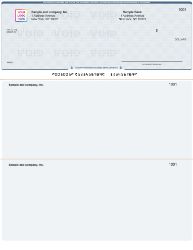
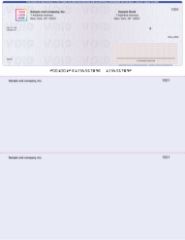
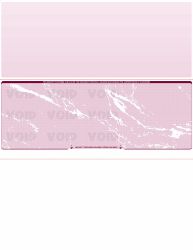
The check occupies the top third of the page. One or two detachable voucher stubs appear in the lower portion, separated from the check by a perforation. This is the most widely supported format and the default for QuickBooks, Quicken, and many other accounting platforms. The check-on-top layout works for both accounts payable and general business check printing. When you select "Voucher" as the check style in QuickBooks, it prints to a check-on-top sheet. Checkomatic's check-on-top business checks are compatible with all versions of QuickBooks and most other platforms that default to this layout.


Check-in-Middle (Check in Middle Format)

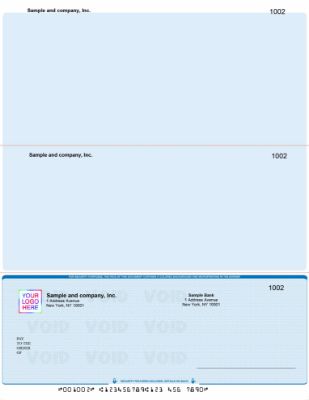
The check sits in the center of the page with one voucher stub above and one below. This is the standard format for Peachtree/Sage 50, Sage 100, and several specialized legal, real estate, and title software platforms. QuickBooks does not support check-in-middle for its standard payroll printing workflow. If your software is Sage 50 and you order check-on-top stock, every check in the batch will print misaligned. Confirm your software's required format before ordering. Checkomatic's check-in-middle format is certified compatible with Sage 50 and Peachtree.


Check-on-Bottom (Check on Bottom Format)

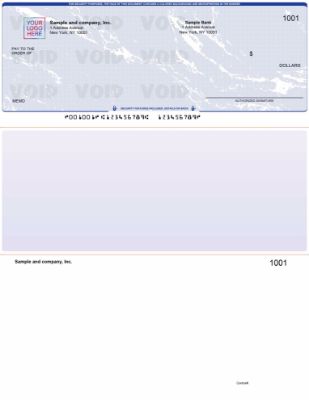
The check occupies the bottom third of the page. Stub information, which typically includes earnings details for payroll or purchase order details for accounts payable, appears in the upper portion. This format is used by Sage 100, some payroll systems, and a range of ERP platforms. It is less common than top or middle formats but important for businesses whose software specifically outputs to this layout. Checkomatic stocks check-on-bottom formats for businesses using compatible software.


3-on-a-Page (3 on a Page Format)

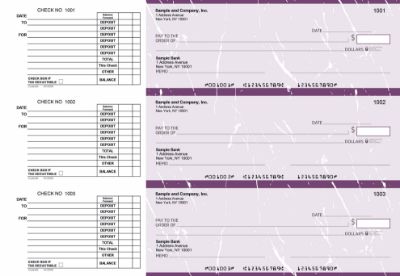
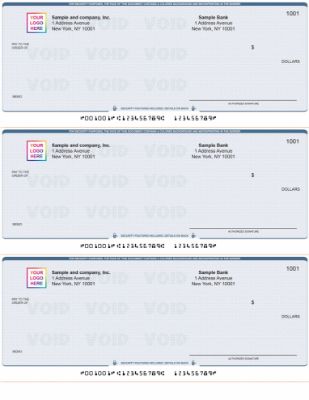
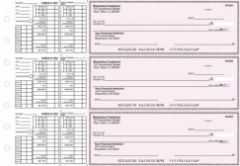
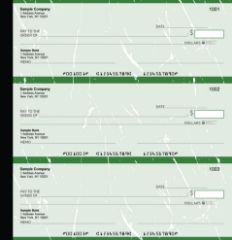
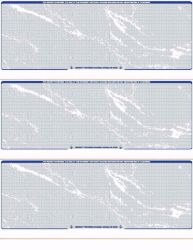
Three individual checks appear on a single letter-size sheet, separated by perforations. Each check is smaller than a standard business check and does not include a voucher stub on the same sheet. This format is used for high-volume accounts payable processing, payroll runs with large employee counts, and any situation where stub-level detail is tracked elsewhere in the software rather than on a physical tear-off. QuickBooks supports 3-on-a-page output. Checkomatic's 3-on-a-page checks are available in both business and payroll configurations.


Wallet Size

A compact format sized like a personal check, used by owner-operators and sole proprietors who print through accounting software but prefer a smaller check. QuickBooks supports wallet-size output as one of its check style options. Wallet checks do not include full voucher stub fields on the check itself; pay stub or remittance information prints separately. Checkomatic offers wallet-size formats through its QuickBooks checks page.


Software Compatibility by Format

Your accounting or payroll software determines which check stock format you need. There is no universal format that works everywhere. Ordering without confirming your software's required layout is one of the most common and costly check supply errors.

QuickBooks (all versions) defaults to check-on-top for business checks, with voucher being the standard check style. QuickBooks also supports 3-on-a-page and wallet. Sage 50 and Peachtree default to check-in-middle. Sage 100 and some Sage ERP versions use check-on-bottom. Microsoft Dynamics GP varies by configuration. ADP and Paychex payroll outputs depend on how the printing template is configured. Most check printing software allows you to specify a template layout; the template number or name tells you which physical paper format to order.

If you are unsure which format your software uses, the fastest way to find out is to open a test print in your software and identify whether the check face lands at the top, middle, or bottom of the print preview. Match that position to the format name when ordering. Checkomatic's digital proof review step, which happens before every order goes to press, confirms that your check number, routing number, account number, and format are all correct before any paper is printed.


Security Features on Check Stock Paper

The security features on check stock paper serve two distinct purposes. Visible features deter fraud by signaling to anyone handling the check that it is a genuine security document. Hidden features provide verifiable authentication that can confirm or deny a check's legitimacy during an investigation or dispute. Both categories are necessary for fully effective fraud protection.


Chemically Reactive Paper

This is the most important protection against check washing, which remains the most common form of physical check alteration. Chemically reactive paper contains agents that react visibly to the same household solvents used to remove ink from a check surface. When a criminal attempts to wash the payee name or dollar amount from a check printed on reactive stock, the paper itself stains permanently and visibly in the affected area. The reaction cannot be reversed or concealed, and the resulting staining signals tampering to any teller or processing system that inspects the document.


Genuine Foundry Watermarks

True watermarks are created during papermaking by shaping the paper fiber mat while it is still wet. The watermark appears as a lighter or darker area when the paper is held to light because the fiber density is different in that zone. A watermark printed on the surface of paper using white ink or bleach is not a genuine watermark and is visible as a flat printed mark rather than a translucent fiber variation. All Checkomatic check stock uses genuine foundry watermarks, and every product in the line meets or exceeds the security guidelines published by the Check Payment Systems Association (CPSA) created at the paper mill, not surface-printed imitations.


Microprinting

Text is printed at a scale so small it appears as a solid line to the naked eye but resolves into readable words under magnification. Standard photocopiers and printers reproduce microprinting as a blurred, unreadable line because they cannot resolve characters at that scale. Microprinting is typically placed along the signature line, the border, or the payee line area where an altered check would need to be cut or overprinted. Any attempt to reproduce the check mechanically degrades the microprinting to an obviously blurred line rather than clean characters.


Thermochromic Ink

Heat-sensitive ink that disappears temporarily when rubbed with a finger and reappears when released. The ink is typically printed as a small icon or band that a teller can verify in seconds at the point of presentment. A counterfeit check printed on plain paper cannot replicate thermochromic ink without the specialized manufacturing process used to embed it.


Void Pantograph

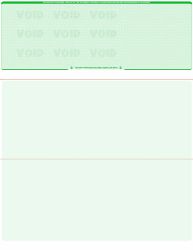
A background pattern designed so that when the check is photocopied or scanned at consumer printer resolution, the word VOID appears across the check face. The pattern is invisible at normal viewing but becomes clearly legible in copies. This deters the most basic counterfeiting attempt of simply photocopying a genuine check.


Invisible Fluorescent Fibers

Security fibers embedded in the paper that glow under ultraviolet light. Bank UV lamps, which are standard at most teller windows and check verification stations, reveal these fibers instantly. A counterfeit check on plain stock shows no fluorescent response under UV examination.


Security Warning Band

A printed panel on the back of the check listing the security features present in the document, which serves a dual purpose. It educates recipients about what to look for when verifying the check, and it signals to anyone handling the check that it is a security document produced by a professional manufacturer. The warning band also helps tellers identify checks that lack expected features, which flags potential counterfeits that lack the band entirely.

All Checkomatic check stock paper includes all six features above as standard on every order. There are no security tiers or upgrade packages. Every format, from personal checkbooks to 3-on-a-page business checks to blank MICR stock, ships on the same security paper.


Paper Weight and Why 24lb Is the Standard

Check stock paper weight matters for two reasons: printer performance and MICR toner adhesion. Most standard office paper runs at 20lb bond weight (75 GSM). This weight works for ordinary documents but creates problems in MICR check printing applications.

The ANSI X9.18 standard, which governs check paper specifications approved by the ABA, specifies 24lb bond paper (90 GSM) as the recommended weight for check stock. At 24 pounds, the paper provides sufficient thickness and rigidity to pass through high-speed reader-sorter machines without jamming or tearing. It also provides the surface texture and coating characteristics that allow MICR toner to adhere properly. MICR toner contains magnetic iron oxide particles that must bond firmly to the paper surface through the entire check lifecycle, including multiple machine readings, handling, and sometimes folding and mailing.

Some check stock manufacturers use long-grain paper construction at the 24lb weight, meaning the paper fibers run parallel to the long edge of the sheet. Long-grain paper feeds more smoothly through laser printers and reduces the curl that can cause misfeeds. Paper curl in a printer causes the MICR line to print outside its required tolerance zone, which can lead to processing rejections even when the toner content is correct.

A specific manufacturing feature worth knowing: some blank check stock includes a MICR positioning square, a faint printed marker on the paper that shows exactly where the MICR special characters should begin. This eliminates the need for a separate MICR gauge during printer setup and helps operators confirm alignment without test-printing multiple sheets. Not all blank stock includes this feature, but it is worth requesting when setting up a new blank-stock MICR printing operation.


Check 21 and How Imaging Requirements Affect Your Stock

The Check Clearing for the 21st Century Act, universally called Check 21, became effective in 2004 and fundamentally changed how paper checks travel through the banking system. Before Check 21, physical checks had to move from bank to bank to complete the clearing process. Check 21 authorized banks to create digital images of checks and exchange those images electronically, allowing the physical check to be truncated at the first point of deposit.

The digital image of a check, called an Image Replacement Document or IRD, is treated as a legal substitute for the original. This means that a check's information will be captured as a digital image, transmitted electronically, and potentially never physically travel past the first bank that scans it. What matters to you as someone ordering check stock is that the paper and printing quality must support clean, high-contrast imaging.

Check stock that uses colored backgrounds, busy patterns, or low-contrast security printing can degrade the quality of the digital image, causing the captured data to be difficult to read in the IRD. This is why check security features are designed to be both fraud-deterring and imaging-compatible: void pantographs appear on copies but do not degrade the MICR data; fluorescent features respond to UV light rather than visible spectrum; watermarks appear under light rather than blocking print fields. Security features that interfere with imaging create processing problems that defeat the purpose of having the features at all.

ABA-compliant check stock is specifically designed to image cleanly under the ANSI X9.100-140 standard, which governs the technical requirements for check images in the Check 21 system. All Checkomatic check stock is manufactured to this standard, meaning your checks will image correctly when a bank captures them for IRD processing.


Storing and Controlling Check Stock

How you store check stock paper directly affects both security and print quality. The storage requirements differ significantly between pre-printed and blank stock.


Pre-Printed Check Stock Storage

Pre-printed check stock is a live financial instrument from the moment it leaves the manufacturer. Each sheet carries your routing number, account number, and a pre-printed MICR line. Anyone with access to a sheet of pre-printed stock can attempt to fraudulently fill in payee and amount information. Storage requirements include a locked, access-controlled location such as a safe or locked filing cabinet, an access log identifying who retrieved stock and when, a reconciliation process that matches physical check count against printed check numbers, and immediate investigation of any count discrepancy.

This is one of the main arguments for blank check stock in organizations with high internal fraud risk: a stolen sheet of blank stock is essentially worthless without MICR printing capability. A stolen sheet of pre-printed stock requires only a pen.


Blank Check Stock Storage

Blank check stock requires less rigorous security because it contains no account data. However, it does require careful physical storage for print quality. Keep blank stock in its original sealed packaging until use, in a climate-controlled area away from direct sunlight, heat, and humidity. Paper that absorbs moisture develops curl, which causes misfeeds and MICR misalignment. Paper exposed to UV light can develop static that causes sheets to stick together in the printer tray. Store flat in a horizontal position. Do not stack heavy objects on top of sealed packages, as pressure deforms the paper fibers and affects how sheets feed through high-speed printers.


Check Number Reconciliation

Whether you use pre-printed or blank stock, tracking check number sequence is a basic fraud control that most small businesses overlook. Every check you print consumes a check number. Voided checks consume numbers without resulting in payment. At the end of any period, the count of checks printed plus voided checks plus unused stock should equal the total number of check numbers issued in sequence. A gap in the sequence is either an unrecorded void or a missing check that needs immediate investigation. Our check register guide covers the sequential numbering principles that make this reconciliation work.


The Case for Pre-Printed Checks Over Blank Stock

Blank check stock is frequently presented as the more sophisticated or secure option, and for large organizations with dedicated accounts payable infrastructure it often is. But for the majority of businesses, the actual total cost and operational complexity of running a MICR printing setup tilts the decision toward pre-printed checks from a trusted manufacturer.

The infrastructure costs of in-house MICR printing include a dedicated MICR laser printer, typically several hundred to several thousand dollars depending on volume capacity; OEM MICR toner cartridges, which cost significantly more than standard toner and must be purchased from certified suppliers to ensure ANSI compliance; check printing software that generates MICR-compliant output; periodic printer maintenance and MICR signal verification to confirm the magnetic output has not degraded; and staff training to manage the setup correctly.

Against this, pre-printed check stock from Checkomatic requires none of this infrastructure. The MICR line is printed at the manufacturing facility using certified magnetic ink, ANSI-compliant by design. You load the checks into any standard laser or inkjet printer, your accounting software fills in the variable data, and you print. The per-check cost of pre-printed stock is higher than blank stock at scale, but when the MICR printer, toner, software, and maintenance costs are factored in, pre-printed checks are often more economical for organizations printing fewer than several thousand checks per month.

Pre-printed checks from Checkomatic also include a digital proof review before any check goes to press. You verify your routing number, account number, business name, check number starting point, and format before production begins. This eliminates the most common source of costly mistakes in check ordering: wrong account number, wrong format, wrong starting check number. For a business that needs checks quickly and correctly, the proof step is a practical safeguard that blank-stock in-house printing cannot replicate at the order stage.


Why Order Check Stock From Checkomatic

Checkomatic has manufactured personal and business checks from Monroe, NY since 1997. Every format is produced in-house on ABA-compliant check stock paper with all six security features as standard on every order: chemically reactive paper, genuine foundry watermarks, microprinting, thermochromic ink, void pantographs, and invisible fluorescent fibers. No tiers, no upgrades, no add-on security packages.


Every Format Stocked and Ready

The full Checkomatic check stock range covers every standard format and workflow:


Proof Review on Every Order

Before any check stock ships, Checkomatic sends a digital proof showing your routing number, account number, business name, check number starting point, and layout. You approve or correct before the order prints. This step eliminates the most common and most expensive check supply error: receiving a full order of checks with incorrect account information or the wrong format.


Free Logo Printing and No Setup Fees

Black-and-white logo printing is included free on every business check order. Color logo printing is available as an add-on. There are no setup fees, no plate fees, and no minimum order requirements beyond what is shown on the product pages. Bulk pricing applies automatically at higher quantities.


Fast Turnaround

Standard orders ship in 3 to 5 business days from proof approval. Rush delivery is available at checkout. Checkomatic's in-house manufacturing in Monroe, NY means the order does not pass through a fulfillment middleman, which keeps turnaround predictable and consistent.

Explore the full catalog at checkomatic.com. For check stock decisions, start with your software format, then choose between pre-printed and blank stock based on your printing infrastructure. If you are not running a MICR printer, pre-printed is the right choice. If you are running MICR in-house and need flexible unencoded stock, Checkomatic's blank check stock ships on the same security paper as every other product in the line.


The Short Version on Check Stock Paper

Check stock paper is a specialized product with specific requirements that standard office paper cannot meet. The format is dictated by your accounting software. The MICR line must be printed with certified magnetic ink whether that happens at the manufacturer (pre-printed stock) or in your office (blank stock with MICR printer). The paper weight should be 24lb with long-grain construction to ensure correct feeding and MICR adhesion. Security features should cover both physical tampering and imaging-compatible fraud deterrence to meet Check 21 standards.

For most businesses, pre-printed check stock from a trusted manufacturer eliminates the infrastructure complexity of in-house MICR printing while delivering the same security features and full ANSI compliance. For organizations already running MICR printing infrastructure, blank check stock from the same security paper is the flexible, account-neutral alternative.

Either way, the check stock paper you choose affects every check you write. Getting the format, the security level, and the MICR compliance right from the start costs less than fixing a batch of rejected checks or replacing stock that will not align with your software.


Frequently Asked Questions


What is check stock paper?

Check stock paper is security-grade paper manufactured specifically for printing checks. It contains built-in fraud deterrents including chemically reactive paper that reacts visibly to washing solvents, genuine foundry watermarks, microprinting, thermochromic ink, void pantographs, and invisible fluorescent fibers. It comes in two forms: pre-printed stock with your banking and company details already on it, and blank check stock where all information including the MICR line is printed by your own MICR printer and software at the time of use. Both types must meet ANSI X9 standards and ABA processing requirements to be accepted by the banking system.


What is the difference between blank check stock and pre-printed checks?

Pre-printed checks arrive with your business name, address, routing number, account number, and MICR line already printed using certified magnetic ink at the manufacturing facility. You only need a standard printer to add variable data such as payee, date, and amount. Blank check stock arrives with no information at all. Your software and a MICR-capable printer must print everything, including the MICR line with compliant magnetic toner. Blank stock costs less per sheet at volume and does not carry live account data in storage, but requires significant MICR printing infrastructure investment and ongoing toner quality management.


Which check stock format works with QuickBooks?

QuickBooks defaults to check-on-top format for business checks, where the check occupies the top third of the letter-size sheet with one or two voucher stubs below. QuickBooks also supports 3-on-a-page and wallet size. It does not support check-in-middle or check-on-bottom for payroll printing. Sage 50 and Peachtree use check-in-middle. Always confirm your software's required format before ordering, because the wrong format produces an entire batch of misaligned, unusable checks that cannot be corrected without a replacement order.


Is MICR still required for check printing in 2025?

Yes. MICR remains a legal requirement for paper checks in the United States despite the widespread adoption of digital check imaging under the Check 21 Act. The Federal Reserve's Regulation CC and ANSI X9.27 standards both require the MICR line to be printed with certified magnetic iron oxide ink or toner. A check with the MICR line printed in standard toner may be rejected by bank reader-sorter equipment and can incur per-item manual handling fees. When you order pre-printed checks from Checkomatic, the MICR line is printed at the facility with certified magnetic ink, so no MICR printer is required at your end.


How should check stock paper be stored?

Pre-printed check stock must be kept in a locked, access-controlled location because each sheet carries live banking information. Reconcile physical check counts against printed check numbers regularly, and investigate any count discrepancy immediately. Blank check stock needs clean, dry, climate-controlled storage in its original packaging, stored flat away from direct sunlight and humidity. Both types should be kept away from heat sources. Paper that absorbs moisture or develops curl from heat exposure feeds poorly through printers and can cause MICR line misalignment, which leads to processing rejections regardless of toner quality.

Jun 24, 2026

How to Endorse a Check: Every Type and Stamp Explained

What Endorsing a Check Actually Means

Knowing how to endorse a check correctly is one of the small things that prevents large problems. An endorsement is the act of signing the back of a check to authorize a bank to process it. Without an endorsement, most banks will not accept a check for deposit or cash it. Your signature on the back is your legal confirmation that you are the intended payee, that you authorize the transaction, and that you accept the terms under which the check is being processed.

The endorsement does more than unlock the transaction. Under UCC Article 3, which governs negotiable instruments in the United States, the type of endorsement you use changes the check's legal status. A blank endorsement turns the check into a bearer instrument, payable to whoever holds it. A restrictive endorsement limits where the funds can go. A qualified endorsement limits your own liability as the endorser if the check is later dishonored. Choosing the wrong type when you endorse a check is not just an inconvenience; it can mean losing money to fraud or carrying liability you did not intend.


Where to Endorse a Check

The endorsement area is on the back of the check, at one end of the paper. It is usually labeled "Endorse Here" with one or more horizontal signature lines. Below that marked zone is a second area labeled "Do Not Write, Stamp, or Sign Below This Line." That lower zone is reserved for bank processing codes added as the check moves through the clearing system. Writing or stamping in that area can cause your check endorsement to be rejected, misrouted, or flagged as problematic.

Under Regulation CC, the federal rule governing check availability and collection, the payee endorsement must be placed in the area starting 1.5 inches from the trailing edge of the check. The bank of first deposit places its own endorsement, including routing and transit number, in the zone from three inches to 1.5 inches from the leading edge. This geographic separation ensures that when a check travels through multiple banks during processing, each institution's marks are in distinct and identifiable areas.

Write or stamp within the endorsed zone only. Keep your signature and any additional text within the lines. If you use an endorsement stamp, confirm it fits within the endorsement area before pressing it to the check.


What to Check Before You Sign

Before you endorse any check, verify the following on the front of the document.


  • Your name in the payee line: The name in "Pay to the Order of" should match your name or your business name as registered with your bank. If it is slightly different, your bank may still accept it, but significant discrepancies can cause rejection.
  • The signature on the front: The check must be signed by an authorized account holder in the drawer's signature field. An unsigned check cannot be processed.
  • The date: Banks may refuse checks older than six months, often called stale-dated checks. Post-dated checks can create complications depending on when the recipient tries to deposit them.
  • The written and numeric amounts match: Under the UCC, the written amount controls when there is a conflict between the two. If they do not match, ask the payer to issue a corrected check rather than trying to deposit a discrepant one.
  • No signs of alteration: Look for discoloration, smearing, scratched ink, or misaligned text that could indicate the check has been washed or altered.


Once you are satisfied the check is genuine and correct, proceed to endorse the check. Do not endorse a check you intend to mail or leave unattended before depositing; an endorsed check without a restrictive phrase is far more dangerous in the wrong hands than an unendorsed one.


Blank Endorsement

A blank endorsement is just your signature, nothing else. It is the simplest form and also the riskiest. Under UCC Article 3, a blank endorsement converts the check into a bearer instrument, meaning whoever physically holds it can legally cash or deposit it, regardless of whose name is on the front.

Banks accept blank endorsements for in-person deposits and cash transactions. The teller sees you hand over the check and can verify your identity. The problem arises if the check leaves your hands before it reaches the bank. A check you endorsed blank and then dropped, mailed without a restrictive phrase, or left on a desk can be deposited or cashed by anyone who picks it up. There is essentially no recourse once it has been negotiated by someone else.

Use a blank check endorsement only when you are standing at a bank counter or ATM and depositing immediately. Never sign a check blank in advance of going to the bank. If you endorse a check and then lose it before depositing, that blank endorsement is the same as handing cash to whoever finds it. If you need to pre-endorse for any reason, use a restrictive endorsement instead.

What to write: Your signature only, matching the name printed on the front payee line.


Restrictive Endorsement

A restrictive endorsement adds text to the endorsement area that limits what can be done with the check. The most common form of this check endorsement is "For Deposit Only," which tells the bank the check can only be deposited into an account, not cashed over the counter or transferred to a third party. Adding your account number makes the restriction more specific, directing the deposit to exactly one account rather than any account in your name.

Under UCC Section 3-206, a bank that receives a check bearing a restrictive endorsement must apply the funds consistently with those instructions. If someone tries to cash a check endorsed "For Deposit Only," the bank is on notice and should refuse. If a bank honors a check in violation of a restrictive endorsement, it takes on liability for the wrongful payment. A forged endorsement, where someone signs another person’s name in the endorsement area, is handled separately under UCC Article 3 and creates its own fraud liability chain independent of the endorsement type used.

There is an important nuance that most guides do not mention: UCC 3-206 is explicit that a restrictive endorsement "is not effective to prevent further transfer or negotiation." The restriction on a restrictive check endorsement creates legal liability for anyone who violates it, but it does not mechanically stop the check from moving. The protection is legal, not physical. Someone determined to commit fraud may still attempt to pass the check. The restrictive endorsement gives your bank grounds to reject the attempt and gives you legal recourse if the bank fails to do so. It is the standard practice for good reason, but it works through legal consequence rather than technical lock.

What to write: "For Deposit Only to Account [your account number]" followed by your signature below. If you prefer not to put your account number on a paper that multiple hands may touch, "For Deposit Only" with your signature alone is still a significant step up from a blank endorsement.


Special Endorsement

A special endorsement, sometimes called a third-party endorsement or full endorsement, transfers the check from you to another named person or entity. You write "Pay to the Order of [full name]" in the endorsement area and sign below. The named person then has the right to deposit or cash the check as if it had been written to them directly.

Signing a check over to another person this way is called a special endorsement. It is used to pay contractors with a client check, to hand a check to a family member for deposit on your behalf, or to redirect a payment you received to someone you owe. This type of check endorsement is also used in estate and trust administration when checks payable to deceased persons need to be redirected.

The critical limitation is that not all banks accept third-party checks. Many institutions have policies against accepting checks that have changed hands, because the chain of endorsements creates verification challenges and fraud risk. Before you sign a check over to someone else, confirm with their bank that it will accept the deposit. Some banks require both the original payee and the new payee to be present with identification. If the receiving bank refuses the check, the original payee is in a difficult position with no clear path to deposit.

What to write: "Pay to the Order of [full legal name]" then your signature below. You can add "For Deposit Only" beneath your signature for an extra layer of protection.


Qualified Endorsement

A qualified endorsement adds the phrase "without recourse" alongside or above your signature. This is the one endorsement type that changes your own legal liability as the endorser rather than restricting the check's use.

When you endorse a check without qualification, you implicitly warrant certain things under UCC Article 3: that you are entitled to enforce the check, that all signatures on it are genuine and authorized, and that the check has not been altered. You also take on secondary liability, meaning if the check bounces after you have transferred it, the person you transferred it to can come back to you for payment.

Writing "without recourse" removes that secondary liability. You are passing along whatever rights you have to the instrument, but you are not guaranteeing it will be honored. If the drawer's bank refuses payment, the loss falls on the holder rather than on you as the endorser.

This endorsement appears most often when attorneys distributing settlement checks, trustees handling estate assets, or agents acting in a formal capacity need to pass checks along without vouching for whether the funds are actually in the drawer's account. It is also used in secondary market transactions where notes and checks change hands between institutions. For everyday personal or business deposits, it is rarely relevant. For anyone acting in a fiduciary role who handles checks they did not originate, it is an important protection.

What to write: "Without Recourse" then your signature below. You can combine it with a special endorsement by writing both "Pay to the Order of [name]" and "Without Recourse" above your signature.


FBO Endorsement

FBO stands for "for the benefit of." An FBO endorsement is used when a check is made out to one party but the funds are intended to benefit a third person. The most common example is retirement account custodians receiving rollover checks. A check made out to "Fidelity Investments FBO John Smith" goes to Fidelity as the custodian, but the funds must be credited to John Smith's account specifically.

FBO endorsements also appear when parents deposit checks made out to minor children, when guardians deposit checks on behalf of beneficiaries, and when insurance companies receive settlement checks on behalf of policyholders. The FBO designation signals to the receiving institution that there is a specific beneficiary whose account or record must receive the funds, and that the depositing party is acting in an institutional or custodial role rather than as the ultimate beneficiary.

How to endorse an FBO check depends on the institution's specific instructions. Generally, the custodian or institutional party signs, and the FBO designation from the front of the check carries through to the deposit record. If you receive an FBO check and are unsure how to handle it, contact the receiving institution directly before endorsing, because incorrect handling of FBO checks can delay or misdirect the funds.

What to write: Follow the institution's instructions. Generally, the institutional party signs in the endorsement area. Do not attempt to cash an FBO check or redirect it to a non-designated account.


Mobile Deposit Endorsement

Mobile check deposit has introduced specific endorsement requirements for how to endorse a check that did not exist when the other endorsement types were established. Most banks now require a specific phrase for mobile deposits, typically "For Mobile Deposit Only" or "For Mobile Deposit Only at [Bank Name]" written above or below your signature in the endorsement area.

This requirement exists because of a double-deposit risk. When you photograph a check for mobile deposit, the physical check still exists in your hands. Without a specific mobile deposit endorsement, nothing prevents you from then taking that same physical check to a branch or check-cashing store and depositing or cashing it a second time. Both deposits may initially clear because the two banking systems have not yet communicated. The double-deposit is later caught during settlement, but by then both payouts may already have occurred.

Under Regulation CC, a bank that receives a check via remote deposit capture has indemnity rights against a depositor who then presents the same check through another channel, but only if the check was properly endorsed for mobile deposit. If you skip the mobile deposit endorsement, you lose that legal clarity and your bank loses its indemnity claim if a dispute arises. Many mobile banking apps will reject a check image outright if the mobile deposit endorsement text is missing, which is why some customers find their deposits failing without understanding why.

What to write: "For Mobile Deposit Only" or "For Mobile Deposit Only at [Your Bank Name]" then your signature. Check your specific bank's mobile deposit screen for their required wording, as phrasing varies by institution.


Business and Corporate Endorsement

Endorsing a check for a business has stricter requirements than a personal endorsement, and getting it wrong can cause the check to be rejected or create a UCC warranty problem.

A proper business endorsement includes the full legal name of the business exactly as registered with the bank, followed by the authorized signer's name and their title. For example: "ABC Plumbing Services Inc. / Jane Doe, Treasurer." Simply writing a personal signature without the business name, or writing only the business name in script without a title and individual name, introduces ambiguity about whether an authorized person executed the endorsement.

This matters legally because under UCC Article 3, a person who endorses an instrument without clearly indicating their representative capacity may face personal liability if the instrument is dishonored. A bare business name with no individual signature leaves open the question of who executed the endorsement. A personal name with no business connection leaves open the question of whether the check was properly redirected from the business payee to an individual. A bank that catches this ambiguity may return the check or place a hold pending verification.

For businesses that receive checks regularly, a pre-printed endorsement stamp that includes the business name, bank name, account number, "For Deposit Only," and a line for the authorized signer's signature resolves all of these issues consistently. A stamp ensures the check endorsement is legible, complete, and in the same format every time.

What to write: Full legal business name, then "For Deposit Only," then account number, then the authorized signer's name and title. Or use an endorsement stamp pre-formatted with all of these fields.


Checks Made Out to Two People

A check with two payees on the front can be written in two ways: with "and" between the names, or with "or" between the names. The word between the names determines who must sign.

When the check reads "John Smith and Jane Doe," both named parties must endorse the check before it can be deposited. Banks treat the word "and" as requiring both signatures because both parties have a joint claim to the funds. If only one person signs, the bank should reject the deposit. This commonly creates friction in situations where spouses, business partners, or co-payees cannot both be present at the same time.

When the check reads "John Smith or Jane Doe," either party can endorse and deposit independently. The word "or" signals that the payer authorized either person to receive the funds. One signature is sufficient.

If the check uses only a comma or slash between names without "and" or "or," bank policies differ on how to interpret it. Some treat a comma as "or," others as "and." When in doubt, having both parties endorse is the safer approach. Contact your bank before depositing an ambiguous two-party check to confirm their policy.


When to Use an Endorsement Stamp

A check endorsement stamp saves time and consistency for any business that needs to endorse checks regularly. It is a pre-inked or self-inking rubber stamp that imprints your business name, bank name, account number, and endorsement phrase in one press on the back of each check. They are the standard solution for any business that receives more than a handful of checks per month.


Why Handwriting Wears Out

Writing five lines of information on the back of every incoming check is slow, inconsistent, and error-prone at volume. Account numbers get transposed. Business names get abbreviated differently on different days. The ink color varies. The placement drifts outside the endorsement zone. Any of these inconsistencies can cause a bank to question the endorsement, place a hold, or return the item. At scale, handwritten endorsements are also a time cost that adds up quickly.


What an Endorsement Stamp Contains

A properly formatted business endorsement stamp typically includes five lines of information, all within the endorsement area:


  • Line 1: "For Deposit Only" (the restrictive endorsement phrase)
  • Line 2: Your full legal business name
  • Line 3: Your bank name
  • Line 4: Your account number
  • Line 5: A blank line for the authorized signer's signature


Some stamps include the routing number as well, which speeds up processing for banks that verify routing information manually. Some businesses add "Remote Deposit" or "Mobile Deposit Only" if all their deposits are handled through remote capture systems rather than in-branch.


Types of Endorsement Stamps

Self-inking stamps are the most widely used for business check deposits. They re-ink automatically with every impression and do not require a separate ink pad. They are compact, produce consistent impressions, and work for high daily volumes without degradation in print quality.


Pre-inked stamps produce sharper, finer impressions than self-inking stamps because the ink is stored inside the stamp die rather than in a separate pad. They are preferred when legibility of the impression matters most, such as when account numbers or routing numbers are included in small type. They have a finite impression life before they need to be re-inked.


Traditional rubber stamps with a separate ink pad are less common in business settings but still used in very low-volume situations. They give more control over ink density but require an ink pad to be kept on hand and replaced separately.


What Makes a Good Endorsement Stamp

The stamp must fit within the check's endorsement area. Most standard personal and business checks have a 1.5-inch endorsement zone. The stamp should be sized to fit comfortably within that space without overprinting into the "Do Not Write Below This Line" zone. Bank endorsement stamp guidelines generally require the stamp to remain above the restricted zone line. The impression must be clear enough for automated processing systems to read account numbers accurately.


Checkomatic Endorsement Stamps and Checks

Checkomatic has supplied checks and check accessories to US businesses from Monroe, NY since 1997. Endorsement stamps are part of that product line, alongside the personal and business checks that make them necessary.


Custom Endorsement Stamps

Checkomatic's endorsement stamps are custom-printed with your business name, bank name, account number, and "For Deposit Only" across five lines. Every stamp is self-inking, so there is no separate ink pad to manage. The pre-inked formulation uses high-quality black ink with a long-lasting pad rated for a thousand impressions or more before needing replacement. You specify your information during the order process, and the stamp ships ready to use.

The stamp fits standard personal and business checks, including all Checkomatic check formats. If your business receives checks and deposits them regularly, the stamp pays for itself in time saved within the first week of use.


Custom Signature Stamps

Checkomatic also offers a custom signature stamp for quickly signing bills, invoices, and other business documents. You scan and upload your actual signature during the order process, and the stamp reproduces it accurately on paper. Signature stamps are not a substitute for a live signature on checks you are issuing, but they speed up high-volume document signing for authorizations, approvals, and correspondence.


Address Stamps

Business name and address stamps save the same kind of time as endorsement stamps when addressing envelopes, labeling outgoing correspondence, or stamping return address information on documents. Checkomatic's address stamps use the same self-inking format as the endorsement line.


Checks That Pair With the Stamps

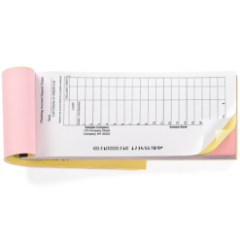
Every business check Checkomatic produces ships on ABA-compliant security stock with full fraud deterrent features. The checks are designed to work with standard laser and inkjet printers and are compatible with QuickBooks, Sage 50, and most other major accounting platforms. Manual business checks include a carbonless duplicate behind each check that records the payment details when you write. Manual payroll checks include pre-printed stub fields for earnings and deductions.

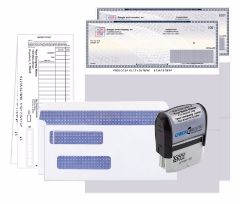
For complete check setup from scratch, the manual starter pack bundles manual checks, deposit slips, double-window envelopes, and an endorsement stamp in one order. Everything matched and coordinated from the same Monroe, NY facility.

Explore the full range at checkomatic.com, or go directly to endorsement stamps, personal checks, or business checks.


The Short Version on How to Endorse a Check

Knowing how to endorse a check correctly is a legal act governed by UCC Article 3, not just a formality. The type of endorsement you use determines who can negotiate the check, what happens if it bounces, and whether your bank has any legal recourse if something goes wrong. A blank endorsement is fine at a bank counter and a risk everywhere else. A restrictive endorsement is the default choice for most deposits. A mobile deposit endorsement activates Regulation CC indemnity protections against double deposits. A qualified endorsement protects your own liability when passing checks along in a fiduciary capacity.

For businesses depositing checks regularly, a pre-printed endorsement stamp is the practical answer. It puts the right information in the right format in the right place on every check, faster and more consistently than handwriting, and it removes the most common source of business endorsement errors: incomplete or inconsistent information across five lines of required detail.


Frequently Asked Questions


What is the safest way to endorse a check?

The safest everyday endorsement is a restrictive endorsement. Write "For Deposit Only to Account [your account number]" in the endorsement area, then sign your name below. This ties the check to one specific account and prevents it from being cashed or redirected if lost or stolen after you sign it. For mobile deposits, write "For Mobile Deposit Only" before signing instead, which adds Regulation CC indemnity protection against double deposits. Never use a plain blank signature for any check you are not depositing in person immediately.


Where exactly do you endorse a check?

On the back of the check, in the marked endorsement area, usually labeled "Endorse Here" with one or more signature lines. Below that is a zone marked "Do Not Write, Stamp, or Sign Below This Line," which is reserved for bank processing codes. Under Regulation CC, the payee endorsement must be placed in the area starting 1.5 inches from the trailing edge of the check. Writing or stamping outside the designated endorsement zone can cause the check to be rejected or misrouted during processing.


Can you endorse a check over to someone else?

Yes, using a special endorsement. Write "Pay to the Order of [full name]" in the endorsement area, then sign your name underneath. The named person can then deposit or cash the check as if it had been written to them. However, many banks do not accept third-party checks or require both parties present with identification. Confirm with the receiving bank before relying on this method, because policies vary significantly and a refused third-party check can leave both parties without a clear path forward.


What does "without recourse" mean on a check endorsement?

Writing "without recourse" above your signature creates a qualified endorsement, which limits your liability if the check is later dishonored. Normally, endorsing and transferring a check means you implicitly guarantee it will be honored. If it bounces, the person you gave it to can seek payment from you. "Without recourse" removes that guarantee. You are passing along whatever rights you have without vouching for the funds. This endorsement is most common for attorneys, trustees, and agents who handle checks in a fiduciary role and have no way to confirm the drawer's account is funded.


Does a business need a different endorsement than an individual?

Yes. A business endorsement must include the full legal business name as registered with the bank, the authorized signer's individual name, and their title. Writing only a personal signature or only the company name in script creates UCC ambiguity about whether an authorized representative actually executed the endorsement. Banks may return the check or place holds when this is unclear. A pre-printed endorsement stamp that includes the business name, "For Deposit Only," the account number, and a signer line resolves all of these issues on every check consistently.

Jun 23, 2026

Check Fraud Scams: Every Type Explained and How to Avoid Them

How Big the Check Fraud Problem Actually Is

Check fraud is not a fading problem from the era of paper banking. It is accelerating. FinCEN, the US Treasury's Financial Crimes Enforcement Network, reported more than 350,000 Suspicious Activity Reports filed for check fraud in 2021, a 23 percent increase from the prior year. In 2022, that number climbed to more than 680,000 reports, nearly doubling in a single year. The FBI and US Postal Inspection Service issued a joint advisory in January 2025 confirming that mail theft-related check fraud continued rising, with SAR filings for check fraud nearly doubling from 2021 to 2023.

The reason check fraud persists as digital payments grow is that checks carry all the information needed to drain an account: your name, your bank's routing number, your account number, and your signature. Every check you write has this printed on it. Anyone who gains physical access to one of your checks has everything needed to commit fraud against you, and organized mail theft networks have made that physical access easier than ever.

According to the 2024 AFP Payments Fraud Survey, 63 percent of organizations experienced check fraud in the prior year. The same survey found 75 percent of organizations still used checks and 70 percent had no immediate plans to stop. Check fraud is not an edge case affecting only the careless. It affects the majority of businesses that still write checks, and the attack methods keep evolving.


The Federal Law That Makes Fake Check Scams Work

Understanding why fake check scams succeed requires understanding one specific piece of federal banking regulation: Regulation CC, which implements the Expedited Funds Availability Act. Regulation CC requires banks to make deposited funds available to customers quickly, typically within one to two business days for most check types. This applies to personal checks, business checks, and cashier's checks alike.

What Regulation CC does not do is verify that the check is legitimate before making the funds available. The bank extends a provisional credit to the depositor while the check works through the interbank clearing process. If you deposit a check for $3,000 today, you may be able to spend $3,000 tomorrow. But that money is not confirmed. Your bank is effectively lending it to you against the expectation that the check will clear.

The interbank verification process, where your bank confirms with the issuing bank that the account exists and funds are present, takes considerably longer than one to two days. It can take days to two weeks or longer for a fraudulent check to be identified and returned as unpaid. When that happens, your bank reverses the provisional credit. If you have already spent the money or sent it somewhere, you owe your bank the full amount. The bank will pursue you for repayment because you were the depositor who initiated the transaction. The scammer is long gone.

This is the precise mechanism that every fake check scam exploits. The scammer never needs a real check. They only need the gap between when your bank makes funds available and when the check is confirmed as fake. That window gives them all the time they need.


Check Washing: The Chemical Attack on Your Mail

Check washing is the process of stealing a legitimate signed check and chemically removing the ink so the payee name and dollar amount can be rewritten. It requires no technical background and uses chemicals available in any hardware or grocery store.


How Check Washing Works

The criminal first obtains a signed check, most commonly through mail theft. Blue USPS collection boxes, unsecured home mailboxes, apartment cluster mailboxes, and checks caught at postal sorting facilities are all documented targets. The FBI and USPIS report that organized mail theft networks systematically target blue drop boxes using master keys stolen from postal employees, often operating in the early morning hours before regular mail pick-up.

Once the criminal has a signed check, they protect the signature by taping over it. The check is then soaked or rubbed with acetone, bleach, benzene, carbon tetrachloride, or specialized ink removal solvents. Standard ballpoint pen ink and most rollerball inks dissolve readily in these solvents. The FBI notes that criminals sometimes trace the signature in pencil before washing because pencil graphite does not dissolve in common solvents, preserving a signature guide if the tape method damages the original.

After washing, the criminal is left with a blank signed check. They fill in a new payee name and a new, typically larger amount, then deposit or cash it. The check processes normally because it is a genuine document drawn on a real account with a real signature. You discover the fraud only when an unexpected debit appears on your account statement, often days or weeks after the check has cleared.


The Gel Pen Defense

The pen you use to write checks is one of the most important physical defenses against check washing. Standard ballpoint pens use oil-based dye ink that sits on top of paper fibers and dissolves readily in common solvents. Gel pens use water-based pigment ink that bonds into the paper fibers themselves. The pigment embeds physically into the paper rather than resting on the surface, resisting chemical removal far more effectively than dye-based inks. The Uniball Signo 207 is frequently recommended by security researchers and law enforcement because its Super Ink formulation is specifically engineered to resist the chemicals used in check washing. Always write checks with a black gel pen. The security benefit is real and the cost difference is minimal.


Chemically Reactive Paper as the Backup Defense

Gel ink alone does not fully protect a check printed on ordinary paper stock. Security check stock adds a paper-level defense through chemically reactive paper, which contains compounds that react visibly to acetone, bleach, and other washing solvents by producing obvious staining or discoloration. A criminal cannot wash a check on chemically reactive stock without leaving visible tamper evidence that alerts any bank teller or ATM camera review. Combined with microprinting along signature lines that breaks visibly when forged and void pantographs that activate on copying, security check stock makes check washing both harder and more likely to be caught.


Check Cooking: One Stolen Check Into Unlimited Fakes

Check cooking is the digital evolution of check alteration. Per the FBI and IC3's 2025 advisory, check cooking involves photographing or scanning a stolen check and using widely available photo editing software to alter the payee name and dollar amount. The manipulated image is then printed on blank check stock using a high-resolution printer and deposited, often through mobile deposit channels or ATMs.

The critical difference between check washing and check cooking is scale. Check washing destroys the original physical check to produce one altered instrument. Check cooking preserves the check image and can produce an unlimited number of counterfeit checks from a single stolen original. The account holder whose check was stolen may never see that original check deposited at all, because the criminals prefer to use the image rather than risk detection with the physical document.

The FBI specifically notes that check cooking fraud tends to involve smaller individual check amounts by design. Checks written for amounts below common transaction monitoring thresholds escape automated scrutiny for longer periods. A criminal producing ten checks for $800 each from a single stolen check image can collect $8,000 across ten separate deposits before any one transaction triggers a review. One Houston woman reported losing $24,000 to a combination of check washing and check cooking from a single check stolen from her mailbox.

Check cooking exploits the mobile deposit channel specifically. Mobile deposit capture systems photograph the check through a phone camera. Well-printed counterfeits with correct MICR line formatting can pass through initial mobile deposit screening. The fraud surfaces only when the account holder's bank reconciles against the issuing bank and finds checks being presented that the account holder never wrote.


The Overpayment Scam and Why It Always Wins

The overpayment scam is the most reported fake check fraud against individuals. The American Bankers Association identifies it as one of the most common instruments used to deceive consumers, and it works with near-perfect reliability against anyone who does not understand the Regulation CC mechanics described above.

The setup is typically an online sales platform. You list something on Craigslist, Facebook Marketplace, eBay, or a similar site. A buyer contacts you, agrees to your price, and then sends a check for significantly more than the agreed amount. They have a story ready: a third party is paying on their behalf, it was an accidental overpayment, the extra amount covers shipping through their carrier. They ask you to deposit the check, keep your agreed portion, and wire or send back the excess to them or to a third party.

The check looks convincing. It may bear the name of a real business or bank. It may appear to be a cashier's check or certified payment. You deposit it. Regulation CC makes the full amount available within one to two business days. The money appears real in your account. You send the excess as instructed. Days to weeks later, your bank notifies you the check was fraudulent and reverses the provisional credit. You now owe your bank the full check amount. The money you sent is gone and unrecoverable. The buyer is unreachable.

The rule that prevents this scam from working on you is unconditional: never wire money, send gift cards, transfer cryptocurrency, or use a payment app to forward funds to anyone based on a check they sent you first. Never accept a check for more than the agreed price. Any buyer who insists on sending more than you asked is running this scam regardless of how credible their explanation sounds.


Fake Job and Mystery Shopper Check Scams

Fake job check scams are an overpayment scam wrapped in an employment context. You respond to a posting for a work-from-home or mystery shopper position. The employer seems credible and communicates professionally. Shortly after accepting the role, they send a check to cover your start-up expenses, equipment purchases, or first assignment costs.

In the mystery shopper version, your assignment is to evaluate a money transfer service such as Western Union or MoneyGram, or to purchase gift cards and report on the experience. You deposit the check, keep a small amount as your pay, and use the rest to complete the assignment by wiring funds or buying gift cards and sharing the PIN numbers. The check is fake. By the time it bounces, you have sent real money that cannot be recovered, and the employer has vanished.

In the work-from-home version, the check covers equipment that must be purchased from a specific vendor, who is the scammer or a co-conspirator. You transfer money to buy the equipment. The check bounces after the transfer completes.

Legitimate employers do not send checks to new hires before their start date. Legitimate employers do not ask employees to wire money, buy gift cards, or transfer funds as part of their job duties. Any employment arrangement that involves receiving a check and then sending any portion of it anywhere is a fake job scam.


Lottery and Prize Check Scams

Lottery and prize check scams use the same Regulation CC mechanics as the overpayment scam with a different pretext. You receive a notification by mail, email, or phone that you have won a prize, lottery, or sweepstakes. A check arrives as an advance on your winnings or to cover the fees and taxes required before your full prize is released. You are instructed to deposit the check and wire the fees or taxes to a designated address.

No legitimate sweepstakes or lottery requires winners to pay fees or taxes before receiving their prize. The IRS does not collect taxes through third parties and does not require pre-payment via wire transfer or gift card. Any communication following this pattern is a scam regardless of how official the accompanying check looks or how recognizable the sponsoring organization appears to be. A specific version of this scam targets older adults using Publisher's Clearing House branding or similar well-known sweepstakes names. The check will bounce. Any fees you sent will be unrecoverable.


Check Kiting: The TikTok Trend That Is a Federal Crime

Check kiting exploits the check processing float by writing checks between accounts to create the temporary appearance of funds that do not exist. In its basic form, a person with two bank accounts writes a check from Account A to deposit into Account B, then immediately writes a check from Account B before the Account A check has cleared. Cycling transactions between accounts this way temporarily inflates available balances, allowing cash withdrawals of money that was never real.

In September 2024, a version of this scheme went viral on TikTok. Videos showed users depositing bad checks at Chase Bank ATMs and immediately withdrawing cash before the bank could identify the checks as fraudulent. The clips spread rapidly across the platform with some framing the activity as exploiting a bank glitch rather than committing fraud. Lines reportedly formed at Chase ATMs as viewers tried to replicate the scheme.

There was no glitch. Writing a bad check and withdrawing funds before it clears is check kiting, a federal crime under 18 U.S.C. Section 1344, the federal bank fraud statute. The penalties are up to 30 years in federal prison and fines up to one million dollars per count. Participants in the TikTok scheme faced immediate account closures at Chase, demands for repayment of any withdrawn funds, and in cases involving substantial amounts, referrals to federal law enforcement. The fact that a video made it look like a harmless exploit did not change what it was legally.

For businesses, organized check kiting has historically been used to inflate reported cash balances across accounts at different banks. It is detectable through consistent bank reconciliation. Banks share information about kiting patterns with each other and with law enforcement.


Mule Accounts and How Victims Become Accomplices

Most people who handle fraudulent checks in the check fraud chain are not the original criminals. They are recruited as mule account holders: individuals who allow their personal bank accounts to be used as transit points for moving stolen funds. In a check fraud context, a mule account holder may deposit a counterfeit check and then transfer the funds onward to the actual criminal's account, typically receiving a small cut of the proceeds.

Mule recruitment happens through several channels. Fake job offers promising easy remote work. Social media posts offering money for a simple favor involving a check and a transfer. Romantic relationships where the other person asks for help with a financial task. The FBI FinCEN reporting notes that stolen checks are also sold on dark web marketplaces and encrypted social media platforms for a fraction of their face value, then deposited by recruited mule account holders who may not fully grasp what they have been recruited into.

The legal exposure for a mule account holder is serious. If you deposit a check and transfer funds at someone else's direction and the check is fraudulent, you may be liable for conspiracy to commit bank fraud even if you did not steal the original check. Your account will be closed. Your bank will demand repayment of all withdrawn funds. Depending on the dollar amounts and evidence of intent, law enforcement may pursue charges.

The only protection is refusing any arrangement where someone you do not know and fully trust asks you to deposit a check and forward any portion of the money elsewhere. The only person who benefits from that arrangement is the person directing it.


Security Features That Stop Each Type of Attack

Security check stock does not prevent all fraud, but it significantly raises the effort required for each attack method and creates visible evidence of tampering that protects both check writers and the institutions processing their checks.


Against Check Washing

Chemically reactive paper is the primary physical defense. It contains compounds that react to acetone, bleach, and other washing solvents by producing visible staining or color changes that cannot be concealed. A teller handling a washed check on chemically reactive stock can see the evidence of tampering. Genuine foundry watermarks, embedded in the paper during manufacturing rather than printed on the surface, cannot be removed or replicated without destroying the check entirely. Any attempt to wash the ink from a watermarked check damages the watermark itself, providing an additional visible indicator.


Against Check Cooking

Void pantographs are the primary defense against counterfeiting by scanning and reprinting. These hidden patterns in the check background activate visibly when the check is photocopied or digitally scanned, causing the word VOID to appear across the face of any reproduction. A counterfeit printed from a scanned check will carry this VOID marker, alerting anyone who handles it. Invisible fluorescent fibers embedded in security check stock glow under ultraviolet light. Bank teller stations commonly use UV inspection for high-value checks, and embedded fibers cannot be replicated in any printed reproduction.


Against Counterfeiting Generally

Heat-sensitive thermochromic ink disappears when rubbed with a finger and reappears when released. This behavior cannot be reproduced by any printing process, making it an immediate manual verification tool for anyone suspecting a counterfeit. The MICR line at the bottom of the check, printed in genuine magnetic ink, reads distinctly different under magnetic scanning equipment than the same line reproduced with standard laser or inkjet toner. Bank processing systems flag checks whose MICR line fails the magnetic reading test, which catches most printed counterfeits at the first processing stage.

Every Checkomatic check, whether a personal checkbook or any business check format, is printed on security stock with all of these features as standard on every order.


How to Protect Your Checks Before They Leave Your Hands

Most check fraud starts with mail theft. The single most effective habit change is stopping the use of blue USPS drop boxes for outgoing checks. The USPIS has documented widespread compromise of blue box locks through stolen postal master keys. Take outgoing checks with payments directly inside a post office and hand them to a postal employee, or use USPS Informed Delivery, the free service that photographs your incoming and outgoing mail so you can verify each piece arrived without interception.

Write every check with a black gel pen. Pigment-based gel ink bonds into paper fibers rather than sitting on the surface, and resists the solvents used in check washing far better than ballpoint or rollerball ink. The Uniball Signo 207 is specifically recommended by law enforcement. The cost of switching to gel pens is negligible against the protection it provides.

Reconcile your bank account weekly rather than monthly. Both check washing and check cooking can result in unauthorized checks clearing days to weeks before you notice. Weekly reconciliation closes the detection window significantly. The full reconciliation process is covered in our checkbook management guide.

For businesses, enroll in your bank's Positive Pay service. Positive Pay requires you to transmit a file of every check you issue, including check number, date, and amount. When a check presents for payment, the bank verifies it against your issued check list. Any check that does not match exactly is held for your review before it clears. Positive Pay eliminates both check washing and check cooking fraud against business accounts for any check included in the file, because no counterfeit or altered check can match your original issued check data precisely.

Store your blank checks in a locked location. A stolen checkbook gives a criminal not just blank checks but also your routing number and account number, enough to initiate ACH debits against your account without writing a check at all. Do not leave checkbooks in your car, at your desk at work, or in any location accessible to people outside your household.


How to Report Check Fraud: The Four-Agency Guide

If you suspect check fraud or believe you have been targeted by a fake check scam, report to all four of the following agencies. Each covers a different enforcement jurisdiction, and reporting to all four maximizes the chance that the fraud is investigated and that your report contributes to pattern detection that may stop the same scammer from hitting other people.


Your bank, immediately. This is the most time-sensitive step. Contact your bank the moment you suspect fraud. Request copies of all fraudulent checks. Ask the bank to flag your account for unusual activity. Discuss whether closing the compromised account and opening a new one is appropriate. Banks may be able to reverse transactions that have not fully settled if contacted quickly enough.


The Federal Trade Commission at ReportFraud.ftc.gov or 1-877-382-4357. The FTC aggregates fraud reports nationally to identify scam patterns and pursue enforcement against large-scale operations. Your report adds data that may connect your experience to other victims and help trigger an investigation.


The FBI Internet Crime Complaint Center at ic3.gov. The IC3 is the primary federal reporting channel for internet-facilitated fraud, which includes most fake check scams originating from online marketplaces, email, or social media. The IC3 shares data with federal, state, and local law enforcement and with international partners. File here if the fraud involved online communication, wire transfers, or cryptocurrency.


The US Postal Inspection Service at uspis.gov or 1-877-876-2455. The USPIS has specific jurisdiction over all mail theft-related fraud. If your checks were stolen from a mailbox or USPS drop box, or if you received fraudulent checks through the mail, the USPIS is the agency with direct investigative authority. USPIS has significantly expanded resources for mail theft cases in recent years given the documented rise in check fraud.

For businesses qualifying as financial institutions, a Suspicious Activity Report must also be filed with FinCEN through the Bank Secrecy Act electronic filing system within 30 days of detecting suspicious activity. If no suspect can be identified at the time of detection, the filing window extends to 60 days.


Why Checkomatic Checks Reduce Your Fraud Risk

Checkomatic has manufactured ABA-compliant checks in Monroe, NY since 1997. Every order ships with a full security feature stack as standard. There is no base tier without security features. Whether you order a personal checkbook or a case of business checks, the paper includes chemically reactive compounds, genuine foundry watermarks, microprinting along signature and border areas, heat-sensitive thermochromic ink, void pantographs that activate on copying, and invisible fluorescent fibers detectable under UV light.


The Proof Step That Prevents Another Common Fraud Vector

Every Checkomatic order includes a digital proof review before printing begins. You verify your routing number, account number, business name, and check number sequence before any checks are manufactured. A routing number error on printed checks means every check you write bounces, which is operationally disruptive and can also create a fraud exposure if you hand out checks before discovering the error. The proof step eliminates this entirely. Checkomatic's in-house manufacturing means your banking information never passes through third-party print vendors where interception is possible.


Duplicate Checks for Personal Accounts

Checkomatic's personal checkbooks are available in duplicate format with a carbonless copy behind every check. The copy auto-records the check number, date, payee, and amount when you write the original. If your checkbook is stolen from the mail, duplicate copies in the book let you immediately identify exactly which check numbers are missing, which is the first step in reporting to your bank and preventing fraudulent checks from clearing. Without duplicates, most people cannot accurately reconstruct which checks were outstanding when a theft occurred.


The Full Range for Every Use Case

For personal use: personal checkbooks in standard and duplicate formats with included paper registers. For business payments: business checks in all formats including manual business checks with carbonless duplicates, QuickBooks-compatible checks for software-integrated payroll and accounts payable printing, and blank check stock for organizations printing their own MICR lines. All formats carry the identical security stack. Standard orders ship within 3 to 5 business days from proof approval.

Explore the full catalog at checkomatic.com.


The Short Version on Check Fraud Scams

Every check fraud scam exploits one or both of two realities. First, checks carry your routing number, account number, and signature on a physical object that can be stolen from your mailbox. Second, Regulation CC requires banks to make deposited funds available before a check is confirmed as genuine, creating a window that scammers exploit to get you to send real money before the fake check collapses.

The defenses are not complicated. Black gel pen. Security check stock with chemically reactive paper. No blue USPS drop boxes for outgoing checks with sensitive information. Weekly account reconciliation. Positive Pay for business accounts. Never wire money or buy gift cards based on a check someone else sent you first. Report any fraud immediately to your bank and all four relevant agencies.


Frequently Asked Questions


What is the most common check fraud scam targeting individuals?

The overpayment scam is the most reported fake check fraud against individuals. A stranger sends a check for more than an agreed amount and asks you to wire back the difference before your bank identifies the check as fraudulent. It works because Regulation CC requires banks to make deposited funds available within one to two business days while the actual interbank verification that confirms a check is genuine takes much longer. By the time the bank reverses the provisional credit, the victim has already sent real money that cannot be recovered.


What is check washing and how does it work?

Check washing is a physical fraud where a criminal steals a check, most often from a mailbox or USPS drop box, and removes the ink using household chemicals such as acetone, bleach, or benzene. The signature is protected during the process. Once the original ink is removed, the criminal rewrites the payee name and amount on the blank signed check and deposits or cashes it. Writing checks with a black gel pen, whose pigment bonds into paper fibers and resists common solvents, and using security check stock with chemically reactive paper that stains visibly when chemicals touch it, are the two most reliable countermeasures.


What is check cooking and how is it different from check washing?

Check cooking is the digital version of check alteration. A criminal photographs or scans a stolen check and uses photo editing software to change the payee name and amount. The altered image is printed on blank check stock and deposited through mobile deposit or ATMs. Unlike check washing, which alters one physical check, check cooking allows a single stolen original to generate an unlimited number of counterfeits. The FBI notes that check cooking fraudsters deliberately use smaller individual amounts to stay below transaction monitoring thresholds and extend the fraud undetected.


Is check kiting a crime and what are the penalties?

Check kiting is a federal crime under 18 U.S.C. Section 1344, the federal bank fraud statute, with penalties of up to 30 years in federal prison and fines up to one million dollars per count. Kiting exploits the check clearing float by writing checks between accounts to temporarily create the appearance of funds that do not exist. In September 2024 this scheme went viral on TikTok when users filmed themselves depositing bad checks at Chase ATMs and withdrawing cash before the checks cleared. Participants faced account closures, repayment demands, and federal fraud referrals for cases involving significant amounts.


How do you report a check fraud scam?

Report to four agencies. Contact your bank immediately to protect the account, flag unauthorized activity, and get copies of any fraudulent checks. File with the FTC at ReportFraud.ftc.gov or 1-877-382-4357. File with the FBI Internet Crime Complaint Center at ic3.gov for any fraud involving online communication or digital payments. Report to the US Postal Inspection Service at uspis.gov or 1-877-876-2455 if mail theft was involved. For qualifying businesses, a Suspicious Activity Report must be filed with FinCEN within 30 days of detecting suspicious activity, extendable to 60 days if no suspect can be identified at the time of the report.

Jun 23, 2026

Check Fraud Scams: Every Type Explained and How to Avoid Them

How Big the Check Fraud Problem Actually Is

Check fraud is not a fading problem from the era of paper banking. It is accelerating. FinCEN, the US Treasury's Financial Crimes Enforcement Network, reported more than 350,000 Suspicious Activity Reports filed for check fraud in 2021, a 23 percent increase from the prior year. In 2022, that number climbed to more than 680,000 reports, nearly doubling in a single year. The FBI and US Postal Inspection Service issued a joint advisory in January 2025 confirming that mail theft-related check fraud continued rising, with SAR filings for check fraud nearly doubling from 2021 to 2023.

The reason check fraud persists as digital payments grow is that checks carry all the information needed to drain an account: your name, your bank's routing number, your account number, and your signature. Every check you write has this printed on it. Anyone who gains physical access to one of your checks has everything needed to commit fraud against you, and organized mail theft networks have made that physical access easier than ever.

According to the 2024 AFP Payments Fraud Survey, 63 percent of organizations experienced check fraud in the prior year. The same survey found 75 percent of organizations still used checks and 70 percent had no immediate plans to stop. Check fraud is not an edge case affecting only the careless. It affects the majority of businesses that still write checks, and the attack methods keep evolving.


The Federal Law That Makes Fake Check Scams Work

Understanding why fake check scams succeed requires understanding one specific piece of federal banking regulation: Regulation CC, which implements the Expedited Funds Availability Act. Regulation CC requires banks to make deposited funds available to customers quickly, typically within one to two business days for most check types. This applies to personal checks, business checks, and cashier's checks alike.

What Regulation CC does not do is verify that the check is legitimate before making the funds available. The bank extends a provisional credit to the depositor while the check works through the interbank clearing process. If you deposit a check for $3,000 today, you may be able to spend $3,000 tomorrow. But that money is not confirmed. Your bank is effectively lending it to you against the expectation that the check will clear.

The interbank verification process, where your bank confirms with the issuing bank that the account exists and funds are present, takes considerably longer than one to two days. It can take days to two weeks or longer for a fraudulent check to be identified and returned as unpaid. When that happens, your bank reverses the provisional credit. If you have already spent the money or sent it somewhere, you owe your bank the full amount. The bank will pursue you for repayment because you were the depositor who initiated the transaction. The scammer is long gone.

This is the precise mechanism that every fake check scam exploits. The scammer never needs a real check. They only need the gap between when your bank makes funds available and when the check is confirmed as fake. That window gives them all the time they need.


Check Washing: The Chemical Attack on Your Mail

Check washing is the process of stealing a legitimate signed check and chemically removing the ink so the payee name and dollar amount can be rewritten. It requires no technical background and uses chemicals available in any hardware or grocery store.


How Check Washing Works

The criminal first obtains a signed check, most commonly through mail theft. Blue USPS collection boxes, unsecured home mailboxes, apartment cluster mailboxes, and checks caught at postal sorting facilities are all documented targets. The FBI and USPIS report that organized mail theft networks systematically target blue drop boxes using master keys stolen from postal employees, often operating in the early morning hours before regular mail pick-up.

Once the criminal has a signed check, they protect the signature by taping over it. The check is then soaked or rubbed with acetone, bleach, benzene, carbon tetrachloride, or specialized ink removal solvents. Standard ballpoint pen ink and most rollerball inks dissolve readily in these solvents. The FBI notes that criminals sometimes trace the signature in pencil before washing because pencil graphite does not dissolve in common solvents, preserving a signature guide if the tape method damages the original.

After washing, the criminal is left with a blank signed check. They fill in a new payee name and a new, typically larger amount, then deposit or cash it. The check processes normally because it is a genuine document drawn on a real account with a real signature. You discover the fraud only when an unexpected debit appears on your account statement, often days or weeks after the check has cleared.


The Gel Pen Defense

The pen you use to write checks is one of the most important physical defenses against check washing. Standard ballpoint pens use oil-based dye ink that sits on top of paper fibers and dissolves readily in common solvents. Gel pens use water-based pigment ink that bonds into the paper fibers themselves. The pigment embeds physically into the paper rather than resting on the surface, resisting chemical removal far more effectively than dye-based inks. The Uniball Signo 207 is frequently recommended by security researchers and law enforcement because its Super Ink formulation is specifically engineered to resist the chemicals used in check washing. Always write checks with a black gel pen. The security benefit is real and the cost difference is minimal.


Chemically Reactive Paper as the Backup Defense

Gel ink alone does not fully protect a check printed on ordinary paper stock. Security check stock adds a paper-level defense through chemically reactive paper, which contains compounds that react visibly to acetone, bleach, and other washing solvents by producing obvious staining or discoloration. A criminal cannot wash a check on chemically reactive stock without leaving visible tamper evidence that alerts any bank teller or ATM camera review. Combined with microprinting along signature lines that breaks visibly when forged and void pantographs that activate on copying, security check stock makes check washing both harder and more likely to be caught.


Check Cooking: One Stolen Check Into Unlimited Fakes

Check cooking is the digital evolution of check alteration. Per the FBI and IC3's 2025 advisory, check cooking involves photographing or scanning a stolen check and using widely available photo editing software to alter the payee name and dollar amount. The manipulated image is then printed on blank check stock using a high-resolution printer and deposited, often through mobile deposit channels or ATMs.

The critical difference between check washing and check cooking is scale. Check washing destroys the original physical check to produce one altered instrument. Check cooking preserves the check image and can produce an unlimited number of counterfeit checks from a single stolen original. The account holder whose check was stolen may never see that original check deposited at all, because the criminals prefer to use the image rather than risk detection with the physical document.

The FBI specifically notes that check cooking fraud tends to involve smaller individual check amounts by design. Checks written for amounts below common transaction monitoring thresholds escape automated scrutiny for longer periods. A criminal producing ten checks for $800 each from a single stolen check image can collect $8,000 across ten separate deposits before any one transaction triggers a review. One Houston woman reported losing $24,000 to a combination of check washing and check cooking from a single check stolen from her mailbox.

Check cooking exploits the mobile deposit channel specifically. Mobile deposit capture systems photograph the check through a phone camera. Well-printed counterfeits with correct MICR line formatting can pass through initial mobile deposit screening. The fraud surfaces only when the account holder's bank reconciles against the issuing bank and finds checks being presented that the account holder never wrote.


The Overpayment Scam and Why It Always Wins

The overpayment scam is the most reported fake check fraud against individuals. The American Bankers Association identifies it as one of the most common instruments used to deceive consumers, and it works with near-perfect reliability against anyone who does not understand the Regulation CC mechanics described above.

The setup is typically an online sales platform. You list something on Craigslist, Facebook Marketplace, eBay, or a similar site. A buyer contacts you, agrees to your price, and then sends a check for significantly more than the agreed amount. They have a story ready: a third party is paying on their behalf, it was an accidental overpayment, the extra amount covers shipping through their carrier. They ask you to deposit the check, keep your agreed portion, and wire or send back the excess to them or to a third party.

The check looks convincing. It may bear the name of a real business or bank. It may appear to be a cashier's check or certified payment. You deposit it. Regulation CC makes the full amount available within one to two business days. The money appears real in your account. You send the excess as instructed. Days to weeks later, your bank notifies you the check was fraudulent and reverses the provisional credit. You now owe your bank the full check amount. The money you sent is gone and unrecoverable. The buyer is unreachable.

The rule that prevents this scam from working on you is unconditional: never wire money, send gift cards, transfer cryptocurrency, or use a payment app to forward funds to anyone based on a check they sent you first. Never accept a check for more than the agreed price. Any buyer who insists on sending more than you asked is running this scam regardless of how credible their explanation sounds.


Fake Job and Mystery Shopper Check Scams

Fake job check scams are an overpayment scam wrapped in an employment context. You respond to a posting for a work-from-home or mystery shopper position. The employer seems credible and communicates professionally. Shortly after accepting the role, they send a check to cover your start-up expenses, equipment purchases, or first assignment costs.

In the mystery shopper version, your assignment is to evaluate a money transfer service such as Western Union or MoneyGram, or to purchase gift cards and report on the experience. You deposit the check, keep a small amount as your pay, and use the rest to complete the assignment by wiring funds or buying gift cards and sharing the PIN numbers. The check is fake. By the time it bounces, you have sent real money that cannot be recovered, and the employer has vanished.

In the work-from-home version, the check covers equipment that must be purchased from a specific vendor, who is the scammer or a co-conspirator. You transfer money to buy the equipment. The check bounces after the transfer completes.

Legitimate employers do not send checks to new hires before their start date. Legitimate employers do not ask employees to wire money, buy gift cards, or transfer funds as part of their job duties. Any employment arrangement that involves receiving a check and then sending any portion of it anywhere is a fake job scam.


Lottery and Prize Check Scams

Lottery and prize check scams use the same Regulation CC mechanics as the overpayment scam with a different pretext. You receive a notification by mail, email, or phone that you have won a prize, lottery, or sweepstakes. A check arrives as an advance on your winnings or to cover the fees and taxes required before your full prize is released. You are instructed to deposit the check and wire the fees or taxes to a designated address.

No legitimate sweepstakes or lottery requires winners to pay fees or taxes before receiving their prize. The IRS does not collect taxes through third parties and does not require pre-payment via wire transfer or gift card. Any communication following this pattern is a scam regardless of how official the accompanying check looks or how recognizable the sponsoring organization appears to be. A specific version of this scam targets older adults using Publisher's Clearing House branding or similar well-known sweepstakes names. The check will bounce. Any fees you sent will be unrecoverable.


Check Kiting: The TikTok Trend That Is a Federal Crime

Check kiting exploits the check processing float by writing checks between accounts to create the temporary appearance of funds that do not exist. In its basic form, a person with two bank accounts writes a check from Account A to deposit into Account B, then immediately writes a check from Account B before the Account A check has cleared. Cycling transactions between accounts this way temporarily inflates available balances, allowing cash withdrawals of money that was never real.

In September 2024, a version of this scheme went viral on TikTok. Videos showed users depositing bad checks at Chase Bank ATMs and immediately withdrawing cash before the bank could identify the checks as fraudulent. The clips spread rapidly across the platform with some framing the activity as exploiting a bank glitch rather than committing fraud. Lines reportedly formed at Chase ATMs as viewers tried to replicate the scheme.

There was no glitch. Writing a bad check and withdrawing funds before it clears is check kiting, a federal crime under 18 U.S.C. Section 1344, the federal bank fraud statute. The penalties are up to 30 years in federal prison and fines up to one million dollars per count. Participants in the TikTok scheme faced immediate account closures at Chase, demands for repayment of any withdrawn funds, and in cases involving substantial amounts, referrals to federal law enforcement. The fact that a video made it look like a harmless exploit did not change what it was legally.

For businesses, organized check kiting has historically been used to inflate reported cash balances across accounts at different banks. It is detectable through consistent bank reconciliation. Banks share information about kiting patterns with each other and with law enforcement.


Mule Accounts and How Victims Become Accomplices

Most people who handle fraudulent checks in the check fraud chain are not the original criminals. They are recruited as mule account holders: individuals who allow their personal bank accounts to be used as transit points for moving stolen funds. In a check fraud context, a mule account holder may deposit a counterfeit check and then transfer the funds onward to the actual criminal's account, typically receiving a small cut of the proceeds.

Mule recruitment happens through several channels. Fake job offers promising easy remote work. Social media posts offering money for a simple favor involving a check and a transfer. Romantic relationships where the other person asks for help with a financial task. The FBI FinCEN reporting notes that stolen checks are also sold on dark web marketplaces and encrypted social media platforms for a fraction of their face value, then deposited by recruited mule account holders who may not fully grasp what they have been recruited into.

The legal exposure for a mule account holder is serious. If you deposit a check and transfer funds at someone else's direction and the check is fraudulent, you may be liable for conspiracy to commit bank fraud even if you did not steal the original check. Your account will be closed. Your bank will demand repayment of all withdrawn funds. Depending on the dollar amounts and evidence of intent, law enforcement may pursue charges.

The only protection is refusing any arrangement where someone you do not know and fully trust asks you to deposit a check and forward any portion of the money elsewhere. The only person who benefits from that arrangement is the person directing it.


Security Features That Stop Each Type of Attack

Security check stock does not prevent all fraud, but it significantly raises the effort required for each attack method and creates visible evidence of tampering that protects both check writers and the institutions processing their checks.


Against Check Washing

Chemically reactive paper is the primary physical defense. It contains compounds that react to acetone, bleach, and other washing solvents by producing visible staining or color changes that cannot be concealed. A teller handling a washed check on chemically reactive stock can see the evidence of tampering. Genuine foundry watermarks, embedded in the paper during manufacturing rather than printed on the surface, cannot be removed or replicated without destroying the check entirely. Any attempt to wash the ink from a watermarked check damages the watermark itself, providing an additional visible indicator.


Against Check Cooking

Void pantographs are the primary defense against counterfeiting by scanning and reprinting. These hidden patterns in the check background activate visibly when the check is photocopied or digitally scanned, causing the word VOID to appear across the face of any reproduction. A counterfeit printed from a scanned check will carry this VOID marker, alerting anyone who handles it. Invisible fluorescent fibers embedded in security check stock glow under ultraviolet light. Bank teller stations commonly use UV inspection for high-value checks, and embedded fibers cannot be replicated in any printed reproduction.


Against Counterfeiting Generally

Heat-sensitive thermochromic ink disappears when rubbed with a finger and reappears when released. This behavior cannot be reproduced by any printing process, making it an immediate manual verification tool for anyone suspecting a counterfeit. The MICR line at the bottom of the check, printed in genuine magnetic ink, reads distinctly different under magnetic scanning equipment than the same line reproduced with standard laser or inkjet toner. Bank processing systems flag checks whose MICR line fails the magnetic reading test, which catches most printed counterfeits at the first processing stage.

Every Checkomatic check, whether a personal checkbook or any business check format, is printed on security stock with all of these features as standard on every order.


How to Protect Your Checks Before They Leave Your Hands

Most check fraud starts with mail theft. The single most effective habit change is stopping the use of blue USPS drop boxes for outgoing checks. The USPIS has documented widespread compromise of blue box locks through stolen postal master keys. Take outgoing checks with payments directly inside a post office and hand them to a postal employee, or use USPS Informed Delivery, the free service that photographs your incoming and outgoing mail so you can verify each piece arrived without interception.

Write every check with a black gel pen. Pigment-based gel ink bonds into paper fibers rather than sitting on the surface, and resists the solvents used in check washing far better than ballpoint or rollerball ink. The Uniball Signo 207 is specifically recommended by law enforcement. The cost of switching to gel pens is negligible against the protection it provides.

Reconcile your bank account weekly rather than monthly. Both check washing and check cooking can result in unauthorized checks clearing days to weeks before you notice. Weekly reconciliation closes the detection window significantly. The full reconciliation process is covered in our checkbook management guide.

For businesses, enroll in your bank's Positive Pay service. Positive Pay requires you to transmit a file of every check you issue, including check number, date, and amount. When a check presents for payment, the bank verifies it against your issued check list. Any check that does not match exactly is held for your review before it clears. Positive Pay eliminates both check washing and check cooking fraud against business accounts for any check included in the file, because no counterfeit or altered check can match your original issued check data precisely.

Store your blank checks in a locked location. A stolen checkbook gives a criminal not just blank checks but also your routing number and account number, enough to initiate ACH debits against your account without writing a check at all. Do not leave checkbooks in your car, at your desk at work, or in any location accessible to people outside your household.


How to Report Check Fraud: The Four-Agency Guide

If you suspect check fraud or believe you have been targeted by a fake check scam, report to all four of the following agencies. Each covers a different enforcement jurisdiction, and reporting to all four maximizes the chance that the fraud is investigated and that your report contributes to pattern detection that may stop the same scammer from hitting other people.


Your bank, immediately. This is the most time-sensitive step. Contact your bank the moment you suspect fraud. Request copies of all fraudulent checks. Ask the bank to flag your account for unusual activity. Discuss whether closing the compromised account and opening a new one is appropriate. Banks may be able to reverse transactions that have not fully settled if contacted quickly enough.


The Federal Trade Commission at ReportFraud.ftc.gov or 1-877-382-4357. The FTC aggregates fraud reports nationally to identify scam patterns and pursue enforcement against large-scale operations. Your report adds data that may connect your experience to other victims and help trigger an investigation.


The FBI Internet Crime Complaint Center at ic3.gov. The IC3 is the primary federal reporting channel for internet-facilitated fraud, which includes most fake check scams originating from online marketplaces, email, or social media. The IC3 shares data with federal, state, and local law enforcement and with international partners. File here if the fraud involved online communication, wire transfers, or cryptocurrency.


The US Postal Inspection Service at uspis.gov or 1-877-876-2455. The USPIS has specific jurisdiction over all mail theft-related fraud. If your checks were stolen from a mailbox or USPS drop box, or if you received fraudulent checks through the mail, the USPIS is the agency with direct investigative authority. USPIS has significantly expanded resources for mail theft cases in recent years given the documented rise in check fraud.

For businesses qualifying as financial institutions, a Suspicious Activity Report must also be filed with FinCEN through the Bank Secrecy Act electronic filing system within 30 days of detecting suspicious activity. If no suspect can be identified at the time of detection, the filing window extends to 60 days.


Why Checkomatic Checks Reduce Your Fraud Risk

Checkomatic has manufactured ABA-compliant checks in Monroe, NY since 1997. Every order ships with a full security feature stack as standard. There is no base tier without security features. Whether you order a personal checkbook or a case of business checks, the paper includes chemically reactive compounds, genuine foundry watermarks, microprinting along signature and border areas, heat-sensitive thermochromic ink, void pantographs that activate on copying, and invisible fluorescent fibers detectable under UV light.


The Proof Step That Prevents Another Common Fraud Vector

Every Checkomatic order includes a digital proof review before printing begins. You verify your routing number, account number, business name, and check number sequence before any checks are manufactured. A routing number error on printed checks means every check you write bounces, which is operationally disruptive and can also create a fraud exposure if you hand out checks before discovering the error. The proof step eliminates this entirely. Checkomatic's in-house manufacturing means your banking information never passes through third-party print vendors where interception is possible.


Duplicate Checks for Personal Accounts

Checkomatic's personal checkbooks are available in duplicate format with a carbonless copy behind every check. The copy auto-records the check number, date, payee, and amount when you write the original. If your checkbook is stolen from the mail, duplicate copies in the book let you immediately identify exactly which check numbers are missing, which is the first step in reporting to your bank and preventing fraudulent checks from clearing. Without duplicates, most people cannot accurately reconstruct which checks were outstanding when a theft occurred.


The Full Range for Every Use Case

For personal use: personal checkbooks in standard and duplicate formats with included paper registers. For business payments: business checks in all formats including manual business checks with carbonless duplicates, QuickBooks-compatible checks for software-integrated payroll and accounts payable printing, and blank check stock for organizations printing their own MICR lines. All formats carry the identical security stack. Standard orders ship within 3 to 5 business days from proof approval.

Explore the full catalog at checkomatic.com.


The Short Version on Check Fraud Scams

Every check fraud scam exploits one or both of two realities. First, checks carry your routing number, account number, and signature on a physical object that can be stolen from your mailbox. Second, Regulation CC requires banks to make deposited funds available before a check is confirmed as genuine, creating a window that scammers exploit to get you to send real money before the fake check collapses.

The defenses are not complicated. Black gel pen. Security check stock with chemically reactive paper. No blue USPS drop boxes for outgoing checks with sensitive information. Weekly account reconciliation. Positive Pay for business accounts. Never wire money or buy gift cards based on a check someone else sent you first. Report any fraud immediately to your bank and all four relevant agencies.


Frequently Asked Questions


What is the most common check fraud scam targeting individuals?

The overpayment scam is the most reported fake check fraud against individuals. A stranger sends a check for more than an agreed amount and asks you to wire back the difference before your bank identifies the check as fraudulent. It works because Regulation CC requires banks to make deposited funds available within one to two business days while the actual interbank verification that confirms a check is genuine takes much longer. By the time the bank reverses the provisional credit, the victim has already sent real money that cannot be recovered.


What is check washing and how does it work?

Check washing is a physical fraud where a criminal steals a check, most often from a mailbox or USPS drop box, and removes the ink using household chemicals such as acetone, bleach, or benzene. The signature is protected during the process. Once the original ink is removed, the criminal rewrites the payee name and amount on the blank signed check and deposits or cashes it. Writing checks with a black gel pen, whose pigment bonds into paper fibers and resists common solvents, and using security check stock with chemically reactive paper that stains visibly when chemicals touch it, are the two most reliable countermeasures.


What is check cooking and how is it different from check washing?

Check cooking is the digital version of check alteration. A criminal photographs or scans a stolen check and uses photo editing software to change the payee name and amount. The altered image is printed on blank check stock and deposited through mobile deposit or ATMs. Unlike check washing, which alters one physical check, check cooking allows a single stolen original to generate an unlimited number of counterfeits. The FBI notes that check cooking fraudsters deliberately use smaller individual amounts to stay below transaction monitoring thresholds and extend the fraud undetected.


Is check kiting a crime and what are the penalties?

Check kiting is a federal crime under 18 U.S.C. Section 1344, the federal bank fraud statute, with penalties of up to 30 years in federal prison and fines up to one million dollars per count. Kiting exploits the check clearing float by writing checks between accounts to temporarily create the appearance of funds that do not exist. In September 2024 this scheme went viral on TikTok when users filmed themselves depositing bad checks at Chase ATMs and withdrawing cash before the checks cleared. Participants faced account closures, repayment demands, and federal fraud referrals for cases involving significant amounts.


How do you report a check fraud scam?

Report to four agencies. Contact your bank immediately to protect the account, flag unauthorized activity, and get copies of any fraudulent checks. File with the FTC at ReportFraud.ftc.gov or 1-877-382-4357. File with the FBI Internet Crime Complaint Center at ic3.gov for any fraud involving online communication or digital payments. Report to the US Postal Inspection Service at uspis.gov or 1-877-876-2455 if mail theft was involved. For qualifying businesses, a Suspicious Activity Report must be filed with FinCEN within 30 days of detecting suspicious activity, extendable to 60 days if no suspect can be identified at the time of the report.

Jun 22, 2026

Check Register: How to Set Up and Use a Checkbook Ledge

What a Check Register Is and What It Does

A check register is a transaction log you maintain yourself for your checking account. It records every check you write, every deposit you make, every ATM withdrawal, every debit card purchase, every automatic payment, and every bank fee, in the order they happen, with a running balance updated after each entry.

The fundamental difference between a check register and your online banking app is timing. Your bank only records transactions after they have settled through its processing system. A check you wrote last Tuesday may not appear on your bank's records for several more days if the payee has not deposited it yet. Your banking app shows you the bank's version of your account at this moment. It does not know about the check you wrote. Your check register does, because you recorded it the moment you wrote it. That difference is what makes a check register the more accurate picture of what you can actually spend without overdrawing your account.

Anyone who writes checks should maintain a check register. Without one, every check you write represents an invisible deduction that your bank balance does not reflect until the check clears, which can be days or weeks later. If you spend from what looks like available funds in the meantime, you risk an overdraft when the check finally posts.


The Accounting Role of a Check Register

Most consumer guides treat a check register as a personal finance tool. In formal accounting, it has a more specific role. A check register is technically a cash disbursement journal, which is a special-purpose subledger that records all cash payments made from a checking account. Per standard accounting practice, transactions are first recorded in the check register and then periodically summarized and posted to the general ledger's cash account.

This means your check register sits between your individual transactions and your general ledger. The general ledger does not capture the detail of every individual check payment; it captures totals. The check register holds the detail. When an accountant or auditor needs to trace a specific payment, the check register is the document they go to, not the general ledger.

For personal finances, this distinction rarely matters in a formal sense. For small business owners, it is meaningful. The check register for your business checking account is an accounting record, not just a convenience. Keeping it accurately and separately for each checking account you maintain is part of sound bookkeeping practice. If your business has a payroll account and an operating account, each needs its own check register. Mixing transactions from multiple accounts into one register creates exactly the kind of confusion that makes reconciliation difficult and audits complicated.


Every Column in a Check Register Explained

A complete check register uses six core columns. Some paper registers add a seventh for fee tracking. Here is what each column does and why it matters.


Column 1: Date

The date the transaction occurred, not the date it clears your bank. If you write a check on the 14th, record it on the 14th even if the payee deposits it on the 20th. Using the transaction date rather than the clearing date keeps your register accurate for the period you are tracking and makes it easier to identify transactions during reconciliation. For automatic payments, use the scheduled withdrawal date, not the date you set up the payment.


Column 2: Check Number or Transaction Code

For paper checks, this is the check number from the top-right corner of the check. Check numbers run sequentially and should never be skipped in your register, even for voided checks. For non-check transactions, use a consistent abbreviation code. A full list of standard codes appears in the next section. Consistent coding in this column makes it easy to scan your register and understand at a glance what type of transaction each line represents.


Column 3: Description or Payee

Who received the payment, what the deposit was from, or what the transaction was for. Be specific enough that you can identify this entry three months later. "Rent" is adequate. "Electric" is adequate. "Misc" is not useful and will confuse you during reconciliation. For deposits, noting the source (paycheck, client payment, tax refund) helps you track income patterns over time. For recurring automatic payments, including the biller name and last four digits of the account being paid speeds up identification when you are reconciling.


Column 4: Payment or Debit

Any money leaving the account. Checks, ATM withdrawals, debit card purchases, automatic bill payments, wire transfers, and bank fees all belong in this column. Never leave a debit unrecorded. A single missed debit will throw your running balance off for every subsequent entry until you catch and correct it.


Column 5: Deposit or Credit

Any money entering the account. Paychecks, direct deposits, wire transfers received, refunds, interest credits, and cash deposits all belong here. Record the gross deposit amount, not the net. If you deposit a check for $1,200 and have a $3 mobile deposit fee, record a $1,200 deposit and a separate $3 debit for the fee.


Column 6: Running Balance

The current account balance after each transaction. This is the column you watch. Update it after every single entry by adding deposits and subtracting debits. The running balance in your check register is your actual available balance, accounting for all transactions you have initiated whether or not they have cleared your bank. Do not skip updating this column. If you enter a transaction without updating the balance, the next entry's balance will be wrong and every balance after that will cascade incorrectly.


Column 7: Cleared Status (Strongly Recommended)

A checkbox or letter marker indicating that this transaction has appeared on your bank statement and been confirmed. Mark entries with a checkmark or the letter C when you verify them against your statement during reconciliation. Unmarked entries are your outstanding transactions: checks written but not yet cashed, deposits not yet posted. This column is the direct source for your list of outstanding items at reconciliation time. Without it, you have to rebuild that list from scratch every month.


Standard Transaction Codes for Your Check Register

When a transaction is not a paper check, the check number column needs a code that identifies what type of transaction it was. Most paper check registers print a legend on the inside cover. Here are the standard codes and what they represent:


  • ATM: Cash withdrawal from an automated teller machine. Use this any time you pull cash from an ATM, whether your bank's machine or an out-of-network machine.
  • DEP or D: Deposit of any kind. Use it for paychecks, refunds, cash deposits, wire transfers received, and any other credit to the account.
  • ACH: Automated Clearing House electronic transfer. Use this for automatic payments, online bill pay initiated through your bank, and direct debits set up by a biller. This is the most common code for recurring automatic payments.
  • EFT: Electronic funds transfer. Use this for wire transfers and online payments where ACH is not the specific network. Some registers use ACH and EFT interchangeably; pick one and stay consistent.
  • POS or DC: Point of sale or debit card. Use this for any debit card purchase at a merchant, whether in person or online. Both codes mean the same thing; your register may print one or the other.
  • INT: Interest credit. Use this when your bank posts earned interest to the account. This is a deposit, so it goes in the Deposit column with INT in the code column.
  • NSF: Non-sufficient funds fee. Use this when the bank charges you because a check or payment bounced due to insufficient funds. This is a debit and goes in the Payment column.
  • OD: Overdraft fee. Use this when the bank pays a transaction despite insufficient funds and charges you a coverage fee. Also a debit in the Payment column.
  • SC: Service charge. Use this for monthly maintenance fees, paper statement fees, wire fees, or any other bank account fee that is not specifically an NSF or overdraft charge.
  • VOID: Voided check. Use this when a check was spoiled, written in error, or cancelled before it was used. Record the check number and VOID in the description so your sequential numbering stays intact. Never skip this entry and never throw away a voided check without recording it first.


Using consistent codes makes it easier to scan your register during reconciliation and to categorize expenses for tax or budgeting purposes. If your bank statement uses a different abbreviation for the same transaction type, note both in your description column so you can match them up quickly.


How to Set Up a Check Register From Scratch

Whether you use the paper register that comes with your checkbook, a paper ledger notebook, a spreadsheet, or a dedicated app, the setup process is the same.


Step 1: Get Your Starting Balance

Find your current account balance from your most recent bank statement, not your banking app. Bank statements represent a settled, confirmed balance as of the statement date. Your app balance may include provisional credits or exclude pending transactions that have not fully settled. Write this balance in the Running Balance column on the first line. Label it "Opening Balance" or "Beginning Balance" in the description column with the statement date so you know exactly where your register starts.


Step 2: Record All Outstanding Transactions

Before you record any new transactions, identify everything that has occurred since your last bank statement that has not yet appeared on it. Outstanding checks you wrote, deposits you made, automatic payments that have scheduled but not posted: all of these belong in your register before anything else. Enter each one in date order with the correct debit or deposit amount and update your running balance after each entry. This brings your register balance to the present moment.


Step 3: Set Up Your Columns

On a paper register, these columns are pre-printed. On a spreadsheet, create headers for Date, Check No., Description, Payment, Deposit, Balance, and Cleared. In Google Sheets or Excel, enter the formula for the running balance: for the first entry row (row 3, with row 1 as headers and row 2 as opening balance), the balance formula is the previous row's balance plus any deposit in this row minus any payment in this row. Copy that formula down for as many rows as you need. Set the balance column to currency format so values display clearly.


Step 4: Record Every Transaction Going Forward

From this point, record every transaction when it happens. Write a check: enter it immediately. Make a deposit: enter it before you leave the bank or close the app. Receive an automatic payment confirmation: enter it that day. The moment you start delaying entries, your running balance becomes unreliable and the register loses its primary purpose.


How to Record Every Type of Transaction

Paper Checks

Enter the check number in column 2, the date written in column 1, the payee name in column 3, the check amount in the Payment column, and update your running balance. Do this the moment you write the check, not after you hand it over. The check is committed the instant you sign it regardless of when the payee deposits it.


Deposits

Enter DEP or D in the code column, today's date, a description of the deposit source in column 3, and the deposit amount in the Deposit column. Update the balance. If a deposit is a mobile check deposit subject to a hold, record the full amount but note in the description that the funds are on hold until a specific date. This prevents you from spending held funds by mistake.


ATM Withdrawals

Enter ATM in the code column, the date, the ATM location or purpose in the description, the withdrawal amount in the Payment column, and update your balance. If the ATM charged an out-of-network fee, record it as a separate line with SC in the code column rather than adding it to the withdrawal amount. Separate lines make bank statement matching easier.


Debit Card Purchases

Enter POS or DC in the code column, the transaction date, the merchant name in the description, the purchase amount in the Payment column, and update your balance. Record debit card transactions at the time of purchase. Pending debit card transactions that have not yet settled are still committed funds. Treating them as available because they show as pending is the most common source of unexpected overdrafts.


Automatic Payments and ACH Debits

Enter ACH in the code column, the scheduled payment date, the biller name in the description, the payment amount in the Payment column, and update your balance. Enter automatic payments on the day they are scheduled to withdraw, not when you receive a confirmation. The best practice is to enter all known recurring automatic payments at the beginning of each month before any of them actually post, so your register reflects the full month's committed cash flow from day one.


Bank Fees and Interest

Enter SC for service charges or INT for interest in the code column as soon as these appear on your statement during reconciliation. Most bank fees are not communicated in advance and only appear when you compare your register to your statement. Recording them immediately when you see them prevents them from becoming a mystery discrepancy in subsequent months.


Why Voided Checks Must Stay in Your Check Register

When you make a mistake on a check and cannot use it, the correct action is to write VOID across the face of the check in large letters, retain the voided check in your checkbook, and record the void in your check register. Most people skip all three of these steps and simply throw the spoiled check away. This creates two problems.

First, a missing check number in your sequence looks like a potential fraud indicator. Your bank, your accountant, and any auditor reviewing your records expects check numbers to run sequentially. A gap between check 1047 and 1049 raises the question of what happened to 1048. If you cannot produce the voided check or a register record showing it was voided, you cannot answer that question definitively. The gap looks like an unaccounted transaction.

Second, a voided check with your routing number and account number on it is sensitive financial information. Throwing it away without destroying it gives anyone who finds it in your trash everything they need to attempt an ACH debit from your account. Cross-shredding voided checks is the correct disposal method.

Recording VOID in the check number column of your register, with the date and a note, preserves your sequential record and confirms to anyone reviewing your books that the gap was intentional and documented.


The Cleared Column and What It Tells You

The cleared or reconciled column is the least understood part of a check register, and it is also the most useful during monthly reconciliation. Every time you confirm a transaction against your bank statement, you mark it in this column with a checkmark, the letter C, or an asterisk depending on your preference. The convention does not matter as long as you use it consistently.

All unmarked entries in your register at the end of the reconciliation period are your outstanding transactions. They are what has not yet appeared on your bank statement. Your list of outstanding checks for the reconciliation formula comes directly from this column: every check entry without a cleared mark is an outstanding check. Every deposit entry without a cleared mark is a deposit in transit.

This makes the cleared column the source of truth for bank reconciliation. Instead of rebuilding your outstanding transaction list from memory or by comparing two documents line by line, you simply filter for unmarked entries in the check register. It saves time and reduces errors significantly, particularly when you have a long register history.

When a transaction clears your bank but shows a different amount than what you recorded, investigate before marking it cleared. A check that cleared for $104.50 when you wrote $140.50 is either a bank error or a recording error. Either way, you need to identify which before you mark anything and move on.


How to Reconcile Your Check Register Monthly

Monthly reconciliation is the process of verifying that your check register and your bank statement describe the same account, accounting for timing differences. It takes ten to twenty minutes when your register is current. The process connects directly to the reconciliation formula covered in detail in our checkbook management guide.


Step 1: Record Any Missing Bank Statement Items

Before comparing the two records, go through your bank statement and find any entries not yet in your register. Bank fees, interest credits, automatic debits you forgot to enter, and returned check NSF fees are the most commonly missed. Add every one to your register and update your running balance before proceeding.


Step 2: Mark Cleared Transactions

Go through your bank statement line by line. For each transaction, find the matching entry in your check register and mark it cleared in the cleared column. Verify the amounts match. A $10 discrepancy between what you recorded and what cleared is not a rounding issue; it is a real difference that needs an explanation.


Step 3: List All Outstanding Items

After marking every matched transaction as cleared, scan your register for any entries without a cleared mark. These are your outstanding items: checks written but not yet deposited, and deposits made but not yet posted. List them separately with their amounts.


Step 4: Apply the Reconciliation Formula

Take your bank statement's ending balance, add any deposits in transit, and subtract outstanding checks. The result is your adjusted bank balance. Take your check register's ending balance, add any bank credits you had not yet recorded before step 1, and subtract any bank debits you had not yet recorded. The result is your adjusted register balance. Both adjusted figures must match. If they do not, work through the common causes covered in the checkbook management guide until you find and resolve the difference.


Business Check Register Best Practices

Businesses that write checks need check registers with the same urgency as individuals, but the requirements are stricter because the stakes are higher. A missed transaction in a personal register is inconvenient. A missed transaction in a business register can cause a vendor payment to appear unpaid, distort your cash position, or create a discrepancy that surfaces during a tax audit.


Keep a Separate Register for Each Checking Account

If your business has more than one checking account, each account needs its own dedicated register. A common example is a payroll account separate from the operating account. Mixing both accounts' transactions into a single register makes it impossible to reconcile either one independently, since each bank statement covers only one account. Separate registers maintain a clean one-to-one relationship between the register and the bank statement it reconciles against.


Maintain Check Number Sequence Strictly

Business check numbers are part of your audit trail. Sequential numbering lets you confirm that every check issued is accounted for. A gap in the sequence requires an explanation: either a voided check was recorded as VOID, or a check is unaccounted for. Letting check numbers fall out of sequence, by reusing numbers, skipping ranges, or failing to record voids, weakens your internal controls and makes fraud harder to detect.


Reconcile to the Cash Disbursement Journal Standard

For businesses using accounting software, the check register in your software is the cash disbursement journal. QuickBooks maintains its own bank register that tracks every transaction against your checking account. This register feeds the general ledger's cash account automatically. The monthly bank reconciliation in QuickBooks compares this register to your bank statement and flags unmatched items. Running this reconciliation monthly is a required step in the month-end close process for any business with checks as part of its payment workflow.


Review Outstanding Checks Quarterly

Checks that remain uncashed after 90 days need follow-up. After six months, they become stale and most banks will refuse them. After a year or more, they may become subject to state unclaimed property reporting requirements. A check register with a reliable cleared column makes this review simple: filter for outstanding check entries older than 90 days and follow up with each payee.


Paper vs Digital Check Registers

The format of your check register does not change what it does. The choice between paper and digital comes down to how you write checks and how you prefer to interact with financial records.


Paper Check Registers

Paper registers come with every Checkomatic personal checkbook order. They are compact, fit in the same drawer or bag as the checkbook, require no electricity or software, and are available the instant you write a check. For people who write occasional checks and prefer a physical record they can glance at without opening a device, paper works reliably. The limitation is that arithmetic in a paper register is manual: a single wrong calculation propagates forward until you catch it. Using a calculator and double-checking the balance after each entry eliminates most errors.


Spreadsheet Check Registers

A spreadsheet in Google Sheets or Excel replicates all check register columns with the advantage of automatic running balance calculation. The balance formula subtracts debits and adds credits as you enter each row, eliminating arithmetic errors entirely. Spreadsheets also make it easy to filter and sort transactions, use SUMIF formulas to total spending by category, and run simple reports. The main discipline requirement is the same as a paper register: entering transactions at the time they happen rather than reconstructing them from memory at the end of the month.


Accounting Software Registers

QuickBooks, Xero, and similar platforms maintain a bank register automatically as part of their broader accounting function. Every transaction entered through the software populates the register, and the bank reconciliation module compares it against your imported or manually entered bank statement. For businesses, this is the most complete option because the register integrates with the general ledger, accounts payable, and financial reporting. For individuals, it is more infrastructure than most people need for a checking account.


How Checkomatic Checks Support Better Register Management

Checkomatic manufactures personal and business checks in Monroe, NY with ABA-compliant security features on every order. Several specific products directly support the check register habits described in this guide.


Paper Register Included With Every Personal Checkbook

Every personal checkbook order from Checkomatic includes a paper check register. The register is pre-formatted with all standard columns: date, check number, description, payment, deposit, and running balance. It fits in the same checkbook cover as your checks and is ready to use the moment your order arrives. You do not need to create a register separately or download a template; it is included with the checkbook.


Duplicate Checks Eliminate the Most Common Register Error

The most frequent check register failure is forgetting to record a check in the first place. You write a check in a hurry, hand it over, and move on without logging it. Your running balance then overstates your available funds by exactly that check's amount until you catch the omission. Checkomatic's personal checkbooks in duplicate format include a carbonless copy behind every check that auto-records the check number, date, payee, amount, and memo the moment you write the original. The copy stays in the book as a permanent physical backup of every check you write. Duplicate checks do not replace the register for deposits, ATM withdrawals, and non-check transactions, but they solve the single most common register gap.


Sequential Check Numbers on Every Order

Every Checkomatic order allows you to specify your starting check number and prints sequentially from there. This maintains the sequential numbering integrity that your check register, your bank reconciliation, and any audit of your records depends on. Ordering replacement checks that continue your number sequence is a simple entry in the order form. Checkomatic also includes a digital proof step before printing begins, where you verify your check number starting point along with your routing number and account number, so the batch arrives ready to use without numbering gaps.


The Full Product Range for Every Check Register Format

Whether you need personal checkbooks with registers, personal deskset checks for organized desk-based check writing, manual business checks with carbonless duplicates for handwritten business payments, or QuickBooks-compatible checks for software-integrated check printing, every format ships with ABA-compliant security features and is backed by 3 to 5 business day standard delivery. Rush options are available at checkout.

Explore the full Checkomatic catalog at checkomatic.com.


The Short Version on Check Register and Ledger Management

A check register is a simple tool with a specific job: to give you an accurate real-time picture of your available balance that includes every transaction you have initiated, whether or not your bank has processed it yet. Six columns, consistent entries, and a cleared marker for reconciliation are all it takes. The discipline is recording transactions immediately rather than reconstructing them later.

The check register's role in accounting is more formal than most consumer guides acknowledge. It is a cash disbursement subledger that feeds the general ledger, which means the habits you build around maintaining it have implications beyond personal convenience. Voided checks recorded rather than discarded. Sequential check numbers preserved. Separate registers per account. Monthly reconciliation within a few days of your statement date. These practices matter more as the stakes around your financial records grow.


Frequently Asked Questions


What is a check register and why do you need one?

A check register is a running record of every transaction in your checking account, maintained by you rather than by your bank. It covers checks written, deposits made, ATM withdrawals, debit card purchases, automatic payments, and bank fees. Its primary value is that it includes transactions you have initiated that have not yet cleared your bank, giving you an accurate picture of your true available balance. Your online banking app only shows what the bank has already processed. In formal accounting, a check register functions as a cash disbursement journal: a subledger that records individual cash transactions before they are summarized and posted to the general ledger.


What columns does a check register need?

A complete check register needs six columns. Date records when the transaction occurred. The check number or transaction code column holds the check number for paper checks, or a standard abbreviation such as ATM, DEP, ACH, POS, or NSF for other transaction types. Description or payee identifies who was paid or what the deposit came from. Payment or debit records money leaving the account. Deposit or credit records money entering the account. Running balance is updated after every single entry. A seventh cleared column, used to mark transactions that have appeared on your bank statement, is highly recommended for reconciliation.


What transaction codes belong in a check register?

Standard codes for the check number column include ATM for cash machine withdrawals, DEP or D for deposits of any kind, ACH for automated clearing house electronic transfers and automatic payments, EFT for electronic funds transfers and wire payments, POS or DC for debit card purchases, INT for interest credits, NSF for returned check fees, OD for overdraft fees, SC for bank service charges, and VOID for checks that were spoiled and must be recorded to preserve the sequential check number record. Using consistent codes throughout your register makes it easier to identify transaction types and match entries against your bank statement during reconciliation.


How often should you reconcile your check register?

At minimum once a month, within a few days of receiving your bank statement. Reconciling monthly keeps you within the 60-day window under federal Regulation E for reporting unauthorized electronic transactions. If you write checks regularly or manage a business checking account, reconciling weekly is better practice. The more frequently you reconcile, the faster you catch bank errors, unauthorized charges, and outstanding checks that have been sitting too long without being cashed.


Do duplicate checks eliminate the need for a check register?

No, but they eliminate the most common register failure. Duplicate checks include a carbonless copy behind every check in the book that automatically records the check number, date, payee, amount, and memo when you write the original. This prevents the most frequent gap in check registers, which is forgetting to record a check. However, duplicate checks only record paper check transactions. They do not capture deposits, ATM withdrawals, debit card purchases, automatic payments, or bank fees. A complete check register is still required for full account tracking. Duplicate checks and a check register work best together, not as substitutes for each other.

Jun 19, 2026

Check Fraud Prevention: How to Protect Your Personal and Business Checks

Check fraud is not a niche concern. According to the 2025 AFP Payments Fraud and Control Survey, checks remain the payment method most targeted by fraudsters, with 63% of organizations reporting attempted or actual check fraud in 2024. FinCEN, the Financial Crimes Enforcement Network, received more than 682,000 check-fraud-related Suspicious Activity Reports filed in 2024, a figure roughly 95% higher than 2020 levels.

FinCEN reported over $688 million in suspicious activity tied to mail-theft related check fraud in just a six-month window in 2023. Of stolen checks that were used fraudulently, 44% were altered and deposited, 26% were used to create counterfeit checks, and 20% were signed and deposited fraudulently.

The rise is driven by two converging factors. First, postal mail theft targeting checks has accelerated sharply. Cases of serious crime against postal workers more than doubled between 2019 and 2023, according to a GAO analysis. Criminals purchase stolen USPS master keys on dark web marketplaces to access collection boxes. Second, check fraud is technically simple compared to other financial crimes. A stolen check, a bottle of acetone, and a desktop printer are enough to execute most schemes. The barriers to entry are low and the financial payoff per incident can be high.

The result is that both individuals who write personal checks and businesses that issue payments by check face meaningful, measurable fraud risk. The defenses are also well established, which is the focus of the rest of this guide.


The Main Types of Check Fraud

Check Washing

Check washing is the most prevalent form. A criminal steals a check, typically from a mailbox before or after it reaches its destination, and applies chemical solvents including acetone, bleach, or nail polish remover to dissolve the ink. Standard oil-based ballpoint ink sits on the paper surface and lifts away cleanly. The criminal then rewrites the payee name and dollar amount and deposits the check. The original account holder's bank information and signature remain intact, making the altered check look legitimate to bank processing systems.


Counterfeit Checks

With a stolen or intercepted check as a template, fraudsters can scan the document and use desktop publishing software to recreate it, printing counterfeit copies on standard paper with a high-quality printer. These counterfeits carry real routing numbers and account numbers from the victim's original check, which is enough for them to pass initial review at ATMs and mobile deposit channels. The fraud typically surfaces when the item is returned days later during interbank clearing.


Check Forgery

Forged checks involve creating or altering a check with a forged signature. This can involve signing a stolen blank check, forging the maker's signature on a counterfeit, or adding a second endorsement to redirect a deposited check to a different account. Signature forgery is easier when the legitimate signature is visible on a stolen check and the fraudster has time to practice.


Check Kiting

Kiting exploits the float period between when a check is deposited and when it fully clears. The fraudster writes a check from Account A to Account B, then writes a check from Account B back to Account A, creating a cycle of inflated artificial balances. The Check 21 Act of 2004 compressed clearing times to one to two days at most institutions, making sustained kiting much harder, but short-term kiting attempts still occur. Writing a check when you know your account lacks the funds to cover it, regardless of expected deposits, constitutes check fraud under federal law.


Remote Deposit Capture Fraud

Remote deposit capture allows checks to be deposited by photographing them through a mobile banking app. Fraudsters exploit this by depositing the same check multiple times at different institutions before any of them communicate the duplication, or by depositing a counterfeit check through mobile deposit, which uses optical character recognition rather than MICR scanning and is less effective at detecting altered paper.


How to Verify a Check Is Legitimate

When you receive a check you did not expect, from someone you do not know well, or for an amount that does not match what was agreed, verify it before depositing. Verification takes five minutes and can prevent weeks of recovery work.


Step 1: Check the Physical Paper

Legitimate checks are printed on specific security paper with texture and weight you can feel. Run your thumb across the paper. It should feel slightly rough, not smooth or glossy. Hold the check up to a light source and look for a watermark. On genuine high-security checks, watermarks are embedded in the paper fibers at the mill and appear as subtle light and dark patterns when backlit. A printed or copied watermark looks flat and does not have the same translucent quality. Check for the security feature list typically printed on the back of the check. If those features are listed but absent from the front of the check, something is wrong.


Step 2: Verify the Check Number in Two Places

Every check has its check number printed twice: in the top-right corner and in the MICR line at the very bottom-right of the check. These two numbers must match exactly. If they do not, the check has been altered. This is one of the most reliable fraud indicators available because altering a check usually changes the face of the document but leaves the MICR line untouched, or vice versa. A mismatch between the two printed check numbers is a near-certain sign of tampering.


Step 3: Look Up the Routing Number

The nine-digit ABA routing number in the MICR line at the bottom-left of the check identifies the issuing bank. You can verify that this routing number actually belongs to the bank named on the check by using the ABA routing number lookup tool at the American Bankers Association website, or through your own bank's verification resources. If the routing number on the check resolves to a different institution than the one named on the face of the check, the check is fraudulent.

To confirm whether the bank is a legitimate federally insured institution, use the FDIC BankFind Suite at fdic.gov/bankfind-suite, which allows you to search any bank name and confirm its charter status and contact information. If the bank named on the check does not appear in the FDIC database, do not deposit the check.


Step 4: Call the Issuing Bank Directly

For any check above a few hundred dollars from a source you cannot independently verify, call the bank directly. Find the bank's phone number on its official website, not from the check itself. The phone number printed on the check may be part of the fraud. Call the bank's general customer service line, provide the check number, dollar amount, and account number, and ask whether the check was legitimately issued and whether the account has sufficient funds to cover it. For cashier checks, ask specifically whether your institution issued cashier check number X in the amount of Y to the named payee.


Step 5: Use Official Verification Tools

For US Treasury checks including tax refunds, Social Security payments, and government benefit payments, the Treasury Check Verification System (TCVS) at tcvs.fiscal.treasury.gov allows anyone to verify whether a check is a genuine Treasury issuance. As of late 2024, TCVS added payee name validation through its API, which allows financial institutions to confirm that the payee name on the check matches Treasury records.


Red Flags That Signal a Fake or Altered Check

These patterns do not prove a check is fraudulent on their own, but any one of them warrants verification before you deposit or cash:

  • The check arrived unsolicited, without a prior transaction or agreement explaining why you are receiving it
  • The amount is larger than expected, often paired with a request to send back the difference
  • The check number in the top-right corner does not match the check number in the MICR line at the bottom-right
  • The routing number does not match the bank named on the check when verified through the ABA lookup
  • The bank name printed on the check does not appear in the FDIC BankFind Suite
  • The paper feels thin, smooth, or glossy rather than textured
  • Watermarks are absent, poorly reproduced, or only visible as printed ink rather than a paper fiber pattern
  • The check has a PO Box rather than a street address for the bank
  • The memo line says "approved payment," "payment approved," or "certified funds," which are phrases used by fraudsters to create a false sense of legitimacy
  • The sender is communicating exclusively by email or text and using pressure tactics around urgency or confidentiality
  • The postmark does not match the location of the named bank

Your bank's provisional credit for a deposited check is not confirmation the check is real. Banks make deposited funds available within one to two business days as required by Regulation CC. The check itself takes several additional days to fully clear through the interbank system. If you spend provisionally credited funds and the check later bounces, you owe the bank the full amount regardless of whether you knew the check was fake.


How to Prevent Check Washing

Use a Black Gel Ink Pen

This is the single highest-impact behavioral change for personal check security. Standard ballpoint pens use oil-based ink that sits on the surface of check paper. Common household solvents including acetone (nail polish remover), rubbing alcohol, and bleach dissolve this ink cleanly, leaving the underlying paper undamaged and ready for the fraudster to rewrite.

Gel ink pens work differently at a chemical level. Gel ink uses pigment suspended in a water-based gel carrier. When it dries, the pigment bonds directly with the paper fibers rather than sitting on top of them. Solvents that would dissolve ballpoint ink cannot remove gel pigment without also visibly damaging the paper, which means any washing attempt leaves obvious evidence of tampering. The Better Business Bureau specifically recommends indelible black gel ink for writing checks.


Fill All Fields Completely and With No Gaps

Leave no blank spaces on any line of a check. Draw a line through any unused space on the payee line and the written amount line. A fraudster who cannot wash the ink off can sometimes extend or alter what is already written by inserting characters before or after existing text. Writing "one hundred dollars" and then drawing a line to the end of the amount line leaves no room to insert "and fifty" in front of "dollars." Starting the dollar amount as far left as possible in the numeric box prevents adding digits before the number.


Order Chemically Reactive Check Stock

High-security check paper responds visibly to chemical solvents. When a check washing attempt is made, the chemically reactive paper develops visible staining or discoloration in the area exposed to solvent. The damage is irreversible and obvious to anyone examining the check, including bank tellers and processing systems. This is a primary security feature on all Checkomatic business and personal checks, which use chemically reactive paper as a standard included feature on every order.


Protecting Checks Sent Through the Mail

Mail theft is the most common entry point for check fraud. Criminals steal checks from blue collection boxes, from residential and business mailboxes before or after delivery, and increasingly from postal carriers directly. The checks are then washed or counterfeited for deposit.


Drop Checks at the Post Office Counter

Dropping an envelope containing a check into a blue USPS collection box leaves it exposed to anyone with a collection box master key, which are sold on dark web marketplaces. Taking checks directly to a postal clerk at the post office counter eliminates this exposure entirely. The clerk processes the envelope into the secure postal stream directly. This single habit change removes the most common attack vector for check washing fraud.


Enroll in USPS Informed Delivery

This is a free service from the United States Postal Service that almost no check fraud guide mentions. Informed Delivery sends you a daily email showing scanned images of the exterior of letter-sized mail pieces that are scheduled to arrive at your address that day. If a check you are expecting does not show up in Informed Delivery and does not arrive, you know to contact the issuer immediately before the check reaches a fraudster and is altered. You can sign up at informeddelivery.usps.com using any residential or business address. The service also provides tracking updates on incoming packages. Enrollment takes about ten minutes and costs nothing.


Request Secure Mailing Options

For high-value checks, use USPS Certified Mail with return receipt, which requires a signature upon delivery and provides a delivery confirmation record. This does not prevent theft from the collection side but creates accountability at the delivery end. Some businesses send high-value checks via UPS or FedEx rather than USPS because private carriers have separate tracking systems and different physical handling chains.


Consider Electronic Alternatives for Regular Payments

Recurring payments to known, trusted payees are candidates for ACH transfer rather than paper check. ACH eliminates mail exposure entirely. For one-time payments to new recipients where a paper trail matters, a check sent directly from a post office counter with Informed Delivery monitoring is a reasonably secure approach.


The Overpayment Scam: How It Works and Why It Always Wins

The overpayment scam is the most financially damaging check fraud scheme targeting individuals, and most fraud guides do not explain the mechanics clearly enough for people to recognize it in real time.

The setup: you are selling something, accepting a payment for services, or receiving a prize or inheritance. The paying party sends a check for significantly more than the agreed amount, usually accompanied by an explanation: the extra is to cover shipping costs, taxes, fees, or to pay a third party on their behalf. They ask you to deposit the check and wire or transfer back the excess amount.

The mechanics of why this always succeeds for the fraudster: when you deposit the check, your bank credits your account under Regulation CC, typically within one business day for amounts under your bank's threshold. You see the money in your balance and believe the check has cleared. It has not. Regulation CC requires banks to make funds available before the check has actually settled through the interbank system. The check can take three to ten business days to fully clear, during which time the fraudster's fake check is traveling through the system. When it bounces, the bank debits your account for the full deposit amount. The money you wired to the fraudster is gone permanently. You are left owing the bank the deposit amount you already returned.

The protection is simple: never send any money based on a deposited check until your bank explicitly confirms the check has fully cleared, not just that funds are provisionally available. This is a distinction banks are not always clear about when customers call to "verify" a deposit. Ask specifically whether the check has cleared final interbank settlement, not whether the funds are showing in your balance.


This is the legal dimension of check fraud prevention that virtually no consumer-facing guide covers, and it has direct consequences for what happens when a check written by you is altered and cashed fraudulently.

Section 3-406 of the Uniform Commercial Code states that a person whose failure to exercise ordinary care substantially contributes to an alteration of an instrument is precluded from asserting the alteration against a person who, in good faith, pays the instrument. In plain terms: if your own carelessness made it easier for someone to alter your check, you may lose the right to hold your bank responsible for paying the altered version.

Courts have interpreted ordinary care in the check fraud context to include using reasonably secure ink when writing checks. Writing a check in standard ballpoint pen that dissolves easily in common household solvents could be argued as a failure to exercise ordinary care, particularly if your bank offered you chemically reactive check stock or gel pen guidance. The burden of proving negligence falls on the bank, not you, but the argument becomes available to the bank as a defense against making you whole.

For businesses, this liability is amplified. Legal experts note that a business's failure to use adequate security features on its checks can constitute negligence in a fraud case. When a bank offers a business high-security check stock or Positive Pay and the business declines both, the bank has a strong argument that the fraud loss should fall entirely on the business rather than being shared or absorbed by the bank.


Positive Pay for Businesses

Positive Pay is the most effective active fraud prevention tool available to businesses that issue checks. It works by creating a verification layer between every check you issue and every payment that attempts to clear your account.


How Positive Pay Works

Each time your business issues checks, you transmit a file to your bank listing every check by number, dollar amount, and issue date. When a check is presented for payment, the bank compares the presented item against your file. If all fields match, the check clears. If any field does not match, the bank flags it as an exception item and contacts you to decide whether to approve or reject the payment before funds are released.

Payee Positive Pay is an enhanced version that also verifies the payee name against your issue file. Since check washing almost always changes the payee name, Payee Positive Pay catches altered checks that standard Positive Pay might miss if the check number and amount were not altered. This is the version most fraud prevention professionals now recommend as baseline for any business issuing checks regularly.


What Positive Pay Stops

Positive Pay catches counterfeit checks with a correct check number but wrong amount, altered checks where the payee or dollar amount was changed, checks written on a closed or wrong account number, and duplicate check presentment attempts. It does not catch forged drawer signatures on checks that are otherwise correctly listed in your issue file, which is why high-security check stock that makes signature forgery obvious remains important even when Positive Pay is enrolled.


The Liability Shift When You Decline Positive Pay

If your bank offers Positive Pay and you do not enroll, many bank deposit agreements shift fraud liability to your business for losses that Positive Pay would have caught. The UCC framework supports this: if an adequate fraud prevention tool was available and you chose not to use it, the argument that the bank bears responsibility for paying a fraudulent check weakens considerably. For businesses issuing more than a handful of checks per month, the cost of Positive Pay, typically under $50 per month at most institutions, is trivially small compared to the exposure.

For businesses whose check volume makes Positive Pay worthwhile, ordering business checks and QuickBooks-compatible checks from Checkomatic ensures the check number, amount, and formatting align precisely with what your Positive Pay issue file expects. Discrepancies between what your software records and what actually prints on the check can create false exceptions in Positive Pay. Checkomatic's checks are formatted to match accounting software outputs exactly, eliminating that source of error.


What Check Security Features Actually Stop Fraud

Not all check security features carry equal weight. Some deter casual copying; others prevent specific fraud methods. Here is what each feature actually does.


Chemically Reactive Paper

The most important security feature for check washing prevention. When a solvent is applied to chemically reactive paper, the paper develops visible staining or discoloration. The reaction is permanent and obvious, making the altered check visibly damaged in a way that bank tellers and processing systems are trained to reject. Every Checkomatic personal and business check is printed on chemically reactive paper as a standard feature.


Genuine Foundry Watermarks

A real watermark is created during paper manufacturing by pressing a pattern into the paper pulp before it dries. The pattern becomes part of the paper fiber structure and is visible as translucent light and dark areas when held up to light. Printed watermarks, which some low-cost check printers use, are just ink on the paper surface and can be replicated by a photocopier. Genuine foundry watermarks cannot be photocopied because they are a property of the paper thickness, not a surface marking.


Microprinting

Tiny text, typically reading "ORIGINAL DOCUMENT" or a similar phrase, printed along signature lines or borders at a scale that is readable under magnification but appears as a solid line to the naked eye. Photocopiers and desktop printers cannot reproduce microprinting at accurate scale; copies show the line as a blurred or broken smear rather than legible text. Bank tellers and fraud detection systems use magnification to verify microprinting on suspected counterfeit checks.


Heat-Sensitive Thermochromic Ink

An element on the check printed in ink that disappears when you rub it with your thumb and reappears when released. This feature is designed for quick verification at the point of cashing. A teller can verify authenticity without any equipment. Counterfeit checks printed on a desktop printer do not have thermochromic ink, so rubbing the relevant area produces no change.


Void Pantograph

A background pattern on the check that reveals the word "VOID" when the check is photocopied or scanned. The pattern is calibrated to the resolution of standard copying equipment; copying shifts pixel values in a way that makes the hidden word visible. This prevents the most basic form of counterfeiting, which is simply photocopying an existing check and trying to pass the copy.


Invisible Fluorescent Fibers

Fibers embedded in the paper during manufacturing that glow under ultraviolet light. Banks keep UV lights at teller windows specifically to verify this feature. Counterfeit checks printed on standard paper do not have these fibers and fail UV inspection. They are invisible under normal light and do not affect the printed appearance of the check.

All six of these features are standard on every personal and business check manufactured by Checkomatic. They are not optional upgrades or premium tiers; they are built into the check stock used for every order. This level of security is what the ABA considers the baseline for responsible check issuance.


Why Checkomatic Checks Reduce Your Fraud Risk

Checkomatic has manufactured personal and business checks in Monroe, NY since 1997. Every check is produced in-house on ABA-compliant security stock with all six major security features included as standard. Your banking information never passes through third-party print vendors. No setup fees. Free black-and-white logo printing on every order.


Security on Every Single Order

Whether you order personal checkbooks, business checks, QuickBooks checks, or manual payroll checks, every order uses the same high-security paper stock with chemically reactive paper, foundry watermarks, microprinting, thermochromic ink, void pantographs, and fluorescent fibers. These are not tiered options. They are on every Checkomatic check.


Correct Formatting for Positive Pay Compatibility

Checkomatic checks are formatted to align precisely with QuickBooks' default print settings and other major accounting software outputs. When what prints on your check matches exactly what your software records in the issue file you transmit to your bank for Positive Pay, false exceptions disappear and fraud detection works as intended. Formatting mismatches between your printed checks and your software output are a common operational cause of Positive Pay failures.


Blank Check Stock for MICR In-House Printing

For businesses printing MICR data in-house, Checkomatic blank checks provide the same high-security paper base. The security of the underlying paper stock does not depend on pre-printed bank information; it is inherent to the paper itself. In-house MICR printing on Checkomatic blank stock gives you both operational flexibility and the fraud resistance of professional-grade security paper.


Fast Delivery With Proof Review

Every Checkomatic order includes a digital proof step where you verify your routing number, account number, and check number before production begins. Standard orders ship in 3 to 5 business days. Rush options are available. Incorrect banking information on a printed check creates operational problems and potential Positive Pay exceptions on the very first use. The proof step eliminates that risk.

Explore Checkomatic's full range at checkomatic.com or go directly to personal checks, business checks, QuickBooks checks, or blank check stock.


The Short Version on Check Fraud Prevention

Check fraud prevention is layered by design. No single measure stops every attack. High-security check stock stops washing and counterfeiting. Gel ink makes washing harder. Secure mailing removes the most common theft opportunity. USPS Informed Delivery alerts you when expected checks do not arrive. Regular bank statement monitoring catches fraud before the reporting window closes. Positive Pay stops altered and counterfeit checks before they debit your account. And ordering from a manufacturer whose checks include all standard security features rather than treating them as upsells removes the foundation-level vulnerability that low-cost check printing creates.

The 63% of organizations that reported check fraud in 2024 were not all negligent. Check fraud is persistent and organized. But the ones who had layered defenses in place recovered faster and lost less than those who treated check security as an afterthought.


Frequently Asked Questions


How can you tell if a check is fake?

The most reliable physical indicator is a check number mismatch: the number printed in the top-right corner of the check should match the number at the far right of the MICR line at the bottom. If they differ, the check has been altered. Beyond that, verify the routing number against the ABA lookup tool to confirm it matches the bank named on the check, look for genuine watermarks by holding the check up to light, test for thermochromic ink by rubbing the designated area, and confirm the bank's existence in the FDIC BankFind Suite at fdic.gov. Never use a phone number printed on the check itself to verify it.


What is check washing and how does it work?

Check washing is a method where a criminal steals a check and applies chemical solvents including acetone, bleach, or rubbing alcohol to dissolve the oil-based ink from a standard ballpoint pen. Once the original payee and amount are removed, the criminal rewrites the check to themselves for a higher amount and deposits it. The account holder's bank information and signature remain intact. According to FinCEN, check alteration accounts for approximately 44% of mail-theft related check fraud. Using a black gel ink pen significantly resists this because gel pigment bonds with paper fibers and cannot be removed without visibly damaging the paper.


What is the best pen to use when writing a check?

A black gel ink pen is the right choice. Gel ink uses water-based pigment that bonds directly to paper fibers when dry, rather than sitting on the surface like oil-based ballpoint ink. Common household solvents that dissolve ballpoint ink in check washing schemes cannot remove gel ink without leaving obvious visible damage to the paper. Beyond the practical security benefit, the Uniform Commercial Code Section 3-406 can reduce your legal right to hold your bank responsible for a fraud loss if your own carelessness contributed to making the alteration possible. Using easily removable ink is an argument the bank can raise.


What is Positive Pay and do I need it?

Positive Pay is a bank service for businesses that compares every check presented for payment against a file of checks the business authorized. When a check is presented with a number, amount, or payee name that does not match the issue file, the bank flags it as an exception and holds it for the business to review before releasing funds. It stops counterfeit checks, altered checks, and duplicate presentment. Most banks charge under $50 per month. If your bank offers Positive Pay and you decline it, your deposit agreement may shift fraud liability to your business for losses the service would have caught. For any business issuing more than a few checks per month, enrolling is worth considerably more than it costs.


If I deposit a fake check and spend the money, am I responsible?

Yes. Banks make deposited funds provisionally available within one to two business days under Regulation CC, but the check itself takes several more days to settle through the interbank clearing system. During that window, the funds appear available but the check has not actually cleared. If the check is returned as counterfeit or fraudulent, the bank reverses the full deposit from your account regardless of whether you spent the funds. This is precisely how overpayment scams function: the fraudster sends a fake check, you deposit it and send back the supposed excess, the check bounces, and you owe the bank both the original deposit amount and lose what you wired. Never send money based on a deposited check until your bank confirms the final interbank settlement, not just provisional availability.

Jun 18, 2026

Business Checks for Payroll: The Complete Employer Guide

A standard business check includes one or two voucher stubs for accounts payable information: invoice number, purchase order reference, amount paid, and vendor account details. These stubs help your bookkeeping team match payments to bills.

A payroll check includes stubs specifically formatted for wage payments. The pre-printed fields on a payroll check stub cover gross wages, hours worked for hourly employees, overtime hours and rate, regular earnings, bonus or commission amounts if applicable, every tax deduction itemized separately, voluntary deductions such as health insurance premiums and retirement contributions, and the resulting net pay. Most payroll check formats include year-to-date totals for both earnings and deductions, giving each employee a running record of what they have earned and paid in taxes through the current pay period.

This structure is not just convenient. In 42 states, providing employees with detailed wage information on each payday is a legal obligation. A payroll check with pre-printed stub fields is the physical format designed to fulfill that obligation when you issue paper paychecks. Using a plain business check for payroll, without a proper earnings and deductions record attached, fails the pay stub requirements in most states.


What Must Go on a Payroll Check and Stub

The paycheck itself contains the same fields as any other business check: your business name and address, the employee's name as payee, the net pay amount in both numbers and words, the check date, your bank's routing number and account number in the MICR line at the bottom, and your authorized signature. The check number tracks sequentially and appears in both the top-right corner and the MICR line.

The stub is where payroll-specific detail lives. A complete payroll check stub includes:


  • Employer name and address
  • Employee name, and in most states employee ID or Social Security Number last four digits
  • Pay period start and end dates
  • Pay date
  • Hours worked for hourly employees, broken out by regular hours, overtime hours, and applicable rate for each
  • Gross earnings before any deductions
  • Itemized mandatory deductions: federal income tax, state income tax where applicable, Social Security (6.2%), and Medicare (1.45%)
  • Itemized voluntary deductions: health insurance premiums, dental, vision, 401(k) or retirement contributions, FSA contributions, garnishments
  • Net pay: what the employee receives after all deductions
  • Year-to-date (YTD) totals for gross earnings and each deduction category


The YTD column is particularly important for both employees and employers. Employees need it at year-end to reconcile their W-2 against what they received. Employers need it to verify that Social Security withholding stops correctly once an employee's earnings exceed the annual wage base, which is $176,100 for 2025. Once an employee's gross wages pass that threshold, no further Social Security tax is withheld for the remainder of the calendar year. The YTD gross column on the check stub is where you track that threshold with every payroll run.


How to Calculate Net Pay for a Payroll Check

The figure that goes on the payroll check itself, in the dollar box and the written amount line, is always net pay. Net pay is what the employee takes home after all withholdings and deductions are applied. The calculation works in layers.


Step 1: Determine Gross Pay

Gross pay is total compensation before any deductions. For hourly employees, multiply hours worked by the hourly rate. Add overtime at 1.5 times the regular rate for any hours over 40 in a workweek under the Fair Labor Standards Act. For salaried employees, divide the annual salary by the number of pay periods in the year. A biweekly pay schedule has 26 periods; a semi-monthly schedule has 24.


Step 2: Subtract Pre-Tax Deductions

Pre-tax deductions reduce the taxable wage base before any taxes are calculated. Common pre-tax deductions include 401(k) contributions, health insurance premiums paid through a Section 125 cafeteria plan, HSA contributions, and FSA contributions. Subtracting these from gross pay gives you the taxable wages used to calculate federal and state income taxes.


Step 3: Calculate and Withhold Payroll Taxes

Before running your first payroll, you need an Employer Identification Number (EIN) from the IRS. This nine-digit number is required on all payroll tax filings including Form 941, the quarterly payroll tax return. Federal income tax is withheld based on the employee's W-4 filing status and the IRS Publication 15-T withholding tables. The rate varies by income level and the number of allowances or adjustments the employee claimed. Social Security tax is 6.2% of gross wages, stopping once the employee's year-to-date earnings exceed the $176,100 Social Security wage base for 2025. Medicare tax is 1.45% of gross wages with no cap, plus an additional 0.9% for wages above $200,000 for single filers. State income tax applies where required; rates and methods vary by state.


Step 4: Subtract Post-Tax Deductions

Post-tax deductions come out after taxes are calculated. These include Roth 401(k) contributions, wage garnishments ordered by a court, child support payments, and some supplemental insurance premiums. These reduce net pay but do not reduce the taxable wage amount.


Step 5: Net Pay Is What Goes on the Check

Subtract all deductions from gross pay. The result is net pay: the exact amount written on the payroll check. This is the number that must match between the dollar box and the written amount line. Both lines must agree. Under the Uniform Commercial Code, the written amount line controls in a conflict, so any discrepancy between the two creates a legal complication the employer is responsible for.


When Paper Checks Are Legally Required

Many small business owners assume that switching all employees to direct deposit is a simple operational decision. In a significant number of states, it is not. The intersection of federal and state wage payment law creates a situation where paper payroll checks are sometimes legally required, and employers who eliminate them without understanding the rules expose themselves to compliance risk.


Federal Law on Direct Deposit

The Electronic Fund Transfer Act at the federal level does not prohibit employers from requiring direct deposit, but it does require two things. First, employers cannot dictate which specific bank or financial institution an employee must use to receive their direct deposit. Second, if an employer mandates direct deposit at a specific institution, they must offer a completely different payment method such as a paper check as an alternative. Beyond these federal baselines, state law controls.


States That Prohibit Mandatory Direct Deposit

California explicitly prohibits mandatory direct deposit. Under California wage payment law, employee choice is a fundamental condition of any electronic payment setup. An employer who requires direct deposit without the employee's voluntary written consent may face civil penalties. New York similarly requires employee consent before electronic wage payment begins. Several other states impose comparable restrictions. Employers operating in multiple states need to know the rules in each location where they employ workers, since a policy that is compliant in Texas may violate California law for the same employee working remotely.


Unbanked Employees and the Paper Check Obligation

A meaningful share of the workforce does not have a checking account. According to FDIC data, approximately 4.5% of US households were unbanked as of the most recent survey. For employees without bank accounts, direct deposit is not available as a practical matter. In most states, an employer cannot force an unbanked employee to open an account or use a payroll card as their only option; a paper paycheck must be offered. For these employees, payroll checks are not optional. They are the legally required payment method.

The practical consequence for employers: maintaining a supply of properly formatted payroll checks with correct security features is a compliance requirement, not just a legacy convenience, as long as any employee in the organization cannot or does not consent to direct deposit.


Payroll Check Formats and Software Compatibility

Payroll check stock comes in several physical formats. Choosing the wrong one means your accounting software will print each payroll check misaligned, with the check portion landing in the stub area and the stub area covering the check face. Every check in the batch will be unusable. Understanding which format matches your software before you order is not optional.


Check-on-Top (Voucher Style)

The check occupies the top third of the letter-size page. Two pay stubs sit below it, separated by perforations. This is the most widely supported payroll check format and the default for QuickBooks payroll printing. When you process payroll in QuickBooks and select Voucher as the check style, the software prints to this layout. One stub goes to the employee with their paycheck; the other stub stays in the employer's records after the check is detached. Checkomatic's check-on-top business checks are compatible with all versions of QuickBooks, Quicken, and most other mainstream payroll and accounting software.


Check-in-Middle

One stub above the check and one below it. This format is the default for Peachtree/Sage 50 and several legal, title company, and specialized accounting platforms. QuickBooks does not print payroll checks in check-in-middle format. If your software is Sage 50 and you order check-on-top stock, none of your payroll checks will align correctly. Checkomatic's check-in-middle format is available for Sage and compatible platforms.


Wallet Size for QuickBooks Payroll

A compact personal-check-sized format for owner-operators and sole proprietors who print payroll through QuickBooks but prefer a smaller check. This format prints through the QuickBooks Wallet check style setting. It does not include full pay stub fields on the check itself; stubs print separately. Available from Checkomatic's QuickBooks checks page.


Manual Three-on-a-Page with Carbonless Copies

Three payroll checks per letter-size page, each with a built-in carbonless duplicate behind it. You write the check by hand and the carbon copy auto-records everything except your signature. This format works for very small businesses with just a few employees where handwritten payroll checks are practical. The carbonless copy stays in the book as a permanent record of each payment. Checkomatic's manual payroll business checks come pre-formatted with payroll stub fields for gross pay, deductions, and net pay.


Manual Payroll Checks vs Computer-Printed Checks

Small businesses with a handful of employees often start with manual payroll checks written by hand. As employee count grows, computer-printed checks through accounting software become more practical. Each approach has a different set of supply requirements.


Manual Payroll Checks

Manual payroll checks require no printer, no software license, and no alignment setup. You write the check by hand, fill in the stub fields from your payroll calculation, and hand or mail the check to the employee. The carbonless duplicate stays in your records. The drawback is calculation accuracy: every deduction and withholding must be computed correctly by hand or from a spreadsheet, and any arithmetic error on the check face cannot be corrected after signing without voiding and reissuing.

Manual checks work best for very small businesses, businesses with variable or seasonal employee counts, and situations where checks need to be issued on short notice without waiting for a full payroll run. Checkomatic's manual business checks include payroll, accounts payable, and multi-purpose formats.


Computer-Printed Payroll Checks

Computer-printed payroll checks use either pre-printed check stock with your banking information already on it, or blank check stock that your software prints the MICR line onto using magnetic toner. Pre-printed stock works with any standard laser or inkjet printer. Blank check stock requires a MICR-capable printer to produce the routing and account numbers in the magnetic ink that bank processing equipment requires. Pre-printed stock is simpler for most small businesses; blank stock provides more flexibility for organizations with multiple bank accounts or changing banking relationships.

QuickBooks-compatible pre-printed payroll check stock from Checkomatic means your banking information is already on the check, your software fills in the payroll data, and you print to the correct format without any MICR printer setup. The proof step at the time of ordering verifies your routing number and account number before the checks are manufactured, eliminating the most common source of payroll printing problems.


Pay Stub Requirements by State

Federal law under the Fair Labor Standards Act requires employers to maintain payroll records for at least three years, covering hours worked and wages paid. The FLSA does not require employers to provide those records to employees in the form of pay stubs. That obligation comes from state law, and it varies significantly across all fifty states.

As of 2025, 42 states have some form of pay stub requirement. States generally fall into three categories. Access states require that employees be able to view their pay information on request, often through an online portal or payroll system, without necessarily receiving a paper stub with each paycheck. Print states require a physical written or printed pay stub that the employee can keep, though most accept electronic delivery if the employee can genuinely access and print it. No-requirement states impose no specific pay stub obligation beyond the federal FLSA recordkeeping rules, though most employers in those states provide stubs voluntarily as a standard practice.

California has the most detailed pay stub requirements of any state. Every California employer must provide an itemized written wage statement with each paycheck showing gross wages, total hours worked for non-exempt employees, all deductions, net wages, the inclusive dates of the pay period, the employee's name and the last four digits of their Social Security number, the employer's legal name and address, and the applicable hourly rates in effect during the pay period. Illinois added new pay stub requirements effective January 1, 2025 under Public Act 103-0953, requiring transparency on hours, rates, overtime, and deductions, with a three-year retention obligation even after an employee leaves.

Using a properly formatted payroll check with pre-printed voucher stub fields provides a physical record that covers the requirements of most state pay stub laws, since the stub fields capture all standard required information. For businesses operating in multiple states, confirming that your payroll check stubs include all state-required fields before issuing any paychecks is an important compliance step.


Security Features on Payroll Checks

Payroll checks are particularly attractive targets for check fraud because they are issued on a predictable schedule, often for similar amounts, and employees receive them directly. A stolen or altered payroll check can be difficult to detect quickly if the employer is not reconciling their payroll account frequently.

The security features required on payroll check stock are the same as those on any high-security business check: chemically reactive paper that shows visible staining when a solvent is applied during a washing attempt, genuine foundry watermarks embedded in the paper at the mill rather than printed on the surface, microprinting along signature lines that appears as a solid line visually but breaks into text under magnification, heat-sensitive thermochromic ink that disappears when rubbed and reappears when released, void pantographs that reveal the word VOID when the check is photocopied, and invisible fluorescent fibers that glow under ultraviolet light.

All Checkomatic payroll and business checks are printed on security stock with all six features as standard. They are not optional tiers. Every order, regardless of quantity or format, uses the same bank-grade security paper. For businesses using Positive Pay, Checkomatic checks are formatted to match your accounting software's output exactly, which eliminates formatting mismatches that cause false exceptions in the Positive Pay verification process.


Why Order Payroll Checks From Checkomatic

Checkomatic has manufactured business checks including payroll formats in Monroe, NY since 1997. Every order is produced in-house on ABA-compliant security stock. Your banking information never passes through third-party print vendors. Free black-and-white logo printing on every order. No setup fees.


Every Payroll Format Available

Checkomatic carries the full range of payroll check formats for every software and workflow. Whether you need QuickBooks-compatible check-on-top voucher checks for computer-printed payroll, Sage-compatible check-in-middle format, manual carbonless payroll checks for handwritten payments, or blank check stock for in-house MICR printing, all formats are available with the same security features and ABA-compliant manufacturing:


Proof Review Before Every Order Ships

Every Checkomatic order includes a digital proof step where you verify your routing number, account number, business name, and check number sequence before production begins. Payroll check errors discovered after printing mean voiding an entire batch and reordering, which creates a pay delay your employees notice. The proof step prevents that from happening.


Fast Turnaround for Payroll Deadlines

Standard orders ship in 3 to 5 business days from proof approval. Rush delivery options are available at checkout for businesses that need checks quickly before an upcoming payroll run. If you are transitioning from direct deposit to paper checks for new employees, or setting up a payroll check system for the first time, Checkomatic's turnaround gives you enough time to receive, verify, and load checks before the next payroll date.

Explore the full Checkomatic catalog at checkomatic.com or go directly to manual payroll checks, check-on-top for QuickBooks, or blank check stock.


The Short Version on Business Checks and Payroll

Payroll checks are not interchangeable with standard business checks when you are paying employees. The voucher stubs with pre-printed payroll fields are what makes them appropriate for meeting state pay stub requirements. The right format determines whether your accounting software can print them at all. The security features on the check stock protect both the employer and the employee from payroll fraud. And in states that prohibit mandatory direct deposit or serve unbanked employees, paper payroll checks are not optional. They are the legally required alternative.

Getting the format, the compliance fields, and the security right from the start costs less time and money than correcting payroll errors, resolving state labor complaints, or dealing with fraudulent payroll checks after the fact.


Frequently Asked Questions


What is the difference between a payroll check and a regular business check?

A payroll check includes one or two detachable voucher stubs pre-printed with fields for gross pay, itemized deductions including federal income tax, Social Security, and Medicare, net pay, pay period dates, and year-to-date totals. A regular business check has stubs formatted for accounts payable information such as invoice numbers and vendor account references. Payroll checks are designed to meet state pay stub requirements when you issue paper paychecks, which most basic business checks are not set up to do.


Can an employer require all employees to use direct deposit instead of paper checks?

It depends on state law. Federal law under the Electronic Fund Transfer Act does not prohibit mandatory direct deposit, but requires that employees be free to choose their own bank. Many states including California and New York go further and prohibit mandatory direct deposit entirely or require the employee's voluntary written consent. Most states also require employers to offer a paper check alternative for employees who are unbanked or who do not consent to electronic wage payment. Employers should check their specific state's wage payment laws before eliminating paper payroll checks.


What information must appear on a payroll check stub?

Federal law under the FLSA does not require employers to provide pay stubs, only to maintain payroll records. However, 42 states have their own requirements. Most state laws require at minimum: employer name and address, employee name, pay period dates, gross earnings, all itemized deductions including federal and state income tax, Social Security, and Medicare, and net pay. Many states also require year-to-date totals and, for hourly workers, hours worked and applicable pay rates. California has the most detailed requirements and includes the employee's last four Social Security number digits and all applicable hourly rates in effect during the pay period.


Which check format works with QuickBooks for payroll?

QuickBooks supports check-on-top (voucher style) and wallet size for payroll check printing. Check-on-top places the check at the top of the page with two pay stub vouchers below. QuickBooks does not support check-in-middle or check-on-bottom formats for payroll. Ordering the wrong format means every payroll check will print misaligned and be unusable. Checkomatic's QuickBooks-compatible payroll checks align precisely with QuickBooks' default payroll print settings, eliminating alignment problems from the start.


Do I need special check stock to print payroll checks?

Yes. Payroll checks must be printed on security check stock that includes protection against counterfeiting and alteration. Plain white paper produces a document that lacks the security features bank tellers verify, may fail fraud detection systems, and does not meet the professional standard expected on a legal wage payment. Pre-printed payroll check stock with your banking information already on it works with standard laser or inkjet printers. Blank check stock requires a MICR-capable printer that uses magnetic toner to print the routing and account numbers in the MICR line at the bottom of the check.

Jun 17, 2026

Checkbook Management: How to Balance and Reconcile Your Account Every Month

Good checkbook management starts with understanding why your bank balance and your checkbook register almost never show the same number at the same moment. That is not a mistake. It is the normal result of timing differences between when you record transactions and when your bank processes them. Checkbook management is the discipline of keeping your records accurate enough that you always know what you actually have, rather than what the bank app happens to show. Done consistently, it catches bank errors, unauthorized charges, bounced checks, and math mistakes before they compound. Skipped for a few months, it turns into hours of detective work and, sometimes, money you cannot recover.


What Checkbook Management Actually Means

Proper checkbook management has two components that work together. The first is maintaining a check register, your running record of every transaction that goes in or out of your account. The second is monthly bank reconciliation, which is the process of comparing your register to your bank statement and accounting for the differences.

Most people conflate the two or skip one entirely. Checking your bank app balance is not checkbook management. Your bank app shows the bank's version of your account at a specific moment. It does not know about checks you have written that the payee has not deposited yet, or deposits you made this morning that have not posted. Those outstanding items exist in your records but not in the bank's records, which means the app balance overstates what you can safely spend. This gap is called check float, and depending on how many outstanding checks you have, it can be anywhere from a few dollars to several hundred.

Good checkbook management closes that gap. It gives you a number you can actually rely on: your true available balance after accounting for everything in motion.


How to Set Up and Maintain a Check Register

A check register is a running log of every transaction in your checking account. It does not matter whether you use a paper register, a spreadsheet, or a budgeting app. The structure is the same.


The Five Columns Every Check Register Needs

Every check register entry needs five pieces of information to be useful at reconciliation time:

  • Date: When you wrote the check, made the deposit, or authorized the payment. Use the actual transaction date, not the date you expect it to clear.
  • Check number or transaction type: The check number from the top-right corner of the check, or a label like DEP for deposit, ATM for cash withdrawal, ACH for electronic payment, FEE for bank charge.
  • Payee or description: Who received the check or what the transaction was for. Be specific enough that you can identify it three months later. "Electric bill" is more useful than "utility."
  • Amount: Debit (money out) or credit (money in), recorded separately so it is clear which direction the transaction moved.
  • Running balance: Your updated account balance after each transaction. Subtract debits, add credits. Keep this column current after every single entry.


What to Record and When

The most important discipline in checkbook management is recording transactions immediately, not at the end of the week. Every check you write, the moment you write it. Every debit card purchase, the moment you make it. Every deposit, the moment you initiate it. Every automatic payment, on the day it is scheduled to hit.

The reason timing matters is outstanding checks. Once you write a check and hand it to someone, that money is committed. It is no longer available to you even though it has not left your bank yet. If you do not record it immediately, you can forget about it, think you have more money than you do, spend the same funds, and end up with a bounced check when the payee finally deposits yours. That sequence generates overdraft fees from your bank, possibly a returned check fee from the payee, and in some cases ChexSystems entries that affect your ability to open new accounts.


Transactions to Record in Your Check Register

The following belong in your check register every time they occur, without exception:

  • Every check you write, with its check number
  • Every debit card purchase, including small transactions
  • Every ATM withdrawal, including the ATM fee if applicable
  • Every automatic payment, including subscriptions, insurance, loan payments, and utilities set up on autopay
  • Every deposit, including direct deposit payroll, check deposits, and cash deposits
  • Every bank fee: monthly maintenance fees, overdraft fees, stop payment fees, wire fees
  • Every interest credit if your account earns interest
  • Every transfer in or out of the account

Bank fees are the most commonly missed category. They appear on the bank statement at month end and are not communicated in advance. Recording them at reconciliation time keeps them from becoming a mystery discrepancy next month.


Why Duplicate Checks Change the Equation

The single most common checkbook management failure is forgetting to record a check in the register. You write the check in a hurry, hand it over, and move on without logging it. A week later, the register is off by exactly that amount and you spend twenty minutes trying to figure out why.

Duplicate checks solve this problem at the source. A duplicate checkbook includes a thin carbonless copy behind every check in the book. When you press down to fill out the check, the copy records every field automatically: check number, date, payee, amount, and memo. You tear out the original and leave the duplicate in the book as a permanent physical record.

One detail almost no guide mentions: the signature does not transfer to the duplicate. This is intentional. If someone steals your checkbook, the carbonless copies cannot be used to replicate your signature on fraudulent checks. The security is built into the design.

Duplicate checks cost a small amount more per order than single checks, but the time they save at reconciliation and the errors they prevent make that difference worthwhile for anyone who writes more than a handful of checks per month. Checkomatic offers personal checkbooks in duplicate format, and manual business checks with built-in carbonless copies are available for business owners who prefer handwritten checks over software-printed ones.


How to Reconcile Your Checkbook: Step by Step

Bank reconciliation is the monthly process of comparing your check register to your bank statement and bringing both into agreement. It takes ten to twenty minutes when your register is current. It can take hours when it has been neglected for months. Here is the full process.


Step 1: Gather Your Materials

You need three things in front of you at the same time: your bank statement or online banking transaction list for the period you are reconciling, your check register or transaction log for the same period, and any receipts or payment confirmations you have not yet recorded. Make sure both records cover the same date range. Do not mix the current month's transactions with a prior month's statement.


Step 2: Record Any Missing Items From the Bank Statement

Before you compare, check whether your bank statement shows anything you have not already recorded in your register. Common entries that appear on statements without advance notice include monthly maintenance fees, ATM fees charged by out-of-network machines, interest credits, and automatic payments you forgot to log. Add every one of these to your register now and update your running balance. If you see a transaction you do not recognize at all, flag it before proceeding; do not skip it and come back.


Step 3: Match and Check Off Every Cleared Transaction

Go through your bank statement line by line. For each transaction, find the matching entry in your check register. When you confirm they match, check off both the bank statement entry and the register entry. Pay attention to amounts. A $82.19 transaction recorded as $28.19 will throw off your balance by $54.00 and take time to locate.

Transactions that appear in both places are cleared. Transactions in your register that have no match on the bank statement are either outstanding (timing difference) or an error. Transactions on the bank statement with no register match are either something you forgot to record or a bank error.


Step 4: List All Outstanding Transactions

Outstanding transactions are items in your register that do not appear on the bank statement yet. They fall into two categories:

  • Outstanding checks: Checks you have written and recorded but the payee has not yet cashed or deposited. These reduce your true available balance even though the bank does not show the deduction yet.
  • Deposits in transit: Deposits you have made and recorded that the bank has not yet posted. These are most common with deposits made near the end of a statement period, deposits made on weekends or holidays, and mobile check deposits that require an extra processing day.

List every outstanding item separately. You will need the totals for the reconciliation formula.


Step 5: Apply the Reconciliation Formula

This is covered in detail in the next section, but at this step you apply the two-part formula, compare the two adjusted figures, and confirm they match.


Step 6: Investigate Any Remaining Difference

If the two adjusted figures do not match, you have an error somewhere. Common causes are covered in a dedicated section below. Do not round, estimate, or accept a small difference. Even a $1 discrepancy points to a real problem that will compound in future months if you leave it unresolved.


The Reconciliation Formula, Clearly

Most checkbook management guides describe reconciliation in prose without ever showing the actual math. Here it is, presented as two clear equations that both must produce the same number.


Bank Side Adjustment

Bank Statement Ending Balance
+ Deposits in Transit (recorded by you, not yet posted by bank)
- Outstanding Checks (written by you, not yet cashed by payee)
= Adjusted Bank Balance


Register Side Adjustment

Check Register Ending Balance
+ Bank Credits Not Yet in Register (interest earned, refunds posted by bank)
- Bank Debits Not Yet in Register (fees, NSF charges, automatic debits)
= Adjusted Register Balance


The Test

Adjusted Bank Balance = Adjusted Register Balance
If these match, your checkbook is balanced.


A Worked Example

Here is a concrete illustration of how the formula works in practice:

Bank Statement Ending Balance: $3,240.00
+ Deposit in transit (mobile check, deposited Friday, posts Monday): $850.00
- Outstanding check #1042 to landlord (not yet cashed): $1,200.00
- Outstanding check #1047 to electric company: $87.50
= Adjusted Bank Balance: $2,802.50

Check Register Ending Balance: $2,790.50
+ Interest earned posted by bank (not yet in register): $4.00
+ Refund credit from Amazon (not yet recorded): $8.00
= Adjusted Register Balance: $2,802.50

Result: $2,802.50 = $2,802.50. Balanced.


The key insight most guides omit: deposits in transit and outstanding checks are reconciling items that do not require new register entries. They are timing adjustments made only to the bank side of the formula during reconciliation. Bank fees, interest, and credits you have not recorded yet do require new register entries because they reflect real transactions your records were missing.


Managing Outstanding Checks: What Most Guides Skip

Outstanding checks are checks you have written and recorded but the payee has not yet cashed. They sit in the gap between your records and the bank's, and they carry risks that go well beyond a temporary reconciliation difference.


The Float Window Is Shorter Than You Think

Before the Check 21 Act of 2004, checks physically traveled between banks and the clearing process took three to five days. That multi-day window was known as check float, and some people exploited it by writing checks without sufficient funds and depositing money before the check cleared. The Check 21 Act allowed banks to exchange digital images of checks instead of physical documents, compressing clearing time to one to two days at most institutions. Writing a check knowing your account cannot cover it is check kiting, a form of bank fraud that can result in criminal charges. The idea that float time gives you a few days of cushion is outdated and legally dangerous.


Outstanding Checks Over 90 Days

If a check you have written has been outstanding for more than 90 days, something has gone wrong. The payee may have lost it, misplaced it, or moved on without depositing it. You should not assume the money is yours to spend.

A check outstanding beyond six months becomes a stale check that most banks will not honor. The practical steps are: first, contact the payee and confirm they received the check. If they cannot locate it, issue a stop payment order at your bank (typically $20 to $35) and reissue the check. If you cannot reach the payee, maintain the stop payment order and keep the funds set aside in your records.

Some businesses print "Void after 90 days" on their checks to encourage timely deposit. This notice has limited legal effect. Most banks are not required to honor a check beyond six months, but they also are not required to reject a check simply because it says "void after 90 days" unless the account holder has specifically placed a stop payment. If prompt deposit matters, a formal stop payment is the only reliable mechanism.


Unclaimed Property Laws: The Risk Businesses Ignore

This is the outstanding check risk that almost no personal finance or checkbook guide addresses. If your business issues a check and it remains uncashed for one to five years depending on your state, that outstanding amount becomes subject to state unclaimed property laws. You are legally required to attempt to contact the payee, conduct due diligence, and ultimately turn the funds over to the state if the payee cannot be located.

Failing to comply is a violation, not an oversight. States audit businesses for unclaimed property compliance. The consequence of mishandling this is not just a penalty; it is also the loss of the funds you were holding plus interest. Tracking outstanding checks beyond 90 days is the first step in managing this obligation. Reviewing your outstanding check list quarterly and following up on anything over 60 days is a sound internal control practice for any business that issues checks regularly.


Why Your Checkbook Does Not Balance and How to Fix It

When your adjusted bank balance and adjusted register balance do not match, the difference points you toward the problem. Here are the most common causes in order of frequency.


Math Error in the Running Balance

Re-total your additions and subtractions from the last three to five entries in your register. Arithmetic errors in the running balance are the most common source of small discrepancies. A single wrong calculation compounds forward through every subsequent entry until you catch it.


Transposed Digits

A check for $172.00 recorded as $127.00 creates a $45 discrepancy. A deposit of $1,890 recorded as $1,980 creates a $90 discrepancy. The difference between a transposition error and a regular arithmetic error is that transposition discrepancies are always divisible by nine. If your discrepancy divided by nine gives you a whole number, look for a transposed amount.


Forgot to Record a Transaction

Compare your bank statement transaction list to your register line by line. Any bank statement entry without a matching register entry is either a transaction you forgot to record or a bank error. Bank fees are the most commonly missed; automatic payments are second.


Duplicate Register Entry

Less common, but possible when you enter a transaction and then enter it again from a receipt. Sort your register by amount for the period and look for identical entries on the same or nearby dates.


Outstanding Check You Already Accounted For

If you included an outstanding check in your bank-side adjustment but the check actually cleared during the period, you have subtracted it twice. Verify that every check you listed as outstanding in Step 4 still shows as uncleared on the bank statement.


A Transaction Cleared for a Different Amount

Occasionally a merchant processes a payment for a slightly different amount than what you wrote on the check, usually due to a tip adjustment on a restaurant check. Review cleared check amounts on your statement against your register entries.


Bank Error

Banks make mistakes less often than people assume, but they do occur. A deposit credited to the wrong account, a check amount processed incorrectly, or a fee applied in error are all possibilities. If you cannot find the discrepancy in your own records, escalate to your bank. Banks generally correct their own errors when you report them promptly with documentation.


Checkbook Reconciliation and Fraud Detection: The 60-Day Window

Consistent checkbook management is one of the most effective fraud detection tools available to individuals and small businesses. It works because fraudulent transactions have to show up somewhere on your bank statement, and if you reconcile monthly you will see them within 30 days of when they occur.

Here is the legal detail almost no checkbook management guide mentions: under Federal Regulation E, if someone makes an unauthorized electronic transaction from your account, you must report it to your bank within 60 days of the date the statement containing that transaction was sent to you. After 60 days, your liability protection erodes and in some cases disappears entirely. If you reconcile within two weeks of receiving each monthly statement, you are well within the protective window. If you let statements pile up for three or four months, you may find unauthorized charges that you are no longer able to dispute.

For checks specifically, the reporting window can vary by institution but is typically 30 to 60 days. A forged check or altered check that cleared your account must be reported promptly. Your bank has obligations to investigate, but only if you give them notice within their stated timeframe.


What Fraud Looks Like in Reconciliation

Fraudulent activity does not always appear as an obvious large charge. Watch for these patterns during reconciliation:

  • Small recurring charges ($9.99, $14.99) you do not recognize on the bank statement
  • ACH debits from companies you have never transacted with
  • Checks cleared that are not in your register at all
  • Checks that cleared for different amounts than you wrote
  • Two debits for the same merchant on the same day (possible double charge)
  • Deposits missing that you know you made

Every unexplained discrepancy deserves investigation, not rounding or ignoring. The ones that seem small are sometimes the starting point for larger problems.


Checkbook Management for Businesses

Business checkbook management and reconciliation follows the same core process as personal management but operates at higher transaction volumes, with more stakeholders, and with greater legal consequences for errors.


Frequency and Segregation of Duties

Businesses with significant check volume should reconcile weekly rather than monthly. The more transactions flowing through the account, the faster errors and unauthorized activity compound. Many accounting professionals recommend that the person who writes checks should not be the same person who performs the reconciliation. This segregation of duties is a basic internal control that prevents a single person from both executing and concealing fraudulent activity.


Reconciliation in QuickBooks and Accounting Software

QuickBooks, Sage, and other accounting platforms have built-in bank reconciliation modules that automate the matching of cleared transactions. The software flags outstanding items, calculates adjustments, and tracks whether each period has been reconciled. Even with software, the underlying logic is identical to the manual formula: bank balance adjusted for timing items, book balance adjusted for unrecorded items, both adjusted figures must match. The adjusted bank balance and adjusted book balance (or adjusted register balance) are two names for the same concept: the true cash position after all timing differences are accounted for.

For businesses using QuickBooks to print checks, using QuickBooks-compatible checks from Checkomatic ensures that every check number and amount printed by the software aligns exactly with what appears in the reconciliation module, eliminating manual entry errors between print and record.


Business Check Register Best Practices

For businesses that write checks by hand rather than through accounting software, manual business checks with carbonless duplicate copies provide a built-in transaction record for every payment. The duplicate stub records the check number, payee, amount, and memo at the moment of writing, creating a physical audit trail that does not depend on a separate software entry.

For payroll specifically, manual payroll checks include voucher stubs with fields for earnings, deductions, and net pay, giving both the employer and employee a paper record of each payment cycle without additional documentation.


Outstanding Check Review Schedule

Businesses should formally review their outstanding check list at every reconciliation. Any check outstanding more than 60 days warrants a follow-up call or email to the payee. Any check outstanding more than 90 days should have a formal stop payment or reissuance decision made. Any check outstanding beyond one year should be reviewed for potential unclaimed property reporting obligations under your state's laws.

Record retention matters here too. Audit standards and most state unclaimed property regulations require documentation of due diligence efforts when tracking and reporting uncashed checks. Keep copies of stop payment orders, reissuance records, and correspondence with payees about outstanding items for at least seven years.


Why Checkomatic Checks Make Checkbook Management Easier

The right checks reduce checkbook management friction. Here is how Checkomatic products directly support every stage of the process.


Duplicate Checks for Automatic Records

Checkomatic's personal checkbooks in duplicate format eliminate the most common register gap: the check you forgot to write down. The carbonless copy stays in the book after you tear out the original, giving you a permanent physical record of every payment. For people who write checks regularly, duplicates are the single highest-impact change you can make to your checkbook management habits.


Manual Business Checks With Built-In Stubs

Checkomatic's manual business checks come three to a page with carbonless duplicates behind each check. The built-in stubs record payee, check number, amount, and memo at the moment of writing. This is the business equivalent of duplicate personal checks: a physical audit trail that requires no separate software entry and survives a system failure or software migration.


QuickBooks Checks That Match Your Software Exactly

For businesses reconciling through QuickBooks, Checkomatic's QuickBooks-compatible checks are formatted to align precisely with QuickBooks' default print templates in check-on-top, 3-on-a-page, and wallet formats. When what prints on the check matches what the software records, reconciliation discrepancies caused by format misalignment disappear entirely.


Security Features That Reduce Fraud Risk

Every check Checkomatic manufactures includes chemically reactive paper, genuine foundry watermarks, microprint signature lines, heat-sensitive thermochromic ink, void pantographs, and invisible fluorescent fibers. These security features make check alteration and fraud significantly harder, which reduces the likelihood that a fraudulent check clears your account in the first place. The best fraud prevention happens before the check is cashed, not after it shows up in reconciliation.


Blank Checks for High-Volume Business Accounts

For businesses with multiple bank accounts or in-house MICR printing setups, Checkomatic's blank check stock is available in all major formats. Blank checks allow full control over MICR data printing while still using Checkomatic's ABA-compliant security paper as the base.

Every Checkomatic order ships with a digital proof step, where you verify your routing number, account number, and check number before production begins. Incorrect banking information on printed checks is the fastest way to create reconciliation nightmares; the proof step prevents that from happening.


The Short Version on Checkbook Management

Effective checkbook management comes down to three consistent habits: record every transaction immediately, reconcile against your bank statement every month within a few days of receiving it, and investigate every discrepancy rather than rounding it away. The reconciliation formula is not complicated once you understand that outstanding checks and deposits in transit adjust the bank side, while unrecorded bank fees and credits adjust your register side, and both adjusted figures must arrive at the same number.

The legal dimension matters too. The 60-day fraud reporting window under Regulation E, the unclaimed property obligations for businesses with old outstanding checks, and the federal fraud risk of exploiting check float are all real issues that most checkbook guides do not mention. Knowing them protects you and, if you run a business, protects your company.

If you need checks that support better record keeping from the first moment you write them, explore Checkomatic's full range at checkomatic.com: personal checkbooks with duplicate format, personal deskset checks, manual business checks with built-in stubs, QuickBooks-compatible checks, and check-on-top business checks that reconcile cleanly every time.


Frequently Asked Questions


How often should you balance your checkbook?

At minimum, reconcile your checkbook once a month within a few days of receiving your bank statement. If you write checks frequently or manage a business account with high transaction volume, weekly reconciliation is more practical. The more regularly you reconcile, the faster you catch errors, unauthorized charges, and outstanding checks before they create larger problems. Monthly reconciliation also keeps you within the 60-day fraud reporting window required by federal Regulation E.


What is the difference between a check register balance and a bank statement balance?

Your check register balance includes every transaction you have recorded, including checks you have written that the payee has not yet cashed and deposits you have made that the bank has not yet posted. Your bank statement balance only shows transactions the bank has already processed. Outstanding checks and deposits in transit explain most of the difference between the two figures. Bank reconciliation accounts for those timing differences and any unrecorded fees or credits to bring both figures to the same adjusted balance.


What happens to outstanding checks that are never cashed?

An uncashed check becomes stale after six months and most banks will refuse to honor it. For individuals, an uncashed check you wrote simply means the payee never collected; contact them to arrange reissuance. For businesses, uncashed checks that remain outstanding for one to five years depending on the state become subject to unclaimed property laws. The business is legally required to conduct due diligence, attempt to notify the payee, and turn the funds over to the state if the payee cannot be located. This is a real legal obligation, not just an accounting technicality.


What should you do if your checkbook does not balance after reconciliation?

Work through these causes in order: check for math errors in your running balance, look for transposed digits (discrepancies divisible by nine often point here), find any bank statement transaction you forgot to record, check for duplicate register entries, verify that every check you listed as outstanding is actually still uncleared, and look for transactions that cleared for different amounts. If you see any transactions you do not recognize, contact your bank immediately. Under Regulation E, you have 60 days from the statement date to report unauthorized electronic transactions.


Are duplicate checks better than single checks for checkbook management?

For anyone writing checks regularly, yes. Duplicate checks include a carbonless copy behind every check that automatically records the check number, date, payee, amount, and memo at the moment you write the original. The signature does not copy, by design, to prevent someone who steals your checkbook from using the copies to forge signatures. Duplicates eliminate the most common register error: forgetting to record a check. They cost slightly more per order than single checks but reduce the time spent troubleshooting reconciliation discrepancies caused by missing register entries.

Jun 16, 2026

Types of Checks: Every Check Type and Term Explained

Most people know what a check looks like. Fewer know the difference between a certified check and a cashier check, why a voided check is used to set up direct deposit, what a counter check is, or why the written dollar amount on a check legally overrides the numeric amount if they conflict. This guide covers all the types of checks used in personal and business banking, every part of a check and what it does, and which check formats are right for different situations. If you order checks online or write them regularly, understanding this terminology saves time and prevents costly mistakes.


Every Part of a Check Explained

Before covering the types of checks, it helps to understand what every field on a check does. Each element has a specific function, and filling in any of them incorrectly can cause a check to bounce, be rejected, or be returned.


Payer Information (Top Left)

The account holder's name and address appear in the upper-left corner. On a personal check, this is the individual's name and home address. On a business check, this is the legal business name and business address. The name must match the name registered on the bank account. If you form an LLC and pay someone from a personal check, the name mismatch creates a paper trail problem your accountant and the IRS may flag.


Check Number (Top Right)

A sequential number that identifies each individual check. It appears in two places: the top-right corner of the check face and in the MICR line at the bottom of the check. These two numbers should always match. If they do not, it is a strong indicator the check has been altered or counterfeited. Banks will flag this discrepancy during processing.


Fractional Routing Number (Top Right, Below Check Number)

This is the field almost no guide explains, yet it appears on every check printed in the US. It looks like a fraction, formatted as PP-YYYY/XXXX. The numerator identifies the bank's ABA institution code and Federal Reserve district; the denominator represents the routing symbol. It was created for manual check processing before the MICR system existed and still functions as a backup today. If the MICR line at the bottom of a check is damaged, torn, or unreadable, bank tellers and processing centers use the fractional routing number to manually route the check to the correct institution. Checkomatic prints this correctly on every check order because it is a required element of ABA-compliant check stock.


Date Line (Top Right)

The date the check is written. Checks are generally valid for six months from this date. After that, they become stale-dated and most banks will refuse to process them. Writing a future date on a check (post-dating) does not legally prevent a bank from cashing it early in most US states, though many banks will attempt to honor the date. If you need to delay a payment, stopping payment on a check is more reliable than post-dating it.


Payee Line ("Pay to the Order of")

The name of the person, business, or organization being paid. The payee must endorse the check on the back before depositing or cashing it. Writing "Cash" in this field makes the check payable to anyone who holds it, which eliminates the security of named-payee checks. Avoid leaving the payee line blank entirely; a blank payee line is essentially a signed blank check.


Dollar Box (Numeric Amount)

The payment amount written in numbers, placed in the small box immediately to the right of the payee line. The dollar amount should be written as close to the dollar sign as possible to prevent anyone from inserting additional digits before the number.


Written Amount Line

The same dollar amount written out in words on the line below the payee field. This is the legally binding amount if the written and numeric amounts differ. Courts and banks default to the written amount in the event of a conflict. If you write "$150" in the dollar box but "one hundred dollars" on the written line, the check legally authorizes payment of $100. Always verify both fields match before signing.


Memo Line

An optional field for notes. It has no effect on how the check is processed or whether it clears. Common uses include noting an invoice number, account number, pay period, or purpose of payment. Some payees, such as utility companies, specifically request that you include your account number in the memo field so they can apply the payment correctly. On business checks with voucher stubs, detailed payment notes go on the stubs rather than the memo line.


Signature Line (Bottom Right)

The account holder's signature authorizes the bank to release the funds. Without a valid signature, a check is not valid and the bank should not pay it. The signature should match the signature on file with the bank. Never sign a blank check and never sign a check before filling in all other fields.


The MICR Line (Bottom of Check)

The row of numbers and symbols printed in magnetic ink at the very bottom of every check. MICR stands for Magnetic Ink Character Recognition. The system was developed by Stanford Research Institute and General Electric and adopted as the US banking standard in 1958. Modern check-sorting equipment reads the MICR line magnetically at speeds exceeding 2,400 checks per minute. The line contains three elements in order from left to right:


  • ABA Routing Number: Nine digits that identify the bank. Printed between two transit symbols (the ⑆ character). Every bank in the US has a unique routing number assigned by the American Bankers Association.
  • Account Number: Identifies the specific checking account. Length varies by institution. Printed between transit and on-us symbols.
  • Check Number: Matches the check number printed in the top-right corner. If these two numbers differ, the check has been tampered with.


Business checks on full letter-size stock also include an optional auxiliary on-us field at the far left of the MICR line. Under NACHA rules, the presence of this field makes the check ineligible for ACH conversion, preventing vendors from converting your payment to an electronic debit without your explicit consent.


Personal Check Types

Standard Personal Checks

The most common form of check, drawn against a personal checking account. Personal checks are printed with the account holder's name, address, routing number, and account number. They come in checkbooks of 25 to 50 checks and measure approximately 6 inches wide by 2.75 inches tall. The bank does not guarantee payment; if the account has insufficient funds when the check is presented, it bounces and both parties face fees.

Checkomatic offers personal checkbooks in four background styles with free black-and-white logo printing on every order. Standard shipping runs 3 to 5 business days.


Duplicate Personal Checks

Duplicate checks include a thin carbonless copy behind each check in the book. When you press down to fill in a check, the copy automatically records everything you wrote. You tear out the original and the duplicate stays in the book as a permanent record of every payment. This is especially useful for people who pay recurring bills by check or want a paper record without entering every transaction into a register. Checkomatic's personal checkbooks are available in both single and duplicate formats.


Personal Laser Checks (QuickBooks Wallet Format)

Wallet-sized personal checks designed to print through QuickBooks and compatible accounting software. They are the same physical dimensions as a standard personal check but formatted for laser or inkjet printing rather than handwriting. Owner-operators and sole proprietors who manage finances through QuickBooks but want a portable, personal-sized check use this format. Checkomatic carries QuickBooks wallet personal checks compatible with all current versions of QuickBooks.


Personal Deskset Checks

Three checks per page with a side stub on each check for quick transaction notes. The pages fit into a 7-ring binder for organized desk filing. This format is popular with individuals who write checks frequently and want a more professional-looking format than a standard wallet checkbook. Checkomatic's personal deskset checks come in multiple colors and include free logo printing.


Top Stub Personal Checks

A spiral-bound format with a record stub above each check rather than a side stub. The stub stays attached after you tear out the check, giving you a running record of each payment. Good for individuals who want checkbook-style portability with built-in recordkeeping. Available at Checkomatic's personal top stub check page.


Secretary Deskbook Checks

Three checks per page at 6 x 2.75 inches each, in a compact deskbook format with a built-in transaction register. Smaller than a full business check page, larger than a standard wallet checkbook. A good middle-ground format for individuals who write checks frequently and want to keep them organized at a desk without a full business check setup. Available from Checkomatic's secretary deskbook product page.


Guaranteed Payment Checks: Cashier Checks and Certified Checks

Personal and business checks depend on the account holder having sufficient funds when the check is presented. Cashier checks and certified checks remove that uncertainty for the payee. Both are appropriate for large transactions where the recipient needs assurance that the payment will clear.


Cashier Checks

A cashier check is issued by the bank and drawn directly from the bank's own funds. When you request one, your account is debited immediately and the bank takes responsibility for the payment. The check is signed by a bank representative rather than by you. Because the bank is the payer, the check cannot bounce. Cashier checks are commonly required for real estate closings, vehicle purchases, large contractor payments, or any situation where the payee does not know you well enough to trust a personal check for a high-value transaction. Banks typically charge a fee of $10 to $15 for cashier checks.


Certified Checks

A certified check is your own personal check, but the bank has verified that the funds exist and set them aside in your account. The bank stamps or marks the check to confirm certification. Unlike a cashier check, the funds remain in your account; they are simply earmarked and unavailable for any other purpose until the check clears. You sign the check, not the bank. Certified checks provide the same guarantee against bouncing as cashier checks, but the bank's direct liability is lower since the payment comes from your account rather than the bank's. Both types are considered substantially more secure than standard personal checks for the payee.


The Fraud Risk With Cashier Checks

Cashier check fraud is common specifically because the checks look so trustworthy. Counterfeit cashier checks are used in overpayment scams where a buyer sends a cashier check for more than the purchase price and asks the seller to wire back the difference. The check looks real, your bank may initially credit the funds, but when the check bounces days later you are responsible for the full amount you wired. If you receive a cashier check from someone you do not know for more than the agreed amount, do not release goods or wire money until your bank explicitly confirms the funds have fully cleared, not just been provisionally credited.


Business Check Types

Standard Business Checks

Any check drawn from a business checking account in the name of a legal business entity. Business checks display the company name, business address, and often a logo. They come in several format types (covered in the next section) and are compatible with accounting software like QuickBooks, Sage, and Quicken. Unlike personal checks, they include an auxiliary on-us field in the MICR line that prevents ACH conversion under NACHA rules.


Payroll Checks

Business checks used specifically to pay employees. They follow the check-on-top voucher format, with the check at the top of the page and detailed pay stubs below. The stubs carry gross pay, itemized deductions (federal tax, state tax, Social Security, Medicare, benefits), and net pay. One stub goes to the employee as their earnings record; one stays in the employer's records. Checkomatic's payroll business checks are available in manual format for businesses that write payroll by hand.


Accounts Payable Checks

Used to pay vendors, suppliers, and contractors. These follow the same voucher format as payroll checks but the stub fields are for invoice numbers, purchase order numbers, payment terms, and vendor account references rather than earnings and deductions. The structured recordkeeping reduces the chance of paying the same invoice twice. Checkomatic offers accounts payable business checks in both manual and computer-print formats.


Blank Business Checks

Check stock with no pre-printed bank account information. All check data, including the MICR line with routing and account numbers, is printed in-house using MICR toner on a compatible laser printer. Blank checks are used by businesses with multiple bank accounts (each account needs different MICR data), companies using payroll software that prints banking information directly, or operations that need custom check layouts their software handles. Checkomatic's blank checks are available in check-on-top, check-in-middle, check-on-bottom, and 3-on-a-page formats.


Counter Checks

A type of check almost no guide covers in any useful depth. Counter checks are temporary checks issued by a bank teller at the branch counter when a customer needs checks immediately and their printed checks have not arrived yet. They are printed on-demand with minimal information: usually just the routing number, account number, and a basic check layout. Counter checks do not carry your name or address pre-printed on them. Some payees will not accept counter checks because the lack of pre-printed personal information makes them look less legitimate. They are not a substitute for properly printed checks; they are a bridge solution when you urgently need to make a payment.


Business Check Formats Explained

Understanding the types of checks for businesses also means understanding the different physical formats. Choosing the wrong format means misaligned printing in your accounting software, which makes every printed check unusable.


Check-on-Top (Voucher Check)

The most widely used business check format. The check occupies the top third of an 8.5 x 11-inch page. Two detachable voucher stubs sit below it. Compatible with QuickBooks, Quicken, Rent Manager, and most mainstream accounting platforms. The right choice for payroll and accounts payable when you need a paper record attached to every payment. Checkomatic's check-on-top business checks are available with full ABA-compliant security features.


Check-in-Middle

One voucher stub above the check, one below. Used by Peachtree/Sage 50, Softpro, Landtech, and other title company or legal software platforms. QuickBooks does not support this format. If your accounting software is Sage 50 or similar, this is typically your required format. Available from Checkomatic's check-in-middle product page.


Check-on-Bottom

Two voucher stubs above the check, which sits at the bottom of the page. Used by certain AP automation systems and older accounting platforms. Less common than check-on-top but available from Checkomatic's check-on-bottom product page.


3-on-a-Page Checks

Three checks per letter-size sheet with no attached voucher stubs. Each check is 3.5 inches tall. No recordkeeping stub comes with each check, so payment details must be tracked in software or separately. This format costs less per check than voucher styles. It is commonly used by non-profits, schools, foundations, and small businesses that track payment details entirely in their accounting software and do not need a physical stub per check. Compatible with QuickBooks, Quicken, and Microsoft Money. Checkomatic's 3-on-a-page checks include free logo printing.


Continuous Checks

Connected sheets of checks in a perforated strip format designed for dot-matrix or pin-feed printers. The continuous strip feeds through the printer automatically, allowing high-volume batch printing without reloading individual sheets. This format was common in earlier business computing and remains in use in industries that still run legacy dot-matrix printer setups, particularly in manufacturing, distribution, and some government-adjacent operations. They are compatible with QuickBooks, Sage 50, Peachtree, and other software platforms that support continuous forms. Checkomatic can discuss continuous check availability for specific software compatibility needs.


Manual Business Checks (Handwritten)

Three-to-a-page handwritten checks with carbonless duplicate copies behind each check. The carbon copy auto-records every payment you write, creating an instant paper trail without any software. Manual business checks work for small businesses, contractors, property managers, or any operation that prefers handwritten payments over software-generated ones. Checkomatic carries manual business checks in accounts payable, payroll, multi-purpose, pocket, and executive deskbook formats.


Special and Situational Check Types

Voided Checks

A voided check is a standard personal or business check with the word "VOID" written in large letters across the front. This prevents the check from being used as a payment. The MICR line at the bottom remains intact and readable, which is the entire point. Voided checks are used to provide banking information when setting up direct deposit with an employer, authorizing ACH payments, configuring payroll software, or linking a bank account to a payment platform. The routing number and account number visible in the MICR line are what the other party actually needs, and the VOID marking ensures the check cannot be submitted for payment. Never send a voided check by email as an unprotected attachment; the routing and account numbers in the MICR line are enough for someone to attempt unauthorized ACH debits from your account.


eChecks (Electronic Checks)

An eCheck is the digital equivalent of a paper check. The payer authorizes a payment by providing their routing number and account number through a secure online form, and the transaction is processed through the ACH network. eChecks clear faster than paper checks, typically within one to three business days. They are commonly used for online bill payment, subscription services, rent platforms, and B2B transactions. The underlying security depends on the platform handling the transaction; unlike paper checks, there is no physical document with MICR ink and security paper features.


Traveler Checks

Pre-printed checks in fixed denominations sold by banks and financial institutions for use while traveling. The buyer signs each check at purchase; the merchant witnesses a second signature at the time of use and verifies they match. If lost or stolen, traveler checks can be replaced. Their use has declined significantly with the widespread adoption of debit cards and multi-currency credit cards, but they remain accepted at many hotels and financial institutions abroad.


Post-Dated Checks

A check written with a future date. The intent is that the payee will not deposit or cash the check until the date written on it. However, banks in most US states can legally process a post-dated check before the written date unless the account holder has specifically notified the bank in advance. If you need to delay a payment, a formal stop payment order is more reliable than post-dating. For payees: if you receive a post-dated check, do not attempt to deposit it early without the payer's explicit consent; doing so can damage the business relationship and may trigger legal complications if the account has insufficient funds on the early deposit date.


Stale Checks

Any check presented for payment more than six months after the date written on it. Banks are generally not required to honor stale checks, though they may choose to at their discretion. If you find an old check you have not cashed, contact the issuer before depositing it. Government checks, including IRS refund checks, often have their own stated validity periods printed directly on the check. Payroll checks from employers typically expire sooner than six months per company policy.


Money Orders

Not technically a check, but functionally similar. A money order is a guaranteed paper payment purchased with cash, debit card, or in some cases a credit card at post offices, banks, or retail stores. Like a cashier check, payment is guaranteed because it was prepaid at purchase. Money orders have a dollar limit (typically $1,000 per money order at the US Postal Service) and are commonly used when someone does not have a checking account, wants to send cash securely through the mail, or needs a guaranteed payment method without involving a bank.


Check Terminology Glossary

ABA Routing Number

The nine-digit number in the MICR line that identifies the issuing bank. Established by the American Bankers Association in 1910. Every bank operating in the US has at least one ABA routing number. Some banks use different routing numbers for paper checks versus wire transfers or ACH transactions. When ordering checks, always use the routing number printed on an existing check, not one from your bank's website that may be specific to a different transaction type.


MICR Line

Magnetic Ink Character Recognition. The row of numbers and symbols at the bottom of every check, printed in iron-oxide-based magnetic ink in the E-13B font. Banks use electromagnetic scanning to read MICR lines during automated processing. Checks printed without genuine MICR ink can cause processing delays, errors, and returns from branch deposits even if they pass mobile deposit. Every Checkomatic check is printed with bank-grade MICR ink on every order.


Fractional Routing Number

A backup form of the ABA routing number printed in fraction format (PP-YYYY/XXXX) in the upper-right corner of a check near the date. It existed before MICR technology and is still printed on every US check as a manual processing backup. If the MICR line is damaged or torn, bank tellers use the fractional routing number to identify the issuing institution and route the check correctly.


Bounced Check / NSF Check

A check returned by the bank because the account had insufficient funds (NSF) to cover the payment when it was presented. Both the payer and the payee typically incur fees: the payer's bank charges an NSF fee (commonly $25 to $35), and the payee's bank may charge a returned check fee. Some payees also charge their own returned check fees, and repeated bounced checks can result in account closure and entry into databases like ChexSystems that affect your ability to open a new account.


Stop Payment

An instruction to the bank not to honor a specific check if it is presented. You can initiate a stop payment by contacting your bank with the check number, amount, and payee. Banks typically charge a stop payment fee of $20 to $35 and the order is valid for six months, after which it may need to be renewed if the check has not surfaced. Stop payment orders cannot cancel a check that has already cleared.


Endorsement

A signature on the back of a check that authorizes deposit or payment to the endorser. A blank endorsement is just your signature; anyone can cash or deposit a check with only your blank endorsement, so only sign the back of a check when you are at the bank or ready to deposit it immediately. A restrictive endorsement adds the words "For Deposit Only" along with your account number, which prevents the check from being cashed and limits it to deposit into your specific account. A third-party endorsement (signing a check over to someone else) requires both your endorsement and the new payee's endorsement and is often not accepted by banks without advance notice.


Check Register

A record of every check you write, including the check number, date, payee, and amount. Check registers are typically found at the back of a personal checkbook or kept separately. Reconciling your check register against your bank statement monthly catches bank errors, fraudulent activity, and outstanding checks that have not yet cleared. Many personal check types from Checkomatic include a check register.


Duplicate Checks

Checks with a thin carbonless copy behind each check in the book. The duplicate automatically records what you write on the original. No separate register entry needed for each payment; the duplicate stays in the book as a permanent record. Useful for high-volume check writers who want a physical paper trail without the effort of entering every transaction manually.


Voucher Stubs

Detachable sections of a business check that remain behind after the check itself is torn off. One stub typically goes to the payee (vendor or employee) as a remittance detail; the second stub stays in the payer's records. Stubs carry fields for invoice numbers, purchase order references, pay period dates, deduction breakdowns, and running balance. They create a physical audit trail that supplements but does not replace software records.


Which Type of Check Do You Need?

With all these types of checks available, here is a direct decision guide based on situation:

  • Paying personal bills, rent, or individuals: Standard personal check or personal checkbook with duplicates for automatic recordkeeping.
  • Running payroll for employees: Check-on-top business check with voucher stubs, or dedicated payroll business checks with earnings and deduction detail fields.
  • Paying vendors from QuickBooks: Check-on-top voucher checks or 3-on-a-page checks, depending on whether you need physical stubs per check.
  • Paying vendors from Sage 50 / Peachtree: Check-in-middle format.
  • High-volume check printing with dot-matrix hardware: Continuous tractor-feed checks.
  • Multiple bank accounts or custom MICR layouts: Blank check stock with in-house MICR printing.
  • Guaranteeing a large payment (real estate, vehicles): Cashier check from your bank.
  • Providing banking details for direct deposit or ACH setup: Voided check.
  • Immediate need, no printed checks available: Counter check from your bank branch.
  • Traveling without bank access: Traveler checks or multi-currency debit card.


Why Order Your Checks From Checkomatic?

Understanding all the types of checks is useful. Ordering the right ones at the right price from a manufacturer that builds them correctly is what actually matters. Checkomatic has manufactured personal and business checks at its Monroe, New York facility since 1997. Every order is produced in-house on ABA-compliant security stock with bank-grade MICR ink. No third-party vendors handle your banking information. No setup fees. Free black-and-white logo printing on every check order.


Every Format in One Catalog

Whether you need a personal checkbook, QuickBooks voucher checks, 3-on-a-page business checks, manual payroll checks with duplicate stubs, or blank check stock for MICR printing, Checkomatic has it all:


Security on Every Order

Every Checkomatic check includes chemically reactive paper, genuine foundry watermarks, microprint signature lines, heat-sensitive thermochromic ink, void pantographs, and invisible fluorescent fibers as standard features. These are not optional upgrades. They are on every order because check fraud causes real financial harm and we manufacture checks that banks and auditors can trust.


Fast Delivery and Transparent Pricing

Standard orders ship 3 to 5 business days from proof approval. Rush delivery options are available at checkout. Every order includes a digital proof step where you verify every digit of your routing number, account number, and check number before anything prints. Pricing is clear and direct, with no bank-style markups, no setup fees, and quantity discounts built into the order process.


The Short Version on Types of Checks

There are more types of checks than most people realize, and each one exists because a specific situation calls for it. Personal checks cover everyday payments. Business checks add the format, voucher stubs, and security layers that business financial management requires. Cashier checks and certified checks are for high-value guaranteed transactions. Voided checks are for account setup and direct deposit. Counter checks are a temporary bridge. And within the business check category, the format you choose determines whether your accounting software can print checks correctly at all.


Understanding the terminology, including the MICR line, fractional routing number, endorsement rules, and stale check policies, prevents the kind of mistakes that cause checks to be rejected, returned, or exploited. If you are ready to order the right check type for your situation, start at checkomatic.com and explore the full catalog.


Frequently Asked Questions


What are the most common types of checks?

The most common types of checks are personal checks, business checks, cashier checks, certified checks, payroll checks, and voided checks. For businesses, the main format types are check-on-top voucher checks, check-in-middle, check-on-bottom, and 3-on-a-page checks. Each serves a different purpose depending on the payment situation and accounting software in use.


What is the difference between a cashier check and a certified check?

A cashier check is drawn directly from the bank's own funds after debiting the payer's account. The bank signs it and guarantees payment. A certified check is drawn from the payer's own account; the bank verifies the funds exist, sets them aside, and stamps the check to certify it. Both guarantee the check will not bounce, but a cashier check places the bank's direct liability on the payment while a certified check relies on the payer's earmarked funds.


What is a voided check used for?

A voided check has the word VOID written across its face, making it unusable for payment while keeping the MICR line readable. It is used to share your routing number and account number when setting up direct deposit with an employer, authorizing ACH payments, or configuring payroll or accounting software that needs your banking details. Never send a voided check via unsecured email since the MICR line contains enough information for someone to attempt an unauthorized ACH debit.


What is the MICR line on a check?

The MICR line is the row of numbers at the very bottom of every check, printed in magnetic iron-oxide ink. It contains three elements from left to right: the 9-digit ABA routing number (identifying your bank), your account number (identifying your specific account), and the check number. Banks use electromagnetic scanning to read the MICR line during automated processing at speeds exceeding 2,400 checks per minute. If the MICR line is damaged, the fractional routing number in the upper-right corner of the check serves as a manual backup.


How long is a check valid before it goes stale?

Most banks consider a check stale after six months (180 days) from the date written on it. After that point, the bank may refuse to process the check. Government and IRS refund checks may have stated expiration dates shorter than six months. Company payroll checks often expire sooner per internal policy. If you receive a check and do not deposit it within 90 days, contact the issuer to confirm it is still valid before attempting to deposit it.


Jun 15, 2026

Personal Checks vs Business Checks: The Full Difference

Most people researching personal checks vs business checks assume the difference comes down to whose name is printed on top. That is true, but it is also the least important distinction. The real differences involve physical size, format, security layers, how banks treat them, how the IRS sees them at tax time, and one specific legal protection that almost no guide covers: ACH conversion eligibility. If you are deciding which type of check to order, or whether you can keep using your personal checkbook for your small business, this guide gives you the complete picture.


What Is a Personal Check?

Understanding personal checks vs business checks starts with how each one works at the account level. A personal check is a paper payment instrument drawn against a personal checking account. It carries the account holder's name, home address, bank name, ABA routing number, and account number. The check authorizes the bank to transfer a specified amount from the writer's personal account to the payee once it is deposited or cashed.

Personal checks are used for everyday transactions where other payment methods are either unavailable or impractical: rent payments, utilities, gifts, medical co-pays, or purchases from individuals who do not accept cards. They come in a compact personal checkbook that fits in a bag or desk drawer, with each check measuring roughly 6 inches wide by 2.75 inches tall.

Most banks include a starter pack of personal checks when you open a checking account. Once those run out, you can reorder through your bank or, more cost-effectively, through a dedicated check printing service. Banks routinely charge $25 to $40 per box; third-party printers like Checkomatic deliver the same quantity for considerably less with no sacrifice in quality or security compliance.


What Is a Business Check?

A business check is drawn against a dedicated business checking account and issued in the name of the business entity, not the individual owner. Whether you run a sole proprietorship, LLC, S-Corp, or partnership, business checks carry your company name, business address, and any logo you choose to include. They are used to pay employees, vendors, contractors, taxes, rent, inventory, and any other business-related expense.

The format is fundamentally different from a personal check. Business checks print on a full 8.5 x 11-inch letter-size sheet at 8.5 x 3.5 inches per check, with one or two voucher stubs attached. Those stubs are where you record invoice numbers, payee details, deduction breakdowns for payroll, or balance information. One stub stays in your records; the other goes to the vendor or employee as a remittance detail. This stub system is what makes business checks genuinely useful for accounts payable and payroll, not just a cosmetic upgrade from personal checks.

Most business check formats are designed to feed through a laser or inkjet printer and align precisely with accounting software like QuickBooks, Quicken, Sage 50, and Microsoft Money. The check itself prints exactly where the software expects it, with the MICR line in the correct position for bank processing.


The 7 Real Differences Between Personal Checks and Business Checks

When you look at personal checks vs business checks side by side, seven concrete differences explain why the two are not interchangeable.

1. Physical Size and Format

A personal check is 6 inches wide by 2.75 inches tall. It comes in a wire-bound checkbook of 25 to 50 checks per book. A business check prints on a full letter-size sheet (8.5 x 11 inches), with the check occupying approximately 8.5 x 3.5 inches and one or two voucher stubs filling the rest of the page. The size difference is not arbitrary. Business checks need to feed through office laser printers and sit flat in filing systems, ring binders, or accounts payable archives.


2. What Is Printed on the Face

A personal check shows the individual's name, home address, and personal bank account information. A business check shows the legal business name, business address, and company logo when one is included. This distinction matters when a vendor deposits your payment. The bank verifies that the name on the check matches the account. If your business is an LLC and you pay a vendor from a personal account, you have created a paper trail that directly contradicts the legal separation your LLC is supposed to provide.


3. Voucher Stubs and Recordkeeping

Personal checks include no stubs. You write a check and the only record is your register entry. Business checks come with one or two detachable stubs per check. The stubs carry fields for invoice number, purchase order number, pay period, deductions for payroll checks, memo notes, and a running balance. That information stays attached to each payment and creates a physical audit trail without relying entirely on software records.


4. Security Features

Both personal and business checks include basic security features, but business checks carry more of them by default. Standard business check security features include:


  • Chemically reactive paper that shows visible staining if someone attempts to wash or alter the check
  • Genuine foundry watermarks built into the paper fibers at the mill, not printed on top
  • Microprinting along signature lines that reads as a solid line to the naked eye but breaks apart when photocopied
  • Heat-sensitive thermochromic ink that disappears when rubbed and reappears when released
  • Void pantographs that reveal the word "VOID" when someone photocopies or scans the check
  • Invisible fluorescent fibers embedded in the paper that glow under UV light, visible at bank counters


According to the Association for Financial Professionals, roughly 63 percent of organizations reported check fraud attempts in 2024. Businesses face greater fraud exposure than individuals because they write checks in larger amounts, more frequently, to more parties. The layered security on business check stock reflects that reality.


5. Software Compatibility

Personal checks are written by hand. Business checks are often printed directly from accounting software. This means the physical format of a business check has to align exactly with what the software expects. QuickBooks-compatible checks come in three supported layouts: check-on-top with two voucher stubs below, 3-on-a-page with no stubs, and wallet size for owner-operators. QuickBooks does not support check-in-middle or check-on-bottom formats. Ordering the wrong format means every check you print will be misaligned, and misaligned checks get returned by banks.


6. Cost Per Check

The cost comparison for personal checks vs business checks is closer than most people expect. per check than business checks because they use less paper, simpler layout, and fewer security features. A box of 150 personal checks from a bank runs $25 to $40. A box of 250 business checks from a direct printer runs $35 to $70 depending on format and security tier. The cost difference per individual check is smaller than most people expect, typically a few cents. That gap narrows further when you account for the bookkeeping, accounting, and potential legal costs that come from not separating your finances properly.


7. How Banks and the IRS Treat Them

Banks can place longer holds on business checks because they are often written for larger amounts. The IRS does not require you to use business checks, but it does expect clear separation between personal and business finances. If you commingle funds using personal checks for business expenses and your return is audited, you will need to reconstruct which transactions were business-related from a single mixed account. Accountants charge more for that work, and the IRS does not view mixed records favorably. Home-based business owners who cannot clearly separate expenses from a dedicated business account face a higher risk of having legitimate deductions questioned.


The ACH Conversion Difference Nobody Talks About

This is the distinction that almost every personal checks vs business checks guide leaves out, and it is genuinely important for businesses that write checks to vendors or employees.

When you mail a check to a vendor, that vendor or their bank can in many cases convert it to an electronic ACH debit rather than processing it as a paper check. This is called check conversion, and it is governed by NACHA operating rules. The converted transaction clears faster, but you lose the paper check record, and the debit may hit your account differently than a paper check would.

Here is what matters: personal checks are eligible for ACH conversion. Business checks are not, as long as they contain what is called an auxiliary on-us field in the MICR line. This extra field at the far left of the MICR strip is present on standard business check stock (which is nine inches wide, compared to six inches for consumer checks). Under NACHA rules, the presence of that field makes the check automatically ineligible for ACH conversion. The vendor or their bank cannot convert it without your knowledge.

For businesses running accounts payable or payroll, this protection matters. It means your payment clears as a paper check with full documentation, your bank gets a copy of the paid check for your records, and no party can electronically debit your account in a way you did not explicitly authorize. Personal checks written for business expenses carry none of this protection by default.


Business Check Formats Explained

Once you decide you need business checks, you have to pick a format. The format determines how the check and its stubs are arranged on the page, which accounting software it is compatible with, and what workflow it supports. Choosing the wrong one creates printer alignment problems that make every check you print unusable.


Check-on-Top (Voucher Style)

The check occupies the top third of the page. Two voucher stubs sit below it. This is the most widely supported format and the default for QuickBooks, Quicken, Rent Manager, and most other mainstream accounting software. It is the right choice for payroll, accounts payable, and any situation where you need a paper record attached to every payment. Checkomatic's check-on-top format is compatible with all versions of QuickBooks and includes full ABA-compliant security features.


Check-in-Middle

One voucher stub above the check, one below it. This format is used by Peachtree/Sage 50, Softpro, Landtech, and several title company software platforms. QuickBooks does not support this format. If your software is Sage 50, this is typically your required format. If your software is QuickBooks, do not order this. Checkomatic carries check-in-middle business checks for Sage and compatible platforms.


Check-on-Bottom

Two stubs above the check, which sits at the bottom of the page. Less common than check-on-top but used by certain AP automation systems and older accounting platforms. Checkomatic's check-on-bottom format is available in standard and security tiers.


3-on-a-Page

Three checks per sheet with no stubs. Each check is 3.5 inches tall with a small strip at the bottom to bring the page to letter size. This format costs less per check because you get three per sheet instead of one. The tradeoff is no voucher recordkeeping attached to each check. It works well for non-profits, reimbursement payments, simple contractor payments, or any scenario where you track details in your software rather than on the check itself. Checkomatic's 3-on-a-page checks are compatible with QuickBooks, Quicken, and Microsoft Money.


Manual Business Checks

Handwritten rather than printer-fed. Manual business checks come in three-to-a-page format with carbonless duplicate copies behind each check. The duplicates give you an automatic record of every check you write without entering anything into software. Checkomatic carries manual business checks in accounts payable, payroll, and multi-purpose configurations, as well as an executive deskbook and pocket check format for on-the-go use.


Blank Business Checks

No pre-printed bank information. You print all check data in-house using MICR toner and a compatible laser printer. This format works for businesses with multiple bank accounts, payroll software that prints banking data directly, or operations that need custom check formats. Blank checks from Checkomatic are available in check-on-top, check-in-middle, check-on-bottom, and 3-on-a-page layouts.


When Should You Switch From Personal to Business Checks?

The question of when to switch from personal checks to business checks has a clear answer: the moment you form a legal business entity, your personal checkbook becomes the wrong tool. An LLC exists specifically to separate you from your business for liability purposes. Paying business expenses with a personal check is the clearest possible signal that the two are not actually separate. A creditor who successfully argues you have been commingling funds can ask a court to pierce the corporate veil and hold you personally liable for business debts. That risk is not theoretical; it is a standard argument in commercial litigation.

For sole proprietors, the legal exposure is lower because there is no entity separation to protect in the first place. But the bookkeeping and tax arguments still apply. If you write more than a handful of business checks per month from a personal account, you are creating tracking work that grows with every transaction. Separating into a dedicated business account and ordering proper business checks eliminates that compounding problem.

The cost difference is smaller than most people expect. A box of personal checks from Checkomatic starts under $15. Business check formats start in a similar range and scale with quantity. The gap between the two products is not a budget argument against switching; it is a few cents per check for substantially better legal protection, recordkeeping, and fraud resistance.


Why Order Personal or Business Checks From Checkomatic?

Whether you need personal checks or business checks, Checkomatic manufactures both at its Monroe, New York facility since 1997. Every check, personal or business, is printed in-house with bank-grade MICR ink on ABA-compliant security stock. There are no third-party print vendors handling your banking information. No setup fees. No design fees for black-and-white logo printing on any order. Full-color logo printing is available for a small additional charge.


Security You Can Verify

Every Checkomatic business check ships with chemically reactive paper, heat-sensitive thermochromic ink, microprint signature lines, genuine foundry watermarks, invisible fluorescent fibers, and void pantographs. These are not optional upgrades; they are standard on every order because cutting corners on check security creates real financial risk for our customers.


Every Format, All in One Place

Whether you need a personal checkbook, QuickBooks voucher checks, 3-on-a-page business checks, manual payroll checks, or blank check stock for MICR printing, Checkomatic carries the full range:


Fast Turnaround, Transparent Pricing

Standard orders ship in 3 to 5 business days from proof approval. Rush delivery options are available at checkout for orders needed before a payroll run or closing. Pricing is direct with no bank markup, no setup fees, and quantity discounts built into the order form. Every order includes a digital proof review before anything prints, so you verify every digit of your routing and account number before your checks are manufactured.


The Short Version on Personal Checks vs Business Checks

Personal checks and business checks perform the same basic function but are built for different financial lives. The differences in size, security, software compatibility, legal protection, and ACH conversion eligibility are all practical, not cosmetic. If you run any kind of business entity, using the right check type is a small cost for a meaningful reduction in risk. The moment to switch is not when it becomes inconvenient to keep mixing; it is the day you form your business.

Checkomatic manufactures both personal and business checks directly, with every security feature included and no fees attached to what should already be standard. Order personal checks or order business checks and have them at your desk in 3 to 5 business days.


Frequently Asked Questions


Can I use personal checks for business expenses?

Technically yes, but it is not recommended. Using personal checks for business creates bookkeeping problems, complicates tax filing, and can weaken the liability protection your LLC or corporation provides. A creditor who argues your personal and business finances are mixed can ask a court to pierce the corporate veil, making you personally liable for business debts. Sole proprietors face lower legal risk but still create unnecessary accounting work by mixing accounts.


What is the size difference between personal checks vs business checks?

A standard personal check is approximately 6 inches wide by 2.75 inches tall. A standard business check is 8.5 inches wide by 3.5 inches tall and prints on a full letter-size sheet. The larger format accommodates voucher stubs, company logos, expanded memo fields, and the precise alignment that computer printing through accounting software requires.


Do business checks offer more security than personal checks?

Yes. Business checks typically include more layered security by default: chemically reactive paper, microprinting along signature lines, genuine foundry watermarks, heat-sensitive thermochromic ink, void pantographs, and invisible fluorescent fibers. Many also carry an auxiliary on-us field in the MICR line that makes them ineligible for ACH conversion under NACHA rules. Personal checks do not have this field and can be converted to electronic ACH debits without the check writer's explicit consent.


Which business check format works with QuickBooks?

QuickBooks supports three check formats: check-on-top (voucher style with the check at the top and two stubs below), 3-on-a-page (three checks per sheet, no stubs), and wallet size for personal or owner-operator use. QuickBooks does not support check-in-middle or check-on-bottom formats. Ordering the wrong format results in misaligned printing on every check, which banks will not accept.


When should a small business switch from personal to business checks?

Switch as soon as you form a legal business entity. If you operate as an LLC, S-Corp, or corporation, your business checks and payments must reflect the business name, not your personal name. For sole proprietors, switching at the point where you are writing more than a few business checks per month eliminates bookkeeping and tax complications before they compound. The cost difference between personal and business checks is small; the risk of not separating is not.

Accepted by the world’s leading banks

Bank of America logo
Capital One logo
Citibank logo
Wells Fargo logo
TD Bank logo
Chase bank logo
;