Blog

Jul 16, 2026

Check Types and Terminology: Complete Glossary Guide

What a Check Is: The Legal Definition

Under Regulation CC (the Federal Reserve's rules for funds availability and check collection), a check is defined as a negotiable demand draft drawn on or payable through a bank. A demand draft means the paying bank must pay the amount immediately upon presentment without delay. A negotiable instrument means the document can be transferred from one party to another and carries the right to receive the funds it represents.

The Uniform Commercial Code (UCC) Article 3 governs negotiable instruments in the US. Under UCC Article 3, a check is a type of draft (a written order directing one party to pay another), specifically a draft payable on demand (meaning the bank must pay when the check is presented, not at a future date) and drawn on a bank. The account holder who writes the check is the drawer. The bank that holds the account is the drawee. The person or entity being paid is the payee.

This legal framework is why a check carries weight in financial and legal transactions. It is not merely a piece of paper requesting payment; it is a legally binding negotiable instrument that obligates the paying bank to honor it when the conditions of the check are met.


Every Field on a Standard Check Explained

A standard US personal or business check has six fields on the face of the check and three machine-readable numbers in the MICR line at the bottom.


The Six Face Fields

Payee line (Pay to the order of): The name of the person or entity to whom the check is made payable. Banks verify this matches the name on the account being credited at deposit.


Date line: The date the check was written. Banks use this to enforce stale date policies (checks older than 180 days may be refused) and to identify post-dated checks.


Convenience amount box: The dollar amount written in numerals in the small box on the right of the payee line. Called the "convenience amount" in banking terminology because it is the amount most quickly read by bank staff and processing software.


Legal amount line: The dollar amount written in words on the long line below the payee line. Under UCC 3-114, when the convenience amount and legal amount conflict, the written (legal) amount controls. This is why the written amount governs disputes about check amounts.


Memo line: An optional field for notes about the payment purpose. Not legally binding but useful for record-keeping and tax documentation. Writing an invoice number in the memo connects the check to the specific obligation being paid.


Signature line: The drawer's authorized signature. Without a valid signature, the check has no legal force and the bank will not honor it. The signature must match the one on file with the bank.


The Three MICR Line Numbers

ABA routing number: The nine-digit number on the far left of the MICR line. It identifies the financial institution (bank or credit union) on which the check is drawn. Administered by the American Bankers Association and maintained by the Federal Reserve routing number database.


Account number: The middle number on the MICR line. It identifies the specific checking account at that bank. Length varies from 8 to 17 digits depending on the bank.


Check number: The number on the far right of the MICR line. It matches the check number printed in the upper right corner of the check face. If these two numbers do not match, the check may have been altered.

For a complete explanation of how to read the MICR line and find your routing number, see our ABA routing numbers guide.


Check Types: Every Major Category Defined

Each check type below serves a different purpose and carries different guarantees regarding payment. Choosing the right check type for a transaction depends on the parties involved, the amount, and the level of payment certainty required.


Personal Check

A personal check is drawn on an individual's personal checking account. The drawer writes the check, fills in the payee, amount, date, and memo, and signs it. The check is funded by whatever balance exists in the account at the time it is presented for payment. Personal checks can bounce if the account has insufficient funds at the time of presentment. They carry no payment guarantee from the bank.

Personal checks are the most widely ordered check type and the primary product Checkomatic manufactures. The full range of personal check formats is at Checkomatic personal checks.


Business Check

A business check is drawn on a business checking account rather than a personal one. It is functionally identical to a personal check in terms of banking processing, but the drawer is an organization rather than an individual. Business checks are used for payroll, vendor payments, accounts payable, rent, utilities, and any other organizational expense requiring a paper payment record.

Business checks printed through accounting software (called computer checks) include voucher stubs that carry payment details like invoice numbers, payment dates, and remittance information. For a full breakdown of business check formats, see our business checks page and our business checks and payroll guide.


Cashier's Check

A cashier's check is drawn on the bank's own funds rather than the customer's account. When a customer requests a cashier's check, the bank immediately debits the customer's account for the check amount plus a fee (typically $8 to $15), then issues a check signed by a bank representative and drawn on the bank's own funds. The bank is the drawer. Payment is guaranteed because the bank itself stands behind the check. Cashier's checks are commonly required for real estate down payments, large vehicle purchases, and any transaction where the payee cannot risk a bounced check.


Certified Check

A certified check is drawn on the customer's own account, but the bank verifies sufficient funds exist and earmarks those funds, setting them aside so they cannot be spent on other transactions until the certified check is paid. The bank stamps the check "CERTIFIED" to confirm this process. Unlike a cashier's check, you remain the drawer; the bank has not assumed payment liability. Certified checks are used for real estate transactions, government payments, tax payments, and large purchases where guaranteed funds are needed but the parties want the payment attributed to the customer rather than the bank.


Payroll Check

A payroll check is a business check issued to an employee as payment for wages, salary, or compensation. It is drawn on the employer's payroll account or general business account. Payroll checks often include a detachable stub showing gross pay, deductions, taxes withheld, and net pay. This stub is the employee's pay stub, which serves as evidence of income for tax, lending, and benefit purposes. In the US, payroll checks are being replaced by direct deposit for most employees, but some businesses and some employees still prefer paper payroll checks. Checkomatic manufactures dedicated payroll business checks in manual format.


Traveler's Check

A traveler check (traveler's check) is a pre-printed, fixed-denomination check issued by a financial institution, travel company, or similar entity. The buyer signs the check at purchase and again at the time of use; the dual-signature requirement prevents unauthorized use if the checks are lost or stolen. Traveler's checks do not expire and can be replaced if lost or stolen. Their use has declined significantly with the spread of debit cards and international ATM networks, but they remain available from some banks and American Express. Traveler's checks are not check-printed products; they are purchased pre-printed, not ordered personalized.


Counter Check (Starter Check)

A counter check is a generic check issued by a bank to a customer who has run out of personalized checks. It is printed with the bank's routing number but typically includes no personalized account holder name or address, just the account number. Banks used to issue them routinely over the counter; today they are less common because personalized check orders can be placed online and delivered within days. Starter checks (a nearly identical concept) are the generic checks provided when a new checking account is opened, before the customer's personalized order arrives. Starter checks work for banking purposes but lack the security features and identification information of personalized checks.


Blank Check (Blank Check Stock)

Blank check stock is security paper with no pre-printed account information. Businesses that print checks using a MICR printer and accounting software order blank check stock and print all check information including the MICR line at the time of payment. This model gives businesses on-demand check printing without ordering pre-personalized checks. Blank check stock requires a MICR-capable printer and appropriate software. Checkomatic produces ABA-compliant blank check stock in multiple formats at blank checks.


Electronic Check (eCheck)

An electronic check (eCheck) is a digital version of a paper check processed through the Automated Clearing House (ACH) network rather than the physical check clearing system. The routing number, account number, and payment amount are transmitted electronically, and the funds move between accounts through ACH rather than through physical check imaging. eChecks are commonly used for online bill payment, recurring payments, and business-to-business transactions where the parties have agreed to electronic payment. No physical check document is produced or transported.


Substitute Check (Image Replacement Document)

A substitute check, also called an image replacement document (IRD), is a paper reproduction of an original check created by a bank during electronic processing. The Check 21 Act (2003) made substitute checks the legal equivalent of original checks. When a check is deposited and scanned, the bank may destroy the original and process the digital image, creating a substitute check if a paper copy is needed at any point in the clearing cycle. Mobile check deposits work because the bank creates a substitute check from the photograph. Substitute checks must conform to ANSI X9.100-140 specifications.


Money Order

A money order is a prepaid payment instrument issued by a bank, post office, retailer, or money service business. It is not technically a check (it does not draw on a personal or business checking account) but is commonly compared to checks as a guaranteed payment method. Money orders are purchased for a specific amount up to the issuer's maximum (USPS money orders go up to $1,000). They are used by people without bank accounts and in situations where personal checks are not accepted but cash payment is inconvenient. Money orders carry a small purchase fee, typically $1 to $5.


Personal Check Format Types

Beyond the basic personal check, there are several format variations that affect how the check is bound, how it tears from the pad, and how payment records are kept. These are distinct from the check types above, which are about the payment mechanism. Format types are about physical design.


Single Check (One-Part)

A single check is one layer of printed check stock. When torn from the pad, only the check leaves; nothing remains in the pad to show what was written. All transaction recording must be done in a separate check register. Single checks are the lowest-cost format per check.


Duplicate Check (Two-Part, Carbonless)

A duplicate check has a carbonless copy sheet behind each check in the pad. Writing on the check face transfers through carbonless paper to the copy, which stays in the pad after the check is removed. The copy records the date, payee, and amount automatically. Duplicate checks cost slightly more but eliminate the need to manually enter every payment in a register. Our comparison of single vs duplicate formats is in our types of checks guide.


Top Stub Check

A top stub check is spiral-bound with a record stub above each check. The stub stays in the book after the check tears down and out. Full-width stub panel gives the most writing space per payment record of any format. Available at Checkomatic personal top stub checks.


Side Tear Check

A side tear check is perforated along the left edge rather than the top. The check tears away from the side of the pad, leaving the stub on the left. The shorter perforation produces a cleaner tear with less risk of accidental damage to the check face. Full guide at side tear checks.


Deskset Check

A deskset check is a larger-format personal check designed for desk use, not portability in a wallet or purse. Deskset checks have more writing room and a larger stub section. Available at personal deskset checks.


Business Check Format Types

Business check formats are categorized by the position of the check on the printed sheet relative to the voucher stubs. The position must match the accounting software's print template.


Check on Top

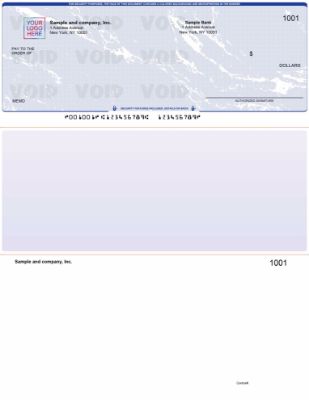
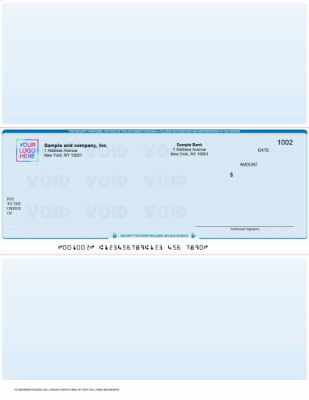
The check occupies the top third of the sheet, with two voucher stubs below. The most common format for QuickBooks, Sage, and most mainstream accounting software. Available at check on top.


Check in Middle

The check occupies the middle third of the sheet, with one voucher above and one below. Used with certain Sage 50 and MYOB templates. Available at check in middle.


Check on Bottom

The check occupies the bottom third of the sheet, with two voucher stubs above. Used with specific accounting software configurations where the voucher-above format is preferred. Available at check on bottom.


3-on-a-Page Check

Three checks occupy one 8.5-by-11-inch sheet with no voucher stubs. Used for high-volume check printing where per-check cost efficiency matters more than voucher records. Available at 3-on-a-page checks.


Manual Business Check

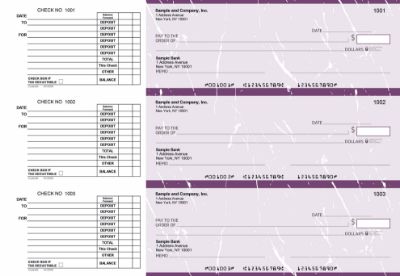
Manual business checks are handwritten rather than software-printed. They come in 3-on-a-page format with detachable stubs, in accounts payable, payroll, multi-purpose, executive deskbook, and pocket formats. The full manual range is at manual business checks.


Voucher Check

The term "voucher check" specifically refers to a business check with one or two attached voucher stubs (detachable sections that stay with the payer and/or payee as a payment record). In business check formats, the voucher carries remittance information: the invoice number, invoice date, payment amount, discount taken, and net payment. The payee detaches the check and deposits it; the voucher remains as a record of what the payment was for. Computer business checks (check on top, check in middle, check on bottom) are all voucher checks.


The Three Types of Check Endorsement

Endorsement is the act of signing the back of a check to transfer ownership or authorize deposit. There are three recognized endorsement types under the UCC, each with different legal effects.


Blank Endorsement

A blank endorsement is simply the payee's signature on the back of the check with no additional instructions. A check with a blank endorsement becomes essentially payable to whoever holds it, like cash. A signed check lying on a desk can be deposited by anyone who picks it up. For this reason, checks should not be signed on the back until the moment of deposit. A blank endorsement is sometimes also called an open endorsement.


Restrictive Endorsement

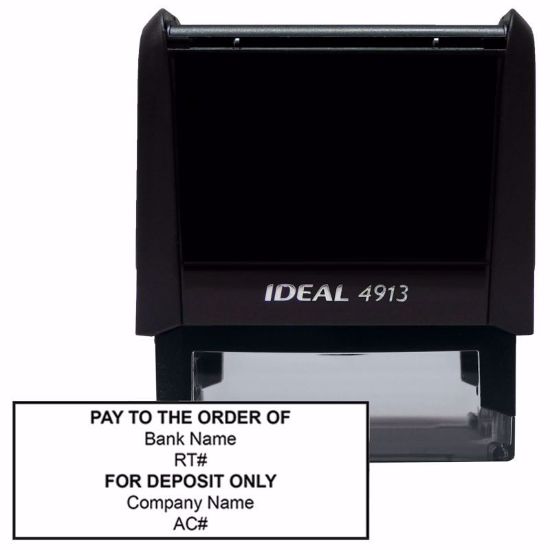
A restrictive endorsement limits what can be done with the check. The most common restrictive endorsement is "For Deposit Only" written above the signature. A check with this endorsement can only be deposited, not cashed. It cannot be transferred to a third party. Restrictive endorsements are recommended for checks deposited by mail or mobile deposit because they prevent the check from being cashed for cash if it is lost or stolen in transit. Self-inking endorsement stamps pre-print this phrase on every check at deposit. See our self-inking endorsement stamps.


Special Endorsement (Third-Party Endorsement)

A special endorsement transfers the check to a specific third party. The payee writes "Pay to the order of [Name]" and signs below it. The named third party then becomes the new payee and can deposit or cash the check. Third-party checks are viewed with suspicion by many banks because they increase the fraud surface; some banks refuse to accept third-party endorsed checks entirely. A check endorsed in this way is sometimes called a two-party check or a third-party check.


Check Problem Terminology: NSF, Stop Payment, Stale, Post-Dated

Check problems have specific banking terms that affect how they are handled by banks and what fees or consequences apply.

NSF (Non-Sufficient Funds) and Bounced Check

A check returns NSF (Non-Sufficient Funds) when the drawer's account lacks enough money to cover the check amount at presentment. The bank returns the check unpaid. The drawer is charged an NSF fee by their bank (typically $25 to $35) and may be charged by the payee as well. The payee's bank may also charge a returned deposit fee. Repeated NSF events can result in account closure and reporting to ChexSystems, which tracks banking history and can prevent the account holder from opening accounts at other banks.


Stop Payment

A stop payment is an instruction from the drawer to their bank not to pay a specific check if it is presented. Stop payments are requested when a check is lost, stolen, sent to the wrong payee, or when a payment dispute arises. Banks charge a stop payment fee (typically $20 to $35). Stop payment orders are valid for six months at most banks and must be renewed if the check is still outstanding after that period. A stop payment does not cancel the underlying payment obligation; if the payee has a valid claim to payment, the drawer still owes the debt.


Stale Check

A stale check is a check presented for payment more than 180 days (six months) after its issue date. Under UCC Article 4, a bank has no obligation to pay a stale check and may dishonor it without liability to the drawer. Banks may choose to pay stale checks at their discretion, but they are not required to. This is why checks should be deposited promptly after receipt and why check registers are important for tracking outstanding checks that have not yet cleared.


Post-Dated Check

A post-dated check carries a future date rather than the current date. The drawer writes a check today with next month's date, intending that the payee not deposit it until that future date. Under the UCC, a bank may pay a post-dated check before the date if it processes the check without noticing the date; however, if the drawer properly notifies the bank of the post-dated check in advance, the bank is obligated to wait until the date before paying. Post-dated checks are commonly used for installment payment arrangements.


Bounced Check

A bounced check is the informal term for a check that is returned unpaid by the paying bank, typically due to NSF but also due to a closed account, a stop payment order, an invalid signature, or a MICR encoding error. The check "bounces" back to the payee's bank and then to the payee, typically with associated fees from both banks.


Dishonored Check

A dishonored check is the formal banking and legal term for any check that is returned unpaid. Dishonor can result from NSF, a closed account, a stop payment, a forged signature, an expired check, or an account hold. Dishonor carries legal consequences: in most US states, issuing a check with knowledge of insufficient funds is a criminal offense if the drawer does not cure the dishonor within a specified notice period.


MICR and Check Processing Terminology

The technical side of check processing has its own vocabulary that appears in banking documentation, check printing specifications, and fraud investigations.

MICR (Magnetic Ink Character Recognition)

MICR refers both to the technology (magnetic ink character recognition) and to the specific characters printed at the bottom of every check. MICR equipment magnetizes the ink and reads each character's unique magnetic waveform to extract the routing number, account number, and check number without optical recognition. MICR is mandated by the American Bankers Association and remains a requirement for check processing in the US as of 2025 despite the growth of digital payments.


E-13B Font

The E-13B font is the specific typeface used for MICR printing on checks in the US, UK, Canada, Australia, and many other countries. It was adopted by the ABA in 1958 and standardized in ISO 1004-1:2013 as the international MICR standard. The font uses characters 0-9 plus four special symbols (routing, on-us, amount, and dash). Each character is designed to produce a unique magnetic waveform distinguishable by MICR readers.


ABA Routing Number (Routing Transit Number)

The nine-digit number that identifies a US bank or credit union. The first four digits are the Federal Reserve routing symbol identifying the Federal Reserve district and the bank's type. Digits five through eight are the bank's ABA institution identifier. The ninth digit is a check digit calculated using a weighted sum formula from the first eight digits, which allows automated systems to verify the routing number is mathematically valid before processing. Our full routing number guide is at ABA routing numbers explained.


Float Time

Float is the period between when a check is written and when it clears the payer's account. During float time, the payer's bank account still shows the money as available even though the check has been issued. The elimination of float through the Check 21 Act (same-day and next-day check processing) has significantly reduced the float period that once allowed businesses to manage cash flow by writing checks against expected but not yet received deposits. Relying on float is now a risk rather than a tool.


Check Truncation

Check truncation is the process of converting a paper check to an electronic image during the clearing cycle and destroying the original paper. Under the Check 21 Act, financial institutions can truncate checks and process electronic images rather than routing physical paper checks between banks. Truncation is what makes mobile check deposits possible: the physical check is photographed, the image is transmitted, and the original paper is retained briefly before being voided or destroyed.


Positive Pay

Positive pay is a fraud prevention service offered by banks to business checking account holders. The business submits an electronic file to the bank listing every check issued (check number, date, amount, and payee). When a check is presented for payment, the bank compares it against the positive pay file. Any check not on the file, or with a mismatched amount or payee, is flagged for the business to review and approve or reject before payment. Positive pay is the most effective defense against check fraud for businesses with high check volume.


Remote Deposit Capture (RDC)

Remote deposit capture is the service that allows depositors to deposit checks by photographing them with a smartphone camera or scanning them with a dedicated device. The bank receives the image and creates a substitute check for processing. RDC eliminates the need to physically visit a branch or ATM to deposit a check. Most consumer banks now offer mobile RDC through their banking app.


ACH (Automated Clearing House)

The Automated Clearing House is the electronic network that processes batch payments between US banks, including direct deposits, electronic bill payments, and electronic checks (eChecks). ACH is not the same as check clearing; paper check clearing uses the Federal Reserve's check clearing system, while ACH processes electronic fund transfers. When a check is converted to an electronic transaction at a retail point of sale (called electronic check conversion), it moves through ACH rather than the paper check system.


Check Security Terminology

Check security has its own specific vocabulary that describes both the protection features built into check paper and the fraud methods those features prevent.

ABA-Compliant Check Paper

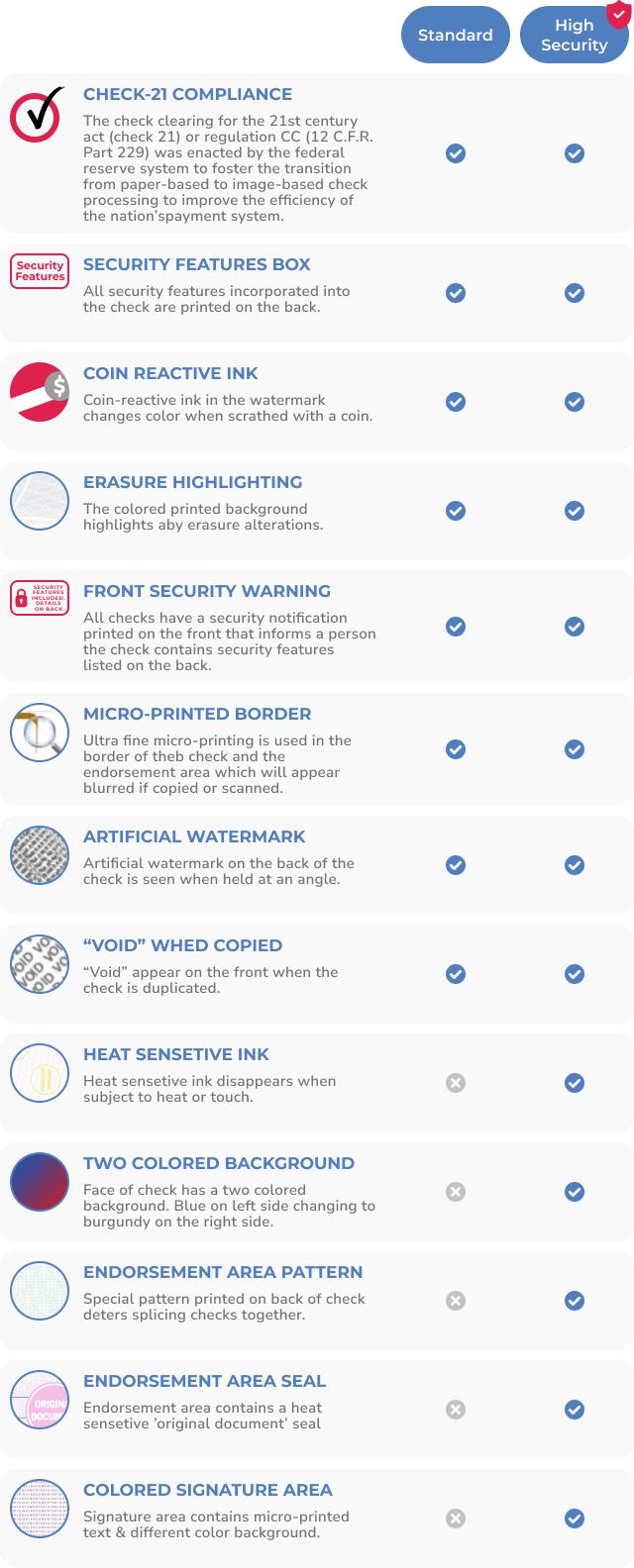
ABA-compliant check paper meets the security paper specifications required by the American Bankers Association for checks to be accepted by US banks and credit unions. ABA-compliant paper includes six standard security features: chemically reactive paper (stops check washing), genuine watermark (embedded in the paper fiber), microprinting (along the signature line, unreadable by copiers), thermochromic ink (heat-sensitive, disappears when warmed), void pantograph (reveals VOID text when photocopied or scanned), and UV fluorescent fibers (glow under ultraviolet light). Every Checkomatic check ships on ABA-compliant paper with all six features at the base price. For the full technical guide, see our check stock paper guide.


Check Washing

Check washing is the process of chemically removing ink from a check using bleach, acetone, or similar solvents, then rewriting the check with different payee information or a larger amount. It is one of the most common forms of check fraud. Chemically reactive paper prevents successful check washing by producing a permanent, visible stain when solvents are applied.


Check Forgery

Check forgery is the signing of another person's name on a check without authorization. A forged check is one that bears a fraudulent signature purporting to be the drawer's. Banks bear primary liability for paying over a forged drawer's signature under UCC Article 4 in most circumstances, provided the account holder was not negligent.


Counterfeit Check

A counterfeit check is a fictitious check produced to look like a genuine check drawn on a real account. Counterfeits are typically produced by scanning and reprinting a genuine check, or by creating one from scratch using stolen account information. The void pantograph background on ABA-compliant checks produces VOID text on any photocopied or scanned reproduction, making counterfeiting more detectable.


Check Kiting

Check kiting is a form of check fraud that exploits float time by writing checks between accounts at different banks to create the appearance of a balance that does not actually exist. As float times have shortened due to Check 21 Act electronic processing, kiting has become much harder to execute successfully.


CPSA (Check Payment Systems Association)

The Check Payment Systems Association is the industry organization whose membership and standards govern ABA-compliant check printing. The CPSA padlock icon on a check printer's ordering page confirms that the printer is a CPSA member producing checks on paper that meets ABA security specifications. All Checkomatic personal and business checks are CPSA-certified.


Complete Check Terminology Glossary A-Z

This alphabetical glossary covers every major check banking term. Terms are cross-referenced where relevant.

ABA (American Bankers Association) The trade organization that administers US bank routing numbers and sets standards for check printing and processing. The ABA routing number identifies each US bank in the check payment system.
 
Account number The number identifying a specific checking account at a bank. Printed in the MICR line at the bottom of the check, in the middle position between the routing number on the left and the check number on the right.
 
ACH (Automated Clearing House) The electronic network for batch payment processing in the US, used for direct deposits, electronic checks (eChecks), bill payments, and electronic check conversion.
 
Bounced check Informal term for a check returned unpaid by the paying bank. Formal term is dishonored check. Common cause: NSF (non-sufficient funds).
 
Cashier check (cashier's check) A cashier check is drawn on the bank's own funds and signed by a bank representative. Guaranteed payment. Required for large transactions where the payee cannot risk a returned check.
 
Certified check A personal check for which the bank has verified sufficient funds and earmarked them in the drawer's account. Bank stamps the check certified. The drawer remains responsible for payment.
 
Check 21 Act The 21st Century Act (2003) that allows banks to process substitute checks (image replacement documents) as legal equivalents of original paper checks. Foundation for mobile deposit and same-day check clearing.
 
Check digit The ninth digit of a nine-digit ABA routing number, calculated using a weighted sum formula applied to the first eight digits. Allows automated systems to verify the routing number is mathematically valid before processing.
 
Check number The sequential number assigned to each check in an order. Appears in the upper right corner of the check face and in the MICR line at the bottom right. Both instances should always match.
 
Clearing The process by which a check moves from the payee's bank through the banking system to the paying bank for settlement. The check "clears" when the paying bank confirms funds and the amount is settled between banks.
 
Convenience amount The dollar amount written in numerals in the small box on the right side of the check's payee line. If it conflicts with the legal (written word) amount, UCC 3-114 says the legal amount controls.
 
Counter check A generic check issued by a bank to an account holder who has run out of personalized checks. Contains the bank's routing number and account number but typically no personalized name or address.
 
Demand draft A legal term for a payment order that must be paid immediately upon presentment, without delay. All standard personal and business checks are demand drafts.
 
Dishonored check The formal term for a check returned unpaid by the paying bank. Reasons include NSF, closed account, stop payment, forged signature, or account hold.
 
Drawee The bank or financial institution against which the check is drawn. For a personal or business check, the drawee is the bank where the drawer holds the account. The drawee definition: the bank responsible for paying the check when presented.
 
Drawer The account holder who writes and signs the check. The drawer definition: the account holder who writes and signs the check, instructing the drawee (bank) to pay the specified amount to the payee. Also called the maker in some legal contexts.
 
E-13B font The specific typeface used for MICR printing on checks in the US, UK, Canada, Australia, and many other countries. Standardized in ISO 1004-1:2013. Used since 1958 in the US banking system.
 
Endorsement A signature or instruction on the back of a check that authorizes deposit, transfer, or cashing. Three types: blank endorsement (signature only), restrictive endorsement (For Deposit Only), special endorsement (Pay to the order of a named third party).
 
Float time The period between when a check is written and when it clears the payer's bank account. The Check 21 Act significantly reduced float by enabling electronic check processing.
 
IRD (Image Replacement Document) The formal name for a substitute check. A paper reproduction of an original check created during the electronic clearing cycle, legally equivalent to the original under the Check 21 Act.
 
Legal amount The dollar amount written in words on the long line below the payee line. Under UCC 3-114, when the legal amount conflicts with the convenience amount (numerals), the legal (written) amount controls.
 
MICR line The row of numbers at the bottom of every check printed in magnetic ink using the E-13B font. Contains the routing number, account number, and check number for automated bank processing.
 
Negotiable instrument A signed document that promises payment of a specific amount to a designated person or bearer, and that can be transferred from one party to another. Checks are the most common form of negotiable instrument in the US. Governed by UCC Article 3.
 
NSF (Non-Sufficient Funds) The reason code on a returned check when the drawer's account lacks sufficient funds to cover the check amount. Also called insufficient funds. Results in check return, bank fees, and potential legal liability.
 
Payee The person or entity named on the "Pay to the order of" line of the check. The payee definition: the intended recipient of the funds and must endorse the back of the check to deposit or cash it.
 
Positive pay A bank fraud prevention service that requires businesses to submit a list of issued checks and then confirms each presented check against the list before payment, flagging mismatches for review.
 
Post-dated check A check bearing a future date rather than the current date. The drawer intends that the payee not deposit until that date. Provides limited protection as banks may pay post-dated checks if they do not notice the future date.
 
Remote deposit capture (RDC) The service allowing check deposits by smartphone photograph or scanner image. The bank converts the image to a substitute check for processing. Foundation of mobile banking check deposit.
 
Routing number The nine-digit ABA routing number identifying a US bank. Printed on the far left of the MICR line. Used to route checks and electronic payments to the correct bank. Also called the routing transit number (RTN) or ABA number.
 
Stale check A check presented for payment more than 180 days after its issue date. Banks may refuse to pay stale checks without liability. Payees should deposit checks promptly to avoid stale date issues.
 
Stop payment A bank instruction from the drawer not to pay a specific check. Requires a fee (typically $20 to $35) and is valid for six months. Does not cancel the underlying payment obligation.
 
Substitute check A paper reproduction of an original check, legally equivalent to the original under the Check 21 Act. Also called an image replacement document (IRD). Created during electronic check clearing when a paper copy is needed.
 
UCC (Uniform Commercial Code) The model set of laws governing commercial transactions in the US, adopted by all 50 states. UCC Article 3 covers negotiable instruments including checks. UCC Article 4 covers bank deposits and collections.
 
Voucher The detachable section(s) of a business check that carry payment details (invoice number, date, amount) for the payer's and/or payee's records. Business computer checks (check on top, middle, or bottom) include one or two vouchers.
 

Why Order Your Checks From Checkomatic

Checkomatic has manufactured every check type described in this guide since 1997, from its Monroe, NY (Monroe NY) in-house production facility. Personal checkbooks, top stub checks, side tear format, deskset checks, business computer checks, manual payroll checks, QuickBooks checks, and blank check stock are all produced under one roof with direct quality control and no reseller markup.

Every Checkomatic check ships on ABA-compliant (ABA compliant) security paper with all six fraud deterrent features included at the base price. No security tier to select. The CPSA padlock on Checkomatic's ordering pages confirms CPSA certification and ABA compliance.

Free black and white logo printing is included on every personal and business check order. Color logo printing is available for a small additional charge. No per-order handling fee is added at checkout. Standard turnaround is 3 to 5 business days from digital proof approval.

For a complete look at every check type available at Checkomatic, start with the personal checkbook collection for personal formats and business checks for business formats. The full accessories range including deposit slips, check envelopes, 7-ring binders, and endorsement stamps ships from the same Monroe, NY facility. Order at checkomatic.com.


The Short Version on Check Types and Terminology

A check is a negotiable demand draft drawn on a bank account. The drawer writes it, the drawee (bank) pays it, and the payee receives the funds. Every check has six face fields (payee, date, convenience amount, legal amount, memo, signature) and three MICR line numbers (routing, account, check number).

The major check types are personal (drawn on individual accounts), business (drawn on business accounts), cashier (drawn on bank funds, guaranteed), certified (personal account, bank earmarks funds), payroll, electronic (eCheck via ACH), and blank check stock. Format variations include single, duplicate, top stub, side tear, and deskset for personal checks, and check on top, middle, bottom, and 3-on-a-page for business checks.

Key terminology to know: MICR (magnetic encoding at the bottom), ABA routing number (nine-digit bank identifier), NSF (non-sufficient funds, why checks bounce), endorsement (back of check authorization), float (gap between writing and clearing), positive pay (fraud protection service), substitute check and Check 21 Act (why mobile deposit works), stale check (over 180 days old), and stop payment (instruction to bank not to pay a specific check).


Frequently Asked Questions


What is the difference between a personal check and a business check?

A personal check is drawn on an individual's personal checking account and is used for personal payments: rent, utilities, gifts, services. A business check is drawn on a business checking account and used for organizational payments: payroll, vendor invoices, accounts payable, and business expenses. The key structural difference is that business computer checks include one or two voucher stubs attached to the check that carry payment detail fields (invoice numbers, descriptions, amounts) for accounting records. Personal checks are wallet-sized with no stub unless you choose a top stub or side tear format. Both types are negotiable instruments processed through the same banking infrastructure.


What is the difference between a cashier's check and a certified check?

Both guarantee payment, but from different sources. A cashier's check is drawn on the bank's own funds: the bank immediately debits your account, then issues a check with the bank as the drawer, signed by a bank representative. A certified check is drawn on your own account: the bank verifies sufficient funds exist, earmarks them so they cannot be spent elsewhere, and stamps the check certified. You remain the drawer on a certified check. Both are used when the payee needs guaranteed payment and cannot accept the risk of a bounced personal check. Cashier's checks involve the bank assuming the payment obligation; certified checks involve the bank verifying and securing your funds but leaving you as the responsible drawer.


What does NSF mean on a check?

NSF stands for Non-Sufficient Funds, also called insufficient funds. An NSF check is returned unpaid by the paying bank because the drawer's account did not have enough money to cover the check amount at the time it was presented. Both the drawer and payee typically incur fees: the drawer's bank charges an NSF fee (commonly $25 to $35), and the payee's bank may charge a returned deposit fee. The check is returned to the payee, who must seek payment through other means. Persistent NSF events can lead to account closure and reporting to ChexSystems, which may prevent the account holder from opening new bank accounts.


What is a MICR line on a check?

The MICR line is the row of numbers printed along the bottom edge of every check in magnetic ink using the E-13B font. MICR stands for Magnetic Ink Character Recognition. The line contains three numbers: the nine-digit ABA routing number on the far left (identifies the bank), the account number in the middle (identifies the specific checking account), and the check number on the right (matches the number in the upper right corner of the check face). Banking equipment magnetizes and reads these characters to route the check automatically to the correct bank for clearing. Any error in MICR encoding causes processing failures and check returns.


What types of checks does Checkomatic offer?

Checkomatic manufactures personal checkbooks, top stub personal checks, personal deskset checks, secretary deskbook checks, QuickBooks wallet personal checks, business computer checks (check on top, in middle, on bottom, and 3-on-a-page), manual business checks (accounts payable, payroll, multi-purpose, executive deskbook, pocket), QuickBooks-compatible computer checks, blank check stock (top, middle, bottom, 3-per-page), and Z-fold pressure seal checks. Every format ships from the Monroe, NY production facility on ABA-compliant security paper with six fraud deterrent features and free logo printing included at the base price.

Jul 16, 2026

Business Check Security Features: Complete Guide


Why Check Security Features Matter in 2025 and 2026

The fraud reality: According to the 2025 AFP Payments Fraud and Control Survey, 63 percent of organizations faced check fraud in 2024. The Financial Crimes Enforcement Network (FinCEN) received more than 680,000 check fraud Suspicious Activity Reports in 2022, nearly double the 350,000 filed in 2021. Check fraud increased approximately 385 percent since the pandemic began, according to data from the American Bankers Association and US Postal Inspection Service. Despite the growth of electronic payments, checks remain the most fraud-targeted payment method in the United States.

Check fraud has not declined with the rise of digital payments. It has grown. Two forces explain this. First, the same digital tools that make modern business efficient (high-resolution scanners, inkjet printers capable of near-photographic output, and widely available photo editing software) also make check counterfeiting easier than it was a decade ago. Second, mail theft has surged, with criminals systematically targeting residential mailboxes and USPS collection boxes to intercept outgoing checks.

Business check security features are the primary defense. A check printed on standard paper with no security features provides essentially no resistance to washing, counterfeiting, or copying. A check with six layered security features creates meaningful obstacles at every stage of the most common fraud attempts, making the check impractical to alter without detection.

Understanding what each feature does, why it works, and which fraud type it stops is the starting point for making informed decisions about your check stock. This guide covers every major business check security feature individually, explains the CPSA certification system, and connects each feature to the fraud type it defends against.

For context on the most common check fraud methods that security features are designed to stop, see our detailed guide on check washing and how secure check stock prevents it.


The Three Fraud Types That Security Features Defend Against

Every business check security feature is designed to defeat one or more of three fundamental fraud types. Understanding these categories helps explain why different features exist and why no single feature is sufficient on its own.


Fraud Type 1: Check Washing (Chemical Alteration)

Check washing is the process of using chemical solvents (acetone, bleach, alcohol-based cleaners) to dissolve the ink in the payee name and dollar amount fields of a stolen check, then rewriting those fields with fraudulent information. The original signature remains intact, making the altered check pass casual inspection. The features that defend against washing are chemically reactive paper and toner adhesion coatings.


Fraud Type 2: Counterfeiting and Copying

Counterfeiting involves reproducing a check digitally, either by scanning an original and printing copies, or by creating a new check using your routing and account numbers with desktop publishing software. Modern consumer-grade printers and scanners can reproduce check designs at high resolution. The features that defend against counterfeiting and copying are the void pantograph, microprinting, genuine watermarks, and UV fluorescent features.


Fraud Type 3: Manual Alteration

Manual alteration involves physically changing information on a check without chemicals, for example by erasing printed or handwritten fields with correction fluid, or cutting and pasting sections. Toner adhesion coatings and security screens defend against this by making toner removal visibly damaging to the paper.

Each fraud type requires different countermeasures. A check that only defends against washing remains vulnerable to counterfeiting. A check that only defends against copying remains vulnerable to washing. This is why the CPSA minimum standard requires features that collectively address both alteration and counterfeiting, and why more features provide meaningfully better protection.


Feature 1: Chemically Reactive Paper

Defends against: Check washing (chemical alteration)

How it works: Chemical compounds embedded in the paper fibers react visibly when contacted by solvents, producing irreversible staining that marks the check as tampered.

Chemically reactive paper is the foundation of business check security. The CHAX Business Check Security Guide calls it "the most fundamental security feature" and notes that "without it, even the most sophisticated printed security features can be defeated." This is because check washing directly attacks the paper surface. If the paper does not react to solvents, a skilled fraudster can remove printed ink without leaving visible evidence.

What the chemistry does: check washing chemicals (acetone, bleach, and similar solvents) target the dye-based colorants in standard pen and printer ink. On unprotected paper, the solvent dissolves the dye without disturbing the paper fibers. On chemically reactive paper, the solvent triggers a reaction with compounds embedded in the paper, producing visible brown, black, or spotted discoloration that cannot be removed or concealed. The staining is irreversible. Any attempt to conceal the staining makes the tampering even more obvious under examination.

CheckDepot's security feature guide explains the visual result: "When someone uses chemicals on our checks, they leave a big stain that can't be hidden. The stain shows up as dark brown or black marks. Bank staff know these marks mean someone tried to change the check, making it easy for them to spot."

The practical test: if you receive a check and notice discoloration, staining, or blotchy marks in or around the payee name or dollar amount fields, those are signs that a washing attempt was made. Genuine chemically reactive paper makes this attempt unmistakably visible.

Checkomatic uses CPSA certified (CPSA certified) chemically reactive paper on every check order. This is not an optional upgrade. Every Checkomatic check ships on this paper at base price, providing washing protection regardless of which check format or product tier you order.


Feature 2: Genuine Watermark

Defends against: Counterfeiting, copying, scanning

How it works: Embedded in the paper during manufacturing, visible under light, impossible to reproduce by scanner, printer, or copier.

A genuine watermark on check stock is created during the papermaking process itself, not during printing. While the paper pulp is still wet, a wire mesh pattern presses into the fibers, creating variations in paper density that appear as subtle light and dark areas when the paper is held up to a light source. Because the watermark is part of the paper fiber structure rather than something printed on the surface, it cannot be reproduced by any printing equipment available to fraudsters.

StockChecks explains the authentication method: "You can spot a real watermark by holding it up to light, where you'll see soft light and dark spots that printers simply cannot copy." CHAX's security guide confirms: "When examining a check for authenticity, holding it up to the light to check for a watermark is one of the quickest and most reliable verification methods available."

The watermark also provides cut-and-paste protection. Because it is in the paper structure itself, cutting a section from one check and attaching it to another produces an obvious boundary where the watermark pattern is discontinuous. Any altered check that shows a mismatched or interrupted watermark is immediately identifiable as fraudulent.


True Watermark vs Artificial Watermark: The Difference

Not all watermarks on business checks are genuine. An important distinction exists between true watermarks and artificial watermarks, and the difference matters for security effectiveness.


True watermark: Created during paper manufacturing by pressing a pattern into the wet pulp. The pattern becomes part of the paper's fiber structure. Visible when held to light. Cannot be scanned, printed, or copied because it exists in the physical paper, not on its surface. StockChecks notes: "True foundry watermarks are one of the best security features for checks, and they've been protecting documents for hundreds of years."


Artificial watermark (simulated watermark): Printed onto the paper surface during check production using white or translucent ink at a specific angle. Visible when the check is tilted. More affordable to produce but less secure than a true watermark because it is applied during printing rather than during paper manufacturing. Taylor's security printing guide describes these as symbols "printed on corporate checks in white or transparent ink that become visible to the human eye when viewed at a 45-degree angle."

The security difference is meaningful. An artificial watermark can potentially be replicated by a sophisticated printer using the right ink formulation and the right printing angle. A true watermark cannot be replicated by any commercial printing process because it requires specialized papermaking equipment. Checkomatic's check stock includes a genuine watermark embedded in the paper during manufacturing, not an artificial printed substitute.


Feature 3: Microprinting

Defends against: Photocopying, scanning, counterfeiting

How it works: Text printed at sub-one-point size appears as a solid line to the naked eye but degrades to an unreadable blur on copies, immediately identifying non-originals.

Microprinting on checks is text printed at an extremely small size, typically less than one point, along the signature line, border, or other defined areas of a check. To the naked eye and to any casual observer, the microprinting appears as a solid or slightly decorative line. Under magnification, the line resolves into readable text, typically phrases like "ORIGINAL DOCUMENT," the company name, or other identifying phrases.

The security mechanism works because of resolution limitations in standard copiers and scanners. CHAX's guide explains: "The tiny text cannot be reproduced at that scale and instead appears as a blurred, indistinct line. This makes it an immediate indicator that a check is a copy rather than an original." Taylor's security printing guide confirms: "Most copiers and scanners, unless capable of very high dots-per-inch quality, will see the microprinting as a solid line."

When a check with microprinting is photocopied, scanned, or digitally reproduced, the microprinting either disappears completely or becomes a broken, blurred smear instead of the crisp line visible on the original. Anyone who knows to look for microprinting, including trained bank tellers and fraud detection systems, can immediately distinguish a copy from an original by examining this detail under a magnifying glass.

Checkomatic includes microprinting along the signature line and border areas of every check. The microprinting is part of the base product on all business check formats, including business checks on top, middle, and bottom formats, and all QuickBooks-compatible check variants.


Feature 4: Void Pantograph

Defends against: Photocopying, scanning, digital reproduction

How it works: A hidden pattern in the check background causes the word VOID to appear prominently on any photocopy or scan of the check.

The void pantograph is one of the most visually striking and immediately understandable security features. A pantograph is a subtle, nearly invisible design printed into the check's background that contains hidden text (usually the word VOID) calibrated to become visible when the check is photocopied or scanned.

StockChecks explains the technical mechanism: "The pattern is calibrated to the resolution thresholds of standard copiers and scanners, so while the original check appears clean and professional, any reproduction clearly displays VOID across its face." The key is tonal calibration: the original check is printed with two background tones so subtly similar that the human eye sees a uniform pattern. When a copier or scanner amplifies the tonal differences during reproduction, the hidden text emerges.

ChoiceChecks confirms the practical effect: the void pantograph "displays when checks are photocopied or scanned on many machines." The StockChecks guide adds: "A pantograph pattern is engineered to become prominently visible when the check is photocopied or scanned. While the original check appears clean and professional, any reproduction clearly displays VOID across its face."

The void pantograph specifically addresses counterfeiting by color copier. A fraudster who photographs your check and attempts to print copies will find that the VOID pattern appears on every print, immediately marking all copies as fraudulent. Recipients who see VOID on a check know immediately they are holding a reproduction rather than an original.

Important limitation: the void pantograph defends against copying and scanning. It does not defend against check washing, which is a physical chemical attack on the original document rather than a reproduction attempt. This is why the void pantograph must be combined with chemically reactive paper for complete alteration and counterfeiting protection.


Feature 5: UV Fluorescent Features

Defends against: Counterfeiting, verification bypass

How it works: Fibers or inks embedded in or on the check are only visible under ultraviolet light, allowing bank equipment and verification tools to authenticate originals.

UV fluorescent check features encompass several related technologies that share a common principle: they are invisible under normal lighting and become visible only under ultraviolet (UV or "black") light. Banks and financial institutions use UV light scanners and handheld UV verification devices to authenticate checks, particularly for high-value transactions.

CheckDepot's guide describes two UV feature types commonly used in business check security. Invisible fluorescent fibers are "tiny threads mixed into the paper that you can only see under special UV light." These fibers are embedded in the paper pulp during manufacturing, making them impossible to replicate with any surface printing process. Visible fluorescent fibers are similar but can also be seen under normal lighting as colored threads in the paper.

Intuit Market's security feature documentation explains the authentication mechanism: "Invisible fluorescent fibers only appear under UV light which prevents photocopying and aid in authentication." When a bank teller or authentication device shines UV light on a check, genuine fluorescent fibers glow. A counterfeit check printed on standard paper from an office supply store will show nothing under UV light, immediately identifying it as non-authentic.

The practical verification step: UV light detection is one of the fastest authenticity checks available to anyone handling high-value check payments. A UV verification pen or portable UV flashlight (available at office supply stores for under $20) allows any merchant or business owner to verify check authenticity at the point of receipt, without any special training or equipment beyond the light source.

Checkomatic's security paper includes UV fluorescent features that are verified by bank processing equipment. These features are present on all orders and add no additional cost to the base check price. For more on how check security features interact with the banking system's fraud detection process, see our business check clearing and processing guide.


Feature 6: Pre-Encoded MICR as a Security Feature

Defends against: Counterfeiting, check routing fraud

How it works: MICR encoding in genuine magnetic iron oxide toner cannot be replicated by standard printers; bank reader-sorters detect the absence of a magnetic signal on counterfeits.

The MICR line (Magnetic Ink Character Recognition) at the bottom of every check is commonly understood as an operational element that enables automated bank processing. It is also a security feature. Bank reader-sorter machines read the MICR line magnetically. A check printed on blank paper using a standard office laser printer contains no magnetic signal in the MICR area, because standard toner is not magnetic. Reader-sorters detect the absence of a magnetic signal where one is expected and flag the item for manual review or rejection.

This means that a counterfeit check produced by scanning an original and reprinting it on blank paper will fail the very first automated bank test, even before any human examination. The fraudster cannot replicate genuine MICR encoding without specialized equipment (a dedicated MICR printer with certified iron oxide toner).

Checkomatic pre-encodes the MICR line at manufacture using ANSI E13-B certified magnetic toner on every order. This is not an option or upgrade. The routing number is verified against the Federal Reserve E-Payments Routing Directory before printing begins. Every batch is run through a MICR reader before shipping. The result is a bank rejection rate under 0.1 percent for MICR-related issues.

For the complete technical explanation of MICR encoding, how reader-sorters detect genuine vs counterfeit MICR, and the E-13B font specifications, see our MICR line explained guide.


Additional Feature: Thermochromic Heat-Sensitive Ink

Heat sensitive ink check thermochromic feature: this heat-reactive ink is printed in a specific location on the check face (typically a small icon, key symbol, or the word ORIGINAL) that changes color or temporarily disappears when warmed by body heat. Pressing a finger firmly against the thermochromic mark causes it to fade. When the check cools, the mark returns to its original state.

Harland Clarke's security feature comparison identifies this as "heat-reactive ink: a heat-sensitive pink icon that disappears when warmed by touch, allowing immediate verification of authenticity." CHAX's guide calls it "one of the most effective" features for instant field authentication because "you can easily authenticate it in the field without any special equipment."

The reason thermochromic ink works as a security feature is that no standard printer, copier, or scanner can reproduce a thermochromic response. A photocopy of a check with thermochromic ink will have the mark permanently visible (because the photocopy is just an ink image), and pressing a finger to the copied mark will produce no response. The mark will not disappear and return. This test takes seconds and requires no equipment, making it one of the fastest verification methods for recipients handling high-value check payments.


Additional Feature: Toner Adhesion

Check toner adhesion coatings are clear chemical treatments applied to the check paper surface that bond laser toner more firmly to the paper fibers. Standard paper and standard laser toner have a relatively weak bond. With chemicals, tape, or physical scraping, toner can be removed from unprotected paper without immediately visible damage.

Toner adhesion coatings make this removal attempt visibly destructive. ChoiceChecks explains: "Helps bond toner to the paper; attempts to remove information can damage the paper." Taylor's security guide calls this feature "toner lock": "a clear coating printed over sensitive areas of secure checks to protect against alteration of those areas. The coating makes removal of laser printer toner extremely difficult compared to untreated paper."

For businesses that use laser check printing (printing variable fields like payee and amount from QuickBooks or another accounting system), toner adhesion is particularly relevant because the printed fields are exactly what a manual alteration attempt would target. A check with toner adhesion makes this attack visible even if the fraudster is careful, because the paper surface shows damage where the toner was forcibly removed. For QuickBooks-compatible checks with this feature, see our QuickBooks checks catalog.

Picture for category Computer Checks


The Check Security Warning Box and Padlock Icon

The check security warning box is a printed area on the back of a secure business check that lists the specific security features incorporated in that check and provides guidance for verifying authenticity. It serves two purposes.

First, it informs anyone receiving the check exactly which security features to look for when verifying authenticity. A warning box entry that says "this check includes chemically reactive paper, watermark, and microprinting" tells the payee's bank teller exactly which verification steps to take and which signs of tampering to look for.

Second, the warning box itself functions as a fraud deterrent. When a potential fraudster examines the back of a check and sees a detailed list of security features, the knowledge that an alteration or copy attempt will be detected reduces the incentive to attempt fraud. StockChecks notes: "A warning band calls attention to features that help verify check's authenticity, and it serves as an active security feature as much as an informational one."

Padlock icon check meaning: the Padlock Icon is printed on the front of the check and functions as the visible indicator that the check has been certified under the CPSA system, covered in detail in the next section.


What CPSA Certification Means

CPSA stands for the Check Payment Systems Association, a financial industry organization formerly known as the Financial Stationers Association. CPSA was established to advance and protect the long-term viability of paper-based payment systems and to develop standards for check security.

CPSA certification definition: CPSA created the Enhanced Check Security Features Padlock Icon in response to growing check fraud perpetrated using copiers and computers, as described in its January 2025 Padlock Icon Guidelines. The CPSA website explains: "The presence of the Padlock Icon on a check indicates that there are a minimum of three features incorporated in the check that add complexity and make the check document harder to reproduce or change."

CPSA does not print checks. Its role is to certify check printing companies that apply and demonstrate compliance. The certification process requires a check printing company to:

  1. Submit an application to CPSA with an affidavit of compliance
  2. Designate a minimum of three overt security features that collectively defend against both alteration and counterfeiting
  3. Submit representative sample checks to CPSA for evaluation
  4. Receive CPSA authorization confirming the samples meet minimum requirements
  5. Renew annually through ongoing compliance

The Padlock Icon itself is a registered certification mark of CPSA on the Principal Register of the United States Patent and Trademark Office since July 15, 1997. Only CPSA-authorized check printing companies can legally print the Padlock Icon on checks. The Padlock Icon and corresponding descriptive text count as one of the required features under CPSA guidelines. Two additional features must be present to reach the three-feature minimum.

What CPSA certified means on a Checkomatic check: Checkomatic is an authorized CPSA user. The CPSA Padlock Icon appears on Checkomatic checks because Checkomatic's checks incorporate six security features, well above the three-feature minimum the CPSA certification requires. The Padlock Icon on a Checkomatic check is not just a symbol. It is backed by actual certification and ongoing compliance.


ANSI X9.100-170: The Check Fraud Deterrent Standard

The CPSA Padlock Icon is formally governed by ANSI X9.100-170-2010, titled "Check Fraud Deterrent Icon," published by the Accredited Standards Committee X9 on Financial Services. This American National Standard specifies the size, placement, and requirements for the Padlock Icon on checks of different sizes, and sets the framework for what qualifies as a certifiable security feature.

The CPSA's Padlock Icon Guidelines describe the original 1999 standard as ANSI X9.51, Fraud Deterrent Icon Standard, subsequently updated and redesignated as ANS X9.100-170 in 2004 and revised as ANSI X9.100-170-2010 in 2010. The standard requires that the Padlock Icon be machine-readable for check processing equipment, not just visually recognizable.

For broader check security guidance, the CPSA also references ASC X9/TG-8 2002, the Check Security Guideline, which provides complete technical guidance on security features, their application, and their relative effectiveness against different fraud types. These standards collectively define the technical framework within which certified check security features operate in the US banking system.


Why Layered Security Beats Any Single Feature

The reason multiple security features are recommended rather than just one or two comes down to fraud type coverage. Each feature defends against specific attack methods, and no single feature addresses all three fraud types:

  • Chemically reactive paper stops check washing but does not stop a photocopier.
  • Void pantograph stops photocopying but does not stop washing.
  • Microprinting degrades on copies but does not react to solvents.
  • Watermark cannot be reproduced by printers but does not prevent washing.
  • UV features authenticate originals but do not physically deter washing or copying.
  • MICR encoding prevents routing fraud and counterfeit MICR but does not stop alteration of the payee name.

The CheckDepot security guide explains this layered logic: "Each security feature adds a critical layer of protection, but their true strength comes in how they work together. When you combine physical elements like fluorescent fibers and true-foundry watermarks with reactive features like heat-sensitive ink and chemical protection paper, you get a robust check protected against every type of fraud attempt."

CHAX's business owner guide reinforces the recommendation: "For higher-risk businesses, those that issue large-dollar checks or have experienced fraud in the past, consider stock that also includes holographic foil and thermochromic ink." The minimum three CPSA features provide a baseline. More features provide coverage across a wider range of fraud attempts.

Checkomatic includes six core security features on every order at base price: chemically reactive paper, genuine watermark, microprinting, void pantograph, UV fluorescent features, and pre-encoded MICR. This combination addresses all three fraud types (washing, counterfeiting, and alteration) across multiple independent verification methods.


How to Verify Check Security Features When Receiving Payment

Knowing the security features that should be present on a check allows anyone receiving payment to perform quick authenticity checks. These verification methods require minimal equipment and take less than 30 seconds:

  • Hold to light (watermark check): Hold the check up to a light source. A genuine watermark embedded in the paper will appear as subtle light and dark variations in the paper. No watermark visible means either the check was printed on non-security paper or the watermark was not included.
  • Magnification (microprinting check): Examine the signature line and border under a magnifying glass or loupe. On a genuine check, microprinting resolves into readable text. On a photocopy or counterfeit, the microprinting is a blurred smear or absent entirely.
  • Heat test (thermochromic check): Press a finger firmly against the thermochromic icon on the check face. On a genuine check, the mark temporarily fades from warmth and returns as it cools. On a copy, the mark does not respond to heat.
  • UV light (fluorescent fiber check): Shine a UV flashlight on the check. Genuine security paper shows glowing fluorescent fibers. Standard paper shows nothing or non-specific fluorescence.
  • Chemical test (wash detection): The check security warning box on the check back typically lists a chemical wash detection area. Some high-security checks include a white box that should remain clear. Any coloration in this box indicates a washing attempt was made.
  • Check number match: The check number printed in the upper right corner must match the check number encoded in the MICR line at the bottom. A mismatch indicates tampering or a counterfeit.

For businesses that regularly accept checks, a UV flashlight and magnifying glass at the point of payment allows quick verification. These checks take under 30 seconds and do not slow operations.


Connection Between Security Features and Check Washing

Check washing is the fastest-growing form of check fraud and the one that most directly affects businesses that mail checks for accounts payable, payroll, or vendor payments. Understanding which security features specifically protect against washing is important for businesses evaluating their check stock.

The primary washing defense is chemically reactive paper. This is not negotiable: no other printed or design security feature provides meaningful resistance to chemical washing. A check with microprinting, watermarks, and a void pantograph but no chemically reactive paper remains fully vulnerable to washing, because those features are on the paper surface and the chemicals can remove the ink without triggering any of them.

Secondary washing defense comes from toner adhesion coatings, which make it harder to remove laser-printed variable fields (payee name, dollar amount) even with mechanical methods. Gel ink pens, rather than ballpoint pens for handwritten fields, also provide resistance because gel ink bonds with paper fibers rather than sitting on the surface.

For a complete guide to check washing, how it works chemically, what the USPS and FBI data show about mail theft, and the full range of prevention strategies beyond check stock selection, see our check washing prevention guide. That guide covers USPS Informed Delivery, secure mailing practices, the UCC 4-401 legal framework for victim recovery, and the FinCEN statistics on check fraud scale.


Why Checkomatic for Secure Business Checks

Checkomatic is an in-house check manufacturer (in-house check manufacturer) producing ABA compliant check stock (ABA compliant) in Monroe, NY (Monroe NY) since 1997. Every check order includes six fraud deterrent security features at base price, with no tiered security levels or upgrade fees required to reach meaningful protection:

  • CPSA certified (CPSA certified) chemically reactive paper: Stains immediately and irreversibly when washing solvents contact the paper. Included on every order.
  • Genuine watermark: Embedded in paper fiber structure during manufacturing. Visible under light. Cannot be reproduced by any commercial printer or scanner.
  • Microprinting: Appears as a solid line to the naked eye. Degrades to an unreadable blur on photocopies and scans. Along signature and border areas.
  • Void pantograph: Hidden background pattern causes VOID to appear prominently on any photocopy or digital reproduction of the check.
  • UV fluorescent features: Invisible under normal light. Visible under UV light to bank verification equipment and UV verification pens.
  • Pre-encoded MICR in certified magnetic toner: Bank reader-sorters detect genuine MICR magnetically. Counterfeits printed in standard toner produce no magnetic signal and are flagged immediately.

Free logo printing (free logo printing) is included on every business check order. Standard turnaround is 3 to 5 business days from proof approval. The routing number is verified against the Federal Reserve E-Payments Routing Directory before any printing begins. Every batch is run through a MICR reader before shipping.

For business checks with all six security features, see our business checks catalog. For QuickBooks-compatible secure checks, see our QuickBooks checks. For personal account holders who want security features on personal checks, see our personal checks range. Order at checkomatic.


What Checkomatic Customers Say

The reviews below are published directly on checkomatic.com, reproduced verbatim with no modifications. Sources: checkomatic.com/quickbooks-starter-pack and checkomatic.com/business-checks-on-top.

"Been with them for 15 years. Always reliable, always good quality, good service. What more can you ask for?"

ATV Inc. | ★★★★★ 5/5 | April 5, 2024 | Source: checkomatic.com/quickbooks-starter-pack

"We use CheckoMatic for all of our check needs! They have great prices and we receive our products in a timely manner!"

CG's Tax Service | ★★★★★ 5/5 | September 18, 2024 | Source: checkomatic.com/quickbooks-starter-pack

"I got 500 checks for less than half of what the bank wanted for 200!"

VVA Voucher Checks (Vietnam Veterans of America) | ★★★★★ 5/5 | July 6, 2024 | Source: checkomatic.com/quickbooks-starter-pack

"Checkomatic was wonderful to work with on a custom order check. Their communication was excellent and always available when a question or concern was presented to them. Super fast turnaround. Will definitely use them for future check orders."

Gina M. | ★★★★★ 5/5 | Verified Customer | Source: checkomatic.com/business-checks-on-top

"First time ordering and I am super impressed with the quality of the checks. No issues with delivery. I will be ordering again!"

TClinton | ★★★★★ 5/5 | April 9, 2025 | Source: checkomatic.com/quickbooks-starter-pack

"Customer service was very helpful. I was able to complete the ordering process in a matter of about 2 minutes. Highly recommend."

Cindy S. | ★★★★★ 5/5 | Verified Customer | Source: checkomatic.com/business-checks-on-top

All reviews reproduced verbatim. Read more at checkomatic/business-checks.


The Short Version on Business Check Security Features

Business check security features are physical, chemical, and printing characteristics that make checks harder to alter, counterfeit, or copy. Three fraud types require different defenses: check washing requires chemically reactive paper and toner adhesion; counterfeiting and copying require the void pantograph, microprinting, watermarks, and UV features; manual alteration requires toner adhesion and chemically reactive paper. CPSA (Check Payment Systems Association) certifies check printing companies that incorporate a minimum of three overt security features covering both alteration and counterfeiting, using the registered Padlock Icon governed by ANSI X9.100-170-2010. A true watermark is embedded in paper fibers during manufacturing and cannot be reproduced by printers. An artificial watermark is printed on the surface and is less secure.

Microprinting appears as a solid line to the naked eye but degrades to an unreadable blur on copies. The void pantograph causes VOID to appear on photocopies. UV fluorescent features glow under UV light but are invisible normally, allowing bank equipment to authenticate originals. Pre-encoded MICR in certified magnetic toner is itself a security feature because counterfeits printed in standard toner produce no magnetic signal. Checkomatic includes all six core features on every check order at base price, with CPSA certification, ABA compliance, and Federal Reserve routing number pre-verification.


Jul 15, 2026

Cheque Printing and Payment Services: Complete Guide

Cheque vs Check: The Same Instrument, Two Spellings

When you search for "cheque printing" you are looking for the same thing as someone who searches for "check printing." The cheque vs check difference is only spelling. Both words refer to a written order directing a bank to pay a specified amount from the account holder's account to the person named on the document. The cheque and check spelling difference is purely regional. The financial instrument is identical.

The United States uses check. The United Kingdom, Canada, Australia, New Zealand, India, and other Commonwealth nations use cheque specifically for the banking document. Both words are recognized across the international financial system. A US check deposited in Canada or a Canadian cheque presented to a US bank teller refers to the same type of negotiable payment instrument processed by the same MICR encoding technology in both countries.

As Merriam-Webster notes, cheque is "chiefly British" for the banking sense, while Cambridge Dictionary labels cheque as the UK form and check as the US form for the same payment document. The only context where the words are not interchangeable is grammatical: cheque applies only to the banking document. Check carries additional meanings in English (to verify, to stop, to mark, a bill at a restaurant) that cheque never does, even in British English. A British bank officer can write a cheque and also check a balance, using both words correctly in the same sentence.


Why the Spelling Difference Exists

The cheque spelling comes from French. The word entered English financial usage in the 18th century as a variant of "exchequer," the government treasury department. British banking adopted the cheque spelling specifically for the payment document and kept it through centuries of financial tradition.

The American spelling check reflects the work of 19th-century lexicographer Noah Webster, who systematically simplified many British spellings when creating what became the foundation of American English dictionaries. Webster removed the French-derived "que" endings from many words: cheque became check, programme became program, catalogue became catalog. The reformed American spelling stuck, while British English kept the original forms.

Canada sits in a middle position linguistically. Canadian English historically followed British spelling conventions, so cheque is the standard Canadian banking term. Canadians use "chequing account" where Americans say "checking account." A Canadian might correctly say "let me check if that cheque has cleared," using both forms in the same sentence exactly as their usage requires.

Australian and New Zealand English follow British conventions and use cheque for the banking document. Indian English, shaped by British colonial influence, also uses cheque in formal financial contexts. The practical effect for anyone searching for cheque printing services is that the search term captures buyers from these Commonwealth markets who may be looking for services compatible with their banking system, and also buyers from those markets who have US bank accounts and want US-format checks.


What Cheque Printing Is

Cheque printing, or check printing, is the production of personalized payment documents by a professional manufacturer. It is distinct from printing a cheque on a personal printer, which requires specialized MICR toner, certified check stock, and compliance with banking printing standards that most home printers cannot meet.

A professional cheque printing service takes your personal or business information, your bank routing and account numbers, and your selected design, then produces physical cheque documents on certified security paper using commercial MICR printing equipment. The output is a pad or book of personalized cheques ready for immediate use.

Cheque printing services exist across the US, UK, Canada, and Australia, each operating under the cheque printing standards of their country's banking authority. In the US, this means ANSI X9.100 compliance. In Canada, this means Canadian CPA Standard 006 (Payments Canada CPA Standard 006) compliance. In the UK, this means compliance with requirements set by the Payment Systems Regulator for the Image Clearing System.

Checkomatic is a US-based cheque printing service, though we use the American spelling and refer to our products as checks. We have produced ABA-compliant checks for US personal and business accounts from Monroe, NY since 1997.


How the Cheque Printing Process Works

Whether the manufacturer calls it cheque printing or check printing, the production process at a professional facility follows the same sequence.

Security Paper Substrate

The foundation of every professionally printed cheque is the security paper. This is not ordinary paper. It is a specially manufactured substrate that incorporates fraud-deterrent features during the papermaking process itself: chemically reactive agents that respond to washing solvents, fluorescent fibers woven into the paper, and a genuine watermark created in the paper mold rather than printed on the surface. No cheque printing service can produce a compliant, bank-acceptable cheque on ordinary copy paper.


MICR Encoding

The most technically exacting step in cheque printing is the MICR line. MICR stands for Magnetic Ink Character Recognition, and the line of characters at the bottom of every cheque must be printed with magnetic toner or ink using the E-13B font at precisely specified character dimensions, spacing, and magnetic signal levels. MICR encoding requirements in the US are governed by the ANSI X9.100-20 standard (character shape and magnetic signal) and ANSI X9.100-160 (placement and location). Any deviation from these specifications can cause the cheque to be rejected by automated banking processing equipment.


Personalization Printing

After the security paper is prepared, the printer applies the personalized information: account holder name, address, bank name, starting check number, background design, and any logo. At Checkomatic, a digital proof cheque image of the complete personalized cheque is generated and sent for approval before production begins. This proof step catches errors in routing numbers, account numbers, or personal information before any security paper is committed.


Quality Verification

Professional cheque printing facilities verify MICR encoding accuracy against the relevant banking authority's routing directory. For US checks, this means verifying the ABA routing number against the Federal Reserve's routing database. For Canadian cheques, this means verification against Payments Canada's financial institution registry.


Packaging and Fulfillment

Completed cheques are padded, covered, boxed, and shipped. At Checkomatic, orders ship within 3 to 5 business days from proof approval, directly from the Monroe, NY production facility.


MICR Encoding: The Technology Behind Every Cheque

The MICR line is the technological heart of the modern cheque. It is what allows banks around the world to process billions of cheques each year through automated equipment at high speed without manual reading of account information.

MICR technology was developed in the United States in the mid-1950s. The American Bankers Association (ABA) was shown the E-13B font in July 1956 and adopted it in 1958 as the MICR standard for negotiable documents in the US. By 1963, MICR had been almost universally adopted across US banking. The same year, ANSI adopted the E-13B font as the American standard for MICR printing.

The E-13B font uses magnetic ink or toner containing iron oxide particles. When a cheque passes through a MICR reader, the reader first magnetizes the ink and then reads the magnetic signal produced by each character as it passes over the reader head. Each character produces a unique waveform that the system identifies precisely. This dual readability (optical and magnetic) is what makes MICR encoding more reliable than standard printing: even when a cheque is smudged, creased, or poorly scanned, the magnetic properties of the characters remain readable.

The E-13B font has since become an international standard. ISO 1004-1:2013 adopted E-13B as the international standard for MICR cheque encoding. Today, the same E-13B font is used for MICR encoding in the US, UK, Canada, Australia, Japan, India, Mexico, and many other countries. A cheque reader in New York and one in London both read the same E-13B characters using the same magnetic detection principles.

What differs between countries is not the MICR font itself but the field structure within the MICR line. The US MICR line uses the nine-digit ABA routing number format. The UK MICR line uses the six-digit sort code format, divided as two groups of three digits. Canadian cheques use a different MICR field arrangement that can include a Payments Canada transaction code, with special "Code 45" encoding required for US dollar payments to CPA member banks. These structural differences mean that a US ABA routing number and a UK sort code are not interchangeable, even though both are printed in E-13B font.


US, UK, and Canadian Cheque Standards Compared

The three largest English-speaking cheque markets all use E-13B MICR encoding but operate under different national standards for cheque design, paper specifications, and printer accreditation. This is the information no competitor covers, and it is what buyers from outside the US need to understand before ordering.


United States: ANSI X9.100 and ABA Standards

US cheque printing is governed by the ANSI X9.100 series of standards published by the Accredited Standards Committee X9, an ANSI-accredited body. Key standards include ANSI X9.100-20 (MICR character specifications), ANSI X9.100-160 (placement and location of MICR fields), and ANSI X9.100-10 (paper specifications for MICR documents).

The US routing number is a nine-digit ABA routing number assigned to each financial institution by the American Bankers Association. This routing number is the critical identifier on every US check. Without a valid ABA routing number, a check cannot be processed through the US banking system.

The Check 21 Act (21st Century Act), enacted in 2003, allows US banks to process substitute checks (also called image replacement documents, or IRDs) as the legal equivalent of original paper checks. This enables remote deposit capture, where a bank customer photographs a check with a smartphone and deposits it electronically. The original paper check may never physically travel to the paying bank. The MICR encoding on the original check is what makes this image-based processing possible.


Canada: CPA Standard 006 and Payments Canada

Canadian cheques are governed by Payments Canada Standard 006, the specification for imageable MICR-encoded payment items drawn on Canadian financial institutions. All cheques drawn on Canadian bank accounts must meet Standard 006 specifications.

The CPSA printer accreditation scheme, formally the Cheque Printer Self Accreditation (CPSA) Program,, administered by Payments Canada in partnership with the Canadian Cheque Manufacturers Industry Group, accredits Canadian cheque printers. Accredited printers receive a four-digit printer identification number from Payments Canada, which must be printed in the upper right corner of the back of every cheque they produce (formatted as "Printer ID#1234"). Cheques from accredited CPSA printers are exempt from routine pre-production testing requirements.

Canadian cheques that include US dollar payments to CPA member banks require "Code 45" in the MICR line, a specific transaction code that identifies the payment currency. This is a Canadian-specific requirement with no equivalent in US check printing. Accounting software that prints Canadian checks often includes a Code 45 checkbox in its check setup options.


United Kingdom: Image Clearing System and ISSFs

UK cheques since October 2017 are processed through the Image Clearing System (ICS), which replaced the physical Paper Clearing System. Under the ICS, an image of the cheque is exchanged electronically between banks rather than the physical document traveling through a clearing cycle. This allows UK cheque funds to be available the next working day after deposit rather than the previous multi-day clearing period.

The ICS introduced a requirement for ISSF image survivable security features (Image Survivable Security Features, ISSFs) on UK cheques. ISSFs are security elements that remain visible and functional in the digital image of a cheque even after the image has been scanned, transmitted, and reproduced. Under UK cheque printing regulations, cheque layouts and personalization can only be produced by approved accredited cheque printers who meet these requirements.

UK cheques use a six-digit sort code (two groups of three digits separated by hyphens, for example 12-34-56) rather than a nine-digit ABA routing number. Sort codes identify the specific bank branch rather than the institution as a whole. A US ABA routing number cannot be used where a UK sort code is required, and vice versa.


What Makes a Cheque Legally Valid

Regardless of the country-specific standard, a valid cheque requires the same core elements to be legally negotiable.

The cheque must be written or printed on a physical document (or in the case of electronic clearing systems, must produce a legible, complete image). It must name the bank it is drawn on. It must carry the account holder's account number and the bank's routing identifier in the MICR line. It must name a payee (the person or entity to be paid). It must state a specific amount in both numbers and written words, with the two agreeing. It must carry the date it was written. And it must carry the account holder's authorized signature.

A cheque missing any of these elements can be returned unpaid by the paying bank. The most common causes of cheque return are MICR encoding errors (wrong routing or account number), a missing or mismatched payee name, an amount discrepancy between the numeric and written amount, and an absent or non-matching signature. Our ABA routing numbers guide explains in detail how to verify your routing number before ordering cheques.


Cheque Security Features That Prevent Fraud

Cheque fraud prevention is a primary concern as cheque fraud remains a significant issue across all markets that use paper payment instruments. The 2025 AFP Payment Fraud and Control Survey found that 63% of financial professionals reported their organizations faced check fraud in 2024. Security features built into the cheque paper itself are the primary defense against the most common fraud methods.


Chemically Reactive Paper

Reactive chemicals in the paper produce a permanent, visible stain when bleach, acetone, or other washing solvents are applied. This stops cheque washing (the most common form of altered cheque fraud), where a thief intercepts a cheque and chemically removes the payee name and amount before rewriting them. Any washing attempt leaves an obvious mark on reactive paper. See our full explanation in our check stock paper guide.


Genuine Foundry Watermark

A watermark embedded in the paper during manufacturing is visible when the cheque is held to light. It cannot be reproduced by any printer or copier because it is a structural property of the paper fiber, not a surface print. Counterfeit cheques on plain paper have no genuine watermark.


Microprinting

Text printed at a scale too small to read without magnification appears as a solid line to the naked eye along the signature line or border. Photocopiers and scanners cannot reproduce microprinting accurately. Any copy shows a blurred line rather than readable text, immediately identifying the document as a reproduction.


Heat-Sensitive Thermochromic Ink

An area of the cheque face printed with thermochromic ink disappears when warmed by touch and returns when it cools. A bank teller can verify authenticity in seconds. A counterfeit on plain paper has no thermochromic zone.


Void Pantograph

A pattern in the cheque background that produces visible VOID text when the document is photocopied or scanned. Any attempt to reproduce the cheque by copying generates an image with VOID prominently displayed, identifying it as a copy rather than an original.


UV-Reactive Fluorescent Fibers

Fibers distributed through the paper that glow visibly under ultraviolet light. Plain paper has no such fibers. UV verification identifies genuine security paper immediately.


Image Survivable Security Features (UK Only)

The UK Image Clearing System introduced ISSFs as an additional layer specific to the image-based cheque processing environment. ISSFs are security elements designed to remain detectable in a digital scan of the cheque, allowing the receiving bank to verify security features even without examining the physical document. ISSFs may include special QR codes or unique coded numbers that link the image to the originating cheque printer's records.

Our complete guide to how each of these features prevents specific fraud attempts is at check validity and fraud prevention.


How Cheques Clear Through the Banking System

Understanding how cheque clearance works, how a cheque moves from being written to clearing your account, is useful context for anyone ordering cheques. The clearing process explains why there is a gap between when a cheque is written and when it debits the payer's account, and why this gap matters for maintaining a check register.

When you write a cheque and hand it to a payee, the payee deposits it at their bank. The payee's bank credits the payee's account provisionally and sends the cheque into the clearing system. In the US, the cheque either travels physically to the paying bank (less common now) or is scanned and transmitted as a substitute check under the Check 21 Act (the standard today). The paying bank receives the cheque or its substitute image, verifies the MICR data, confirms the account has sufficient funds, and debits the payer's account. The paying bank then settles with the payee's bank through the Federal Reserve's settlement system.

The entire cycle from deposit to debit typically takes one to three business days for US checks. During that period, the cheque is outstanding: it has been written and deposited but not yet debited. This is why a check register is essential for maintaining an accurate running balance, as covered in our checkbook registers guide.

In the UK under the Image Clearing System UK (ICS), the equivalent process takes approximately one working day from deposit to funds availability, which is a significant improvement over the previous three-to-four-day Paper Clearing System cycle.


Who Still Uses Cheques and Why

Despite the growth of digital payment methods, cheques and checks remain in widespread use across multiple contexts in 2025.

Personal Use

Many individuals still write personal cheques for rent, charitable donations, gifts, professional services paid by mail, and situations where a paper trail with a signature is preferred over an electronic transaction. In the US, personal checks remain common for payments to landlords, contractors, and organizations that do not accept electronic transfers. Some individuals prefer the control and documentation of writing physical cheques.


Small Business Payments

Small businesses frequently pay suppliers, vendors, and contractors by cheque because it provides a paper record, allows for memo notations linking the payment to specific invoices, and does not require sharing banking details with every payee. A business cheque with the payee's name and a specific invoice reference on the memo line is self-documenting in a way that an electronic transfer is not.


Payroll

While direct deposit has become the default for most employee payroll in the US, some employees without bank accounts still receive paper payroll cheques. Small businesses with a mix of banked and unbanked employees may maintain payroll check printing alongside direct deposit processing. Our business checks and payroll guide covers payroll check options in detail.


Real Estate and Legal Transactions

Earnest money deposits, security deposits, and certain legal settlements are frequently paid by cheque, cashier's cheque, or certified cheque because the paper instrument provides a durable, legally verifiable record of payment. Electronic payments in these contexts may be required to route through escrow or trust accounts with more complex processing than a simple cheque.


Gifts and Charitable Giving

Personal cheques remain common for gifts and charitable contributions because they provide a written record with a signature, they can be made payable to a specific organization, and they give the recipient control over when the funds are accessed rather than triggering an immediate electronic transfer.


Personal Cheque Printing Options at Checkomatic

Checkomatic offers a complete personal cheque order range of personal cheque (check) formats for US bank accounts, all printed on ABA-compliant security paper at the Monroe, NY facility:

  • Personal checkbooks: Standard personal cheques in blue, burgundy, and green. Multiple background styles. Single or duplicate (carbonless copy) format. Includes a check register and deposit slips.
  • Top stub personal cheques: Spiral-bound with a record stub above each cheque. The stub stays in the book after the cheque tears out.
  • Personal deskset cheques: Larger desk-format personal cheques with extended stub space for detailed payment records.
  • Secretary deskbook cheques: Extended record format for high-frequency personal cheque writers.
  • QuickBooks wallet cheques: Personal cheques formatted for QuickBooks personal check printing templates.


Business Cheque Printing Options at Checkomatic

Checkomatic produces the full range of business cheques for US accounts, compatible with all major accounting software platforms:

  • Computer business cheques: Check on top, check in middle, check on bottom, and 3-on-a-page formats for QuickBooks, Sage, and other accounting software.
  • QuickBooks cheques: Check on top and 3-on-a-page formats tested for QuickBooks Desktop and Online templates.
  • Manual business cheques: Accounts payable, payroll, multi-purpose, executive deskbook, pocket, and starter pack formats for hand-written business payments.
  • Blank cheque stock: ABA-compliant blank security paper in top, middle, bottom, and 3-per-page formats for businesses that print cheques on-demand using MICR printers.


Ordering Cheques for a US Bank Account

Whether you call them cheques or checks, ordering US-format payment documents from Checkomatic requires the same information as any US check order. You need your nine-digit ABA routing number, your checking account number, and your starting check number. All three are on the MICR line of any existing check from the same account. The routing number is the nine-digit number on the far left. The account number is in the middle. The check number is on the right.

Canadian and UK buyers with US bank accounts can order US-format checks from Checkomatic using their US ABA routing number. Checkomatic produces ABA compliant cheques (US-format checks) only. If you have a Canadian bank account drawing in Canadian dollars, Checkomatic is not the right printer for that account. Canadian accounts require CPA Standard 006 compliant cheques from a Payments Canada accredited printer. If you have a US bank account regardless of where you live, Checkomatic's ABA-compliant (ABA compliant) checks will work for that account.

The cheque printing ordering process at Checkomatic includes a digital proof step. You review an image of your cheque as it will print, confirming your name, address, logo, routing number, account number, and check number before production begins. Standard cheque printing turnaround is 3 to 5 business days from proof approval.

For a complete walkthrough of the ordering process, see our how to order checks online guide. For a comparison of per-cheque costs across different ordering channels, see our cheap checks guide.


Why Choose Checkomatic for Cheque Printing

Checkomatic has manufactured personal and business checks (cheques) for US bank accounts from Monroe, NY since 1997. This Monroe NY cheque manufacturing facility ships every order in-house. Every order is produced as in-house cheque manufacturing, with no fulfillment partner step and no reseller margin.


ABA-Compliant Security Paper on Every Order

Every Checkomatic cheque ships on ABA-compliant security paper with all six standard fraud deterrent features included at the base price. No security tier to select. No security upgrade to purchase. Chemically reactive paper, genuine watermark, microprinting, thermochromic ink, void pantograph, and UV fluorescent fibers are standard on every personal and business check order. The CPSA padlock on Checkomatic's ordering pages confirms CPSA certification.


Free Logo Printing on Every Order

Free logo printing on cheques (free logo printing cheques) is included on every Checkomatic personal and business cheque order. No setup fee. Color logo printing is available for a small additional per-order charge. Banks do not offer logo printing on checks. Checkomatic's direct manufacturing model includes it at no additional cost as standard.


No Pre-Selected Add-Ons

Checkomatic's checkout does not pre-select fraud protection subscription programs that require active opt-out. The price shown is the price charged. For more on how add-on programs like EZShield and SentryShield work and when they add value, see our EZShield check security guide.


Direct from Monroe, NY

Every Checkomatic cheque is produced at the Monroe, NY manufacturing facility and ships to you directly. No reseller step. No catalog intermediary. No fulfillment partner transmission delay. Your order moves from the ordering system to the production floor at the same facility. Standard turnaround is 3 to 5 business days from digital proof approval.


Full Cheque Accessory Range

A complete cheque-writing operation needs more than cheques. Cheque accessories keep the whole system organized. Checkomatic produces deposit slips cheque (cheque deposit slips) via business deposit slips, double-window check envelopes, 7-ring check binders, and self-inking custom endorsement stamps. All accessories ship from the same Monroe, NY facility and can be ordered alongside a cheque order.

Start your cheque order at checkomatic.com.


The Short Version on Cheque Printing and Payment Services

Cheque and check are the same financial instrument spelled differently by region. The UK, Canada, and Australia use cheque. The US uses check. The banking instrument, the MICR encoding standard, the E-13B font, and the security paper requirements are functionally equivalent across all four markets. The differences between countries are in the field structure of the MICR line (ABA routing number vs UK sort code vs Canadian CPA format), the specific security paper standards (ANSI X9.100 in the US, CPA Standard 006 in Canada, ICS standards in the UK), and the printer accreditation systems (CPSA certification in the US and Canada, accredited printer registry in the UK).

Checkomatic produces US-format cheques (checks) for US bank accounts from Monroe, NY. Every order ships on ABA-compliant security paper with six fraud deterrent features, free black and white logo printing, and no pre-selected add-ons at checkout. Standard turnaround is 3 to 5 business days from digital proof approval.


Frequently Asked Questions


What is the difference between a cheque and a check?

A cheque and a check are the same financial instrument spelled two different ways depending on regional English conventions. The United States uses check. The United Kingdom, Canada, Australia, New Zealand, and other Commonwealth countries use cheque specifically for the banking payment document. Both words refer to a written order directing a bank to pay a specified amount from the account holder's account to a named payee. The spelling difference traces to 19th-century American English spelling reforms led by lexicographers like Noah Webster, who simplified many British spellings. British English kept the original French-derived cheque for the banking document. The underlying financial instrument, the MICR encoding technology, and the security paper requirements are the same regardless of spelling.


What is cheque printing?

Cheque printing is the production of personalized payment documents by a professional manufacturer. A cheque printing service takes your name, address, and bank account details and prints them on certified security paper using commercial MICR equipment, producing a pad or book of personalized cheques ready for use. Professional cheque printing requires certified security paper, MICR toner or ink with the E-13B font, and compliance with your country's banking standards: ANSI X9.100 in the US, CPA Standard 006 in Canada, or ICS requirements in the UK. Checkomatic has provided cheque printing services for US bank accounts from Monroe, NY since 1997, though we use the American spelling and call the products checks.


Can I order cheques for a US bank account from Checkomatic?

Yes. Checkomatic prints personal and business checks (cheques) for US bank accounts from any financial institution. To order, you need your nine-digit ABA routing number, your checking account number, and your starting check number from the MICR line of any existing check. Checkomatic's checks are ABA-compliant and CPSA-certified. They work with any US bank account regardless of where you live. Checkomatic produces US-format checks only. Canadian accounts drawing in Canadian dollars require CPA Standard 006 compliant cheques from a Payments Canada accredited printer, which Checkomatic does not produce.


How does MICR encoding work on cheques?

MICR (Magnetic Ink Character Recognition) encoding uses a special magnetic toner or ink and the E-13B font to print a line of characters at the bottom of every cheque. This MICR line contains the routing number, account number, and check number. When the cheque is processed, banking equipment magnetizes the ink and reads each character's unique magnetic waveform to identify the paying bank, account, and document. E-13B has been the international MICR standard since ISO 1004-1:2013 adopted it, and is used in the US, UK, Canada, Australia, and many other countries. The field structure within the MICR line differs by country: the US uses a nine-digit ABA routing number, the UK uses a six-digit sort code, and Canada uses a Payments Canada format that may include a Code 45 for US dollar payments.


What security features are on professionally printed cheques?

Professionally printed ABA-compliant cheques include six standard security features in the paper itself: chemically reactive paper that stains visibly when washing solvents are applied, preventing check washing; a genuine foundry watermark embedded in the paper fiber and visible when held to light; microprinting along the signature line that cannot be reproduced by copiers or scanners; heat-sensitive thermochromic ink that disappears when warmed; a void pantograph background that displays VOID when the cheque is photocopied or scanned; and UV-reactive fluorescent fibers that glow under ultraviolet light. In the UK, Image Survivable Security Features (ISSFs) add a further layer specific to image-based cheque processing under the Image Clearing System. Every Checkomatic check ships with all six ABA security features included at the base price.

Jul 15, 2026

How Long Does It Take for a Check to Clear


How does check clearing work: the check moves electronically from your bank to the paying bank via the Federal Reserve automated clearinghouse. The paying bank reviews the item and either settles or returns it by the midnight deadline.

Check clearing definition: a check has cleared when the paying bank (the bank where the check writer holds the account) has confirmed that the funds exist and authorized their transfer to the depositing bank (the bank where the payee deposited the check). At that point, the transaction settles and the check writer's account is debited for the final amount.

Check clearing process: when you deposit a check, your bank does not immediately verify with the paying bank whether the funds are available. Instead, it follows the Regulation CC availability schedule, which sets maximum timeframes for releasing funds regardless of whether the check has actually settled. The paying bank has until the end of the next banking day after presentment to return the check unpaid. If it does not return it within that window, the check is considered cleared.

This distinction matters significantly. Your bank may show funds as available in your account before the check has fully cleared. Understanding check clearing vs funds availability is the most important concept in this guide.


Standard Check Clearing Times by Check Type

Check clearing days vary by the type of check deposited. Here is the standard schedule under Regulation CC as updated July 1, 2025:

  • Personal checks: First $275 available next business day; remainder by second business day
  • Business checks: Same schedule as personal checks (first $275 next day, remainder by day 2)
  • On-us checks (drawn on same bank): Next business day in full
  • Cashier's checks: Next business day in full (when deposited in person to a teller into the payee's account)
  • Certified check clearing time: certified checks: Next business day in full (same conditions as cashier's checks)
  • US Treasury checks: Next business day in full, regardless of how deposited
  • US Postal Service money orders: Next business day (at staffed teller); second business day at ATM
  • State and local government checks: Next business day (in person, in-state, into payee's account)
  • Federal Reserve and Federal Home Loan Bank checks: Next business day
  • Non-proprietary ATM deposits (foreign ATM): Fifth business day for all deposits
  • International checks: No set federal timeline; typically 7 to 30 business days

Citi's banking guide confirms the general rule: "It usually takes about 2 business days for a check to clear, though it may take more or less time depending on the circumstances." Chase adds: "Certain types of checks are designed to clear faster, often being available in full by the next business day."


Regulation CC and the Expedited Funds Availability Act

Regulation CC (12 CFR Part 229) is the federal regulation that governs how long banks can hold deposited checks before making funds available. It implements two federal laws: the Expedited Funds Availability Act of 1987 (EFAA) and the Check Clearing for the 21st Century Act of 2003 (Check 21).

Regulation CC check hold rules are administered jointly by the Federal Reserve Board and the CFPB. The FDIC's compliance examination manual describes the scope: "Regulation CC sets forth the requirements that depositary institutions make funds deposited into transaction accounts available according to specified time schedules and that they disclose their funds availability policies to their customers."

Regulation CC applies to all US banks and credit unions. Every institution must post its availability policy at deposit locations where customers are likely to see it. If your bank's policy is more favorable than Reg CC (releasing funds faster), that is allowed. If it is less favorable (holding funds longer without statutory exception grounds), it is a Reg CC violation.

The regulation covers transaction accounts only: checking accounts and similar demand deposit accounts. Savings accounts and money market accounts have different rules under Regulation D.


July 2025 Reg CC Threshold Update: $275 and $6,725

Regulation CC thresholds are adjusted periodically for inflation. The most recent update took effect July 1, 2025, and raised two key dollar amounts that affect every check deposit in the United States.

First $275 next-day floor (was $225): Before July 1, 2025, banks were required to make the first $225 of any check deposit available by the next business day. First $275 check available next day: as of July 1, 2025, that floor is $275. Chase confirmed the transition: banks must make at least $275 available the next business day.

Large deposit exception threshold: $6,725 (was $5,525): Banks can apply an extended hold to the amount of a single-day deposit that exceeds a set threshold. Before July 1, 2025, that threshold was $5,525. After July 1, 2025, it is $6,725. For an $8,000 deposit, the first $6,725 follows the standard schedule. The remaining $1,275 can be held under the large deposit exception.

Many consumer guides published before mid-2025 still reference the old thresholds of $225 and $5,525. If you see those figures, the source predates the July 2025 update. The current figures under federal law are $275 and $6,725.


Checks That Clear in One Business Day

Next day availability check types receive funds in full under Regulation CC section 229.10. To qualify, most of these must be deposited in person to a bank employee and into an account held by the payee of the check.

Next-day availability checks include:

  • Cashier's check clearing time: next business day from any US bank when deposited in person
  • Certified checks
  • Teller's checks
  • US Treasury checks (next-day even at ATM)
  • US Postal Service money orders (next-day at teller; second day at ATM)
  • State and local government checks (same state as paying bank, deposited in person)
  • Federal Reserve Bank and Federal Home Loan Bank checks
  • On-us checks (drawn on the same bank or a branch of the same bank)

The in-person teller requirement matters. The FDIC's compliance guide is specific: "Cashier's, certified, or teller's checks deposited in person to one of your employees and into an account held by a payee of the check" qualify for next-day availability. If the same cashier's check is deposited at an ATM instead, the bank can delay availability to the second business day. US Treasury checks are the exception to this rule: they must receive next-day availability regardless of how they are deposited.

For more on cashier's checks and why they clear faster than personal checks, see our cashier's check and types of checks guide. For certified checks, see our certified check guide. For the difference between a money order and a personal check in clearing time, see our money order and check types guide.


Checks That Clear in Two Business Days

Standard personal checks and business checks deposited at a branch teller or proprietary ATM must have their remaining balance (above the $275 next-day floor) available by the second business day. This is the most common check clearing scenario in the United States.

Investopedia summarizes: "It usually takes one to two business days for a deposited check to fully clear. However, a bank can hold a check longer for several reasons." The $275 first-day availability is guaranteed by federal law. The remaining balance follows the two-business-day schedule unless an exception hold applies.

For a $500 personal check deposited on Monday before the cutoff time:

  • $275 available Tuesday morning (next business day)
  • Remaining $225 available Wednesday morning (second business day)


Available Funds vs Cleared Check: The Most Dangerous Confusion

Available funds and check clearing are two separate tracks that run on different timelines. Conflating them is the source of some of the most costly check fraud losses consumers experience.


Critical distinction: When your bank shows funds as available in your account, it does not mean the check has cleared. Federal law requires your bank to release funds on a set schedule even before the paying bank has confirmed the check is good. If the check later turns out to be fraudulent or the account has no funds, your bank can reverse the credit and take the money back, even weeks after you spent it.

Available balance vs cleared check: LegalClarity's banking guide explains the risk directly: "One of the most dangerous misunderstandings in banking is assuming that because money appears in your account, the check is good. Federal law requires your bank to release funds on a set schedule, but that schedule runs independently of whether the paying bank has actually sent the money."

This distinction is exactly how overpayment check scams work. A fraudster sends you a check for more than you are owed, asks you to wire back the difference, and the check's funds appear available in your account before the check is returned by the paying bank as counterfeit. You wire the refund, and days later your bank reverses the fraudulent deposit. You have lost the wired amount. The check appeared to clear. It did not actually clear.

For more on how fraudulent checks cause financial losses and what the legal framework says about who bears the loss, see our bounced check and NSF check guide and our check washing prevention guide.


Provisional Credit and the Clawback Risk

Provisional credit check: when your bank credits your account for a deposited check before the check actually clears, that credit is provisional. It is subject to reversal if the paying bank returns the check unpaid.

LegalClarity notes: "A check can take weeks to be discovered as fraudulent, and if that happens after you've already spent the funds, you owe the money back to your bank." The provisional credit concept explains why available balance and actual clearing differ. Your bank has technically lent you money against an incoming check that has not yet settled. If the check does not settle, the loan is called in.

The clawback period: while Regulation CC governs when funds must be available, it does not cap how long after deposit a bank can claw back funds from a returned check. A fraudulent check from a sophisticated operation may not be flagged by the paying bank for weeks. During that time, the funds appear in your account, you spend them, and then the reversal arrives.

Protecting yourself: never spend funds from a deposited check until you have independently confirmed the check is good (by calling the issuing bank directly to verify the check is legitimate), or until enough time has passed that a reversal is practically impossible, typically 7 to 10 business days for domestic personal checks from known payors.


How to Count Business Days for a Check Hold

Business day definition banking: business days under Regulation CC are Monday through Friday excluding federal bank holidays. Saturdays, Sundays, and federal holidays do not count.

The day of deposit is Day 0. Holds are counted starting from Day 1, which is the first business day after deposit. The FDIC's Reg CC guide confirms: "Business days are defined as Mondays through Fridays except federal holidays. A banking day is any business day (up to the bank's cut-off hour) when your institution is open for substantially all of its banking activities."

Business day check clearing examples:

  • Monday deposit before cutoff: Day 1 = Tuesday, Day 2 = Wednesday
  • Tuesday deposit: Day 1 = Wednesday, Day 2 = Thursday
  • Wednesday deposit: Day 1 = Thursday, Day 2 = Friday
  • Thursday deposit: Day 1 = Friday, Day 2 = Monday (next week)
  • Friday deposit: Day 1 = Monday, Day 2 = Tuesday

Federal holidays interrupt the count. A deposit made the day before Thanksgiving has Day 1 on the day after Thanksgiving (Friday), not Thursday. This can extend a 2-business-day hold by one or two calendar days depending on where the holiday falls in the week.


The Friday Deposit Trap

Friday deposit check clearing is one of the most misunderstood timing issues in personal banking. A check deposited on Friday afternoon before the cutoff time does not have Day 1 on Saturday. It has Day 1 on Monday.

For a standard 2-business-day hold on a Friday deposit:

  • Day 0: Friday (deposit day)
  • Day 1: Monday
  • Day 2: Tuesday (funds available)

That is 4 calendar days. Wealthvieu's check clearing analysis puts the worse case starkly: "A check deposited on Friday afternoon (before cutoff) has Day 1 on Monday, Day 2 on Tuesday, and the 5-day maximum doesn't clear until the following Friday. A 5-business-day hold on a Friday deposit means you wait until the next Friday , effectively 8 calendar days."

The practical advice: if you need funds quickly, deposit checks early in the week. Tuesday or Wednesday morning deposits give you the fastest calendar-day access to cleared funds. Friday afternoon deposits, particularly for larger checks subject to extended holds, produce the longest calendar-day waits.


Bank Cutoff Times: 2pm and Noon Rules

Cutoff time check deposit: Regulation CC sets minimum cutoff times that banks must follow. NerdWallet's guide notes: "For any deposit, the clock starts on the business day a check is received, before the institution's cutoff time. For checks deposited at physical locations, a bank's cut-off time must be 2 p.m. or later; for those deposited at ATMs or elsewhere, a bank's cutoff must be noon or later."

If you deposit a check after the cutoff time, your deposit is treated as if made on the next business day. A branch deposit at 3pm on Tuesday (after a 2pm cutoff) is processed as a Wednesday deposit. Day 1 becomes Thursday; Day 2 becomes Friday. You have lost an entire business day of clearing time.

Bank of America's deposit policy page adds: "For deposits made on weekends, funds are considered deposited on Monday (the first business day), so the hold will go into effect the next business day (Tuesday)." A Saturday morning branch deposit is treated as a Monday deposit under Reg CC regardless of when the branch opens on weekends.

Practical tip: deposit before 2pm on business days. For mobile deposits, check your specific bank's cutoff time, which may be earlier than the branch cutoff.


Six Statutory Exception Holds Under Reg CC

Regulation CC allows banks to apply extended holds beyond the standard availability schedule in six specific situations. When a bank invokes an exception hold, it must notify you at the time of deposit (or by the next business day if the hold decision is made after deposit) and tell you when the funds will be available.

The six exception hold types under Regulation CC section 229.13:

  1. Large deposits (over $6,725 as of July 2025)
  2. New accounts (open less than 30 days)
  3. Repeated overdrafts
  4. Doubtful collectability
  5. Redeposited checks
  6. Emergency conditions

Each is explained in detail below.


Large Deposit Hold: Over $6,725

Large deposit check hold $6,725: large deposit check hold $6,725: as of July 1, 2025, when a single day's deposits exceed $6,725, the bank can apply an extended hold to the amount above that threshold. The first $6,725 follows the standard availability schedule. The excess can be held for a reasonable additional period, generally up to 7 business days total.

Wealthvieu's scenario example illustrates how this splits: "You deposit a $7,000 personal check via mobile on Tuesday before the cutoff." The first $275 is available same day. The next $5,025 (to $5,300 total) is available by Thursday (Day 2). The remaining $1,700 is subject to the large-check extended hold and available by the following Tuesday (Day 7). The remainder is subject to the extended hold because the total exceeds $6,725.

If the same check were $5,000, no large deposit exception would apply, and the full amount (minus the $275 Day 1 release) would be available by Day 2. The $6,725 threshold determines whether you face the 7-day hold on any portion of your deposit.

Note: for new account holders, the threshold for the 9th-business-day rule on excess amounts is the same $6,725 (or the applicable next-day item threshold). See the new account section below.


New Account Hold: Under 30 Days

New account check hold 30 days: an account is considered a new account for the first 30 calendar days it is open. Banks can apply different availability rules to deposits made during this period.

For new accounts, the standard 2-business-day schedule for personal checks does not apply. The FDIC confirms: "New accounts are exempted from the availability schedules for deposits of local checks." Banks can choose any availability schedule for new account check deposits.

However, even for new accounts, the following must receive next-day availability: cash deposits, electronic payments, and the first $6,725 of cashier's checks, certified checks, government checks, and similar next-day items. The amount above $6,725 for these next-day items can be held until the ninth business day after deposit. The ninth business day rule is the longest hold Regulation CC permits under any circumstance , no statutory exception extends beyond the ninth business day.

A practical example: a new account holder deposits a $10,000 government check on Day 1 of account opening. The first $6,725 must be available the next business day. The remaining $3,275 can be held until the 9th business day after deposit.

The new account exception ends at 30 calendar days from the date the account was established. Day 31 onward, the account is treated as an established account under standard Reg CC schedules.


Repeated Overdraft Hold: The Statutory Definition

Repeated overdraft check hold: banks can apply extended holds to accounts with a history of repeated overdrafts. The statutory definition under Regulation CC is precise, and most consumer guides get it wrong.

Regulation CC section 229.13(d) defines a repeatedly overdrawn account as one that meets either of two conditions in the most recent six-month period:

  • The account has been overdrawn (negative balance) on six or more banking days, or
  • The account has been overdrawn by $5,000 or more on two or more banking days

Investopedia's check hold guide confirms this definition: "An account is considered to be repeatedly overdrawn if it has had a negative balance on six or more banking days during the most recent six-month period, or if the account balance was negative by $5,000 or more two times in the most recent six-month period."

If your account qualifies as repeatedly overdrawn, the bank can hold all check deposits for up to 7 business days beyond the standard schedule. This extended hold status persists for six months from the last qualifying overdraft event. Resolving the underlying overdraft pattern is the only way to exit this hold category.

For an explanation of how bounced checks can trigger an overdraft and how multiple NSF fees stack on a single check, see our bounced check and NSF check guide.


Doubtful Collectability Hold

Doubtful collectability check hold: this exception allows a bank to place an extended hold when it has reasonable cause to believe the check will not be paid by the paying bank. This is the most discretionary of the six exception types and the one that most directly rewards depositors who use security check stock.

According to Investopedia's check hold guide, doubtful collectability can arise from: post-dated checks (the date is in the future), stale-dated checks (more than six months old), and checks that the paying institution has indicated it will not honor. Banks must provide written notice to customers when invoking this exception, including the specific reason for the hold.

From a check quality standpoint, what triggers doubtful collectability concerns? MICR line read errors (when the bank's reader-sorter cannot properly read the magnetic ink characters), missing or degraded security features that suggest the check may be counterfeit, unusual paper stock that does not match standard check stock, and unknown payors with no prior deposit history all raise red flags in automated and manual bank review processes.

For a related discussion on stale checks and when banks are permitted to refuse payment, see our how long checks are valid guide.


Redeposited Check Hold

A redeposited check is a check that was previously returned unpaid and is being presented again for payment. Banks can place an extended hold on redeposited checks because the prior return is evidence that the paying account may have had insufficient funds or another problem.

Investopedia notes: the bank may hold "checks that are redeposited may be held for a reasonable period of time, but the bank may not hold the check as being redeposited after it has corrected the deficiency if a customer returns the check due to a missing endorsement or because the check was postdated." If the original return was for a technical reason such as a missing signature or post-dated date, and that deficiency is now fixed, the bank cannot continue treating it as a problematic redeposit.

For businesses receiving returned checks from customers, understanding when and how to re-present a check is important. See our bounced check and NSF check guide for the check re-presentment rules and NSF fee implications.


Emergency Hold

Emergency check hold: Regulation CC allows banks to delay availability during emergency conditions that prevent normal operations. These include natural disasters, communications infrastructure failures, computer system failures, and similar events outside the bank's control.

Investopedia notes that banks can "override the hold for you" in emergencies as a customer courtesy, but Regulation CC also permits banks to extend holds beyond normal schedules when a genuine emergency prevents them from processing deposits on time.

The emergency exception is rarely invoked in normal banking conditions. Its legal significance is that it gives banks a legitimate basis to delay availability during events like hurricanes, major power outages, or systemic technology failures. Once the emergency conditions resolve, normal Reg CC schedules resume.


Mobile Deposit Check Clearing Time

Mobile check deposit clearing: mobile deposit hold times are governed partly by Regulation CC and partly by your bank's own account agreement. The $275 next-day floor applies equally to mobile deposits. Beyond that, banks have significant discretion.

LegalClarity's banking analysis notes: "Banks commonly set lower daily and monthly deposit limits for mobile deposits and may impose longer holds to manage the higher risk of duplicate submissions. Always review your bank's mobile deposit terms, as they can differ significantly from branch deposit policies."

The duplicate submission risk is real: unlike a branch deposit where you hand the physical check to a teller, a mobile deposit involves photographing the check. The physical check remains in your possession. You could theoretically photograph and deposit the same check twice, or deposit it by mobile and then attempt to cash it at a branch. Banks hold mobile deposits longer to allow time for duplicate detection systems to flag the item.

Wealthvieu's major bank comparison for 2026 shows standard mobile deposit hold schedules ranging from 1 business day (Ally) to 2 business days (Wells Fargo, Citi), with extended holds up to 9 business days for new accounts at some institutions. Check your own bank's mobile deposit agreement for the exact schedule.

Practical advice: write "For Mobile Deposit Only" followed by your account number on the back of any check before mobile depositing. This restricts the check to mobile deposit use and provides documentation against duplicate deposit claims. For more on writing and endorsing checks correctly, see our how to write and cash a check guide.


ATM Deposit vs Branch Deposit Clearing

ATM check deposit clearing time depends on whether the ATM belongs to your bank (proprietary) or to another institution (non-proprietary).

Proprietary ATM (your bank's own ATM): Standard Reg CC schedules apply. The $275 next-day floor applies. Most check types follow the 2-business-day schedule. The cutoff time for ATM deposits is noon (or later) under Reg CC, compared to 2pm for branch deposits.


Non-proprietary ATM (foreign ATM): Non proprietary ATM check hold 5 days: a 5-business-day hold applies automatically to all deposits, including cash. The FDIC confirms: "Funds deposited at nonproprietary ATMs, including cash and all checks, must be made available no later than the fifth business day following the banking day on which they were deposited." This is the foreign ATM check hold, also called the non-proprietary ATM hold, and it applies regardless of the check type or amount (except the $275 next-day floor still applies).

The practical implication: depositing at an ATM that does not belong to your bank automatically triggers the longest standard hold available under Reg CC. If you need funds quickly, always deposit at your bank's own branch or proprietary ATM network.


The Check 21 Act and Electronic Clearing

Check 21 Act clearing: the Check Clearing for the 21st Century Act (Check 21), enacted in 2003, allows banks to create and transmit electronic images of checks rather than physically transporting the paper check between banks. This fundamentally changed how check clearing works.

Before Check 21, a paper check deposited at one bank had to be physically transported to the paying bank for processing. This could take 2 to 5 business days depending on geography. After Check 21, the check is scanned, and the electronic image (a "substitute check" or check image) is transmitted electronically between banks. The Federal Reserve's automated clearinghouse processes these images overnight.

Investopedia's check hold article explains the result: "Check 21 is the Check Clearing for the 21st Century Act. Congress passed it in 2003 to accommodate checks that are processed electronically and to expedite the holding periods for these transactions." The physical paper check is no longer what moves between banks. The image moves.

Check 21 is why a check deposited on Monday morning can have funds available by Tuesday. The electronic image reaches the paying bank the same day, the paying bank confirms funds overnight, and the settlement happens before the next business day starts. The 2-business-day schedule is the maximum; actual clearing for well-known payors often happens overnight.

Check 21 also created the substitute check, a paper reproduction of the check image that has the same legal status as the original check. If you receive a substitute check instead of your original check back, it is legally equivalent.


International Check Clearing Time

International check clearing time has no set federal timeline under Regulation CC, which applies only to domestic checks. When you deposit a check drawn on a foreign bank, the clearing process involves international correspondent banking relationships and can take 7 to 30 business days or longer depending on the country.

Investopedia notes: "Mobile deposits and checks from international banks may take longer to clear." Some banks require international checks to be sent for collection rather than processed as standard deposits, meaning the funds are held until the foreign bank actually confirms payment. There is no Regulation CC minimum availability requirement for foreign checks.

For high-value international payments, wire transfers or international ACH transfers are significantly faster and more reliable than paper checks drawn on foreign banks.


Check Clearing Faster Tips: How to Speed Up Fund Availability

How to avoid check hold: several practical steps can reduce hold times within the bounds Regulation CC allows:

  • Deposit before the cutoff time. Branch cutoff is 2pm; ATM cutoff is noon. A Monday 1pm deposit has Day 1 on Tuesday. The same deposit at 3pm has Day 1 on Wednesday. Deposit early in the day.
  • Deposit at a branch teller, not an ATM. Branch deposits have a later cutoff, allow the teller to physically inspect the check, and avoid the non-proprietary ATM 5-day hold risk.
  • Deposit early in the week. Tuesday or Wednesday deposits give the fastest calendar-day access. Friday deposits extend to the following week even for standard 2-business-day holds.
  • Use cashier's checks or certified checks for large payments. These qualify for next-day availability in full (when deposited in person) rather than the 2-day schedule for personal checks.
  • For more on when to use a cashier's check, see our cashier's check and types of checks guide.
  • Establish a track record with your bank. NerdWallet's guide notes that banks may voluntarily release funds faster for established customers with consistent deposit patterns. A payor who sends you regular checks may see those checks clear faster over time as your bank establishes confidence in the payor.
  • Ask the bank to override the hold. Banks can voluntarily release funds faster than Reg CC requires. If you have a good account standing and an urgent need, ask a branch manager to override the hold. Investopedia notes this is possible "in an emergency, when a long hold time has been placed on the check, and when you're a customer with an established good history."
  • Avoid depositing on or near federal holidays. Any federal holiday in the next 2-3 banking days adds calendar days to your hold. Know the federal bank holiday schedule when timing large deposits.


Faster Alternatives to Paper Checks

Wire transfer vs check clearing: wire transfers clear the same day with no Reg CC hold. If check hold times are affecting your cash flow, faster payment methods bypass the system entirely:

  • Wire transfer: Funds are typically available the same business day. Sender pays $20 to $45 in wire fees. Best for large one-time payments where speed justifies the fee.
  • ACH vs check clearing time: ACH direct deposit funds are available same or next business day with no hold, vs 1-2 business days for checks. No fee to the recipient. Standard for payroll and recurring vendor payments.
  • Zelle: Transfer within minutes between enrolled banks. No hold. Subject to per-transaction and daily limits.
  • Cashier's check or certified check: Next-day availability in full (when deposited in person). Faster than personal checks for large transactions. See our cashier's check and types of checks guide for when this is the right choice.

Bank of America's hold FAQ is direct: "You can avoid a hold on your deposit by encouraging individuals and business entities paying you to use electronic payment solutions such as direct deposit, ACH payments, online transfers, wire transfers and peer-to-peer services such as Zelle." For large payments where the wire fee is a small percentage of the total, wire transfer is often the most practical way to eliminate hold time entirely.


How Checkomatic Check Stock Affects Clearing

The quality of the check stock used to print a check can affect how quickly and smoothly it clears through the banking system. Two factors are most relevant: MICR line quality and security paper features.


MICR Pre-Encoding and Processing Speed

The MICR line (the row of magnetic ink characters at the bottom of every check) contains the bank routing number, account number, and check number. Bank reader-sorter equipment reads these characters magnetically during processing. A MICR line printed with improper toner, at incorrect character dimensions, or with signal strength outside ANSI X9.100-20 tolerances causes read errors.

A MICR read error requires manual intervention: the check is pulled from automated processing and handled by a human operator who re-keys the MICR data. This delays clearing by at least one business day and can trigger a doubtful collectability hold if the bank's fraud detection system flags the processing exception.

Checkomatic is an in-house check manufacturer (in-house check manufacturer) producing ABA compliant check stock (ABA compliant) in Monroe, NY (Monroe NY) since 1997. Every Checkomatic check has the MICR line pre-encoded at the factory using ANSI X9.100-20-compliant magnetic toner before shipping. The routing number is verified against the Federal Reserve E-Payments Routing Directory before any order is printed. This eliminates MICR read errors from incorrect office printer toner. It also reduces the probability of automated processing exceptions.


Security Paper and Doubtful Collectability

CPSA certified (CPSA certified) security paper carries visible fraud deterrent features that bank tellers and fraud detection systems recognize as indicators of a legitimate check. Chemically reactive paper, genuine watermarks, microprinting, void pantograph, UV fluorescent features, and heat-sensitive ink all signal to the receiving bank that the check comes from a legitimate, security-conscious source.

A check printed on blank non-security paper or on paper with missing or degraded security features is more likely to trigger a doubtful collectability review, which can extend the hold time by up to 7 business days. CPSA-certified security paper reduces this risk by providing the physical authenticity markers that banks look for during verification.

For personal checks with pre-encoded MICR and full security features, see our personal checks range. For business accounts payable and payroll, see our business checks line. Free logo printing (free logo printing) is included on every business check order. Standard turnaround is 3 to 5 business days. Order at checkomatic.. For business checks with proper MICR encoding for faster processing, see our ABA routing numbers and MICR guide.


Quick Reference: Clearing Times by Check Type

Large deposit check hold $6725 (written $6,725): any single-day deposit exceeding that amount is subject to an extended hold on the excess amount. On-us check clearing same bank: one business day in full. Cashiers check clearing time: one business day when deposited in person to a teller into the payee's account. Government check clearing time: one business day for US Treasury checks, state, and local government checks deposited in person.


What Checkomatic Customers Say

The reviews below were verified live on checkomatic using Chrome browser verification on July 15, 2026. All reviews are published on Checkomatic's own website, not on any third-party platform such as Google, Trustpilot, or Yelp. Each review is reproduced exactly as written by the customer, with no edits or modifications. The source page URL is shown under every review so you can verify it yourself.

Two source pages were verified: the QuickBooks Starter Pack page at checkomatic.com/quickbooks-starter-pack (which shows 166 customer reviews under the heading "Customer Reviews for Products in Category QuickBooks Checks") and the Computer Check on Top product page at checkomatic.com/business-checks-on-top (which shows 4.67 out of 5 stars based on 36 reviews, with each reviewer labelled "Verified Customer").


Price vs Bank-Ordered Checks

"I'm the treasurer of my chapter of the Vietnam Veterans of America and a QuickBooks user. I ordered the voucher checks. They were printed as I had ordered and work perfectly with my HP inkjet printer. The checks arrived as promised and in perfect condition. I got 500 checks for less than half of what the bank wanted for 200!"

VVA Voucher Checks (Vietnam Veterans of America)  |  ★★★★★ 5/5  |  July 6, 2024
Source: checkomatic.com/quickbooks-starter-pack — "Customer Reviews for Products in Category QuickBooks Checks"


Long-Term Reliability

"Been with them for 15 years. Always reliable, always good quality, good service. What more can you ask for?"

ATV Inc.  |  ★★★★★ 5/5  |  April 5, 2024
Source: checkomatic.com/quickbooks-starter-pack — "Customer Reviews for Products in Category QuickBooks Checks"

"ASJ Wilson Construction has been a client of Checkomatic for some years now and they've never disappointed this company. Thank you Checkomatic for all that you do."

ASJ Wilson Construction  |  ★★★★★ 5/5  |  June 6, 2024
Source: checkomatic.com/quickbooks-starter-pack — "Customer Reviews for Products in Category QuickBooks Checks"

"Great service, never have had an issue, prompt and reliable."

Rosann C.  |  ★★★★★ 5/5  |  Verified Customer
Source: checkomatic.com/business-checks-on-top — Computer Check on Top product page, 4.67/5 based on 36 reviews


Product Quality and First Orders

"First time ordering and I am super impressed with the quality of the checks. No issues with delivery. I will be ordering again!"

TClinton  |  ★★★★★ 5/5  |  April 9, 2025
Source: checkomatic.com/quickbooks-starter-pack — "Customer Reviews for Products in Category QuickBooks Checks"

"We use CheckoMatic for all of our check needs! They have great prices and we receive our products in a timely manner!"

CG's Tax Service  |  ★★★★★ 5/5  |  September 18, 2024
Source: checkomatic.com/quickbooks-starter-pack — "Customer Reviews for Products in Category QuickBooks Checks"

"Affordable and efficient. My go-to business check printer."

Doe  |  ★★★★★ 5/5  |  January 24, 2025
Source: checkomatic.com/quickbooks-starter-pack — "Customer Reviews for Products in Category QuickBooks Checks"


Customer Service and Custom Orders

"Checkomatic was wonderful to work with on a custom order check. Their communication was excellent and always available when a question or concern was presented to them. Super fast turnaround. Will definitely use them for future check orders."

Gina M.  |  ★★★★★ 5/5  |  Verified Customer
Source: checkomatic.com/business-checks-on-top — Computer Check on Top product page, 4.67/5 based on 36 reviews

"Customer service was very helpful. I was able to complete the ordering process in a matter of about 2 minutes. Highly recommend."

Cindy S.  |  ★★★★★ 5/5  |  Verified Customer
Source: checkomatic.com/business-checks-on-top — Computer Check on Top product page, 4.67/5 based on 36 reviews

"Customer service was just fantastic and the job is perfect. Thank you!"

Mauro S.  |  ★★★★★ 5/5  |  Verified Customer
Source: checkomatic.com/business-checks-on-top — Computer Check on Top product page, 4.67/5 based on 36 reviews

"Quick ship and exactly as described."

Steve M.  |  ★★★★★ 5/5  |  Verified Customer
Source: checkomatic.com/business-checks-on-top — Computer Check on Top product page, 4.67/5 based on 36 reviews


The Short Version on Check Clearing Times

Most personal checks clear in 1 to 2 business days under Regulation CC. As of July 1, 2025, the first $275 of any check deposit must be available the next business day. The $6,725 large deposit threshold (raised from $5,525) determines when extended holds apply to the excess amount. Cashier's checks, certified checks, government checks, and on-us checks clear in one business day when deposited in person to a teller. Available funds and a cleared check are two different things. Available funds are released on a federal schedule; the check may not have actually settled by that time.

Funds can be clawed back weeks later if the check is fraudulent. Business days exclude weekends and federal holidays. Day 0 is deposit day; Day 1 is the first business day after. Friday deposits trigger the longest calendar-day waits for any given hold period. Branch deposits clear faster than ATM deposits; proprietary ATM deposits clear faster than non-proprietary ATM deposits (which carry a mandatory 5-business-day hold). Extended holds are permitted in six statutory situations: large deposits over $6,725, new accounts under 30 days, repeated overdrafts (defined as 6 negative banking days in 6 months), doubtful collectability, redeposited checks, and emergency conditions. MICR pre-encoding and CPSA-certified security paper reduce processing errors and doubtful collectability concerns.

Jul 14, 2026

Premium Checkbook Registers: Complete Guide for 2025

What a Checkbook Register Is

A checkbook register is a handwritten record of all transactions in a checking account. It is a small booklet, typically about 3 inches by 6 inches, designed to sit inside a checkbook cover alongside the check pads. Each page has rows for individual transactions and columns for the information you record about each one.

The register is also called a check register, a transaction register, or a checkbook ledger. In business accounting contexts, it is sometimes called a cash disbursements journal when used specifically to track outgoing payments. All of these terms refer to the same basic tool: a structured record of what goes in and out of your checking account and what your current balance is at any given point.

The critical function of a check register is the running balance. Every time you record a transaction, you update the balance to reflect the change. This gives you a real-time picture of exactly how much money you have available, accounting for transactions that are already committed but may not yet have cleared your bank. This is the job that online banking alone cannot do.


Why a Check Register Still Matters in 2025

Online banking has made it easier than ever to see your account balance on a phone or computer. It seems like that should replace a handwritten register. But online banking shows you a lagging picture of your account, not a current one.

Overdraft prevention starts with your register. Your bank's online balance shows transactions that have already cleared: checks that have been deposited and processed, payments that have posted, deposits that have been received and credited. It does not show checks you have written today that the recipient has not yet deposited. It does not show a rent check mailed on the 1st that the landlord holds and deposits on the 15th. It does not show online bill payments initiated but not yet settled. During the gap between when you write a check and when it clears, your online balance looks higher than it actually is.

Overdrafts most commonly happen because someone trusted the online balance, spent money that appeared available, and then had a check clear that the account could no longer cover. A check register eliminates this problem because you record every outgoing transaction the moment you initiate it, reducing the balance immediately rather than waiting for bank processing.

The same logic applies to debit card transactions that have not yet posted, automatic bill payments scheduled for a future date, and any other committed outflow that has not hit the bank's ledger yet. A check register is your accurate, real-time picture. The online balance is the bank's picture, which is always at least partially behind.


The Seven Check Register Columns Explained

A standard paper check register has seven columns. Each column captures a specific piece of information about each transaction. Understanding what goes in each column is the foundation for using the register correctly.

Column 1: Check Number

The check number column records the sequential number printed on the check you wrote. Standard personal checks print this number in the upper right corner of the check face and at the end of the MICR line at the bottom. When you write check number 1045 to pay rent, 1045 goes in this column. For transactions that are not checks (deposits, ATM withdrawals, debit card purchases, electronic payments, bank fees) this column is left blank or filled with a code like "DEP" for deposit, "ATM" for cash withdrawal, or "EFT" for electronic funds transfer depending on your register's format.


Column 2: Date

The date you initiated the transaction. For a check, this is the date you wrote and signed it, which should match the date on the check face. For a deposit, this is the date you made the deposit. For a debit card purchase, this is the date of the transaction. The date column lets you track the sequence of transactions and later match register entries against bank statement dates during reconciliation.


Column 3: Transaction Description

The description column records who you paid, what the deposit was, or what the transaction was for. "Metro Realty , Rent" for a rent check. "Paycheck" for a deposit. "Electric bill" for an automatic payment. "CVS Pharmacy" for a debit card purchase. The description does not need to be formal or detailed; its purpose is to let you identify the transaction quickly when reviewing the register weeks or months later.


Column 4: Debit or Payment

The debit column records payment debit (money going out of your account); also called a withdrawal record. Every check you write, every debit card purchase, every ATM withdrawal, every bank fee, and every automatic payment reduces your balance. Enter the dollar amount in this column and subtract it from your running balance. The column may be labeled "Payment" or "Debit" or carry a minus (-) symbol to indicate subtraction.


Column 5: Cleared Checkmark

The cleared column is a small box or checkmark area that you fill in when you confirm a transaction has been processed by the bank. When you receive your monthly bank statement, you go through each entry in the register and check off each transaction that appears on the statement. Transactions in the register that are not on the statement are outstanding: they have not yet cleared. This column is the key tool for balancing a checkbook.


Column 6: Credit or Deposit

The credit column records money coming into your account. Paycheck deposits, cash deposits, direct deposits, interest earned, and refunds are all credits. Enter the dollar amount in this column and add it to your running balance. The column may be labeled "Deposit" or "Credit" or carry a plus (+) symbol.


Column 7: Balance

The balance column shows the running total in your account after each transaction is recorded. After recording a debit, subtract the debit amount from the previous balance and write the new total. After recording a credit, add the credit amount to the previous balance and write the new total. This column is the reason the register exists: it gives you an accurate, current account balance at all times, even when the bank's posted balance differs due to outstanding transactions.


How to Fill Out a Check Register Step by Step

Filling out a check register takes about thirty seconds per transaction once you are in the habit. The key discipline is doing it at the time of each transaction, not in a batch at the end of the month.

Step 1: Start with your opening balance. On the first line of a new register, enter today's date in the date column and "Opening Balance" in the description column. Enter your current confirmed account balance in the balance column. This is your starting point. You can find your confirmed balance (balance forward) on your most recent bank statement rather than your current online balance, since you will need to add any outstanding checks or pending transactions as you go.


Step 2: Record every transaction as it happens. When you write a check, immediately enter the check number, date, payee, and amount in the debit column. Calculate the new balance: previous balance minus the check amount. Write the new balance in the balance column. Do this before the check leaves your hands.


Step 3: Record non-check debits the same way. When you use your debit card, withdraw cash, or have an automatic payment scheduled, record it in the register the same day. Leave the check number column blank and use a code or description to identify the transaction type.


Step 4: Record deposits when you make them. Create a deposit record: enter the deposit date, a description ("Paycheck"), and the deposit amount in the credit column. Add it to the previous balance and write the new running balance.


Step 5: Check off cleared items against your bank statement. When your monthly bank statement arrives, go through each line and check off every transaction in your register that appears on the statement. Transactions that appear on the statement but are not in your register indicate something you forgot to record and need to add. Transactions in your register that are not on the statement are outstanding.


Step 6: Reconcile the balance. After checking off cleared items, your cleared balance (the total of only the transactions marked as cleared) should match the ending balance on your bank statement. If it does not, find the discrepancy before closing out the month. Our full check register guide at checkomatic.com/blog/check-register/ covers reconciliation in detail.


A Worked Example of a Check Register Page

The example below shows how a check register page looks after several transactions. The opening balance is $2,000 on June 1.

June 1: Check 213 to Metro Realty for rent, $1,200. Balance: $2,000 minus $1,200 equals $800.

June 4: Electric bill (automatic payment), $65. Balance: $800 minus $65 equals $735.

June 12: ATM withdrawal, $125. Balance: $735 minus $125 equals $610.

June 15: Direct deposit paycheck, $1,400. Balance: $610 plus $1,400 equals $2,010.

June 20: Check 214 to Visa Card, $525. Balance: $2,010 minus $525 equals $1,485.

June 28: Check 215, gas bill online payment, $82. Balance: $1,485 minus $82 equals $1,403.

June 30: Direct deposit paycheck, $1,400. Balance: $1,403 plus $1,400 equals $2,803.

When the June bank statement arrives, you check off each of these transactions as they appear. If the rent check (213) cleared June 5, the electric payment cleared June 6, the ATM withdrawal cleared June 12, the deposit posted June 15, the Visa payment cleared June 22, the gas payment cleared June 29, and the second deposit posted June 30, all seven transactions would be marked cleared. Your cleared balance of $2,803 should match the bank statement's ending balance of $2,803. If they do not match, one of the transactions was recorded incorrectly, or there is a transaction on the bank statement (such as a bank fee) that is not in your register.


How to Balance a Checkbook Using Your Register

Balancing a checkbook means confirming that your register and the bank's records agree. You do this monthly when your bank statement arrives. The process is sometimes called reconciling your checkbook.

Start with the ending balance shown on your bank statement. From your register, identify all transactions that are not yet checked off (not cleared). Add any deposits in your register that are not on the statement (outstanding deposits) to the bank statement balance. Subtract any checks or payments in your register that are not on the statement (outstanding checks) from the result. The number you end up with should equal the current balance in your register.

If the two numbers match, your register is accurate. If they do not match, the discrepancy is either a math error in your register, a transaction you forgot to record, a bank fee or interest credit on the statement you have not added to the register, or a check number written to the wrong amount. Work through each possibility until the check register vs bank statement totals agree.

A register that cannot be balanced is a signal that something is missing or incorrect. Common issues include forgetting to record an ATM withdrawal, a bank fee you were not expecting, or a debit card purchase recorded at a slightly different amount than the bank charged due to a tip added at a restaurant or gas station.


Outstanding Checks and Pending Transactions

An outstanding check is a check you have written and recorded in your register but that has not yet appeared on a bank statement because the recipient has not yet deposited it. Outstanding checks are the central reason why your bank's online balance and your register balance will frequently differ.

If you write check 1046 to a contractor on June 15 and they do not deposit it until July 2, that check is outstanding from June 15 through July 1. During those 16 days, your online banking balance will be $500 higher (or whatever the check amount was) than your register balance. If you spend based on the online balance during that period, you may overdraw when the check finally clears.

Your register balance is always more conservative and more accurate than the online balance when you have outstanding checks. Get in the habit of trusting your register number over the bank's number, because your register knows about all committed outflows the bank has not processed yet.


Check Register vs Duplicate Checks: The Difference

Buyers choosing between a standard check register and duplicate checks sometimes assume they serve the same purpose. They overlap in function but are not the same thing.

Duplicate checks, covered in detail in our check register and types of checks guide, use carbonless paper to create an automatic copy of every check you write. The copy stays in the checkbook pad when the original is torn out. Duplicate checks capture a full copy of each check: the date, payee, amount, memo, and check number , everything you wrote on the original.

A check register captures a summary of every account transaction, not just checks. Deposits, debit card purchases, ATM withdrawals, automatic payments, and bank fees all get entered in the register but do not appear in a duplicate check pad because they are not checks. The register also maintains a running balance that duplicates cannot calculate because duplicates do not account for the balance.

Many careful financial managers use both. Duplicate checks provide a physical backup of the exact check text for every check written. The register provides the complete account picture with a running balance that accounts for all transactions, not just checks. For most personal checkbook users, the register is the more important of the two for maintaining day-to-day account awareness.


Common Register Mistakes That Cause Overdrafts

A check register is only useful if it is kept up to date and accurately. These are the mistakes that most commonly lead to incorrect balances and overdrafts.

Forgetting to Record Transactions at the Time They Happen

The most common register mistake is intending to enter a transaction later and then forgetting. A debit card purchase at a gas station, a quick ATM withdrawal, an automatic monthly payment , each one is easy to skip when you are in a hurry. When these accumulate, the register balance becomes inaccurate and unreliable. The discipline of recording every transaction the moment it occurs is what makes the register worth maintaining.


Recording the Wrong Amount

Restaurant debit card charges often include a tip added after the transaction. The amount that clears the bank includes the tip, but if you recorded the pre-tip amount in the register, your balance will be off by the tip amount. The same applies to gas station purchases, which often authorize a higher amount than the actual fill-up. Always record the final amount rather than the authorized or estimated amount.


Ignoring Bank Fees

Monthly service fees, overdraft fees, ATM fees from other banks, and foreign transaction fees all reduce your account balance but do not generate a check number or payment notification. They appear on your bank statement and need to be added to the register during reconciliation. Many people find fee discrepancies only when they balance their checkbook, making reconciliation the only reliable way to catch these hidden outflows.


Using the Online Balance Instead of the Register Balance

As described above, the online balance does not include outstanding checks. Spending to the online balance limit when you have outstanding checks is how overdrafts happen on accounts that technically "had the money." The register balance, not the online balance, is the reliable spending ceiling.


Math Errors in the Balance Column

Handwritten subtraction and addition in the balance column is where small errors accumulate. Transposing digits, making an arithmetic error under pressure, or skipping a calculation step can introduce a discrepancy that gradually makes the register less trustworthy. Using a calculator for the balance column, or double-checking each calculation before recording the new balance, reduces this risk substantially.


Paper Check Registers vs Digital Alternatives

A paper check register booklet in the standard checkbook register format has been the standard tool for checkbook management since personal checks became widely used in household finances. It remains the most practical option for most personal checkbook users. Digital alternatives exist and have meaningful advantages for some users.


Paper Check Register

A paper check register, also called a transaction register booklet, is a small booklet that sits in your checkbook cover next to the check pads. It has pre-printed columns for check number, date, description, debit, cleared, credit, and balance. You write in it with a pen, carry it with the checkbook, and update it the moment each transaction occurs. The register booklet included with Checkomatic personal check orders follows this standard format.

Paper registers have no setup time, work without internet access or software, do not require an account or login, and are immediately available when you are writing a check. They are the default format for most personal checkbook users and the right choice for anyone who writes checks regularly and wants the simplest possible record-keeping system.


Spreadsheet Check Register

An Excel check register or spreadsheet check register (Excel or Google Sheets) is a digital ledger that automates the balance calculation. You enter the date, description, and transaction amount, and the spreadsheet calculates the running balance automatically, eliminating the risk of arithmetic errors. Free templates are available from sources like Vertex42, and more feature-rich paid versions offer bank statement reconciliation tools, spending category tracking, and dashboard views across multiple accounts.

Digital check register options like spreadsheets work well for users who prefer digital organization, use multiple accounts, or want category-based spending analysis alongside transaction tracking. They require more setup than a paper booklet and are less convenient to update in the moment at the checkout counter or while writing a check, but they excel at monthly analysis and reconciliation.


Banking App or Accounting Software

Mobile banking apps and personal finance software like Quicken can import transactions automatically from connected bank accounts. These tools provide transaction history and balance information without manual entry. Their limitation is the same as direct online banking: they show cleared transactions, not outstanding ones. A manual register entry step is still needed if you want to capture checks written before they clear.

For households that use checks rarely and rely primarily on debit cards and electronic payments, banking app transaction tracking may be sufficient. For households or businesses that write checks regularly, a manual register component remains the most accurate way to maintain a current account picture.


What Makes a Register Premium Quality

The term "premium checkbook register" typically refers to a check register booklet with higher-quality paper, more rows per page, clearer column printing, and a more durable cover than the basic staple-bound register booklet included in a standard box of checks.

Premium register qualities to look for include:


  • More rows per page: A premium register provides more transaction rows per page, reducing how frequently you need a new register and keeping more history in a single booklet.
  • Durable cover: A cover that does not bend, tear, or fall apart in a checkbook cover over months of use. Stiff card stock or light board covers stay flat and protect the pages.
  • Clear column printing: Well-defined column lines with distinct labels for each column reduce entry errors. Faint or poorly printed columns make it harder to keep entries in the right column under poor lighting.
  • Adequate writing space in description field: The transaction description column should be wide enough to write a meaningful payee name and memo without cramping.
  • Standard checkbook dimensions: A register that fits correctly in a standard checkbook cover sits flat and does not fold or crinkle when the cover is closed.


The Deluxe personal check site lists "Premium Check Registers" as a separate accessory product, which signals that the market recognizes a difference between the basic staple-bound register in a check box and a sturdier, more detailed booklet sold as a standalone product. Most check users find the included register adequate for routine use; buyers who go through registers quickly or want more recording space can order premium register booklets separately.


Using a Check Register for Business Accounts

In a business context, the accounting check register is also called a cash disbursements journal. It serves the same basic purpose as a personal register: tracking all outgoing cash and check payments from the business checking account. The business register typically adds a column for account codes or expense categories, which helps assign each payment to the right expense account for accounting and tax purposes.

Business check registers are particularly important because business banking has more payment volume, more check types, and more reconciliation requirements than personal banking. A business that issues payroll checks, vendor payment checks, and accounts payable checks from the same account needs a complete register that tracks all three categories simultaneously.

For businesses using QuickBooks or other accounting software, the software's check register or general ledger typically handles the record-keeping function digitally. Manual paper registers are common in smaller operations where software has not been implemented, and as a backup verification tool alongside digital systems.

Checkomatic's manual business checks, computer business checks, and QuickBooks checks are all designed to work within these register-based tracking frameworks. For more on the check types used in business operations, see our business checks and payroll guide.


The Free Check Register Included With Every Checkomatic Order

Every Checkomatic personal checkbook order includes a check register booklet at no additional charge. The register is included with the personal checkbook, standard personal checks, and personal checkbooks in all color and background options. It is also included in the personal top stub checks and secretary deskbook checks orders.

The included register uses the standard seven-column format: check number, date, description, debit, cleared checkmark, credit, and balance. It provides enough rows for the full box of checks plus additional space for non-check transactions during the same period. The register booklet is sized to fit in a standard checkbook cover alongside the check pads.

For buyers who want a more detailed breakdown of check register use, how duplicate checks complement or replace it, and how check stubs in top stub format relate to register entries, see our complete check register guide at checkomatic.com/blog/check-register/.

Personal check orders at Checkomatic also include business deposit slips when ordered together with the checks. For businesses that need matching accessories including double-window check envelopes, 7-ring check binders (7-ring binder storage), and self-inking endorsement stamps, all are available from the same Monroe, NY manufacturer in a single order.


Why Choose Checkomatic

Checkomatic has manufactured personal and business checks in Monroe, NY since 1997. That Monroe NY in-house facility ships every order direct. The in-house manufacturing model means every order is produced at the Checkomatic facility and ships directly with no fulfillment partner step. Standard orders ship within 3 to 5 business days from digital proof approval.


Free Check Register With Every Personal Order

Every Checkomatic personal checkbook order includes a check register booklet at no additional charge. No premium accessory tier required. No separate purchase needed. It is free with personal check order , part of every standard personal check order.


Full Personal Check Format Range

Whether you prefer standard personal checkbooks, top stub checks with the stub above the check, side tear format, personal deskset checks, or secretary deskbook checks, every format includes the check register and deposit slips as standard. See the full range at personal checks.


ABA-Compliant Security Paper Standard

Every Checkomatic personal check ships on ABA-compliant (ABA compliant) security paper with all six standard fraud deterrent features included at the base price. No security upgrade needed. The CPSA padlock on Checkomatic's ordering pages confirms compliance with Check Payment Systems Association standards.


Free Logo Printing on Every Order

Free black and white logo printing is included on every personal and business check order. Color logo printing is available for a small additional per-order fee. No setup charge for either option. For buyers who want a personalized personal checkbook with their name, address, and a logo or mark, the free logo printing at Checkomatic means the personalization costs no extra.


Direct Pricing, No Hidden Fees

Checkomatic's price is the product price. No per-order handling fee is added at checkout. No pre-selected add-on subscriptions require active opt-out. For a full comparison of check pricing across the main ordering channels, see our cheap checks online guide.

Start your personal check order, including the free check register, at checkomatic.com.


The Short Version on Checkbook Registers

A checkbook register, sometimes called a check register or transaction register, is the record-keeping tool that shows you what your account balance actually is, including checks you have written that have not yet cleared the bank. Online banking shows the bank's cleared picture; your register shows the complete committed picture, which is what actually determines whether you will overdraft.

The register has seven columns: check number, date, description, debit (money out), cleared checkmark, credit (money in), and running balance. Fill it out the moment each transaction happens. Balance it monthly against your bank statement by checking off cleared items and reconciling the totals.

The duplicate checks vs register comparison: a register is not the same as duplicate checks. Duplicates copy the check face, the register tracks all account transactions. Premium registers have better paper, more rows, and a sturdier cover than the basic booklet in a check box. Checkomatic includes a check register booklet free with every personal checkbook order, alongside deposit slips and the check pads.


Frequently Asked Questions


What is a checkbook register?

A checkbook register, also called a check register or transaction register, is a small booklet used to record every transaction in a checking account: checks written, deposits made, debit card purchases, ATM withdrawals, automatic payments, and bank fees. It maintains a running balance of your account that includes transactions you have initiated but that have not yet cleared the bank, which is the one thing online banking cannot show you. The register is typically about 3 inches by 6 inches, designed to fit in a checkbook cover alongside the check pads, and uses a standard seven-column format.


What are the seven columns in a check register?

A standard checkbook register has seven columns: (1) Check Number, for the number on any check you write; (2) Date, the transaction date; (3) Transaction Description, who you paid or what the transaction was for; (4) Debit or Payment, money going out of the account; (5) Cleared checkmark, which you fill in when the bank has processed the transaction; (6) Credit or Deposit, money coming into the account; (7) Balance, the running total after each transaction. Every debit is subtracted from the previous balance to produce the new balance. Every credit is added to produce the new balance.


Why should I use a check register if I have online banking?

Online banking shows transactions that have already cleared the bank, not all transactions you have committed to. If you write a check today and the recipient deposits it in two weeks, your online balance shows that money as available for those two weeks even though you have already spent it. A check register records every transaction when you initiate it, giving you an accurate real-time balance that accounts for outstanding checks and pending payments the bank has not processed yet. Overdrafts most commonly happen when someone spends to the online balance while having outstanding checks that the account cannot cover once they clear.


Is a check register the same as duplicate checks?

No. Duplicate checks create a carbonless copy of each check you write, which stays in the checkbook pad after the original is removed. They capture only the checks you write and do not account for deposits, debit card purchases, ATM withdrawals, automatic payments, or bank fees. A check register captures all account transactions in one place and maintains a running balance. Many check writers use both: duplicate checks as a backup copy of each specific check's details, and a register for the complete account picture with a running balance.


Does every Checkomatic personal check order come with a check register?

Yes. A check register booklet is included with every Checkomatic personal checkbook order at no additional charge. The register uses the standard seven-column format and provides enough rows for the full box of checks plus additional non-check transactions. It is sized to fit a standard checkbook cover. The register is one of several items included in every personal checkbook order alongside the check pads and deposit slips. For a detailed guide to using the register effectively, see our check register guide.

Jul 14, 2026

Top Stub Checks and Desktop Checks: Complete Guide


Top Checks Meaning, Top Stub Checks, Desktop Checks: The Naming Guide

Top checks meaning: top checks are business laser checks where the negotiable check is positioned at the top of the sheet. The voucher check definition follows directly from this: a voucher check is any check with detachable voucher stubs, and in top-check format those stubs sit below the check.

The first confusion most buyers encounter is the terminology. "Top checks," "top stub checks," "desktop checks," "check-on-top," "check on top format," and "voucher checks" are used interchangeably by different suppliers, software companies, and buyers. They all refer to the same standard business check layout. Here is how each term maps to the physical product:

  • Top checks / top check format: The check portion sits at the top of the sheet. This is the position description.
  • Top stub checks: Checks that have a top-position check, with stubs below. The most widely searched term for this format.
  • Desktop checks: Checks printed from a desktop computer using accounting software. Almost always refers to the top-check voucher format because that is what most accounting software defaults to.
  • Check-on-top / check on top format: Explicit position description used by suppliers and accounting software documentation.
  • Voucher checks: Checks that include detachable voucher stubs for record-keeping. The term is used broadly, but in the context of laser checks for accounting software, it almost always means the check-on-top layout with two stubs below.

One important disambiguation for "top stub checks": some buyers use this phrase to mean checks with a stub at the TOP (where the stub is at the top and the check is at the bottom). That is actually the bottom-check format or check-on-bottom layout. In this guide and in standard industry usage, "top stub checks" means the check is at the top, with stubs below. If your accounting software needs the check at the bottom, see the bottom check section below.


What Are Top Stub Checks

Top stub checks definition: top stub checks are standard business laser checks where the negotiable check portion occupies the top third of an 8.5 x 11 inch sheet of security paper, with two perforated detachable voucher stubs filling the lower two-thirds. The three sections (check, stub 1, stub 2) are separated by perforations that allow clean tearing after printing.

The check section on a top stub check contains all standard negotiable instrument fields: date, payee name ("Pay to the Order of" line), numeric and written dollar amounts, memo line, account holder signature line, and the MICR line at the bottom edge of the check portion encoding the bank routing number, account number, and check number.

The two stub sections below the check contain payment detail fields that your accounting software populates when printing: invoice numbers, dates, payment amounts, payee information, and any additional remittance information. One stub is the payee's copy (goes to the vendor, employee, or recipient); the other is the issuer's retained record (stays with the check writer for accounting purposes).

Top stub checks are printed one check per page on standard 8.5 x 11 laser or inkjet printer paper. They are the most common business check format sold in the United States, used for payroll, accounts payable, vendor payments, and contractor payments across virtually every industry sector.


What Are Desktop Checks

Desktop checks definition: desktop checks are business checks designed to be printed at a desk using a standard laser or inkjet printer connected to a computer running accounting software. The "desktop" in the name refers to the printing environment (your office desktop computer and printer) rather than a specific check layout.

When people search for "desktop checks," they are almost always looking for computer-printable top-check format voucher checks compatible with QuickBooks, Quicken, Sage, Xero, or similar accounting software. Desktop checks are the modern replacement for the older preprinted check model, where a check manufacturer printed your company name, payee, and amount on each check in advance.

With desktop checks, you order blank security check stock pre-printed with your bank routing number, account number, and check number sequence in MICR encoding at the bottom of the check area. When you process a payment in your accounting software, the software prints the variable fields (payee name, date, dollar amount, memo, invoice numbers, stub details) onto the check stock. The result is a complete, bank-ready check produced in seconds from your office printer.

Desktop checks eliminate several steps from the traditional check process: no separate payroll stub printing, no envelope stuffing of separate check and stub documents, and no manual check writing for each payment. For more on how desktop and computer printable checks work technically, including MICR encoding and printer requirements, see our blank check stock and MICR guide.


Physical Layout and Dimensions

Check on top dimensions 8.5 x 11: top stub checks print on standard US letter-size paper (8.5 inches wide by 11 inches tall). The sheet is divided into three horizontal sections of equal or near-equal height:

  • Check section (top third): Check on top 3.5 inch height is the standard. The check section measures 8.5 inches wide by approximately 3.5 inches tall, occupying the top portion of the sheet.
  • First stub (middle third): Identical dimensions (8.5 x 3.5 inches), containing payment detail fields for the payee's record copy.
  • Second stub (bottom third): Identical dimensions, containing matching payment detail fields for the issuer's retained copy.

TechChecks.net notes a variation called the equal-part format, where all three sections measure slightly taller at 3.66 inches each (equaling exactly one-third of an 11-inch sheet). Standard top stub checks use 3.5-inch sections with the remaining space distributed as margins. The CHAX Software comparison confirms the standard: "The check occupies the top third of a standard letter-size sheet."

All three sections are separated by horizontal perforations that run the full width of the sheet. The perforations allow clean, straight tearing after the check is printed and processed. The check tears off from the top, leaving the two stubs as a connected pair that can be filed together or separated depending on whether the issuer sends one stub to the payee and retains the other.


The Two Voucher Stubs Explained

Top check two stub voucher sections: the two detachable stubs on a top stub check serve different audiences and purposes, which is why most payroll and accounts payable operations prefer this format over simpler check layouts without stubs.


Payee Stub (First Stub Below the Check)

The first stub immediately below the check is the payee's copy. It contains the same payment detail that appears in your accounting software: the vendor's or employee's name, the invoice numbers being paid, the dates of service, any itemized amounts, and the total payment. When you hand or mail the check to a vendor, the stub goes with it (attached until the vendor tears the check off for deposit) or is included as a separate remittance advice.

For payroll checks, this payee stub contains the employee's earnings detail: gross pay, itemized deductions (federal withholding, state withholding, Social Security, Medicare, health insurance, retirement), and net pay. The employee keeps this as their pay stub documentation. Employers in most states are legally required to provide employees with this earnings detail at the time of each paycheck, making the voucher stub format practically mandatory for businesses running payroll.


Issuer Stub (Second Stub)

The second stub is the check writer's retained copy. It mirrors the payment detail from the payee stub and becomes part of the check writer's physical accounting records. Filed with paid invoices or in a check register binder, the issuer stub creates a paper trail that matches the check number and amount to the specific invoice or payroll period it covers. This paper trail supplements (and in audit situations supports) the records in your accounting software.

ChecksForLess.com summarizes the filing value: "The stub on a voucher check answers the question 'what was this check for?' without requiring a separate email or paper invoice." This self-contained documentation is why voucher checks are recommended for any business that might face an accounting audit, dispute, or reconciliation question months after a payment is made.


Who Is the Payee on a Check

Who is the payee on a check: the payee is the person or business named on the "Pay to the Order of" line , the party who receives the payment. The payee's name is the primary field on the check face that determines who can legally cash or deposit the instrument.

Payee on voucher check: on a top stub check, the payee's name appears in three places: on the check face itself in the "Pay to the Order of" field, on the payee stub section which the recipient keeps as a record of payment received, and in the accounting software's check register that generated the printing.

Payee stub copy check: the payee stub is sometimes called the "payee copy" because it is designed for the payee's use. It contains the breakdown of what the payment covers (which invoices, which pay period, which project), helping the payee reconcile the incoming payment against their own accounts receivable or payroll records without needing to contact the check writer for clarification.

The payee is distinct from two other parties in a check transaction: the drawer (also called the maker or check writer , the account holder who signs the check and authorizes payment from their account) and the drawee (the bank that holds the drawer's account and processes the payment when the check is presented). Understanding these three roles matters for businesses using voucher checks because each role generates different documentation requirements.

For a full explanation of check terminology including the payee, drawer, and drawee roles, see our complete check writing guide.


MICR Line Placement on Top Checks

Top check MICR line placement: on a top stub check, the MICR line (the row of magnetic ink characters at the bottom of the check containing the routing number, account number, and check number) is at the bottom edge of the check section, not the bottom edge of the full sheet. This is an important distinction for anyone setting up check printing for the first time.

Because the check occupies the top third of the sheet, the MICR line prints approximately 3.5 inches from the top of the sheet, not at the 11-inch bottom edge of the paper. The two stub sections occupy the lower portion of the sheet below the MICR line. When the sheet is fed through a bank's reader-sorter equipment, the check portion (with the MICR line) is processed and the stubs are discarded or returned.

Checkomatic pre-encodes the MICR line on all check-on-top stock at manufacture using ANSI X9.100-20-compliant MICR toner. The routing number, account number, and starting check number are all pre-printed before the order ships. When you print the variable fields (payee, amount, date) from your accounting software, no MICR printing is required from your office printer. Your standard laser or inkjet printer handles only the non-MICR fields.

For more on MICR encoding, how it works, and why standard toner cannot replace it, see our blank check stock and MICR guide and our ABA routing number guide.


Double Window Envelope Compatibility

Top check double window envelope: top stub checks are designed to be compatible with standard #10 double-window business envelopes, where the check's delivery address and return address are visible through the two transparent windows without requiring manual addressing.

When a top stub check is folded correctly for insertion into a double-window envelope, the recipient's name and address (printed in the payee section of the check) align with the large lower window, and the return address (printed in the upper-left area of the check) aligns with the smaller upper window. This design eliminates the need to address envelopes manually or print separate address labels for mailed check payments.

ChoiceChecks confirms this compatibility: "Top checks are compatible with many double window envelopes." ChecksForLess.com adds the envelope-ordering reminder: "If you mail checks often, double-check envelope compatibility before you order." Our check envelopes are sized and windowed specifically to work with standard top-check format voucher checks.


Check on Top Software Compatibility

Check on top software compatibility: the top-check format is the default layout for the largest number of US accounting software platforms. If you are unsure which format your software needs, top-check is the safest default choice because it works with more programs than any other layout.

Software platforms that use the top-check format as their default or primary check printing layout:

  • QuickBooks Desktop (Pro, Premier, Enterprise, Accountant): Top-check voucher format is the default "Voucher" selection in File > Printer Setup > Check/Paycheck
  • QuickBooks Online: Same voucher format, accessible via Gear > Print Checks
  • Quicken Home and Business, Quicken Premier: Top-check format supported for wallet, voucher, and standard formats
  • Rent Manager: Top-check format is the default check layout
  • Xero: Top-check voucher format compatible
  • NetSuite: Top-check format compatible
  • FreshBooks: Top-check format compatible
  • Wave Accounting: Top-check format compatible

TechChecks.net confirms: "The top-of-page format is the most widely supported format with a check on top of the sheet and 2 voucher stubs on the bottom and is compatible with QuickBooks, Quicken, Rent Manager, and many other software brands." CHAX Software adds: "If your business uses QuickBooks for check printing, you need top format checks."


Top Checks and QuickBooks

Check on top QuickBooks: QuickBooks Desktop and QuickBooks Online both default to the top-check format. In QuickBooks terminology, this format is called "Voucher" in the check printing menu. When you open File > Printer Setup > Check/Paycheck in QuickBooks Desktop, the three options are Voucher, Standard, and Wallet. Voucher equals check-on-top format. Standard equals 3-on-a-page format (no stubs). Wallet equals the smaller 3-on-a-page wallet size.

Checkomatic's QuickBooks-compatible check guide explains why voucher (top-check) is the right choice for most QuickBooks users: "If your business runs payroll and accounts payable through QuickBooks, that default is usually right." The stub sections allow QuickBooks to print employee pay detail (for payroll) and invoice numbers (for vendor payments) directly on the check sheet during the standard check printing run.

For step-by-step QuickBooks printer setup with top-check format, including the alignment test process and the 0.1-inch adjustment most users need on their first order, see our QuickBooks check printing guide. For a comparison of all QuickBooks-compatible check formats, see our QuickBooks checks catalog.

Check on top Quicken: Quicken supports the same top-check format under a similar printer setup menu. Quicken Home and Business and Quicken Premier users can select voucher, wallet, or standard format. The process for setting up alignment in Quicken mirrors QuickBooks: print a test check on plain paper, hold it against the physical check stock, and adjust the alignment settings until fields align correctly.


Top Check vs Middle Check vs Bottom Check: Format Comparison

The three standard business laser check formats each position the negotiable check portion at a different location on the 8.5 x 11 sheet. The choice between them is determined almost entirely by which accounting software you use.


Format Comparison at a Glance


Top check (check-on-top): Check at top third. Two stubs below. Software: QuickBooks, Quicken, Rent Manager, Xero, NetSuite, FreshBooks, Wave. Market share: approximately 65 percent. Best default choice if software unknown.


Middle check (check-in-middle): Check at center third. One stub above, one stub below. Software: Sage 50 (formerly Peachtree), TSS, Softpro, Landtech, construction management software. Market share: approximately 25 percent. Required for Sage 50 users.


Bottom check (check-on-bottom): Check at bottom third. Two stubs above. Software: Paradox, specialized healthcare accounting software. Market share: approximately 10 percent. Serves niche industry-specific applications.

CHAX Software's research confirms these market share figures: "Top checks approximately 65%, middle checks approximately 25%, bottom checks approximately 10%." All three formats use the same 8.5 x 11 paper size, the same MICR encoding requirements, and are accepted by all US banks equally. The format selection affects only your software's print alignment, not the check's banking validity.


Middle Check: Sage 50 and Peachtree Software

Middle check software Sage 50 Peachtree: the middle-check format positions the check in the center of the sheet with one stub above and one below. This format was established as the default by Peachtree Accounting (now Sage 50), which was the dominant small business accounting software in construction, real estate, and project management before QuickBooks gained market share.

Construction and real estate management companies using Sage 50 are the primary middle-check users because the software defaults to center alignment. TechChecks.net confirms: "The middle-of-page format is recommended for users of Peachtree/Sage 50, TSS, Softpro, Landtech, and many other software brands." CHAX Software adds the architectural reason: "Middle checks place the negotiable check portion in the center of the page. One voucher stub appears above the check, and another stub sits below. This format caters to specific accounting software that expects center-aligned check printing."

If you are switching from Sage 50 to QuickBooks, you will need to switch from middle-check to top-check format. The two formats are not interchangeable , printing a QuickBooks check on middle-check stock produces misaligned fields, and printing a Sage 50 check on top-check stock has the same result. Checkomatic supplies middle-check format at business checks in the middle for Sage 50 and Peachtree users.


Bottom Check Software Paradox Healthcare and Specialized Systems

Bottom check software Paradox healthcare: this format serves Paradox database users and healthcare-specific accounting systems.

The bottom-check format is the least common of the three layouts, representing approximately 10 percent of business check sales. With the check at the bottom of the sheet and both stubs above it, the bottom-check format provides maximum vertical space for remittance information above the check , useful for healthcare billing systems where patient or claim detail needs to appear before the payment instrument.

Bottom-check format is primarily required by Paradox database software and custom accounting systems built for medical practices, specialty billing firms, and healthcare-adjacent businesses. TechChecks.net: "The bottom-of-page format is often used with certain custom accounting software commonly found in the healthcare industry." CHAX Software adds: "Bottom checks fulfill an important niche in business check markets. Organizations using this format require it , there's no workaround when software is fixed to bottom format output."

Note on naming: some buyers search for "top stub checks" meaning they want checks where the stub is at the top. If you are one of those buyers and your accounting software requires the check at the bottom, you want Checkomatic's business checks on the bottom format, not the top-check format covered in this guide.


Check on Top 65 Percent Market Share

Check on top 65 percent market share: the top-check format's dominant position in the market reflects the dominance of QuickBooks in US small business accounting software. Because QuickBooks defaults to the top-check format and QuickBooks holds the largest share of US small business accounting installations, the majority of business check orders naturally trend to top-check format.

This market position has a practical benefit for buyers: the widest selection of security features, color options, design choices, and supplier inventory is available for top-check format. Niche formats (middle and bottom) have more limited design options because lower order volume reduces the variety suppliers can economically stock. If you are evaluating which check format to use and have flexibility in your accounting software setup, choosing top-check format gives you the most options in every dimension: supplier choice, price, security features, and delivery speed.

CHAX Software's recommendation: "When in doubt, top checks offer the safest default choice. The format's widespread compatibility means it works with more software than any other layout. If you order top checks and discover you need a different format, the mistake becomes a learning experience rather than a major loss."


Top Stub Personal Checks

Top stub personal checks: top stub personal checks are personal checkbook-format checks where the check itself is positioned at the top of the check sheet with a stub section below or to the side for the account holder's transaction record. This format is less common than the standard personal checkbook format (where stubs appear on the left side of the check), but it exists for personal account holders who prefer the voucher-style documentation format.

Top stub personal checks are used when a personal account holder writes checks frequently enough to benefit from detailed payment documentation on each check (rental property owners paying maintenance vendors from personal accounts, sole proprietors using personal checking for business expenses, or individuals making recurring personal payments to contractors). The top-check format gives these users the same payee-stub documentation that business voucher checks provide.

Checkomatic's personal checks range includes multiple formats for personal account holders. If you want the voucher-style format for a personal account, select from the personal deskset and personal top-stub options in our personal check catalog. For the personal version of the computer-printable top-check format compatible with Quicken and similar personal finance software, our personal laser checks provide the same layout as the business voucher format at personal account scale.


Top Check vs 3-on-a-Page Checks

Top check vs 3 on a page check: within the accounting software context, the choice between top-check voucher format and 3-on-a-page (standard) format comes down to whether you need stub documentation with each check.

Top-check (voucher) format: one check per page, two stubs. Best for payroll (stubs carry earnings detail), detailed vendor payments (stubs show invoice numbers), and any business that maintains physical payment records. More paper per check but more documentation per payment.

3-on-a-page (standard) format: three checks per page, no stubs. Best for high-volume simple vendor payments where the payee does not need remittance detail, businesses that track all payment detail exclusively in their accounting software, and nonprofits processing large AP volumes without individual stub needs. Less paper per check, lower per-check cost, faster printing for batch runs.

Checkomatic's QuickBooks guide offers the clearest decision rule: "Use voucher for payroll and AP. Use 3-on-a-page for simple vendor payments. If you're still not sure, start with voucher. You can always switch formats later." For 3-on-a-page checks, see our 3-on-a-page checks catalog.


The Naming Confusion: Voucher Check, Check-on-Top, Top Stub, Desktop

Top check naming confusion voucher check: the same physical product is called different names by different suppliers, software companies, and industry segments. This naming inconsistency is the primary source of confusion for first-time buyers. Here is a complete translation table:

  • "Top checks" = check-on-top format (Checkomatic, CHAX Software, ChoiceChecks terminology)
  • "Top stub checks" = same product, emphasizing the stubs are below the top-positioned check
  • "Desktop checks" = same product, emphasizing that it prints from a desktop computer
  • "Voucher checks" = same product, emphasizing the detachable voucher stubs (used by Intuit Market, Deluxe, QuickBooks documentation)
  • "Check-on-top" = same product, explicit position description (used by TechChecks.net, SmartPayables)
  • "Laser checks" = sometimes used to describe this format, emphasizing the laser printing compatibility
  • "Computer checks" = same product, emphasizing the computer-printing method

When calling a supplier or searching online for top stub checks, any of these terms will lead to the same product. The physical check is identical; only the marketing name differs by seller. When ordering, confirm the layout description explicitly: "check at the top of the page, two stubs below" to ensure the supplier understands exactly which format you need.


Cheap Top Stub Checks: Direct Manufacturer vs Bank vs Intuit

Cheap top stub checks price comparison: buyers searching for cheap top stub checks are typically comparing three sources , their bank, Intuit Market (QuickBooks' own check ordering service), and direct manufacturers like Checkomatic.


Bank-Ordered Checks

Most banks offer personalized check ordering through their online banking portal, typically through a third-party supplier. Bank check prices typically run $25-$50 for 100-200 checks, or $50-$80 for 250 checks. The premium covers the bank's margin on the third-party order. Bank checks are functionally identical to directly ordered checks; the price difference is the intermediary markup.


Intuit Market (QuickBooks Check Ordering)

Intuit's own check ordering service at intuitmarket.intuit.com offers Basic, Secure Plus, and Secure Premier voucher checks. The CHAX Software price benchmark places typical top-check pricing at $45.99-$51.99 per 500 checks at the market level. Intuit checks guarantee compatibility with QuickBooks, which is valuable for first-time buyers uncertain about alignment, but the pricing includes Intuit's margin on top of the manufacturer's cost.


Direct Manufacturer (Checkomatic)

Cheap top stub checks Checkomatic vs bank vs Intuit: ordering directly from a check manufacturer eliminates the intermediary's margin. Checkomatic is an in-house check manufacturer (in-house check manufacturer) producing checks directly in Monroe, NY (Monroe NY) since 1997. Manufacturing and selling directly means Checkomatic's pricing on top stub checks is typically lower than bank-ordered or Intuit-ordered equivalents for the same security feature level.

The practical comparison: a 250-check order of top-stub voucher checks with full security features (CPSA-certified paper, microprinting, watermark, void pantograph, chemically reactive paper, MICR encoding) from a direct manufacturer costs less than the same order placed through a bank portal or Intuit Market, because no intermediary collects a margin between you and the factory. ABA compliant check stock (ABA compliant) with CPSA certified (CPSA certified) security paper is the standard across all Checkomatic orders regardless of format.


What Is a Starter Check

What is a starter check: a starter check (also called a counter check or temporary check) is a blank check form issued by a bank teller to a customer who has just opened a new checking account and has not yet received their ordered personalized checks. Starter check definition in banking: these are generic bank-printed check forms that include the bank's routing number pre-printed, with the customer's account number added by the teller. They are functional checks that banks honor, but they have limited identifying information compared to standard ordered personal or business checks.

Starter check vs ordered check differences:

  • Starter checks do not include the account holder's name or address (or may show it in handwriting if the teller adds it)
  • Starter checks do not have sequential pre-printed check numbers
  • Starter checks typically have minimal or no security features on the paper stock
  • Starter checks look different from standard checks and some merchants or landlords decline to accept them
  • Starter checks are meant as a temporary supply (typically 5-10 checks) until ordered checks arrive

Starter checks are not related to the top stub check format , they are a separate concept about the temporary checks a bank provides when you open an account. Once your first box of ordered personal or business checks arrives from Checkomatic, starter checks are no longer needed. For new business accounts, order your first box of top stub checks immediately when opening the account to minimize reliance on starter checks. Standard turnaround at Checkomatic is 3 to 5 business days from proof approval.

For more on handling a first check order for a new account, including what routing number to use and how to verify it, see our how to order business checks guide.


Security Features on Top Stub Checks

Top stub checks security features: business checks are a primary fraud target. The quality of security features on your check stock directly affects your vulnerability to check washing, counterfeiting, and alteration. Top stub checks ordered from Checkomatic include the following six base security features on every order at no additional charge:

  • CPSA-certified chemically reactive paper: Stains visibly when solvents contact it, making check washing attempts immediately detectable
  • Genuine watermark: Embedded in the paper fiber structure during manufacturing, visible under light, undetectable on copies
  • Microprinting: Tiny text along borders and signature lines that appears as a solid line to the naked eye but is readable under magnification; scanners and copiers cannot reproduce it
  • Void pantograph: Background pattern that causes "VOID" to appear on any photocopy or scan of the check
  • MICR toner encoding: Routing number, account number, and check number pre-encoded using magnetic ink that bank reader-sorter equipment reads magnetically
  • UV fluorescent features: Visible only under ultraviolet light, used by bank verification equipment to authenticate originals

For a detailed explanation of each security feature, how check washing works, and how security paper prevents it, see our check washing prevention guide.


Check on Top Ordering Guide: How to Order Top Stub Checks

Ordering top stub checks from Checkomatic requires four pieces of information:

  1. Your bank routing number: The 9-digit routing number from the MICR line on your existing checks (or from your bank for a new account). This must be the paper check routing number, not the ACH or wire routing number. See our ABA routing number guide for help locating this.
  2. Your account number: From the MICR line of existing checks or from your bank statement.
  3. Your starting check number: The next check number in your sequence, or check number 1001 for a new account.
  4. Your business name and address: Printed in the upper left of the check. Optional: your phone number, business logo (included free on every order), or tagline.

Checkomatic verifies your routing number against the Federal Reserve E-Payments Routing Directory before printing, confirming the bank name matches your submitted information. This pre-print verification catches entry errors before they produce unusable checks. No pre-selected add-ons at checkout: you see and approve exactly what you are ordering before any production begins.


Why Checkomatic for Top Stub and Desktop Checks

Checkomatic is an in-house check manufacturer (in-house check manufacturer) producing ABA compliant check stock (ABA compliant) directly in Monroe, NY (Monroe NY) since 1997. Every top stub check order includes:

  • CPSA certified (CPSA certified) security paper with six fraud deterrent features at base price
  • Pre-encoded MICR line with your routing number, account number, and starting check number
  • Free logo printing (free logo printing) on every business check order
  • Routing number verified against the Federal Reserve E-Payments Routing Directory before any printing begins
  • Standard turnaround of 3 to 5 business days from proof approval
  • No pre-selected add-ons at checkout

To order top stub checks (check-on-top voucher format) directly: business checks on top. For additional business check formats: all business check formats. For the manual version of top-position checks that you handwrite rather than print: manual business checks. Order at checkomatic.


The Short Version on Top Stub Checks and Desktop Checks

Top stub checks vs bottom stub checks: top stub checks have the check at the top, stubs below; bottom stub checks (check-on-bottom) have the check at the bottom, stubs above. Top stub checks, desktop checks, top checks, check-on-top, and voucher checks are all names for the same product: a business laser check with the negotiable check at the top of an 8.5 x 11 sheet and two detachable voucher stubs below it. The check section is 8.5 x 3.5 inches; MICR encoding sits at the bottom edge of the check section, not the bottom of the full sheet. They are the default format for QuickBooks, Quicken, Xero, and most major accounting software, and hold approximately 65 percent of the US business check market. Middle-check format serves Sage 50 and Peachtree users; bottom-check format serves healthcare and Paradox users. Top-check format is compatible with double-window #10 envelopes for mailing. Cheap top stub checks come from ordering directly from a manufacturer like Checkomatic rather than through a bank portal or Intuit Market. Starter checks are temporary bank-issued checks for new accounts, not the same as top stub checks. A starter check should be replaced as quickly as possible with ordered checks. The payee on a check is the person named on the "Pay to the Order of" line; on a voucher check, the payee stub is the recipient's copy of payment detail.


Jul 13, 2026

Side Tear Checks: What They Are and Why People Choose Them

What Side Tear Checks Are

Side tear checks are personal checks where each check is perforated along its left edge rather than along the top. When you remove a check from the pad, you pull it away from the left side of the book. The action is similar to tearing a page from a spiral-bound notebook from the side rather than from the top.

In every functional respect, side tear checks are identical to standard personal checks. They use the same check dimensions, the same security paper, the same MICR line encoding at the bottom, and the same banking compatibility as any other ABA-compliant personal check. No bank distinguishes between a check torn from the top and a check torn from the side during processing. The check clears identically regardless of which edge it was perforated along.

The only differences between side tear and top tear checks are physical: where the perforation sits on the pad, how the check leaves the book when removed, and where the stub stays after the check is torn out. These are user experience differences, not functional or security differences.


How the Side Perforation Works on Left Side Perforated Checks

A standard personal check pad, whether top tear or side tear, is a bound collection of check blanks. The checks are bound together along one edge so they stay organized and in order. A perforation runs along the edge where the check will eventually separate from the pad.

On a top tear check, the perforation runs horizontally across the full width of the check at the top edge, typically the full 6-inch width of a standard personal check. You pull the check up and forward to tear it free, with the perforation running the length of the check's wider dimension.

On a side tear check, the perforation runs vertically along the left edge of the check, the shorter 2.75-inch height dimension. You pull the check to the right to separate it from the pad, with the perforation running the length of the check's shorter dimension. The stub, the record area where you write the check date, payee, amount, and balance, stays bound to the left of where the check was sitting. After the check tears away, the stub remains in the book with the binding on the left.

Because the side tear perforation covers only about 2.75 inches rather than the approximately 6 inches of a top tear perforation, the mechanical action of removing the check involves a shorter tear path. This is the physical basis for the claim that side tear checks tear more cleanly and with less risk of accidental damage to the check face itself.


Side Tear vs Top Tear: The Practical Differences

Both formats are perforated personal checks with the same dimensions and the same ABA-compliant security features. This check format comparison covers only the practical experience differences that lead buyers to choose one over the other.


Tear Length and Accidental Rip Risk

A top tear check requires separating the check from the pad along the full 6-inch width of the check. A side tear check requires separating it along the 2.75-inch height of the left edge. The shorter tear path on a side tear check means there is less perforation to navigate, and the area exposed to accidental tearing is smaller.

The practical benefit of the short perforation on the left side is that side tear checks are less likely to experience an accidental rip that extends into the check face. A top tear check that catches on something inside a purse, wallet, or checkbook cover can tear partially across the check face if the accidental force hits the upper portion of the check. A side tear check is more protected in this regard because the vulnerable perforated edge is along the short left side rather than across the full top.

CheckAdvantage describes this directly: the shorter left-side perforation makes for a quick, clean tear (trouble-free tear) without accidental rips. This is the primary practical reason people switch from top tear to side tear format.


Stub Position

On a standard top tear personal check (no stub, just the check sheet in a pad), no stub remains after the check is torn out. The record space in a basic checkbook is typically a separate check register booklet included with the checks.

On a side tear format with a built-in stub, the stub sits to the left of the check and remains in the book after the check tears away. Writing on the stub before tearing creates a built-in record of each payment. The stub stays anchored on the left side of the pad in sequence, building a permanent payment record as you work through the box.


Checkbook Orientation

Top tear checks open and remove from the top, so the natural orientation for writing is with the checkbook lying flat and the opening facing up. Side tear checks open from the left, so the natural orientation is with the book lying flat and the opening on the left. Some users find the side tear orientation more natural when writing with the book resting on a surface; others prefer the top tear orientation they have used for years. Preference here is genuinely personal and varies by individual habit.


Side Tear vs Top Stub Checks

Top stub checks are sometimes confused with top tear checks, but they are a meaningfully different format. Understanding the distinction helps buyers choose the right format for their record-keeping preference.

A top stub check has the stub above the check rather than below it. The book is spiral-bound with wire rings at the top, creating a spiral bound book. The stub perforates away from the check rather than the check perforating away from the pad. When you write on a top stub check, you fill in the stub first (recording the date, payee, amount, and balance forward), then fill in the check itself below it, then tear the check down and out from the bottom of the stub. The stub remains in the spiral-bound book above, indexed from top to bottom as you work through the pad.

The top stub format gives you the most writing room for your payment record because the stub is a full check-width panel above the check. Many buyers find the top stub format the most organized and convenient for detailed record-keeping because the stub is prominently positioned right above the check you are filling out, making it natural to complete both at once.

Side tear checks typically have a narrower side stub rather than a full-panel stub. The side stub has room for date, payee, and amount entry, but the space is more limited than the top stub format because the stub is constrained by the check's shorter dimension (about 2.75 inches wide on the stub rather than 6 inches wide).

For buyers who write checks frequently and want detailed per-payment records, the top stub format at Checkomatic's personal top stub checks provides more stub space per check and a more organized spiral-bound record. For buyers who primarily want an easy-tear format with a basic side record or no stub at all, side tear is the right choice.


Why People Choose Side Tear Over Top Tear

The side tear format has a devoted user base that consistently prefers it over standard top tear checks. Their reasons tend to cluster around a few consistent themes.


Cleaner, More Controlled Tear

The most commonly cited reason people prefer side tear checks is the tearing experience itself. A 2.75-inch left-side perforation is short enough that a single clean pull removes the check without the accidental wandering that sometimes happens on a 6-inch top tear. Users who have experienced checks that tore partially into the writing area on a top tear format often switch to side tear and stay with it permanently.


Better Fit for Certain Purses and Wallets

Some purses and wallets have checkbook compartments that are oriented for side access rather than top access. A side tear checkbook fits more naturally in these compartments and the tear direction aligns with the compartment opening. Buyers whose carry organizer uses a left-side opening for checks often find side tear checks the obvious format choice once they are aware it exists.


Habit and Familiarity

Many side tear check users first encountered the format through a bank-issued checkbook that happened to be in side tear format and have used it ever since. Once a person is comfortable with a particular checkbook format, switching to a different physical format requires relearning the muscle memory of check writing and removal. People who like side tear typically want to stay with side tear.


Visual Preference

A smaller group of users simply prefers the visual appearance of a side tear checkbook. The spiral binding runs along the left rather than across the top, which some buyers feel gives the book a cleaner look when held open for writing. This is a minor factor but a real one for buyers who pay attention to how their checkbook presents when they are writing a check in front of a vendor or business.


Single vs Duplicate Side Tear Checks

Side tear checks are available in both single and duplicate format, and the choice between them is the same trade-off as with any personal check format.

Single Side Tear Checks

Single side tear checks are one-part: each check is a single layer of printed check stock, and when you tear it from the pad, nothing remains in the pad to show what was written. You need to record each payment separately in a check register, either the register booklet included with your checks or a separate ledger. Single checks cost less than duplicate format and have a slimmer pad profile, which makes them more compact in a purse or wallet.


Duplicate Side Tear Checks

Duplicate side tear checks add a carbonless copy behind each check in the pad. When you write on the check, the pressure of your pen transfers the date, payee, and amount onto the copy beneath through the carbonless paper. The copy stays in the pad when you tear the original check out from the left side. The carbonless copy acts as an automatic record of every payment without requiring a separate entry in a check register.

Duplicate format costs slightly more than single format per box. The pad is also slightly thicker because each check position has two layers rather than one. Buyers who miss entering transactions in their register, or who want an additional verification layer when reviewing statements, typically find duplicate format worth the additional cost. Our complete comparison of single versus duplicate checks, with the specific considerations for each use case, is in our types of checks guide.


Standard Dimensions of Side Tear Personal Checks

Standard personal checks in the side tear format are the same dimensions as standard top tear personal checks. The detached check measures approximately 6 inches wide by 2.75 inches tall. These are the dimensions that match standard double-window check envelopes, fit standard check processing equipment at banks and retail counters, and are recognized as the personal check size throughout the US banking system.

The stub attached to the left side of the check before it is torn free is narrower than the check itself, typically about 1.5 to 2 inches wide. The stub is bound on its left edge and remains in the book after the check is removed. The full pad, stub plus check, is approximately 7.5 to 8 inches wide before the check is torn out.

These dimensions are consistent across all personal check manufacturers producing side tear format. Checkomatic's side tear personal check format matches these standard dimensions. The detached check fits identically in the same envelopes and processes identically through the same banking equipment as any standard personal check.


Side Tear Checkbook Covers: Checkbook Cover Side Tear Requirements

A standard top tear checkbook cover holds the check pad with the opening at the top. When you switch to a side tear format, the standard cover orientation does not work correctly because the checks need to be accessed and torn from the left side rather than the top.

Side tear checks require a side tear checkbook cover, which opens from the left edge rather than the top. These covers are designed with the check pocket oriented for left-side access. When closed, the cover protects the checks the same way a standard cover does. When opened, the checks are accessible for writing and removal from the left side, matching the side tear perforation direction.

Some manufacturers sell a side tear checkbook cover converter, a simple insert accessory that adapts a standard top-opening cover to hold side tear checks. This is a lower-cost option for buyers who already have a checkbook cover they like and do not want to replace it entirely when switching to side tear format.

If you are ordering side tear checks for the first time and currently use a standard top-opening cover, ordering a matching side tear cover or converter at the same time saves you from having to make a second order once the checks arrive. The checkbook cover does not affect the banking compatibility or security features of the checks; it only determines how you carry and access the checkbook.


Security Features on Side Tear Checks

Side tear checks from a CPSA-certified manufacturer ship on the same ABA-compliant security paper as all other personal checks. The format of the check, whether top tear, side tear, or top stub, does not affect the security paper properties. The six check security features (fraud deterrent features) are present on every ABA-compliant check regardless of format.

Those six features are chemically reactive paper (which produces a visible stain when washing solvents are applied, protecting against check washing), a genuine foundry watermark embedded in the paper fiber (visible when held to light, impossible to replicate on plain paper), microprinting along the signature line (resolves as text under magnification, cannot be reproduced by copiers or scanners), heat-sensitive thermochromic ink (disappears when warmed, confirming authenticity in seconds), a void pantograph background pattern (reveals VOID when photocopied or scanned, detecting check cooking attempts), and UV-reactive fluorescent fibers (glow under ultraviolet light, distinguishing genuine security paper from plain paper counterfeits).

For a complete explanation of each feature and how it prevents specific fraud types, see our check stock paper guide and our check validity and fraud prevention guide.

Every Checkomatic personal check order, including the side tear format, ships on ABA-compliant security paper with all six features included at the base price. No security upgrade is needed and no add-on purchase is required to receive the full security paper baseline.


Other Personal Check Formats to Consider

Side tear checks are one of four main personal check formats. Understanding all four personal checkbook formats helps you confirm whether side tear is the best match for your check-writing habits or whether a different format might serve you better.


Standard Top Tear Personal Checks

The most widely available personal check format. Perforated across the full top edge. No built-in stub. Works with any standard top-opening checkbook cover. Typically the lowest per-check cost of all personal formats. If you write checks occasionally, do not need a built-in payment record, and prefer the most common and easily replaced format, standard top tear is the default choice. See our full personal checkbooks range.


Top Stub Personal Checks

Spiral-bound with the stub above the check. The stub stays in the book after the check is torn down and out. Full-width stub panel gives the most writing space per payment record of any personal check format. Best for buyers who write checks regularly and want the most detailed, organized stub record. Available in four styles at Checkomatic's personal top stub checks page.


Personal Deskset Checks

Larger format designed for desk use. More writing room and a larger stub section. Not designed for portability in a purse or wallet. Best for home-based frequent check writers or small business owners who write personal account checks at a fixed desk. Available at personal deskset checks.


Secretary Deskbook Checks

Extended record format with the most detailed stub of any format Checkomatic offers. Best for very high-frequency personal check writers who need maximum record space. Available at secretary deskbook checks.


What to Order at Checkomatic for Side Tear Format

Checkomatic's side tear personal checks are available through the personal top stub checks product page, which covers the spiral-bound side-accessible format in four styles. These are the Checkomatic personal checks with the left-side bound, side tear orientation.

The four styles available cover different background and color preferences. All four styles support the same customization options: your name and address as you want them printed, starting check number, color and background style, free black and white logo printing on every order, color logo printing for a small additional charge, single or duplicate format, and ABA-compliant security paper as standard.

If you are not sure whether side tear or top stub is the right format for your record-keeping style, the key question is: do you want the stub above the check (top stub) or to the left of the check (side tear)? Both provide a built-in payment record. The top stub gives more stub space. The side tear gives a shorter, cleaner tear path. Either works for the same banking purpose.


How to Order Side Tear Checks

Ordering side tear checks from Checkomatic follows the same process as any personal check order. Have your routing number, account number, and starting check number ready from the MICR line of an existing check before you start. Our ABA routing numbers guide covers exactly how to find and read these numbers.

Select the personal top stub checks product and choose the style that matches your color and background preference. Select single or duplicate format and choose your quantity. Enter your name and address exactly as you want them printed. Enter your routing number, account number, and starting check number. If you want a logo on your checks, upload your logo file at checkout (vector files or high-resolution PNG at 300 DPI). Black and white logo printing is included free. Color logo printing incurs a small additional per-order fee.

Review the digital proof before approving production. The proof shows your chosen background style, color, name, address, logo placement, and MICR line. Verify your routing number and account number digit by digit before approving. Standard orders ship within 3 to 5 business days from proof approval. Rush delivery is available at checkout.

For a complete step-by-step ordering walkthrough, see our how to order checks online guide.


Why Order Side Tear Checks From Checkomatic

Checkomatic has manufactured personal and business checks in Monroe, NY since 1997. That Monroe NY facility produces every check in-house. The in-house manufacturing model means your side tear check order is produced at the Checkomatic facility and shipped directly to you, with no fulfillment partner transmission step and no reseller margin between the manufacturing cost and the price you pay.


Four Styles Available

Checkomatic's personal top stub checks in the side tear format come in four distinct styles, giving buyers a meaningful choice of look and feel beyond a single default option.


Free Logo Printing on Every Order

Free black and white logo printing is included on every Checkomatic personal check order with no setup fee. Color logo printing is available for a small additional charge. Banks do not offer logo printing on personal checks at all. For buyers who want their name, small business mark, or personal logo on their side tear checks, Checkomatic's direct model delivers that at no added charge on the base order.


ABA-Compliant Security Paper Standard

Every Checkomatic side tear personal check ships on ABA-compliant (ABA compliant) security paper with all six standard fraud deterrent features. No security tier to select. No security upgrade to purchase. The full protection baseline is part of every order at no additional cost.


Color Options

Side tear personal checks at Checkomatic are available in blue checks, burgundy checks, and green checks color backgrounds, with multiple background styles including marble, safety pattern, prismatic, and diamond texture. The choice of color and background applies on top of the standard security paper and does not affect the check's ABA compliance or banking compatibility.


No Per-Order Handling Fees or Pre-Selected Add-Ons

Checkomatic's checkout does not add per-order handling fees or pre-select fraud protection subscriptions that require active opt-out. The price shown for a personal top stub check order is the price charged. Checkomatic accessories including deposit slips, check envelopes, and self-inking endorsement stamps can be ordered alongside any check order. For a broader look at pricing, see our cheap checks online guide.

Order your side tear personal checks at checkomatic.com/com-personal-top-stub-checks. For the full range of personal check formats at Checkomatic, see our personal checks collection.


The Short Version on Side Tear Checks

Side tear checks are personal checks where the perforation runs along the left edge rather than across the top. The shorter left-side perforation (about 2.75 inches) produces a cleaner tear with less risk of accidental damage to the check face compared to the full-width top perforation on standard top tear checks. The check dimensions, security features, and banking compatibility are identical to top tear checks. Only the tear direction and stub position differ.

Side tear checks are available in single format (no carbon copy, requires a separate check register) and duplicate format (carbonless copy stays in the pad after each check is torn out). They require a side tear checkbook cover or converter, not a standard top-opening cover.

The choice between side tear and top stub comes down to stub space preference: top stub gives a wider, more detailed stub panel above the check; side tear gives a narrower stub on the left with a shorter, cleaner tear. Both formats provide a built-in payment record. Both ship on ABA-compliant security paper from Checkomatic with free logo printing included.


Frequently Asked Questions


What are side tear checks?

Side tear checks are personal checks where the perforation that separates each check from the pad runs along the left side rather than across the top. The check tears away from the left side of the book, similar to removing a page from a spiral notebook. The record stub (check stub on side) stays bound on the left of the pad after the check is removed. Side tear checks are functionally identical to top tear checks: same standard 6-inch by 2.75-inch personal check dimensions, same ABA security paper features, same banking compatibility. The difference is purely in how the check physically separates from the pad and where the stub sits.


What is the difference between side tear checks and top tear checks?

Top tear checks are perforated along the full width perforation (full-width) across the 6-inch width of the check at the top edge. Side tear checks are perforated along the shorter 2.75-inch left edge. The shorter left-side perforation on side tear checks means less tearing surface and a lower risk of accidental rips into the check face. The stub position also differs: top tear checks in a basic pad have no built-in stub; side tear checks have a narrow stub on the left. The check dimensions, security features, and banking compatibility are identical between the two formats.


Do side tear checks fit in a standard checkbook cover?

Standard checkbook covers designed for top tear format typically do not hold side tear checks correctly because the orientation and tear direction are different. Side tear checks require a side tear checkbook cover, which opens from the left rather than the top. Some manufacturers also offer a side tear converter insert that adapts an existing standard cover to hold side tear checks. When ordering side tear checks for the first time, order a compatible cover or converter at the same time to avoid receiving your checks without the right cover to use them with.


Are side tear checks available in duplicate format?

Yes. Side tear checks are available in both single (one-part) and duplicate (carbonless copy) formats. Duplicate side tear checks work identically to duplicate top tear checks: a carbonless copy sheet sits behind each check, transferring the date, payee, and amount through the paper when you write. The original check tears away from the left, and the carbonless copy stays in the pad as a permanent payment record. Duplicate side tear checks cost slightly more than single format but eliminate the need for separate check register entries on every payment.


What size are side tear personal checks?

Side tear personal checks measure approximately 6 inches wide by 2.75 inches tall when detached from the pad. This is the standard personal check size used across the US banking system, identical to the dimensions of top tear personal checks. The stub attached to the left side before removal is narrower, typically about 1.5 to 2 inches wide. The format of the check (side tear vs top tear) has no effect on the check's dimensions or compatibility with standard check processing equipment and envelopes.

Jul 13, 2026

What Is Check Washing and How to Protect Against It


Check Washing Definition

Check washing definition: check washing is a form of check fraud in which a criminal steals a paper check, uses chemical solvents to dissolve the original ink from the payee line and dollar amount fields, and rewrites those fields with a different payee name and a larger dollar amount before depositing or cashing the altered check.

LegalClarity's check washing guide defines it as: "a form of bank fraud where criminals steal a paper check, dissolve the ink with chemicals, and rewrite it to a different recipient for a larger amount." The SQN Banking Systems analysis adds: "This allows fraudsters to deposit stolen checks into their own accounts after altering the original info while keeping the original signature."

What makes check washing particularly dangerous is the preserved signature. Because the original account holder's signature remains intact on the check, the altered check passes visual inspection at a bank branch or through a mobile deposit app. The bank sees a check with a legitimate signature and does not immediately detect that the payee and amount have been rewritten by someone other than the account holder.


The Scale of Check Washing Fraud: FinCEN, FBI, and ABA Data

Check fraud 385 percent increase since the pandemic: the ABA-USPIS partnership announcement confirmed this figure from US Treasury data.

By the numbers: FinCEN check fraud $688 million: FinCEN received 15,417 BSA reports related to mail theft-related check fraud totaling over $688 million during February 27 to August 31, 2023. The average fraud amount per report was $44,774; the median was $14,215. Check fraud SAR filings FinCEN 2022 2023: in 2022, financial institutions filed over 680,000 check fraud SARs with FinCEN, nearly double the 350,000 filed in 2021. According to the ABA and US Postal Inspection Service, check fraud has increased 385 percent since the pandemic.

Check washing mail theft statistics: the FBI and USPIS issued a joint alert in January 2025 confirming that "Suspicious Activity Reports related to check fraud have nearly doubled from 2021 to 2023." The FBI alert noted that fraudsters "take advantage of regulations requiring financial institutions to make check funds available within specified timeframes, which is often too short a window for the consumer or financial institutions to identify and stop the fraud."

The USPIS states that postal inspectors recover more than $1 billion in counterfeit checks and money orders every year. However, the FinCEN data shows that losses still reach hundreds of millions of dollars in transactions that complete before fraud is detected.

FinCEN's August 2024 Financial Trend Analysis identified three primary outcomes when checks are stolen from the mail: 44 percent of BSA reports involved altered checks (the classic check washing scenario), 26 percent involved counterfeit checks created from stolen check images, and 20 percent involved fraudulently signed checks deposited unaltered. Check fraud accounts for approximately 30 percent of all fraud-related Suspicious Activity Reports filed in 2023, per FinCEN's reporting.

The Texas Bankers Association's 2026 check fraud analysis confirms the trend has not reversed: "In 2024, 682,276 check fraud SARs were filed, an increase from the 665,505 SARs filed in 2023, almost as high as the 683,000 SARs filed in 2022."


How Check Washing Works Step by Step

How does check washing work: the complete sequence from theft to deposit:

  1. Mail theft: The criminal steals a check from a residential mailbox, a USPS blue collection box, or during mail transport. Bill payment season increases the volume of signed, completed checks moving through the mail.
  2. Signature preservation: Before applying any chemicals, the criminal traces the original signature in pencil. Pencil graphite does not dissolve in the chemical solvents used for check washing. This traced pencil outline allows the signature to be retouched after the chemical bath if the original ink is disturbed.
  3. Chemical application: The criminal applies the chosen solvent (acetone, bleach, or other chemical) to the payee line and dollar amount field. The solvent dissolves the dye-based ink used in standard ballpoint pens, removing those fields while leaving the paper intact.
  4. Drying: The check dries until it regains enough stiffness to accept new ink. LegalClarity's guide describes the result: "A check that still carries a genuine signature passes casual inspection at a bank branch or through a mobile deposit app."
  5. Rewriting: The criminal writes a new payee name and typically increases the dollar amount significantly. A check originally written for $43 might be rewritten for $14,500.
  6. Deposit via ATM or mobile: The fraudster deposits the check through an ATM or mobile banking app, avoiding face-to-face contact with bank staff who might detect physical signs of washing.
  7. Rapid withdrawal: FinCEN's alert notes that "once the checks are deposited, the illicit actors often rapidly withdraw the funds through ATMs or wire them to other accounts that they control" before the account holder or bank detects the fraud.


Chemicals Used in Check Washing

Check washing chemicals acetone bleach: SQN Banking Systems compiled the most complete list of commonly identified check washing chemicals, sourced from FBI and law enforcement data: acetone (nail polish remover), bleach, benzene, carbon tetrachloride, and correction fluid. BNC Bank's guide confirms the two most common are acetone and bleach, noting these are "common household chemicals" deliberately chosen because they are inexpensive, widely available, and leave minimal chemical trace.

Each solvent targets the dye-based colorant in ballpoint pen ink, which is an oil-based formulation that sits on the paper's surface. The solvent penetrates the surface layer and dissolves the dye component, leaving the paper relatively intact while removing the visible ink. The FinCEN alert notes that effective check washing requires "some knowledge of the technology and chemicals used to wash checks" but ranks as an "unsophisticated to moderately sophisticated" methodology on their scale of check fraud complexity.


The Chemistry: Why Ballpoint Ink Is Vulnerable and Gel Ink Is Not

Check washing gel pen vs ballpoint pen: this distinction is the single most important practical information for anyone who writes checks, yet it goes unexplained in most consumer guides. Understanding the underlying chemistry explains why the advice actually works.

Ballpoint pen ink: Ballpoint pens use oil-based ink with a dye colorant suspended in an oil carrier. This ink sits on the surface of the paper after writing because the oil viscosity prevents the ink from penetrating deep into the paper fibers. The oil-based surface layer is precisely what makes it vulnerable to chemical solvents , the solvent dissolves the oil carrier and the dye dissolves with it. The paper fibers beneath remain largely undamaged.

Gel pen ink: Gel pens use a water-based formulation with pigment particles (not dye) suspended in a gel. The gel consistency allows the pigment to penetrate into the paper fibers during writing. LegalClarity explains: "The tiny particles in gel ink settle into the paper fibers and bond with them, so attempting to wash the ink off destroys the check itself." When a solvent is applied to gel-inked text, the solvent cannot cleanly dissolve the pigment because the pigment is embedded in the fiber structure of the paper, not sitting on the surface. Removing it would require destroying the paper fibers that trap it, leaving visible damage that signals tampering to anyone who examines the check.

The ABA recommends gel ink specifically for this reason. The SQN Banking Systems guide names the Uniball Signo 207 as a recognized option because it uses a pigmented gel ink formulation that resists common check washing solvents. The BNC Bank guide notes the ABA's position: "permanent gel ink bonds better to the paper fibers and is less prone to check washing than standard ballpoint ink."

One important caveat: gel ink resists physical check washing but does not protect against check cooking (the digital alternative covered below). A sophisticated fraudster who photographs your check and digitally reproduces it is not affected by what pen you used. Gel ink is the defense against the chemical washing scenario, not against digital manipulation.


The Pencil Trace Technique Most Guides Miss

Check washing pencil trace signature: most check washing guides focus on the chemicals used and the pen type recommended. Almost none mention the signature preservation technique that makes washed checks more convincing. The FBI's check fraud alert notes this detail: "The FBI says criminals sometimes trace the signature with a pencil before washing, because pencil marks don't wash away."

Pencil graphite is not a dye-based or oil-based ink. It is a carbon-graphite compound that bonds mechanically to paper fibers through friction. Chemical solvents that dissolve oil-based dye inks do not affect pencil graphite. A criminal who traces the signature in pencil before washing has effectively created a template that remains after the chemical treatment. After the check dries, the pencil trace can guide reinking or retouching the signature area if the original ink was disturbed during washing.

This technique is why the preserved signature on washed checks is not always exactly the original , in some cases it is a retouched or traced version. Banks that examine signature cards against cleared check signatures carefully may detect this discrepancy, but the divergence is often subtle enough to pass routine processing.


Check Cooking vs Check Washing

Check washing vs check cooking digital manipulation: check cooking is the digital alternative to chemical check washing. The FBI's 2025 alert explains: "Check cooking involves the digital manipulation of an image of a stolen check. Using readily available photo editing software and high-tech printers, fraudsters can manufacture checks. Check cooking allows fraudsters to manufacture multiple checks from a single check image."

Where check washing produces one altered check from one stolen check, check cooking can produce dozens. The original stolen check serves as a template. The criminal photographs it, digitally edits the payee and amount in photo editing software, and prints copies on commercially available blank check stock. LifeLock's guide adds: "Cooked checks copy the sequence number from the original, which can be a red flag in a bank's fraud system" when the same check number appears multiple times.

The LSU Law Review's UCC analysis identifies the legal significance of this distinction: a physically washed original check is classified as "altered" under the UCC, while a digitally reproduced check is classified as "counterfeit." This classification determines which bank bears the loss (covered in the UCC section below). For the criminal, cooking is increasingly preferred because it avoids the messy chemical process and leaves no physical evidence on the original document.


How Checks Are Stolen: Mailbox Fishing and USPS Theft

Check washing mail theft: the pipeline for check washing begins with mail theft. The FBI's 2025 alert identifies five ways fraudsters gain access to mail:

  • Checks left in residential mailboxes overnight or for long periods
  • USPS blue collection box theft is common , boxes left unattended particularly after the last pickup time
  • Burglary of USPS postal facilities
  • Robbery of USPS employees
  • Bribery or collusion of USPS employees (FinCEN documented at least one case where a USPS employee stole more than $1.6 million in checks)

Mailbox fishing technique: LegalClarity's prevention guide describes the most common residential theft method: "The most common technique is 'mailbox fishing,' where a thief lowers a weighted, adhesive-coated string into a USPS blue collection box and pulls envelopes back through the slot." For residential mailboxes, LifeLock notes that "a raised red flag tells every passerby that outgoing mail is waiting" and flags the mailbox as containing checks worth targeting.

BNC Bank's guide identifies pre-printed return envelopes (the kind that come with utility bills and doctor's office statements) as particularly targeted: "Criminals look for the distinct size and weight of these envelopes in residential mailboxes or blue USPS collection boxes." These envelopes are recognizable, and bill-payment season ensures they frequently contain signed checks.


Why Fraudsters Prefer ATM and Mobile Deposit

Check washing mobile deposit fraud and RDC remote deposit capture: FinCEN's 2023-2024 research found that fraudsters depositing washed or counterfeit checks "prefer depositing checks via methods that avoid in-person contact with depository institution personnel." The two preferred methods are ATM deposits and Remote Deposit Capture (mobile banking app deposits).

ATM deposits avoid a teller who might physically handle the check and notice the texture of chemically treated paper, the color variation around washed fields, or other physical signs of tampering. Mobile deposit via RDC takes this further: "Check washing RDC remote deposit capture advantage for fraudsters: RDC ensures no one physically handles the check," according to FinCEN's analysis. The bank receives only a check image, not the physical document. Physical signs of washing that are obvious in person, such as the waxy feel of rewashed paper or the slight discoloration halos around altered text, do not appear in a digital image.

LegalClarity's guide adds: "The fraudster deposits the check quickly, sometimes within hours, before the account holder has any reason to check their balance. By the time the real transaction shows up on a statement, the stolen funds have usually been moved or withdrawn."

This ATM and mobile deposit preference is also why the FBI warns that "the compromised checks clear, and the funds are withdrawn by the criminal participants before the fraud is detected" , Regulation CC's availability requirements force banks to make funds accessible before the fraud is identified.


Dark Web Sale of Stolen Check Information

Check washing money mule networks often handle the deposit of altered checks. Money mules are recruited individuals who allow their accounts to be used to deposit washed checks and then withdraw and transfer the proceeds before fraud is detected.

FinCEN's 2023 alert identifies a secondary market for stolen check information beyond direct washing and deposit. Some criminal operations sell the routing number, account number, check number, and signature image from stolen checks on dark web marketplaces and encrypted social media platforms in exchange for convertible virtual currency. A buyer purchases this data and can create counterfeit checks without ever having physically stolen a check themselves.

This dark web market means that even a check stolen months ago that was apparently lost or ignored may resurface later when the stolen data is purchased by a different criminal. Account holders who have ever had mail stolen should consider the possibility that their check data is circulating on secondary markets regardless of whether a fraudulent transaction has appeared yet.


Check Washing Signs: How to Spot a Washed Check

Knowing check washing how to spot signs can help you catch fraud before it damages your finances.

Washed check discoloration halos: if you are the payee examining a check you received, or reviewing cleared check images in your bank's mobile app, these are the physical signs that a check may have been washed before reaching you:

  • Discoloration halos: LegalClarity's guide identifies "faint yellow or brown halos where the solvent soaked into the paper fibers" around rewritten text as the most telling sign. The solvent absorbs unevenly into the paper, creating a visible ring around the chemically treated area.
  • Blurred ink edges: "Blurred edges where fresh ink bled into paper whose protective coating was damaged by the chemical bath." The solvent damages the paper's surface sizing, causing new ink applied to that area to bleed slightly more than normal.
  • Texture changes: "Check washing texture brittle feel: paper that has been soaked and dried feels thinner or more brittle than a normal check." LegalClarity notes: "Run your finger across it. If the check feels like it went through the laundry, that sensation is consistent with chemical treatment."
  • Mismatched handwriting: "Conflicting handwriting styles between the filled-in fields and the signature are another giveaway , a fraudster's handwriting rarely matches the original account holder's."
  • Ink color mismatch: Fresh ink applied after washing may not exactly match the color or sheen of the surviving original ink on the check. If the payee line looks crisp and dark while the signature appears slightly faded or a different color, that mismatch suggests tampering.
  • Visible staining on security checks: If the check was printed on chemically reactive paper, a washing attempt produces visible blotchy discoloration across the check face, not just near the altered text.

When reviewing digital check images in your bank app, look for these signs in the payee and amount fields specifically. Professional check washers try to minimize evidence, but even carefully washed checks often show at least one of these indicators under close examination.


The Gel Pen Defense: Why Pen Choice Matters

Gel pen check washing protection: the ABA and USPIS both recommend using gel ink pens as the first line of defense against physical check washing. The recommendation is specific: gel ink, not just any dark pen. BNC Bank states: "The American Bankers Association (ABA) recommends using permanent gel ink to prevent basic alterations, because it bonds better to the paper fibers and is less prone to check washing than standard ballpoint ink."

Gel ink bonds paper fibers: the USPIS's check washing guidance instructs: "Use pens with indelible black ink so it is more difficult for a criminal to wash your checks." LegalClarity's guide is more specific about the mechanism: "Pigmented gel ink works differently. The tiny particles in gel ink settle into the paper fibers and bond with them, so attempting to wash the ink off destroys the check itself."

Uniball Signo 207 check washing: the SQN Banking Systems guide names a specific pen: "Gel pens, especially black ink, bond with the paper and are hard to remove. The Uniball Signo 207 pen is a good option because it resists the common chemicals used by criminals." The Uniball 207's UNI Super Ink formulation is specifically designed to resist the solvent types used in check fraud attempts.

Important limitation: BNC Bank's guide adds the caveat: "it is important to remain vigilant: while the right ink could deter physical check washing, it will not stop a sophisticated scammer who uses digital editing software." Gel ink protects against chemical washing. It does not protect against check cooking (digital reproduction), which requires security check stock features described below.


Six Security Check Stock Features That Stop Check Washing

Security check stock features: the FBI's check fraud alert lists the full range of security features that limit the effectiveness of check washing: "microprinting, holograms, heat-sensitive ink, watermarks, toner adhesion, chemically reactive paper, security screens, thermal thumbprints, void pantographs, ultraviolet overprinting, security padlock icon, and fraud warnings." The six core features found on quality security check stock each address a different attack vector:


1. Chemically Reactive Paper

Chemically reactive paper check washing: this is the single most effective check washing countermeasure. The paper itself is chemically treated to react visibly when it contacts solvents. LegalClarity explains: "Chemical-sensitive paper is designed to produce visible stains when it contacts solvents, so a washed check may show blotchy discoloration across the entire face, not just near the altered text." Any washing attempt on chemically reactive paper produces obvious staining that alerts the bank before the check clears. The reaction is irreversible and cannot be disguised after the fact.


2. Watermarks

Watermark check security: authentic watermarks are pressed into the paper during manufacturing as part of the paper's fiber structure. They are visible when the check is held up to light and cannot be reproduced by a photocopier, scanner, or printer because they exist in the paper itself, not on its surface. A washed and reprinted check lacks a genuine watermark, which trained bank employees and fraud detection systems can verify.


3. Microprinting

Microprinting check security: tiny text printed along borders, signature lines, and amount areas appears as a solid line to the naked eye but resolves into readable text under magnification. Standard photocopiers and scanners cannot reproduce microprinting clearly. On washed-and-reprinted checks where the microprinting zone was disrupted by chemical treatment, the line appears degraded or entirely absent. Banks that examine cleared checks under magnification can detect missing or degraded microprinting as a fraud indicator.


4. Heat-Sensitive Ink

Heat sensitive ink check: heat-reactive ink printed in a designated area of the check (typically the upper right corner) changes color when warmed by touch or breath. LegalClarity describes: "Heat-reactive ink, often printed in the upper-right corner, fades from green to yellow when warmed by touch or breath , a quick authentication method that also resists solvent attacks." This feature provides instant authentication at the counter and resists check washing because the thermal reactive compound is embedded in the ink formulation and cannot be cleanly removed and replaced.


5. Void Pantograph

Void pantograph check: a background pattern printed on the check that is invisible on the original but causes the word "VOID" to appear prominently when the check is photocopied or scanned. Any attempt to reproduce a security check for check cooking immediately reveals the void pattern in the copy, alerting anyone receiving the copy that it is not an original. Check washers who also attempt to photocopy the washed check as a template for further counterfeits trigger the void pantograph.


6. UV Fluorescent Features

UV features visible under ultraviolet light are printed on quality security check stock. Banks and check verification services with UV light scanners can authenticate checks by verifying the presence and pattern of these UV features. Counterfeit checks printed on blank stock lack these features entirely; washed checks where the UV-printed area was damaged by chemical treatment show degraded or absent UV patterns.

For a full guide to security features and how MICR encoding prevents check fraud, see our blank check stock and MICR guide. 


Secure Mailing Practices to Prevent Check Theft

How to prevent check washing mail: the most effective single action to prevent check washing is to stop putting checks in residential mailboxes or USPS blue collection boxes overnight. The USPIS's official prevention guidance lists the priority steps:

  • Drop mail directly inside the post office lobby through the letter slot that feeds directly into the processing stream. This is more secure than any outdoor box because the mail is immediately under postal facility security.
  • Hand outgoing mail directly to a uniformed postal carrier during their delivery route. LegalClarity's guide confirms: "The safest option is to hand your outgoing mail directly to a uniformed postal carrier."
  • If using a blue collection box, drop mail as close to the posted pickup time as possible. Mail that sits overnight in an outdoor collection box is the highest-risk mail for theft. The USPIS guidance: "Deposit mail before last pickup or at your local Post Office."
  • Never raise the red flag on a residential mailbox to signal outgoing mail. LegalClarity notes: "That flag is a signal to your carrier, but it's also a signal to anyone driving by."
  • If traveling, request USPS Hold Mail rather than letting mail accumulate in an unmonitored box. The FBI and USPIS both cite this as a specific prevention step.
  • Use security envelopes that conceal contents. The FBI's alert recommends this specifically because it prevents criminals from identifying which envelopes contain checks by seeing through the envelope material.


Account Monitoring: How to Catch Check Washing After the Fact

The prevention steps above reduce the risk. Account monitoring catches what slips through. LegalClarity's guide states: "Most banking apps now let you view images of cleared checks, so you can compare the payee name and amount against what you originally wrote. This is where most check washing gets caught, and the speed of your response determines whether you get your money back."

The ABA and USPIS's joint consumer resource adds a specific checking step most people overlook: "If your bank provides an image of a paid check, review the back of the check to ensure the endorsement information is correct and matches the intended payee, since criminals will sometimes deposit your check unaltered." Fraudsters who do not wash the check but simply forge an endorsement on the back can still divert your check to their account. The endorsement check catches this scenario.

BNC Bank's operational guide recommends checking every few days rather than waiting for the monthly statement: "Don't wait for your monthly statement. Check your bank's mobile app every few days to ensure that the checks you wrote were cashed for the correct amount and by the right person." The more quickly a washed check is detected, the better the chances of fund recovery before the fraudster withdraws the money.

When reviewing cleared check images, examine the payee line and amount field specifically for the signs of tampering described in the "how to spot" section: discoloration halos, blurred edges, ink color mismatches, and unusual texture if examining a physical statement.


Positive Pay and the Payee Name Limitation

Positive pay check washing protection: Positive Pay is a bank service primarily used by businesses that write a high volume of checks. The account holder submits a list of issued checks to the bank, including each check's number, date, and dollar amount. When a check is presented for payment, the bank matches it against this list. A check that does not match in check number, date, or amount is flagged as an exception and held until the account holder approves or rejects it.

Positive pay limitation payee name: the key limitation that most guides do not cover clearly. LegalClarity's prevention guide is explicit: "One important limitation: most positive pay systems do not verify the payee name. That means a washed check with the correct number and dollar amount but a different payee could still clear." A fraudster who carefully washes only the payee name while leaving the amount unchanged would not be caught by standard Positive Pay.

Payee positive pay difference: some banks offer an enhanced version called payee positive pay that adds payee name matching to the standard check number and amount verification. LegalClarity notes: "Some banks offer an enhanced version called payee positive pay that adds name matching, but it costs more and isn't universally available." For businesses with high check fraud risk, payee positive pay provides meaningfully stronger protection than standard positive pay, but the additional cost and setup requirements mean it is not universally adopted.

SQN Banking Systems notes that the Treasury Department announced stronger payee name verification requirements starting November 2024, which may expand payee-level verification for government disbursements. For private business accounts, the level of payee verification depends on what your specific bank offers and whether you enroll in an enhanced Positive Pay tier.


USPS Informed Delivery

USPS Informed Delivery check washing: USPS Informed Delivery is a free service at informeddelivery.usps.com that sends account holders daily email notifications showing grayscale images of incoming letter-sized mail and package tracking information. Signing up for this service provides two benefits for check fraud prevention.

First, if you are expecting a check from someone else, Informed Delivery shows you when it is in the mail stream. If the physical check does not arrive after you see it in Informed Delivery, you can immediately report it missing and take action before a fraudster has time to wash and deposit it. The FBI's 2025 alert recommends: "Sign up for Informed Delivery at USPS.com to receive daily email notifications of incoming mail and packages."

Second, for outgoing checks, Informed Delivery does not directly track outgoing mail, but the service can help you confirm that incoming payment confirmations or statements are arriving as expected, flagging any gaps in delivery that might indicate theft.

LifeLock's guide summarizes the benefit: "Consider signing up for USPS Informed Delivery to track incoming mail. If you expect a check and see it on your Informed Delivery notification, you'll know to pick it up quickly and can take swift action if somebody steals it."


UCC 4-401(d): Bank Absorbs the Difference, Not the Customer

Check washing UCC 4-401: the most important legal protection available to check washing victims is embedded in Uniform Commercial Code Section 4-401(d), which governs what a bank can charge a customer's account when an altered check is paid.

UCC 4-401 altered check original amount: under UCC 4-401(d)(1), when a bank pays an altered check, it can only charge the customer's account "the original terms of the altered item" , that is, the amount the check was originally written for, not the fraudulently inflated washed amount. If the account holder wrote a check for $200 and a check washer increased it to $4,500, the bank that pays it can only debit the customer's account $200. The bank absorbs the $4,300 difference.

LifeLock's guide references this protection: "Banks are likely to reimburse scammed money due to check washing if their customer isn't found liable. This falls under Uniform Commercial Code 4-401, which states the item must be 'properly payable' if authorized by a customer. In other words, if the bank doesn't spot the fraud, they're liable for paying you back unless they can prove you were negligent."

The "properly payable" standard is the key: a check is only properly payable if it is authorized by the customer and in accordance with any agreement between the customer and bank. A washed check with an altered payee and inflated amount is not authorized for those terms, making it not properly payable for the altered amount. The original amount the customer wrote was authorized; the washed amount was not.


UCC 4-406: The 30-Day Reporting Duty and the 1-Year Absolute Bar

Check washing UCC 4-406 reporting deadline: while UCC 4-401 protects the customer on the washed amount, UCC 4-406 imposes a critical duty on the customer that most guides mention only briefly. Understanding both halves of this provision is essential because failing the duty can forfeit the protection.

UCC 4-406 30 day reporting window: Under UCC 4-406(c) and (d), the customer must examine bank statements with "reasonable promptness" to discover any unauthorized alterations. Under UCC 4-406(d)(2), if the customer fails to examine their statement and report an alteration, and the same wrongdoer alters another check from the same account within 30 days after the statement was made available, the customer is precluded from asserting that second alteration against the bank if the bank suffered a loss from the customer's failure to report. In plain terms: if you do not report a washed check within 30 days of your statement and the same criminal hits you again, you bear the loss on that second check even if the bank was also at fault.

LegalClarity's guide explains the practical consequence: "The UCC gives you a limited window to notify your bank after altered checks appear on your statement. Under the standard rule adopted across the country, you have 30 to 60 days from when the bank makes your statement available to discover and report any alteration on the face of a check. Miss that window, and you lose the right to demand reimbursement, even if the bank clearly should have caught the forgery."

UCC 4-406 one year absolute bar: UCC 4-406(f) creates an absolute deadline beyond which no protections apply. If a customer does not discover and report an unauthorized alteration within one year after the bank statement is made available, the customer is completely barred from asserting the alteration against the bank under any circumstances. This one-year bar is absolute: it applies regardless of whether the bank acted in good faith, regardless of the bank's negligence, and regardless of the amount of the fraud. After one year, even if the bank paid a washed check through its own negligence, the customer has no recourse. This makes monthly statement review not just good practice but a legal necessity for preserving rights.


Altered vs Counterfeit: Which Bank Bears the Loss

Altered check vs counterfeit check UCC liability: when a fraudulent check clears and both the customer and the two banks are trying to determine who bears the loss, the UCC analysis turns on a single classification question: was the fraudulent item an "altered" check or a "counterfeit" check? This distinction, explained in detail by the LSU Law Review's analysis of recent check fraud cases, determines whether the depository bank (the bank that accepted and deposited the fraudulent check) or the payor bank (the check writer's bank that paid it) ultimately absorbs the loss.

Physically washed original: if the fraudulent check is the original physical check with its payee and amount fields chemically removed and rewritten, it is an "altered" check under the UCC. Under the UCC's presentment warranty provisions, the depository bank that accepted the altered check bears liability for the loss because it is in the better position to detect physical alterations before accepting the item. The payor bank can demand reimbursement from the depository bank.

Digitally reproduced counterfeit: if the fraudulent check is a digital reproduction printed on new check stock (the check cooking scenario), it is a "counterfeit" check. The UCC's reasoning: because the original instrument has been replaced by an entirely new physical document, the payor bank bears liability because it is in the better position to know its own customer's signature and account details. The LSU Law Review explains: "A physically washed original check fits the definition of altered, placing the loss on the depository bank. By contrast, if the original is replaced with a duplicate or substituted check, even if it looks identical, the law treats it as counterfeit, shifting liability to the payor bank."

This distinction "can be frustratingly fact-specific, especially in cases involving chemically washed checks," per the LSU Law Review. The practical implication for account holders: understanding this distinction matters less for the customer's own recovery (which is governed by UCC 4-401 and 4-406) than for understanding why banks sometimes dispute check fraud reimbursement claims between themselves.


UCC 4-302: The Midnight Deadline

UCC 4-302 midnight deadline: a separate UCC provision governs how quickly a bank must act once it identifies a fraudulent check. Under UCC 4-302, a payor bank that receives a check becomes accountable for the amount if it retains the item beyond midnight of the next banking day after receipt without settling, paying, or returning it. This "midnight deadline" is a strict bright-line rule. Missing it by even minutes can result in the bank becoming automatically liable for the check amount, regardless of whether the check was fraudulent.

The LSU Law Review's analysis confirms: "Missing it, even by minutes, generally results in strict liability, regardless of whether the bank could have otherwise challenged the item on alteration or counterfeit grounds. This deadline makes rapid fraud detection and immediate interbank communication critical once a bank identifies a suspect item."

For check fraud victims, this deadline is relevant because it creates pressure on the payor bank to identify and return fraudulent checks quickly. Banks that miss the midnight deadline may not be able to charge the depository bank for a fraudulent item even when they have grounds to do so. This is part of why banks invest in fraud detection systems that can identify suspect items within the overnight processing window.


Federal Criminal Statutes: 18 USC 1708 and 18 USC 1344

Check washing federal charges 18 USC 1708: the theft of mail containing a check is a federal crime under 18 USC 1708, which prohibits the theft or receipt of stolen mail. Conviction carries up to five years in federal prison per offense.

Check washing 18 USC 1344 bank fraud: the subsequent act of depositing a washed check constitutes bank fraud under 18 USC 1344, which prohibits schemes to defraud a financial institution. Conviction carries up to 30 years in federal prison per count.

LegalClarity's check washing guide explains the stacking consequence: "Check washing can trigger charges under multiple federal statutes, each carrying serious prison time. The charges often stack because the crime involves both stealing mail and defrauding a bank. Prosecutors often bring multiple charges from a single check-washing operation, and each washed check can count as a separate offense. A person caught with a stack of altered checks isn't facing one count , they're looking at potential consecutive sentences that add up fast."

State forgery and fraud charges can be added on top of the federal charges, though federal penalties alone are severe enough to result in decades of imprisonment for those convicted of operating systematic check washing operations.


Step-by-Step Victim Recovery

Check washing victim steps what to do: if you discover a washed check has cleared your account or that checks have been stolen from your mail:

  1. Contact your bank immediately. Report the specific transaction, request copies of the cleared check, and instruct the bank not to honor any additional checks from the same checkbook if you believe the check supply has been compromised. Under UCC 4-401(d), the bank can only charge your account the original pre-wash amount; ask them to reverse the difference. Ask whether to close the account and open a new one. LifeLock's guide confirms: "Some banks advise that you close compromised accounts."
  2. Place stop payment orders on outstanding checks. Any other checks from the same check sequence that have not yet cleared may be at risk if your check stock was accessed or photographed. See our stop payment guide for the full stop payment process. For how a voided check is used to close a compromised account safely, see our voided check guide.
  3. File a police report. Provide your local law enforcement with the check number, amount, date, and any evidence including a copy of the original check if you have one. A police report is required documentation for bank reimbursement disputes.
  4. Report to the US Postal Inspection Service. File at uspis.gov/report or call 1-877-876-2455. If the check was stolen from the mail, USPIS has federal jurisdiction. The ABA and USPIS joint alert notes: "Consumers who suspect they have been a victim of check fraud should file a report immediately" with USPIS.
  5. File with the FTC and IC3. Report to the Federal Trade Commission at reportfraud.ftc.gov and the Internet Crime Complaint Center at ic3.gov. These agencies coordinate with law enforcement and provide identity theft recovery resources.
  6. Set up a fraud alert. Contact one of the three major credit bureaus (Experian, Equifax, or TransUnion) to place a fraud alert on your credit file. The bureau notifies the other two. If your routing and account numbers have been exposed, a fraud alert notifies financial institutions to take additional verification steps before opening new accounts or extending credit in your name.
  7. Notify affected payees. If the washed check was intended for a legitimate payee (a landlord, utility company, or contractor), inform them that the check was intercepted and fraudulently altered. Ask about fee waivers for any late payment penalties that result. LifeLock's guide recommends asking payees "if they can waive late fees and penalties while you resolve the issue."
  8. Document everything. Keep copies of every report, bank communication, affidavit, and correspondence. LegalClarity notes: "Keep copies of every report, affidavit, and communication with your bank. If the recovery process stalls or the bank pushes back on reimbursement, that paper trail becomes your evidence in a dispute or regulatory complaint."


Checkomatic Security Check Stock and Check Washing

Checkomatic is an in-house check manufacturer (in-house check manufacturer) producing ABA compliant check stock (ABA compliant) in Monroe, NY (Monroe NY) since 1997. Every Checkomatic check ships on CPSA certified (CPSA certified) security paper that directly addresses the check washing threat through six fraud deterrent features included at base price.

How Checkomatic's security features map to check washing defense:

  • Chemically reactive paper: Produces visible staining when contacted by acetone, bleach, or other solvents. Any washing attempt leaves obvious evidence before the check clears.
  • Genuine watermark: Embedded in the paper fiber structure at manufacture. Cannot be reproduced by scanning, printing, or copying. Missing or degraded on any check printed on counterfeit blank stock.
  • Microprinting: Tiny text lines that appear as solid borders to the naked eye but are readable under magnification. Scanning and printing cannot faithfully reproduce microprinting at the correct scale.
  • Void pantograph: Background pattern invisible on the original that causes "VOID" to appear on any photocopy or scan. Prevents check cooking by making any reproduced copy immediately identifiable as non-original.
  • MICR toner encoding: Every Checkomatic check has the routing number, account number, and check number pre-encoded in ANSI-compliant MICR toner at manufacture. Standard laser or inkjet toner cannot reproduce the magnetic signal, and fake checks printed on blank stock without proper MICR encoding fail bank reader-sorter processing.
  • UV fluorescent features: Visible only under ultraviolet light. Bank verification equipment and fraud screening tools that use UV scanning can authenticate Checkomatic checks and reject counterfeits that lack these features.

For personal checks with security features, see our personal checks range. For business AP and payroll operations requiring the full security feature set, see our business checks overview and our QuickBooks checks for accounting software users. For a deeper explanation of MICR encoding, chemically reactive paper, and ANSI compliance, see our blank check stock and MICR guide. Free logo printing (free logo printing) is included on every business check order. Standard turnaround is 3 to 5 business days from proof approval. Order at checkomatic. For checks with pre-encoded MICR and all six security features for personal use, see our personal laser checks.

For the companion guide on check fraud through bounced and returned checks, see our bounced check guide. For how business checks are ordered and verified, see our how to order business checks guide. For understanding how check security interacts with the ABA routing number and MICR system, see our ABA routing number guide.


The Short Version on Check Washing

Check washing is a fraud in which criminals steal paper checks, dissolve the ink using acetone or bleach, and rewrite the payee and amount. FinCEN documented $688 million in mail theft-related check fraud from 15,417 BSA reports in six months of 2023. Check fraud SARs have nearly doubled since 2021 and increased 385 percent since the pandemic. Criminals prefer ATM and mobile deposit to avoid bank staff detecting physical signs of washing. Check cooking (digital reproduction) is a related fraud that creates multiple fake checks from one stolen original. Defense: use gel ink pens (pigment bonds with paper fibers); order security check stock with chemically reactive paper, watermarks, microprinting, void pantograph, heat-sensitive ink, and UV features; secure outgoing mail by depositing inside the post office or handing to a carrier; review cleared check images in your banking app every few days. UCC 4-401(d): bank pays an altered check at the original amount only; the bank absorbs the washed difference. UCC 4-406: report alterations within 30 days of your statement to preserve serial fraud protections; one-year absolute bar after which all recourse is lost. Criminal charges: 18 USC 1708 (mail theft, up to 5 years) stacks with 18 USC 1344 (bank fraud, up to 30 years), each washed check counting as a separate offense.


Jul 13, 2026

What Is a Money Order and How Does It Work


Check Washing Definition

Check washing definition: check washing is a form of check fraud in which a criminal steals a paper check, uses chemical solvents to dissolve the original ink from the payee line and dollar amount fields, and rewrites those fields with a different payee name and a larger dollar amount before depositing or cashing the altered check.

LegalClarity's check washing guide defines it as: "a form of bank fraud where criminals steal a paper check, dissolve the ink with chemicals, and rewrite it to a different recipient for a larger amount." The SQN Banking Systems analysis adds: "This allows fraudsters to deposit stolen checks into their own accounts after altering the original info while keeping the original signature."

What makes check washing particularly dangerous is the preserved signature. Because the original account holder's signature remains intact on the check, the altered check passes visual inspection at a bank branch or through a mobile deposit app. The bank sees a check with a legitimate signature and does not immediately detect that the payee and amount have been rewritten by someone other than the account holder.


The Scale of Check Washing Fraud: FinCEN, FBI, and ABA Data

Check fraud 385 percent increase since the pandemic: the ABA-USPIS partnership announcement confirmed this figure from US Treasury data.

By the numbers: FinCEN check fraud $688 million: FinCEN received 15,417 BSA reports related to mail theft-related check fraud totaling over $688 million during February 27 to August 31, 2023. The average fraud amount per report was $44,774; the median was $14,215. Check fraud SAR filings FinCEN 2022 2023: in 2022, financial institutions filed over 680,000 check fraud SARs with FinCEN, nearly double the 350,000 filed in 2021. According to the ABA and US Postal Inspection Service, check fraud has increased 385 percent since the pandemic.

Check washing mail theft statistics: the FBI and USPIS issued a joint alert in January 2025 confirming that "Suspicious Activity Reports related to check fraud have nearly doubled from 2021 to 2023." The FBI alert noted that fraudsters "take advantage of regulations requiring financial institutions to make check funds available within specified timeframes, which is often too short a window for the consumer or financial institutions to identify and stop the fraud."

The USPIS states that postal inspectors recover more than $1 billion in counterfeit checks and money orders every year. However, the FinCEN data shows that losses still reach hundreds of millions of dollars in transactions that complete before fraud is detected.

FinCEN's August 2024 Financial Trend Analysis identified three primary outcomes when checks are stolen from the mail: 44 percent of BSA reports involved altered checks (the classic check washing scenario), 26 percent involved counterfeit checks created from stolen check images, and 20 percent involved fraudulently signed checks deposited unaltered. Check fraud accounts for approximately 30 percent of all fraud-related Suspicious Activity Reports filed in 2023, per FinCEN's reporting.

The Texas Bankers Association's 2026 check fraud analysis confirms the trend has not reversed: "In 2024, 682,276 check fraud SARs were filed, an increase from the 665,505 SARs filed in 2023, almost as high as the 683,000 SARs filed in 2022."


How Check Washing Works Step by Step

How does check washing work: the complete sequence from theft to deposit:

  1. Mail theft: The criminal steals a check from a residential mailbox, a USPS blue collection box, or during mail transport. Bill payment season increases the volume of signed, completed checks moving through the mail.
  2. Signature preservation: Before applying any chemicals, the criminal traces the original signature in pencil. Pencil graphite does not dissolve in the chemical solvents used for check washing. This traced pencil outline allows the signature to be retouched after the chemical bath if the original ink is disturbed.
  3. Chemical application: The criminal applies the chosen solvent (acetone, bleach, or other chemical) to the payee line and dollar amount field. The solvent dissolves the dye-based ink used in standard ballpoint pens, removing those fields while leaving the paper intact.
  4. Drying: The check dries until it regains enough stiffness to accept new ink. LegalClarity's guide describes the result: "A check that still carries a genuine signature passes casual inspection at a bank branch or through a mobile deposit app."
  5. Rewriting: The criminal writes a new payee name and typically increases the dollar amount significantly. A check originally written for $43 might be rewritten for $14,500.
  6. Deposit via ATM or mobile: The fraudster deposits the check through an ATM or mobile banking app, avoiding face-to-face contact with bank staff who might detect physical signs of washing.
  7. Rapid withdrawal: FinCEN's alert notes that "once the checks are deposited, the illicit actors often rapidly withdraw the funds through ATMs or wire them to other accounts that they control" before the account holder or bank detects the fraud.


Chemicals Used in Check Washing

Check washing chemicals acetone bleach: SQN Banking Systems compiled the most complete list of commonly identified check washing chemicals, sourced from FBI and law enforcement data: acetone (nail polish remover), bleach, benzene, carbon tetrachloride, and correction fluid. BNC Bank's guide confirms the two most common are acetone and bleach, noting these are "common household chemicals" deliberately chosen because they are inexpensive, widely available, and leave minimal chemical trace.

Each solvent targets the dye-based colorant in ballpoint pen ink, which is an oil-based formulation that sits on the paper's surface. The solvent penetrates the surface layer and dissolves the dye component, leaving the paper relatively intact while removing the visible ink. The FinCEN alert notes that effective check washing requires "some knowledge of the technology and chemicals used to wash checks" but ranks as an "unsophisticated to moderately sophisticated" methodology on their scale of check fraud complexity.


The Chemistry: Why Ballpoint Ink Is Vulnerable and Gel Ink Is Not

Check washing gel pen vs ballpoint pen: this distinction is the single most important practical information for anyone who writes checks, yet it goes unexplained in most consumer guides. Understanding the underlying chemistry explains why the advice actually works.

Ballpoint pen ink: Ballpoint pens use oil-based ink with a dye colorant suspended in an oil carrier. This ink sits on the surface of the paper after writing because the oil viscosity prevents the ink from penetrating deep into the paper fibers. The oil-based surface layer is precisely what makes it vulnerable to chemical solvents , the solvent dissolves the oil carrier and the dye dissolves with it. The paper fibers beneath remain largely undamaged.


Gel pen ink: Gel pens use a water-based formulation with pigment particles (not dye) suspended in a gel. The gel consistency allows the pigment to penetrate into the paper fibers during writing. LegalClarity explains: "The tiny particles in gel ink settle into the paper fibers and bond with them, so attempting to wash the ink off destroys the check itself." When a solvent is applied to gel-inked text, the solvent cannot cleanly dissolve the pigment because the pigment is embedded in the fiber structure of the paper, not sitting on the surface. Removing it would require destroying the paper fibers that trap it, leaving visible damage that signals tampering to anyone who examines the check.

The ABA recommends gel ink specifically for this reason. The SQN Banking Systems guide names the Uniball Signo 207 as a recognized option because it uses a pigmented gel ink formulation that resists common check washing solvents. The BNC Bank guide notes the ABA's position: "permanent gel ink bonds better to the paper fibers and is less prone to check washing than standard ballpoint ink."

One important caveat: gel ink resists physical check washing but does not protect against check cooking (the digital alternative covered below). A sophisticated fraudster who photographs your check and digitally reproduces it is not affected by what pen you used. Gel ink is the defense against the chemical washing scenario, not against digital manipulation.


The Pencil Trace Technique Most Guides Miss

Check washing pencil trace signature: most check washing guides focus on the chemicals used and the pen type recommended. Almost none mention the signature preservation technique that makes washed checks more convincing. The FBI's check fraud alert notes this detail: "The FBI says criminals sometimes trace the signature with a pencil before washing, because pencil marks don't wash away."

Pencil graphite is not a dye-based or oil-based ink. It is a carbon-graphite compound that bonds mechanically to paper fibers through friction. Chemical solvents that dissolve oil-based dye inks do not affect pencil graphite. A criminal who traces the signature in pencil before washing has effectively created a template that remains after the chemical treatment. After the check dries, the pencil trace can guide reinking or retouching the signature area if the original ink was disturbed during washing.

This technique is why the preserved signature on washed checks is not always exactly the original , in some cases it is a retouched or traced version. Banks that examine signature cards against cleared check signatures carefully may detect this discrepancy, but the divergence is often subtle enough to pass routine processing.


Check Cooking vs Check Washing

Check washing vs check cooking digital manipulation: check cooking is the digital alternative to chemical check washing. The FBI's 2025 alert explains: "Check cooking involves the digital manipulation of an image of a stolen check. Using readily available photo editing software and high-tech printers, fraudsters can manufacture checks. Check cooking allows fraudsters to manufacture multiple checks from a single check image."

Where check washing produces one altered check from one stolen check, check cooking can produce dozens. The original stolen check serves as a template. The criminal photographs it, digitally edits the payee and amount in photo editing software, and prints copies on commercially available blank check stock. LifeLock's guide adds: "Cooked checks copy the sequence number from the original, which can be a red flag in a bank's fraud system" when the same check number appears multiple times.

The LSU Law Review's UCC analysis identifies the legal significance of this distinction: a physically washed original check is classified as "altered" under the UCC, while a digitally reproduced check is classified as "counterfeit." This classification determines which bank bears the loss (covered in the UCC section below). For the criminal, cooking is increasingly preferred because it avoids the messy chemical process and leaves no physical evidence on the original document.


How Checks Are Stolen: Mailbox Fishing and USPS Theft

Check washing mail theft: the pipeline for check washing begins with mail theft. The FBI's 2025 alert identifies five ways fraudsters gain access to mail:

  • Checks left in residential mailboxes overnight or for long periods
  • USPS blue collection box theft is common , boxes left unattended particularly after the last pickup time
  • Burglary of USPS postal facilities
  • Robbery of USPS employees
  • Bribery or collusion of USPS employees (FinCEN documented at least one case where a USPS employee stole more than $1.6 million in checks)

Mailbox fishing technique: LegalClarity's prevention guide describes the most common residential theft method: "The most common technique is 'mailbox fishing,' where a thief lowers a weighted, adhesive-coated string into a USPS blue collection box and pulls envelopes back through the slot." For residential mailboxes, LifeLock notes that "a raised red flag tells every passerby that outgoing mail is waiting" and flags the mailbox as containing checks worth targeting.

BNC Bank's guide identifies pre-printed return envelopes (the kind that come with utility bills and doctor's office statements) as particularly targeted: "Criminals look for the distinct size and weight of these envelopes in residential mailboxes or blue USPS collection boxes." These envelopes are recognizable, and bill-payment season ensures they frequently contain signed checks.


Why Fraudsters Prefer ATM and Mobile Deposit

Check washing mobile deposit fraud and RDC remote deposit capture: FinCEN's 2023-2024 research found that fraudsters depositing washed or counterfeit checks "prefer depositing checks via methods that avoid in-person contact with depository institution personnel." The two preferred methods are ATM deposits and Remote Deposit Capture (mobile banking app deposits).

ATM deposits avoid a teller who might physically handle the check and notice the texture of chemically treated paper, the color variation around washed fields, or other physical signs of tampering. Mobile deposit via RDC takes this further: "Check washing RDC remote deposit capture advantage for fraudsters: RDC ensures no one physically handles the check," according to FinCEN's analysis. The bank receives only a check image, not the physical document. Physical signs of washing that are obvious in person, such as the waxy feel of rewashed paper or the slight discoloration halos around altered text, do not appear in a digital image.

LegalClarity's guide adds: "The fraudster deposits the check quickly, sometimes within hours, before the account holder has any reason to check their balance. By the time the real transaction shows up on a statement, the stolen funds have usually been moved or withdrawn."

This ATM and mobile deposit preference is also why the FBI warns that "the compromised checks clear, and the funds are withdrawn by the criminal participants before the fraud is detected" , Regulation CC's availability requirements force banks to make funds accessible before the fraud is identified.


Dark Web Sale of Stolen Check Information

Check washing money mule networks often handle the deposit of altered checks. Money mules are recruited individuals who allow their accounts to be used to deposit washed checks and then withdraw and transfer the proceeds before fraud is detected.

FinCEN's 2023 alert identifies a secondary market for stolen check information beyond direct washing and deposit. Some criminal operations sell the routing number, account number, check number, and signature image from stolen checks on dark web marketplaces and encrypted social media platforms in exchange for convertible virtual currency. A buyer purchases this data and can create counterfeit checks without ever having physically stolen a check themselves.

This dark web market means that even a check stolen months ago that was apparently lost or ignored may resurface later when the stolen data is purchased by a different criminal. Account holders who have ever had mail stolen should consider the possibility that their check data is circulating on secondary markets regardless of whether a fraudulent transaction has appeared yet.


Check Washing Signs: How to Spot a Washed Check

Knowing check washing how to spot signs can help you catch fraud before it damages your finances.

Washed check discoloration halos: if you are the payee examining a check you received, or reviewing cleared check images in your bank's mobile app, these are the physical signs that a check may have been washed before reaching you:

  • Discoloration halos: LegalClarity's guide identifies "faint yellow or brown halos where the solvent soaked into the paper fibers" around rewritten text as the most telling sign. The solvent absorbs unevenly into the paper, creating a visible ring around the chemically treated area.
  • Blurred ink edges: "Blurred edges where fresh ink bled into paper whose protective coating was damaged by the chemical bath." The solvent damages the paper's surface sizing, causing new ink applied to that area to bleed slightly more than normal.
  • Texture changes: "Check washing texture brittle feel: paper that has been soaked and dried feels thinner or more brittle than a normal check." LegalClarity notes: "Run your finger across it. If the check feels like it went through the laundry, that sensation is consistent with chemical treatment."
  • Mismatched handwriting: "Conflicting handwriting styles between the filled-in fields and the signature are another giveaway , a fraudster's handwriting rarely matches the original account holder's."
  • Ink color mismatch: Fresh ink applied after washing may not exactly match the color or sheen of the surviving original ink on the check. If the payee line looks crisp and dark while the signature appears slightly faded or a different color, that mismatch suggests tampering.
  • Visible staining on security checks: If the check was printed on chemically reactive paper, a washing attempt produces visible blotchy discoloration across the check face, not just near the altered text.

When reviewing digital check images in your bank app, look for these signs in the payee and amount fields specifically. Professional check washers try to minimize evidence, but even carefully washed checks often show at least one of these indicators under close examination.


The Gel Pen Defense: Why Pen Choice Matters

Gel pen check washing protection: the ABA and USPIS both recommend using gel ink pens as the first line of defense against physical check washing. The recommendation is specific: gel ink, not just any dark pen. BNC Bank states: "The American Bankers Association (ABA) recommends using permanent gel ink to prevent basic alterations, because it bonds better to the paper fibers and is less prone to check washing than standard ballpoint ink."

Gel ink bonds paper fibers: the USPIS's check washing guidance instructs: "Use pens with indelible black ink so it is more difficult for a criminal to wash your checks." LegalClarity's guide is more specific about the mechanism: "Pigmented gel ink works differently. The tiny particles in gel ink settle into the paper fibers and bond with them, so attempting to wash the ink off destroys the check itself."

Uniball Signo 207 check washing: the SQN Banking Systems guide names a specific pen: "Gel pens, especially black ink, bond with the paper and are hard to remove. The Uniball Signo 207 pen is a good option because it resists the common chemicals used by criminals." The Uniball 207's UNI Super Ink formulation is specifically designed to resist the solvent types used in check fraud attempts.

Important limitation: BNC Bank's guide adds the caveat: "it is important to remain vigilant: while the right ink could deter physical check washing, it will not stop a sophisticated scammer who uses digital editing software." Gel ink protects against chemical washing. It does not protect against check cooking (digital reproduction), which requires security check stock features described below.


Six Security Check Stock Features That Stop Check Washing

Security check stock features: the FBI's check fraud alert lists the full range of security features that limit the effectiveness of check washing: "microprinting, holograms, heat-sensitive ink, watermarks, toner adhesion, chemically reactive paper, security screens, thermal thumbprints, void pantographs, ultraviolet overprinting, security padlock icon, and fraud warnings." The six core features found on quality security check stock each address a different attack vector:

1. Chemically Reactive Paper

Chemically reactive paper check washing: this is the single most effective check washing countermeasure. The paper itself is chemically treated to react visibly when it contacts solvents. LegalClarity explains: "Chemical-sensitive paper is designed to produce visible stains when it contacts solvents, so a washed check may show blotchy discoloration across the entire face, not just near the altered text." Any washing attempt on chemically reactive paper produces obvious staining that alerts the bank before the check clears. The reaction is irreversible and cannot be disguised after the fact.


2. Watermarks

Watermark check security: authentic watermarks are pressed into the paper during manufacturing as part of the paper's fiber structure. They are visible when the check is held up to light and cannot be reproduced by a photocopier, scanner, or printer because they exist in the paper itself, not on its surface. A washed and reprinted check lacks a genuine watermark, which trained bank employees and fraud detection systems can verify.


3. Microprinting

Microprinting check security: tiny text printed along borders, signature lines, and amount areas appears as a solid line to the naked eye but resolves into readable text under magnification. Standard photocopiers and scanners cannot reproduce microprinting clearly. On washed-and-reprinted checks where the microprinting zone was disrupted by chemical treatment, the line appears degraded or entirely absent. Banks that examine cleared checks under magnification can detect missing or degraded microprinting as a fraud indicator.


4. Heat-Sensitive Ink

Heat sensitive ink check: heat-reactive ink printed in a designated area of the check (typically the upper right corner) changes color when warmed by touch or breath. LegalClarity describes: "Heat-reactive ink, often printed in the upper-right corner, fades from green to yellow when warmed by touch or breath , a quick authentication method that also resists solvent attacks." This feature provides instant authentication at the counter and resists check washing because the thermal reactive compound is embedded in the ink formulation and cannot be cleanly removed and replaced.


5. Void Pantograph

Void pantograph check: a background pattern printed on the check that is invisible on the original but causes the word "VOID" to appear prominently when the check is photocopied or scanned. Any attempt to reproduce a security check for check cooking immediately reveals the void pattern in the copy, alerting anyone receiving the copy that it is not an original. Check washers who also attempt to photocopy the washed check as a template for further counterfeits trigger the void pantograph.


6. UV Fluorescent Features

UV features visible under ultraviolet light are printed on quality security check stock. Banks and check verification services with UV light scanners can authenticate checks by verifying the presence and pattern of these UV features. Counterfeit checks printed on blank stock lack these features entirely; washed checks where the UV-printed area was damaged by chemical treatment show degraded or absent UV patterns.

For a full guide to security features and how MICR encoding prevents check fraud, see our blank check stock and MICR guide.


Secure Mailing Practices to Prevent Check Theft

How to prevent check washing mail: the most effective single action to prevent check washing is to stop putting checks in residential mailboxes or USPS blue collection boxes overnight. The USPIS's official prevention guidance lists the priority steps:

  • Drop mail directly inside the post office lobby through the letter slot that feeds directly into the processing stream. This is more secure than any outdoor box because the mail is immediately under postal facility security.
  • Hand outgoing mail directly to a uniformed postal carrier during their delivery route. LegalClarity's guide confirms: "The safest option is to hand your outgoing mail directly to a uniformed postal carrier."
  • If using a blue collection box, drop mail as close to the posted pickup time as possible. Mail that sits overnight in an outdoor collection box is the highest-risk mail for theft. The USPIS guidance: "Deposit mail before last pickup or at your local Post Office."
  • Never raise the red flag on a residential mailbox to signal outgoing mail. LegalClarity notes: "That flag is a signal to your carrier, but it's also a signal to anyone driving by."
  • If traveling, request USPS Hold Mail rather than letting mail accumulate in an unmonitored box. The FBI and USPIS both cite this as a specific prevention step.
  • Use security envelopes that conceal contents. The FBI's alert recommends this specifically because it prevents criminals from identifying which envelopes contain checks by seeing through the envelope material.


Account Monitoring: How to Catch Check Washing After the Fact

The prevention steps above reduce the risk. Account monitoring catches what slips through. LegalClarity's guide states: "Most banking apps now let you view images of cleared checks, so you can compare the payee name and amount against what you originally wrote. This is where most check washing gets caught, and the speed of your response determines whether you get your money back."

The ABA and USPIS's joint consumer resource adds a specific checking step most people overlook: "If your bank provides an image of a paid check, review the back of the check to ensure the endorsement information is correct and matches the intended payee, since criminals will sometimes deposit your check unaltered." Fraudsters who do not wash the check but simply forge an endorsement on the back can still divert your check to their account. The endorsement check catches this scenario.

BNC Bank's operational guide recommends checking every few days rather than waiting for the monthly statement: "Don't wait for your monthly statement. Check your bank's mobile app every few days to ensure that the checks you wrote were cashed for the correct amount and by the right person." The more quickly a washed check is detected, the better the chances of fund recovery before the fraudster withdraws the money.

When reviewing cleared check images, examine the payee line and amount field specifically for the signs of tampering described in the "how to spot" section: discoloration halos, blurred edges, ink color mismatches, and unusual texture if examining a physical statement.


Positive Pay and the Payee Name Limitation

Positive pay check washing protection: Positive Pay is a bank service primarily used by businesses that write a high volume of checks. The account holder submits a list of issued checks to the bank, including each check's number, date, and dollar amount. When a check is presented for payment, the bank matches it against this list. A check that does not match in check number, date, or amount is flagged as an exception and held until the account holder approves or rejects it.

Positive pay limitation payee name: the key limitation that most guides do not cover clearly. LegalClarity's prevention guide is explicit: "One important limitation: most positive pay systems do not verify the payee name. That means a washed check with the correct number and dollar amount but a different payee could still clear." A fraudster who carefully washes only the payee name while leaving the amount unchanged would not be caught by standard Positive Pay.

Payee positive pay difference: some banks offer an enhanced version called payee positive pay that adds payee name matching to the standard check number and amount verification. LegalClarity notes: "Some banks offer an enhanced version called payee positive pay that adds name matching, but it costs more and isn't universally available." For businesses with high check fraud risk, payee positive pay provides meaningfully stronger protection than standard positive pay, but the additional cost and setup requirements mean it is not universally adopted.

SQN Banking Systems notes that the Treasury Department announced stronger payee name verification requirements starting November 2024, which may expand payee-level verification for government disbursements. For private business accounts, the level of payee verification depends on what your specific bank offers and whether you enroll in an enhanced Positive Pay tier.


USPS Informed Delivery

USPS Informed Delivery check washing: USPS Informed Delivery is a free service at informeddelivery.usps.com that sends account holders daily email notifications showing grayscale images of incoming letter-sized mail and package tracking information. Signing up for this service provides two benefits for check fraud prevention.

First, if you are expecting a check from someone else, Informed Delivery shows you when it is in the mail stream. If the physical check does not arrive after you see it in Informed Delivery, you can immediately report it missing and take action before a fraudster has time to wash and deposit it. The FBI's 2025 alert recommends: "Sign up for Informed Delivery at USPS.com to receive daily email notifications of incoming mail and packages."

Second, for outgoing checks, Informed Delivery does not directly track outgoing mail, but the service can help you confirm that incoming payment confirmations or statements are arriving as expected, flagging any gaps in delivery that might indicate theft.

LifeLock's guide summarizes the benefit: "Consider signing up for USPS Informed Delivery to track incoming mail. If you expect a check and see it on your Informed Delivery notification, you'll know to pick it up quickly and can take swift action if somebody steals it."


UCC 4-401(d): Bank Absorbs the Difference, Not the Customer

Check washing UCC 4-401: the most important legal protection available to check washing victims is embedded in Uniform Commercial Code Section 4-401(d), which governs what a bank can charge a customer's account when an altered check is paid.

UCC 4-401 altered check original amount: under UCC 4-401(d)(1), when a bank pays an altered check, it can only charge the customer's account "the original terms of the altered item" , that is, the amount the check was originally written for, not the fraudulently inflated washed amount. If the account holder wrote a check for $200 and a check washer increased it to $4,500, the bank that pays it can only debit the customer's account $200. The bank absorbs the $4,300 difference.

LifeLock's guide references this protection: "Banks are likely to reimburse scammed money due to check washing if their customer isn't found liable. This falls under Uniform Commercial Code 4-401, which states the item must be 'properly payable' if authorized by a customer. In other words, if the bank doesn't spot the fraud, they're liable for paying you back unless they can prove you were negligent."

The "properly payable" standard is the key: a check is only properly payable if it is authorized by the customer and in accordance with any agreement between the customer and bank. A washed check with an altered payee and inflated amount is not authorized for those terms, making it not properly payable for the altered amount. The original amount the customer wrote was authorized; the washed amount was not.


UCC 4-406: The 30-Day Reporting Duty and the 1-Year Absolute Bar

Check washing UCC 4-406 reporting deadline: while UCC 4-401 protects the customer on the washed amount, UCC 4-406 imposes a critical duty on the customer that most guides mention only briefly. Understanding both halves of this provision is essential because failing the duty can forfeit the protection.

UCC 4-406 30 day reporting window: Under UCC 4-406(c) and (d), the customer must examine bank statements with "reasonable promptness" to discover any unauthorized alterations. Under UCC 4-406(d)(2), if the customer fails to examine their statement and report an alteration, and the same wrongdoer alters another check from the same account within 30 days after the statement was made available, the customer is precluded from asserting that second alteration against the bank if the bank suffered a loss from the customer's failure to report. In plain terms: if you do not report a washed check within 30 days of your statement and the same criminal hits you again, you bear the loss on that second check even if the bank was also at fault.

LegalClarity's guide explains the practical consequence: "The UCC gives you a limited window to notify your bank after altered checks appear on your statement. Under the standard rule adopted across the country, you have 30 to 60 days from when the bank makes your statement available to discover and report any alteration on the face of a check. Miss that window, and you lose the right to demand reimbursement, even if the bank clearly should have caught the forgery."

UCC 4-406 one year absolute bar: UCC 4-406(f) creates an absolute deadline beyond which no protections apply. If a customer does not discover and report an unauthorized alteration within one year after the bank statement is made available, the customer is completely barred from asserting the alteration against the bank under any circumstances. This one-year bar is absolute: it applies regardless of whether the bank acted in good faith, regardless of the bank's negligence, and regardless of the amount of the fraud. After one year, even if the bank paid a washed check through its own negligence, the customer has no recourse. This makes monthly statement review not just good practice but a legal necessity for preserving rights.


Altered vs Counterfeit: Which Bank Bears the Loss

Altered check vs counterfeit check UCC liability: when a fraudulent check clears and both the customer and the two banks are trying to determine who bears the loss, the UCC analysis turns on a single classification question: was the fraudulent item an "altered" check or a "counterfeit" check? This distinction, explained in detail by the LSU Law Review's analysis of recent check fraud cases, determines whether the depository bank (the bank that accepted and deposited the fraudulent check) or the payor bank (the check writer's bank that paid it) ultimately absorbs the loss.

Physically washed original: if the fraudulent check is the original physical check with its payee and amount fields chemically removed and rewritten, it is an "altered" check under the UCC. Under the UCC's presentment warranty provisions, the depository bank that accepted the altered check bears liability for the loss because it is in the better position to detect physical alterations before accepting the item. The payor bank can demand reimbursement from the depository bank.

Digitally reproduced counterfeit: if the fraudulent check is a digital reproduction printed on new check stock (the check cooking scenario), it is a "counterfeit" check. The UCC's reasoning: because the original instrument has been replaced by an entirely new physical document, the payor bank bears liability because it is in the better position to know its own customer's signature and account details. The LSU Law Review explains: "A physically washed original check fits the definition of altered, placing the loss on the depository bank. By contrast, if the original is replaced with a duplicate or substituted check, even if it looks identical, the law treats it as counterfeit, shifting liability to the payor bank."

This distinction "can be frustratingly fact-specific, especially in cases involving chemically washed checks," per the LSU Law Review. The practical implication for account holders: understanding this distinction matters less for the customer's own recovery (which is governed by UCC 4-401 and 4-406) than for understanding why banks sometimes dispute check fraud reimbursement claims between themselves.


UCC 4-302: The Midnight Deadline

UCC 4-302 midnight deadline: a separate UCC provision governs how quickly a bank must act once it identifies a fraudulent check. Under UCC 4-302, a payor bank that receives a check becomes accountable for the amount if it retains the item beyond midnight of the next banking day after receipt without settling, paying, or returning it. This "midnight deadline" is a strict bright-line rule. Missing it by even minutes can result in the bank becoming automatically liable for the check amount, regardless of whether the check was fraudulent.

The LSU Law Review's analysis confirms: "Missing it, even by minutes, generally results in strict liability, regardless of whether the bank could have otherwise challenged the item on alteration or counterfeit grounds. This deadline makes rapid fraud detection and immediate interbank communication critical once a bank identifies a suspect item."

For check fraud victims, this deadline is relevant because it creates pressure on the payor bank to identify and return fraudulent checks quickly. Banks that miss the midnight deadline may not be able to charge the depository bank for a fraudulent item even when they have grounds to do so. This is part of why banks invest in fraud detection systems that can identify suspect items within the overnight processing window.


Federal Criminal Statutes: 18 USC 1708 and 18 USC 1344

Check washing federal charges 18 USC 1708: the theft of mail containing a check is a federal crime under 18 USC 1708, which prohibits the theft or receipt of stolen mail. Conviction carries up to five years in federal prison per offense.

Check washing 18 USC 1344 bank fraud: the subsequent act of depositing a washed check constitutes bank fraud under 18 USC 1344, which prohibits schemes to defraud a financial institution. Conviction carries up to 30 years in federal prison per count.

LegalClarity's check washing guide explains the stacking consequence: "Check washing can trigger charges under multiple federal statutes, each carrying serious prison time. The charges often stack because the crime involves both stealing mail and defrauding a bank. Prosecutors often bring multiple charges from a single check-washing operation, and each washed check can count as a separate offense. A person caught with a stack of altered checks isn't facing one count , they're looking at potential consecutive sentences that add up fast."

State forgery and fraud charges can be added on top of the federal charges, though federal penalties alone are severe enough to result in decades of imprisonment for those convicted of operating systematic check washing operations.


Step-by-Step Victim Recovery

Check washing victim steps what to do: if you discover a washed check has cleared your account or that checks have been stolen from your mail:

  1. Contact your bank immediately. Report the specific transaction, request copies of the cleared check, and instruct the bank not to honor any additional checks from the same checkbook if you believe the check supply has been compromised. Under UCC 4-401(d), the bank can only charge your account the original pre-wash amount; ask them to reverse the difference. Ask whether to close the account and open a new one. LifeLock's guide confirms: "Some banks advise that you close compromised accounts."
  2. Place stop payment orders on outstanding checks. Any other checks from the same check sequence that have not yet cleared may be at risk if your check stock was accessed or photographed. See our stop payment guide for the full stop payment process. For how a voided check is used to close a compromised account safely, see our voided check guide.
  3. File a police report. Provide your local law enforcement with the check number, amount, date, and any evidence including a copy of the original check if you have one. A police report is required documentation for bank reimbursement disputes.
  4. Report to the US Postal Inspection Service. File at uspis.gov/report or call 1-877-876-2455. If the check was stolen from the mail, USPIS has federal jurisdiction. The ABA and USPIS joint alert notes: "Consumers who suspect they have been a victim of check fraud should file a report immediately" with USPIS.
  5. File with the FTC and IC3. Report to the Federal Trade Commission at reportfraud.ftc.gov and the Internet Crime Complaint Center at ic3.gov. These agencies coordinate with law enforcement and provide identity theft recovery resources.
  6. Set up a fraud alert. Contact one of the three major credit bureaus (Experian, Equifax, or TransUnion) to place a fraud alert on your credit file. The bureau notifies the other two. If your routing and account numbers have been exposed, a fraud alert notifies financial institutions to take additional verification steps before opening new accounts or extending credit in your name.
  7. Notify affected payees. If the washed check was intended for a legitimate payee (a landlord, utility company, or contractor), inform them that the check was intercepted and fraudulently altered. Ask about fee waivers for any late payment penalties that result. LifeLock's guide recommends asking payees "if they can waive late fees and penalties while you resolve the issue."
  8. Document everything. Keep copies of every report, bank communication, affidavit, and correspondence. LegalClarity notes: "Keep copies of every report, affidavit, and communication with your bank. If the recovery process stalls or the bank pushes back on reimbursement, that paper trail becomes your evidence in a dispute or regulatory complaint."


Checkomatic Security Check Stock and Check Washing

Checkomatic is an in-house check manufacturer (in-house check manufacturer) producing ABA compliant check stock (ABA compliant) in Monroe, NY (Monroe NY) since 1997. Every Checkomatic check ships on CPSA certified (CPSA certified) security paper that directly addresses the check washing threat through six fraud deterrent features included at base price.

How Checkomatic's security features map to check washing defense:

  • Chemically reactive paper: Produces visible staining when contacted by acetone, bleach, or other solvents. Any washing attempt leaves obvious evidence before the check clears.
  • Genuine watermark: Embedded in the paper fiber structure at manufacture. Cannot be reproduced by scanning, printing, or copying. Missing or degraded on any check printed on counterfeit blank stock.
  • Microprinting: Tiny text lines that appear as solid borders to the naked eye but are readable under magnification. Scanning and printing cannot faithfully reproduce microprinting at the correct scale.
  • Void pantograph: Background pattern invisible on the original that causes "VOID" to appear on any photocopy or scan. Prevents check cooking by making any reproduced copy immediately identifiable as non-original.
  • MICR toner encoding: Every Checkomatic check has the routing number, account number, and check number pre-encoded in ANSI-compliant MICR toner at manufacture. Standard laser or inkjet toner cannot reproduce the magnetic signal, and fake checks printed on blank stock without proper MICR encoding fail bank reader-sorter processing.
  • UV fluorescent features: Visible only under ultraviolet light. Bank verification equipment and fraud screening tools that use UV scanning can authenticate Checkomatic checks and reject counterfeits that lack these features.

For personal checks with security features, see our personal checks range. For business AP and payroll operations requiring the full security feature set, see our business checks overview and our QuickBooks checks for accounting software users. For a deeper explanation of MICR encoding, chemically reactive paper, and ANSI compliance, see our blank check stock and MICR guide. Free logo printing (free logo printing) is included on every business check order. Standard turnaround is 3 to 5 business days from proof approval. Order at checkomatic.com. For checks with pre-encoded MICR and all six security features for personal use, see our personal laser checks.

For the companion guide on check fraud through bounced and returned checks, see our bounced check guide. For how business checks are ordered and verified, see our how to order business checks guide. For understanding how check security interacts with the ABA routing number and MICR system, see our ABA routing number guide.


The Short Version on Check Washing

Check washing is a fraud in which criminals steal paper checks, dissolve the ink using acetone or bleach, and rewrite the payee and amount. FinCEN documented $688 million in mail theft-related check fraud from 15,417 BSA reports in six months of 2023. Check fraud SARs have nearly doubled since 2021 and increased 385 percent since the pandemic. Criminals prefer ATM and mobile deposit to avoid bank staff detecting physical signs of washing. Check cooking (digital reproduction) is a related fraud that creates multiple fake checks from one stolen original. Defense: use gel ink pens (pigment bonds with paper fibers); order security check stock with chemically reactive paper, watermarks, microprinting, void pantograph, heat-sensitive ink, and UV features; secure outgoing mail by depositing inside the post office or handing to a carrier; review cleared check images in your banking app every few days. UCC 4-401(d): bank pays an altered check at the original amount only; the bank absorbs the washed difference. UCC 4-406: report alterations within 30 days of your statement to preserve serial fraud protections; one-year absolute bar after which all recourse is lost. Criminal charges: 18 USC 1708 (mail theft, up to 5 years) stacks with 18 USC 1344 (bank fraud, up to 30 years), each washed check counting as a separate offense.


Jul 13, 2026

How to Write a Check to Yourself: Complete Guide


Bounced Check Definition

Bounced check definition: a bounced check is a check that a bank returns unpaid because it cannot be processed. The bank "bounces" the check back to the depositing bank without transferring funds, and the payee receives nothing for the check they deposited or attempted to cash.

Bounced checks go by several names in banking and legal contexts: returned check, dishonored check, NSF check (non-sufficient funds), bad check, and rubber check. LegalClarity's guide defines it as: "A bounced check is a check your bank refuses to pay because your account doesn't have enough money to cover it. Banks call this a 'dishonored' check or an NSF (non-sufficient funds) item."

The financial fallout from a bounced check hits both the person who wrote it and the person who received it. Investopedia's guide confirms: "The potential consequences of a bounced check for an account holder include bank fees, negative credit implications, and potential legal troubles." PNC's guide adds that the impact extends to "damaged relationships with merchants and service providers" who may refuse to accept future checks from the same writer.

Bounced checks are a natural topic alongside our guides on check writing, cashing, and validity. For context on how a check moves through the banking system before it can bounce, see our complete check writing guide and our how to cash a check guide.

Why Checks Bounce: Six Reasons

Why does a check bounce: insufficient funds is the most common cause, but there are five additional reasons a bank can return a check unpaid.

1. Insufficient Funds (NSF)

The account does not have enough available balance to cover the check amount when the check is presented. This is the most common cause. The account holder may have forgotten about the check, had an unexpected debit, or misjudged their available balance.

2. Uncollected Funds

NSF vs uncollected funds: this is a distinction most guides do not make clearly. Uncollected funds are deposited funds that have not yet cleared through the banking system. When you deposit a check from another person, your bank may provisionally credit your account before the check actually clears. If you write a check against that provisional balance before the deposited check clears, and the deposited check later returns NSF, your account now has an uncollected funds problem. The difference: true NSF means the money was never there. Uncollected funds means the money appeared to be there based on a provisional credit that was later reversed. Both result in a bounced check; the underlying cause is different, and the account holder often does not realize the risk they are taking when spending against a provisional balance.

3. Closed Account

A check written from an account that has been closed will be returned immediately. This frequently happens when account holders forget about outstanding checks they wrote before closing an account. Chase's guide recommends: ensure all pending checks have cleared before closing any bank account.

4. Stop Payment Order

The account holder placed a stop payment order on the check before it was presented. The bank honors the stop payment and returns the check unpaid. For the full stop payment process and costs, see our stop payment on a check guide.

5. Account Restrictions or Signature Mismatch

Some bank accounts have restrictions on the number of checks that can be written per period, or require dual signatures on checks above a certain amount. A check that violates these account parameters will be returned. Similarly, a signature on the check that does not match the bank's signature card for the account can cause a return.

6. Errors and Technical Issues

PNC's guide notes that "technical glitches in the banking system or human errors at the bank can lead to bounced checks." While less common, check scanning errors, data entry mistakes, or MICR line reading failures can cause a legitimate check with adequate funds to be returned incorrectly. This is the basis for the wrongful dishonor provisions under UCC 4-402 covered later in this guide.

NSF Fee vs Overdraft Fee: The Critical Difference

NSF vs overdraft fee: these two fees are charged in opposite situations and their distinction determines whether the payee receives payment. Most guides explain one without clearly explaining the other; understanding both is essential.

NSF fee (non-sufficient funds fee / returned item fee): Charged when the bank refuses to pay the check and sends it back unpaid. The payment fails. The payee receives nothing. The check writer owes the NSF fee to the bank, and still owes the original payment to the payee. NSF fees are sometimes called "returned item fees," "bounced check fees," "returned payment fees," or "declination fees" depending on the bank. The CFPB's January 2024 proposed rule noted all these names refer to the same type of charge.

Bounced check overdraft fee: Charged when the bank decides to cover the check despite insufficient funds, allowing the payment to go through. The account balance goes negative. The check writer owes the bank the overdraft amount plus the overdraft fee. The payee receives their payment. LegalClarity explains the key tradeoff: "For the person who wrote the check, an overdraft is actually the less disruptive outcome because the payee gets their money. With an NSF rejection, the payee gets nothing, you get charged, and the payee's bank may charge them a returned-deposit fee on top of it."

Whether the bank charges an NSF fee or an overdraft fee depends on the account settings and whether the account holder has opted into overdraft coverage. Banks must obtain affirmative opt-in consent before covering ATM and one-time debit card transactions with overdraft protection and charging overdraft fees, under Regulation E as amended in 2009. For checks, the opt-in requirement does not apply in the same way, giving banks more discretion to decide whether to pay or return the check.

NSF vs Uncollected Funds: A Third Scenario Most Guides Miss

NSF vs uncollected funds is the most misunderstood cause of unexpected bounced checks. When you deposit a check from another person into your account, your bank provisionally credits your account based on Regulation CC's availability schedule. The first $275 is available the next business day; the remainder typically clears by the second business day for local checks.

During this clearing window, the funds are in your account balance but are not yet fully collected. They are uncollected funds. If you write a check against this provisional balance before the deposited check fully clears, and the original deposited check later bounces NSF, your bank reverses the provisional credit. Any check you wrote against that balance can now also bounce, even though your available balance appeared sufficient when you wrote it.

The practical protection: before writing checks against a recently deposited check, wait until the deposited check has fully cleared. If your bank shows a deposited check as available, that is a Regulation CC availability requirement; it is not a guarantee that the deposited item has been honored by the issuing bank. The distinction between "available" and "cleared" is the source of much bounced-check confusion. For more on how check holds work, see our how to cash a check guide and our write a check to yourself guide which explains the July 2025 Regulation CC thresholds.

The Returned Deposited Item Fee: What the Payee's Bank Charges

Bounced check returned deposited item fee: this fee falls on the payee (the person who received and deposited the bounced check), not on the check writer. When the payee's bank receives notice that a deposited check has been returned by the paying bank, the payee's bank reverses the provisional credit and charges the payee a returned deposited item fee.

LegalClarity's guide names this the fee that most people overlook: "The person who deposited the bounced check often gets hit too. Their bank typically charges a returned-deposit fee for processing the failed item. These fees are generally smaller than NSF fees, but they add insult to injury for someone who did nothing wrong." The CFPB's 2022 bulletin on "Unfair Returned Deposited Item Fee Assessment Practices" addressed concerns about when these fees are charged on items that were never legitimately funded to begin with.

Returned deposited item fees typically run $10-$20 at most banks. The payee's recourse is to pursue the check writer directly for the face amount of the check plus any fees incurred.

Bounced Check NSF Fee Amounts

Bounced check NSF fee: NSF fees have been declining across the industry following sustained regulatory and public pressure. LegalClarity's research found the current landscape: "Many of the largest banks have eliminated NSF fees altogether, and the average fee at banks that still charge one has dropped to roughly $17. That said, some banks continue to charge as much as $37 per returned item."

Investopedia's data on overdraft fees (which often parallel NSF fees at banks that still charge both): "In 2024, the average overdraft fee was $27.08, up from $26.61 in 2023." The divergence reflects a split between large banks (many of which eliminated NSF fees) and smaller community banks and credit unions (which have moved more slowly). TDECU, a credit union, notes its NSF fee is $32, toward the lower end of remaining fees.

Banks can also charge extended overdraft fees if the account remains negative for multiple days. These compound costs mean that a single bounced check at a bank that still charges all three tiers (NSF fee, extended overdraft fee if applicable, plus merchant fee) can easily total $50-$70 in fees alone before the underlying payment is resolved.

NSF Fee Elimination Wave: 2022-2023

NSF fee elimination 2022 2023: the most significant recent development in bounced check fees is the decision by most major US banks to eliminate NSF fees entirely between 2021 and 2023. This wave of changes was driven by regulatory pressure from the CFPB and the FDIC, competitive pressure among large banks, and class action litigation over multiple re-presentment fee practices.

Major banks that eliminated NSF fees include Capital One (January 2022), Citibank (2022), Bank of America (NSF fees eliminated, overdraft reduced to $10, May 2022), Wells Fargo (overdraft fee cut, NSF eliminated for most transactions), JPMorgan Chase (eliminated NSF fees, overdraft protection changes), and others. This was not a federal legal requirement at the time; each bank made the change voluntarily under regulatory and competitive pressure.

If you bank at one of these institutions, you may no longer face an NSF fee for a bounced check. However, you will still face the merchant's returned check fee and any civil or legal consequences that follow non-payment. Elimination of the bank's NSF fee does not eliminate the underlying payment obligation or the consequences of the check remaining unpaid.

The CFPB NSF Fee Proposed Rule and Its Withdrawal

CFPB NSF fee rule withdrawn 2025: on January 31, 2024, the Consumer Financial Protection Bureau published a proposed rule that would have prohibited banks from charging NSF fees on "instantaneously declined" transactions such as debit card and ATM rejections. The proposal concluded this constituted an abusive practice under the Consumer Financial Protection Act.

Critically for check writers, the proposed rule explicitly excluded checks and ACH transactions: "checks and ACH transactions would not be covered, assuming these payment mechanisms do not evolve in such a way that they are able to be declined instantaneously or near-instantaneously." Checks clear over 1-2 business days, making them outside the scope of the instantaneous-decline definition.

The CFPB withdrew this proposed rule on January 14, 2025, stating it would "determine whether a broader approach to also prohibit NSF fees charged for additional transaction types will better protect consumers." As of July 2025, there is no federal cap on NSF fees charged for bounced checks. What your bank charges is governed by your account agreement. Some states have laws affecting these fees, but no uniform federal standard exists.

Merchant Bounced Check Fees by State

Bounced check merchant fee: the payee (a merchant, landlord, utility, or individual) can charge a separate fee for a returned check on top of whatever the bank charges. State laws govern these fees; the caps vary significantly by state.

LegalClarity's legal analysis: "State laws cap these fees, and the caps range widely, from as low as $10 to as high as $50, with most states landing between $20 and $30. Some states set tiered caps based on the check's face value, and a few allow a percentage of the check amount instead of a flat fee when that produces a higher number."

NerdWallet's guide places the typical merchant fee at $20-$40: "Many states allow merchants to charge customers up to $40 for the work of handling a bad check; $30 is most common." For context, a $30 merchant fee plus a $17-$37 bank NSF fee means a single bounced check costs the check writer $47-$67 before any legal action begins, and the original payment is still owed.

Utility companies and landlords typically charge similar bounced check fees. Some landlords reserve the right to require cashier's checks or money orders for all future payments after a tenant's check bounces. For more on cashier's checks as an alternative to personal checks for guaranteed payments, see our cashier's check guide and our money order guide.

The Check Re-Presentment Rule: Up to Three NSF Fees From One Check

Bounced check re-presentment rule: when a check bounces, the payee does not have to give up. They can re-present (resubmit) the same check for payment, hoping the account will have sufficient funds by the time of the second or third attempt. Each re-presentment that also fails generates another NSF fee at the check writer's bank.

Check re-presentment limit: there is no federal law capping the number of re-presentments. TDECU confirms: "No laws limit the number of times they can resubmit it." In practice, standard banking procedure allows:

  • Up to two re-presentments through the traditional paper check clearing system
  • One additional re-presentment as an ACH (electronic) conversion under the Check 21 Act and Nacha rules

This means a single check that bounces three times generates three separate NSF fees at the check writer's bank, which at $25-$37 per fee equals $75-$111 in bank fees alone, on top of the original check amount and merchant fees. LegalClarity confirms the mechanism: "Three attempts on one check can mean three separate fees."

LegalClarity's re-presentment note adds an important consumer protection: "Merchants who re-present checks electronically must generally notify you in advance that they may do so. Look for this disclosure at the point of sale or in the payment agreement's fine print. If you know a check is going to bounce, depositing funds before the next presentment attempt is the fastest way to stop the bleeding."

FDIC Supervisory Guidance on Multiple Re-Presentment Fees

The FDIC issued formal supervisory guidance in August 2022, revised June 2023, specifically addressing the practice of charging multiple NSF fees for re-presented transactions. The FDIC guidance identified elevated consumer compliance risks: "The failure to disclose material information to customers about re-presentment and fee practices has the potential to mislead reasonable customers, and there are situations that may also present risk of unfairness if the customer is unable to avoid fees related to re-presented transactions."

The FDIC guidance listed acceptable risk mitigation practices, including eliminating NSF fees entirely, charging no more than one NSF fee per transaction regardless of re-presentments, and clearly disclosing re-presentment fee practices in account agreements. This guidance, along with concurrent CFPB scrutiny, drove the 2022-2023 wave of NSF fee eliminations at major banks. Banks that did not self-identify and correct problematic re-presentment practices faced examination findings and potential civil money penalties.

The practical implication: if your bank still charges NSF fees and you receive multiple NSF charges for what you believe was a single bounced check, check your account agreement for the re-presentment disclosure. If the disclosure was inadequate, you may have grounds to request fee reversal or file a complaint with the FDIC or CFPB.

Civil Consequences: Demand Letter, Treble Damages, Court Costs

Bounced check civil consequences: if the check writer does not voluntarily pay the bounced check amount plus fees, the payee can pursue civil remedies through the legal system. LegalClarity's legal guide outlines the full civil consequence chain.

The Demand Letter

Bounced check demand letter: most states require the payee to send a formal written demand letter to the check writer before pursuing civil or criminal action. The demand letter states the check amount, accumulated fees, and a deadline (typically 15-30 days) for full payment. Receiving a demand letter and ignoring it has two significant consequences: it strengthens the payee's civil case, and in many states it constitutes evidence of criminal intent used in bad check prosecution.

Treble Damages in Civil Court

Bounced check treble damages: most state bad check statutes allow the payee to recover significantly more than the face value of the check in civil court. LegalClarity confirms: "The most common formula is treble damages , the payee can collect two or three times the original check amount on top of the unpaid balance." Minimum statutory damages of $100 are common even for small checks. Maximum damage caps vary by state, ranging from $500 to $1,500 or more above the check face value. Court filing fees and attorney's fees may also be awarded.

A $300 bounced check that escalates to civil litigation can produce a judgment of $1,000 or more once the treble damages, court costs, and legal fees are computed. The practical advice: do not wait for a demand letter to ignore; resolve bounced checks as quickly as possible after learning of the return.

Criminal Consequences: Misdemeanor vs Felony Thresholds by State

Bounced check criminal charges: writing a check knowing it will bounce is a crime in every US state, not merely a civil matter. The severity of the charge depends on the check amount and whether intent to defraud can be proved.

Bad check misdemeanor felony threshold: every state sets its own dollar cutoff between misdemeanor and felony bad check charges. LegalClarity confirms the range: "Every state sets its own dollar threshold for distinguishing misdemeanors from felonies, and the range is enormous, from as low as $25 in some states to over $1,000 in others. A large cluster of states draw the line at $100 to $500." Below the threshold, bad check charges typically carry fines and up to one year in jail. Above it, felony charges bring the possibility of state prison time and a permanent criminal record that affects employment, housing, and professional licensing.

Chase's guide adds the context of repeat offenses: "Those with repeated offenses are likely to face more serious charges than those who are first-time offenders." Many states allow diversion programs for first-time offenders that involve paying the check amount and fees in exchange for charges being dismissed, but these programs are not available in all jurisdictions and depend on prosecutorial discretion.

The Criminal Intent Standard and Post-Dating

Bounced check criminal intent standard: criminal prosecution requires proving that the check writer knew the account lacked sufficient funds when they wrote the check. An honest mistake in tracking the account balance is not typically a criminal matter. Prosecutors build intent evidence from:

  • Writing a check from a known closed account
  • Writing multiple bad checks in a short period
  • Failing to respond to the required demand letter (creates inference of knowledge and intent)
  • Account records showing the balance was far below the check amount at the time of writing

Bounced check post-dated check prosecution: many people believe that post-dating a check protects them from bad check prosecution because the written date is in the future. This belief is largely incorrect. LegalClarity's criminal law guide is explicit: "Post-dating a check doesn't automatically shield you from prosecution; if the funds weren't available on the date written on the check and the recipient didn't agree to wait, the post-date won't help much." If you and the payee explicitly agreed that the check would not be deposited until a future date, and the payee agreed to that arrangement, the post-date context may provide a defense. But simply writing a future date while knowing the account currently lacks funds does not eliminate the criminal risk if the funds are still absent when the date arrives.

Does a Bounced Check Affect Your Credit Score

Bounced check credit score impact: a bounced check does not directly appear on your Equifax, Experian, or TransUnion credit reports. LegalClarity confirms: "A bounced check won't show up on your Equifax, Experian, or TransUnion credit reports directly. Banks and credit unions typically don't report returned checks to those agencies."

The indirect credit score impact comes from two sources:

  1. Missed payment reporting: If the bounced check was paying a credit card bill, mortgage, auto loan, or other credit account, and the bounced check results in a late or missed payment, the creditor may report the delinquency to the credit bureaus. That late payment will affect your credit score.
  2. Account closure and ChexSystems: If repeated bounced checks lead your bank to close your account, the closure is reported to ChexSystems (covered below). While ChexSystems itself does not report to the major credit bureaus, a closed account with NSF history can eventually become a collection account if the bank is unable to recover fees from you, and collections do appear on credit reports.

NerdWallet's guide advises the fastest resolution path: "If you pay up as soon as possible, a bounced check isn't likely to appear on a credit report, so it probably won't hurt your credit score. If the check goes unpaid, however, it becomes an outstanding debt, and that can be reported by a bank, merchant or debt collection agency to the major credit reporting bureaus."

ChexSystems: 5-Year Record, What It Tracks, Second Chance Accounts

Bounced check ChexSystems record: ChexSystems is a nationwide specialty consumer reporting agency regulated under the Fair Credit Reporting Act (FCRA). ChexSystems collects information from banks and credit unions about checking and savings account problems and provides that information to financial institutions when consumers apply to open new accounts.

ChexSystems 5 year retention: negative information on a ChexSystems report is retained for five years from the date of the event. A bank account closed due to excessive bounced checks, overdrafts, or fraud will remain on your ChexSystems record for five years, during which most traditional banks will use that history as grounds to deny new account applications.

What ChexSystems tracks: the ChexSystems FAQ confirms the agency collects: reports of forcibly closed checking and savings accounts; reports of returned checks reported to Certegy Payment Solutions (a check verification subsidiary); records of inquiries made about you; and records of check orders you have placed. This is broader than most people realize. Checkomatic check orders appear as a record of check orders placed, which is neutral information used by banks to understand your check-writing history.

ChexSystems second chance account: most major banks offer "second chance" checking accounts designed for consumers who have a ChexSystems record. Second chance accounts typically have limited features (no checkbook, lower overdraft limits, higher fees), are designed to help consumers rebuild their banking history, and may convert to standard accounts after 12 months of positive account management. Prepaid debit cards are another option that requires no ChexSystems check. Neither provides the full payment flexibility of a standard checking account, but both preserve basic banking access while the ChexSystems record ages.

If you believe your ChexSystems record is inaccurate, you have the right under the FCRA to dispute the entry directly with ChexSystems, which must investigate and correct inaccurate information within 30 days of receiving a dispute.

TeleCheck vs ChexSystems: Two Different Systems

TeleCheck vs ChexSystems difference: these two systems both relate to check history but serve completely different purposes and affect different situations. Most guides mention both without distinguishing them clearly.

Bounced check TeleCheck merchant system: TeleCheck is a check verification and risk management service used by merchants at the point of sale. When you write a check at a grocery store, pharmacy, or retailer that uses TeleCheck, the merchant's terminal queries the TeleCheck database before accepting your check. TeleCheck tracks a history of unpaid checks at those specific merchant types. A flag in TeleCheck causes the merchant to decline your check at the register. TeleCheck issues an error code (typically Code 3 or Code 4) rather than denying the transaction outright. NerdWallet explains: "If you bounced your check with a merchant, you may be listed in a database maintained by TeleCheck, a check acceptance company. Many merchants use this agency's database or a similar one before they take your check."

ChexSystems: A banking industry reporting agency used by banks and credit unions when evaluating new account applications. A ChexSystems record does not affect merchant check acceptance; it affects whether you can open a new bank account. The two systems operate independently and report to different audiences.

The practical distinction: if a merchant has declined your check, the relevant system is TeleCheck (or a similar service like Certegy). If a bank has denied your account application, the relevant system is ChexSystems. You can request your file from both systems independently under FCRA rights and dispute inaccurate entries in each.

Wrongful Dishonor Under UCC 4-402: When the Bank Is at Fault

Wrongful dishonor UCC 4-402: not every bounced check is the account holder's fault. When a bank incorrectly returns a check that should have been paid (because the account had sufficient funds), the bank has committed "wrongful dishonor" under Uniform Commercial Code Section 4-402.

UCC 4-402 bank liability wrongful dishonor: Cornell Law School's version of UCC 4-402 states: "A payor bank is liable to its customer for damages proximately caused by the wrongful dishonor of an item. Liability is limited to actual damages proved and may include damages for an arrest or prosecution of the customer or other consequential damages."

The actual damages clause is important: if a bank wrongfully returns your check and you are subsequently arrested or prosecuted for bad check charges because of the bank's error, the bank is liable for the consequences of that wrongful dishonor, including prosecution-related damages. LegalClarity confirms: "If you believe your bank wrongfully returned a check, contact the bank immediately and request a written explanation. Keep records of every fee and consequence that followed. The bank should reverse its own NSF fee and may need to compensate you for downstream costs."

UCC 4-402(c) adds a specific provision: a bank's determination of whether sufficient funds exist can be made at any time between receiving the check and returning it, and the bank need only make one determination. If the bank makes a second voluntary determination and the account has sufficient funds at that point, the dishonor is wrongful if the second determination is the one used. This prevents banks from using a first-moment-low-balance snapshot to justify returning a check when funds were available moments later in the same day.

If you believe your bank wrongfully returned a check, file a formal complaint with the bank in writing, request reversal of the NSF fee, and if the bank does not cooperate, file a complaint with the CFPB at consumerfinance.gov or with your state's banking regulator.

What to Do If You Bounced a Check

Bounced check what to do: act immediately. The longer you wait, the more fees accrue, the closer the check gets to being re-presented, and the stronger the payee's case becomes if the matter escalates.

  1. Deposit funds immediately. Get the account balance above the check amount as fast as possible. If the check is re-presented after you have funded the account, it will clear and the situation resolves financially. LegalClarity's guide: "Deposit funds into your account. Get the balance above zero and above the check amount as fast as possible."
  2. Contact the payee directly. Call or visit the person or business. Explain what happened, commit to a specific repayment date, and ask whether they have already re-presented the check. Most payees would rather receive payment than pursue legal action. Chase's guide: "Start by reaching out to the payee to express your intention to resolve the issue and make the missing payment as soon as possible."
  3. Request an NSF fee waiver from your bank. NSF fee bank waiver first offense: if this is your first bounced check, call your bank's customer service immediately after depositing funds and ask to have the NSF fee reversed. LegalClarity's guide notes that banks "will reverse the NSF fee if you ask" for first offenses. Be polite and specific: say "I have brought the account to a positive balance and this is my first NSF fee. Could you please reverse it as a one-time courtesy?" Many banks will accommodate this request for customers in good standing.
  4. Pay the merchant's returned check fee. Contact the merchant separately if the payee has indicated they received a bounced check notice. Offer to cover their returned check fee in addition to the original check amount.
  5. Keep all documentation. Save records of when you deposited funds, communications with the payee, any fee reversals, and the sequence of events. LegalClarity advises keeping documentation specifically to dispute any ChexSystems entry if the incident is inaccurately reported.

What to Do If You Received a Bounced Check

Bounced check from customer what to do: if you are the payee and receive notice that a deposited check has been returned, you have several options depending on the amount and the relationship.

  1. Contact the check writer immediately. Phone, email, or visit. In many cases the bounced check was accidental. Arranging a direct replacement payment (cash, money order, or ACH transfer) is the fastest resolution. PNC's guide: "Contact the issuer directly as soon as possible. Notify them of the problem and request another form of payment, such as cash, a money order, or a direct transfer."
  2. Wait before re-depositing. Ask the check writer whether they have deposited funds to cover the check. If they have, re-presenting the check may be the most practical resolution without requiring a new payment instrument. If the account was closed or the check bounced for a reason other than NSF, re-presentment will not resolve the issue.
  3. Send a demand letter if the check writer is unresponsive. Most states require a written demand letter before pursuing statutory damages or criminal referral for bad checks. Your state's attorney general website typically publishes the required notice language. Keep a copy of the demand letter and send it via certified mail to document delivery.
  4. Consider small claims court for smaller amounts. For amounts within your state's small claims limit (typically $5,000-$10,000), filing in small claims court is a practical option. You can claim the check face amount, accumulated bank fees, merchant fees, court costs, and in many states statutory damages.

Three Types of Overdraft Protection

Bounced check overdraft protection types: setting up overdraft protection before a check bounces is the most practical prevention strategy. Three main types exist with different costs and structures.

Linked Savings Account Transfer

Overdraft protection linked savings: when the checking account has insufficient funds, the bank automatically transfers money from a linked savings account to cover the check. This is typically the lowest-cost option. Transfer fees are usually $0-$12 per transfer (some banks charge nothing). The account holder needs to maintain a savings balance to use this option. Chase's guide recommends this as the first-choice overdraft protection because "depending on the institution and account details, this may be a free service."

Linked Credit Line (Overdraft Line of Credit)

Overdraft linked credit line: the bank extends a small line of credit that automatically covers checking account shortfalls. Unlike a linked savings account, this type carries interest from the day of the transfer (typically 15-25% APR). The interest cost makes this more expensive than a linked savings account for any overdraft not repaid immediately, but it prevents the check from bouncing regardless of savings balance.

Bank Discretionary Overdraft Coverage

Bank discretionary coverage (sometimes called "standard overdraft service") allows the bank to cover checks at its discretion based on account history and relationship. Banks charge overdraft fees (typically $25-$35 per item) for this service. Account holders who have not explicitly opted into discretionary coverage may not have this protection. This is the most expensive type of overdraft protection and the one most affected by the 2022-2024 regulatory changes that reduced or eliminated these fees at major banks.

How to Prevent Bounced Checks

Preventing bounced checks requires active account monitoring and appropriate safety nets. The specific steps that work:

  • Track available balance, not posted balance. LegalClarity's guide recommends checking the "available" balance figure in your banking app, not the "posted" or "total" balance. Outstanding checks you have written but that have not yet cleared reduce your available balance but may not yet show in the posted balance. Available balance is the accurate figure for writing new checks against.
  • Maintain a buffer. Chase's guide suggests keeping "a minimum balance of a few hundred dollars" as a buffer against unexpected debits and timing mismatches. The buffer absorbs check processing timing differences without bouncing.
  • Set up low-balance alerts. Most banking apps allow you to receive text or email notifications when the account balance drops below a threshold you set. Setting the alert above your minimum comfort level gives you time to add funds before a check is presented.
  • Wait for deposited checks to fully clear before writing against them. The uncollected funds problem (covered earlier) is avoided by not spending against provisional credits from deposited checks until you have confirmed the deposited item has fully cleared.
  • Set up overdraft protection. The linked savings account transfer is the lowest-cost option for most account holders. Set it up before a bounced check occurs, not after.
  • Proofread checks before writing. Chase's guide notes that incorrect check amounts, wrong dates, or mismatched payee names can also trigger a return. Double-checking the check before handing it over costs nothing and prevents avoidable returns.

For businesses, maintaining a dedicated business checking account for payables and payroll with a sufficient minimum balance is the structural solution. For guidance on business check formats and ordering, see our how to order business checks guide.

Checkomatic Checks and Fraud-Related Returns

While most bounced checks result from account balance issues rather than fraud, a meaningful share of returned checks are returned because they are counterfeit, altered, or written on accounts that never legitimately existed. These fraud-related returns affect both the payee (who receives nothing and may face fees) and the account holder (whose account information was compromised).

Checkomatic is an in-house check manufacturer (in-house check manufacturer) producing ABA compliant check stock (ABA compliant) in Monroe, NY (Monroe NY) since 1997. Every check ships on CPSA certified (CPSA certified) security paper with six fraud deterrent features that directly address the most common forms of check fraud that lead to fraudulent returns:

  • Chemical-reactive paper that resists check washing (alteration of payee or amount)
  • Void pantograph that appears on photocopies
  • Microprinting that blurs on copies and counterfeits
  • Genuine watermark visible under light
  • MICR toner-encoded routing and account numbers for accurate bank processing
  • UV fluorescent features for authentication

For personal check stock with security features, see our personal checks range. For business AP and payroll checks, see our business checks overview. Free logo printing (free logo printing) is included on every business check order. Standard turnaround is 3 to 5 business days from proof approval. Order at checkomatic.com. For more on check security features and why they matter, see our blank check stock and MICR guide.

The Short Version on Bounced Checks

A bounced check is a check returned unpaid by the bank because the account lacked sufficient funds or had another processing issue. NSF fee: charged when the bank refuses to pay and returns the check. Overdraft fee: charged when the bank covers the check anyway. NSF vs uncollected funds: uncollected funds are deposited checks not yet cleared; spending against them can cause bounced checks even when your balance shows positive. The returned deposited item fee hits the payee's bank account, not just the check writer's. Re-presentment: a payee can resubmit a bounced check up to twice via paper plus once electronically, generating up to three NSF fees. Many major banks eliminated NSF fees in 2022-2023 under FDIC and CFPB pressure; no federal cap currently exists. Civil consequences: demand letter, 15-30 days to pay, treble damages in court. Criminal: requires proof of intent, misdemeanor or felony depending on amount and state law; post-dating does not automatically protect against prosecution. ChexSystems: specialty consumer reporting agency, retains negative records for 5 years, affects future bank account openings. TeleCheck: separate merchant-facing system, affects check acceptance at retailers. UCC 4-402: if the bank wrongfully returns a check with sufficient funds, the bank is liable for damages including arrest-related costs.


Accepted by the world’s leading banks

Bank of America logo
Capital One logo
Citibank logo
Wells Fargo logo
TD Bank logo
Chase bank logo
;