Blog

Oct 14, 2026

What Is a Cashier's Check and How Does It Work?
A cashier's check is drawn on the bank's own funds rather than yours, which changes who guarantees the payment, how quickly the funds must be released, and what happens if the check is lost or turns out to be counterfeit.

Oct 13, 2026

How to Fill Out a Check: Step-by-Step Guide for Business Owners

Filling out a check incorrectly can result in a returned payment, a processing delay, or an opened door for check fraud. Whether you are paying a vendor, running payroll, or sending a tax payment to the IRS, every field on the check matters. This guide covers each field in sequence, provides written-out examples for common business payment amounts, and addresses business-specific rules that most general guides skip entirely.


Quick Answer: How to Fill Out a Check Correctly

To fill out a check correctly, write the date, the payee's full legal name, the numeric dollar amount, the written dollar amount in words, a memo note, and your signature, in that order. The written amount in words is the legally controlling amount if the two fields ever conflict.

  • Always use a permanent ink ballpoint pen (blue or black), never pencil
  • Write the payee's full legal name exactly as it appears on their bank account
  • Fill the written amount line completely, then draw a line through any remaining blank space
  • If the numeric box and written words conflict, the written words control legally (UCC Article 3)
  • Void the entire check if you make a mistake; never use correction fluid or cross out errors
  • Log every business check in your check register or accounting software immediately after writing it
Check FieldWhat to WriteCommon Mistake to Avoid
DateToday's full date (MM/DD/YYYY or written out)Postdating (banks often cash it early anyway)
Pay to the Order OfFull legal name of payee or business entityNicknames or abbreviations that do not match the payee's account
Numeric Amount ($)Exact amount in numbers with cents (e.g., 1,250.00)Leaving cents blank or omitting the decimal
Written AmountSpelled out in full (e.g., One thousand two hundred fifty and 00/100)Mismatching the numeric box; leaving blank space at the end
MemoInvoice number, account reference, or pay periodLeaving blank (makes reconciliation and dispute resolution harder)
SignatureAuthorized signer's signature in permanent inkSigning before filling out all other fields


What Are the Parts of a Business Check?

Understanding each part of a check before you write one prevents errors and helps you catch problems before a check leaves your hands. Business checks contain the same core fields as personal checks, but they also include your company name, business address, and sometimes a logo or account branding.

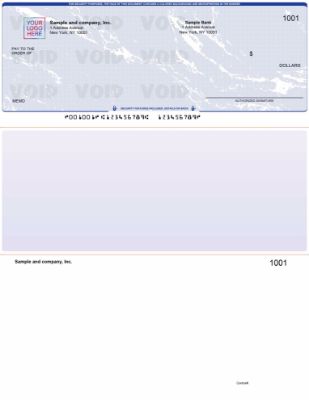
  • Business name and address (preprinted): Your legal business name and mailing address appear in the upper left corner. This identifies the account holder to the payee and to the bank that processes the check.
  • Check number (preprinted): Located in the upper right corner and repeated in the MICR line at the bottom. Use check numbers to track payments and reconcile your register against bank statements.
  • Date line: Where you write the date the check is issued. Located in the upper right area, below the check number.
  • Pay to the Order Of line: The full legal name of the person, business, or agency you are paying.
  • Numeric amount box ($): The payment amount written in numbers, always including cents (e.g., 1,500.00).
  • Written amount line: The payment amount spelled out in words. This is the legally controlling amount under UCC Article 3 if there is ever a discrepancy between the numeric box and the words.
  • Memo line: An optional but highly recommended field for identifying the purpose of the payment, such as an invoice number, account reference, or pay period.
  • Signature line: Where the authorized account signer signs in permanent ink. Some business accounts require two signatures above a certain dollar threshold.
  • Bank name (preprinted): Your bank's name and often its address, appearing in the center or lower portion of the check.
  • MICR line (bottom): The row of numbers printed in magnetic ink at the bottom. Contains your bank's routing number, your account number, and the check number, in that order. Do not write over or obscure the MICR line.

If you need high-security checks with fraud-deterrent features built into the check stock itself, Checkomatic offers options with watermarks, void pantographs, and chemically reactive paper that protect payments from alteration.
 

Burgundy


How Do You Fill Out a Check Step by Step?

Follow these six steps in order. Filling fields out of sequence, particularly signing before completing all other fields, creates unnecessary risk.


Step 1: Write the Date in the Date Field

Write the current date in the date field in the upper right corner of the check. Use the full date including month, day, and year. You can write it numerically (10/13/2026) or in full (October 13, 2026).

  • Postdating: Writing a future date on a check does not legally prevent a bank from cashing it early. Most banks are not required to hold a postdated check unless you provide a formal postdating notice to the bank in advance. Do not rely on postdating to manage timing of payments.
  • Backdating: Writing a past date can create an inaccurate accounting record and can be considered fraudulent in certain contexts. Use the actual date.
  • Stale-dating: Business and personal checks are generally considered stale after 180 days. If a payee has held a check for more than six months, they may have difficulty depositing it.


Step 2: Write the Payee's Full Legal Name

On the "Pay to the Order Of" line, write the full legal name of the person or business you are paying. This should match the name on the payee's bank account exactly.

  • Business payee: Use the registered legal business name including the entity suffix. "Johnson Supply Co. LLC" not "Johnson Supply" or "Johnson."
  • Individual payee: Use their full legal name as it appears on a government-issued ID.
  • Government agencies: Use the exact name shown on the payment instructions. For IRS payments, write "United States Treasury," not "IRS."
  • Two payees: Write both names on the payee line. Use "AND" if both must sign before the check can be deposited. Use "OR" if either can deposit it independently. For vendor splits and joint reimbursements, "OR" gives more flexibility. For a shared account or legal settlement, "AND" ensures both parties are involved.
  • Checks to "Cash": Never make a business check payable to "Cash." Any person who possesses a check made out to Cash can cash it, including someone who steals or finds it.


Step 3: Write the Dollar Amount in the Numeric Box

In the small box to the right of the payee line (the $ box), write the exact payment amount in numbers. Start writing at the far left edge of the box, leaving no room for anyone to insert additional digits before your number.

  • Always include cents, even for round amounts: write 500.00, not 500
  • Use a decimal point between dollars and cents: 1,250.75
  • Use a comma for thousands: 10,000.00, not 10000.00
  • If the box is small, you may abbreviate the thousands with a comma: 25,000.00


Step 4: Write the Dollar Amount in Words on the Written Amount Line

This is the most important field on the check and the most frequently filled out incorrectly. Write the dollar amount in words on the long line below the payee line, beginning at the far left. This written amount is what the bank legally honors in any dispute with the numeric box.

  • Write whole dollars as words: "Five hundred" not "500"
  • Write cents as a fraction over 100: "75/100" for 75 cents, "00/100" for zero cents
  • After writing the amount and fraction, draw a line through all remaining blank space on the line
  • The line through the blank space is a fraud-prevention measure that prevents anyone from adding words after your amount

See the full reference table in the next section for exact written-out examples for common business payment amounts from $50 to $25,000.


Step 5: Fill In the Memo Line

The memo line is optional but strongly recommended for all business payments. It creates the paper trail that supports reconciliation, tax reporting, and payment dispute resolution. Without a memo note, tracking down the purpose of a check months later can be difficult and time-consuming.


Payment TypeWhat to Write in the Memo
Vendor invoiceInvoice number (e.g., INV-2026-0045)
Office or commercial rentMonth and property address (e.g., Oct 2026 rent, 123 Main St)
IRS tax paymentEIN or SSN, tax year, and form number (e.g., EIN 12-3456789 / 2025 / Form 941)
Employee reimbursementExpense description and period (e.g., Oct 2026 travel reimbursement)
Loan or line of credit paymentLast four digits of the account number only
Professional services retainerRetainer reference (e.g., Legal retainer Q4 2026)
Passport application feeApplicant's name and date of birth
PayrollPay period dates (e.g., Pay period 10/01/2026 to 10/15/2026)


Step 6: Sign the Check on the Signature Line

Sign the check in the lower right corner using the same signature you provided to the bank when you opened the account. Banks compare signatures against their records during processing, particularly for checks above certain amounts.

  • Sign only after all other fields are complete. A signed blank check is the equivalent of signing a blank check to whoever finds or takes it.
  • For business accounts with dual-signature requirements, both authorized signers must sign before the check is issued.
  • An authorized employee may sign checks only if they are listed on your bank's signature card. Adding an authorized signer requires an in-person visit to the bank with that person's valid government-issued ID.
  • Never allow an unauthorized person to sign on behalf of your business, even if you trust them personally.

After signing, record the check in your register or accounting software immediately. Note the check number, date, payee, amount, and memo. Your bank statement will show only checks that have already cleared, not outstanding checks, so this record is your only current view of what is still pending.


How Do You Write Dollar Amounts in Words on a Check?

Writing out dollar amounts in words is the step that generates the most questions and the most errors. The format is consistent: spell out the whole dollar amount, express the cents as a fraction over 100, and fill the remaining blank space with a drawn line.

Numeric AmountCorrect Written Amount (Words Line)
$50.00Fifty and 00/100 _______________
$100.00One hundred and 00/100 _______________
$100.75One hundred and 75/100 _______________
$250.50Two hundred fifty and 50/100 _______________
$500.00Five hundred and 00/100 _______________
$1,000.00One thousand and 00/100 _______________
$1,250.50One thousand two hundred fifty and 50/100 _______________
$2,000.00Two thousand and 00/100 _______________
$5,000.00Five thousand and 00/100 _______________
$10,000.00Ten thousand and 00/100 _______________
$25,500.75Twenty-five thousand five hundred and 75/100 _______________


Rules to follow when writing amounts in words:

  • The word "and" appears only once, between the whole dollar amount and the cents fraction
  • Cents are always expressed as a fraction over 100 (50 cents = 50/100), not as a word like "fifty cents"
  • For zero cents, write 00/100, not "even," "no cents," or leaving it blank
  • Hyphenate compound numbers from twenty-one through ninety-nine (forty-five, seventy-two)
  • Do not include commas in the words (write "One thousand" not "One,000")
  • Do not start with the word "Dollars" (it appears preprinted at the end of the line)
  • Draw a line through all remaining blank space after the cents fraction


How to Fill Out a Check for Specific Payments

Most of the variation between check payments comes down to what goes in the payee field and the memo line. Here are the most common business payment types and exactly what to write for each one.


Blue


How to Fill Out a Check for the IRS

IRS payments have specific requirements that differ from standard vendor payments.

  • Payee line: Write "United States Treasury" exactly. Do not write "IRS," "Internal Revenue Service," or "U.S. Treasury" with abbreviations.
  • Memo line: Write your EIN (or SSN for individual filers), the tax year the payment covers, and the tax form number. Example: "EIN 12-3456789 / Tax Year 2025 / Form 941."
  • Attaching: Do not staple the check to the tax form. Attach it with a paper clip.
  • SSN note: For IRS payments, writing your SSN or EIN in the memo is required by the IRS so they can apply the payment to the correct account. This is one of the rare cases where including a tax ID in the memo is necessary.


How to Fill Out a Check for Rent

  • Payee line: Write the landlord's full legal name or the property management company's registered business name, exactly as it appears on your lease.
  • Memo line: Include the rental address and the month being paid. Example: "123 Oak Street, Suite 200, October 2026 rent."
  • Date note: Write today's actual date, not the rent due date. Postdating a rent check does not prevent the landlord from depositing it immediately.


How to Fill Out a Check for a Passport Application

  • Payee line: Write "U.S. Department of State" exactly. Do not abbreviate to "Dept. of State" or "State Dept."
  • Memo line: Write the applicant's full name and date of birth. Example: "Jane A. Smith DOB 01/15/1985."
  • Two-check rule: In many cases you need two separate checks: one for the U.S. Department of State (the application fee) and one for the acceptance agent (the execution fee). Confirm the current requirements at the passport acceptance facility before submitting.
  • Check type accepted: Personal and business checks are both accepted for passport applications. Money orders are also accepted.


How to Fill Out a Payroll Check

  • Payee line: Use the employee's full legal name exactly as it appears on their W-4 form.
  • Memo line: Note the pay period clearly. Example: "Pay period 10/01/2026 to 10/15/2026."
  • Payroll records: Log gross pay, net pay, and all withholdings in your payroll records for every check issued. The check itself shows only the net amount paid.
  • Best check type for payroll: Voucher checks are the preferred format for payroll because the detachable stub shows gross wages, tax withholdings, deductions, and net pay, giving the employee a complete payment record alongside the check.


How to Fill Out a Check to Yourself as a Business Owner

  • Write your own full legal name on the payee line, not your business name.
  • In the memo line, note the purpose: owner draw, reimbursement, or loan repayment.
  • If your business is an LLC or corporation, consult with your accountant before writing owner draws, as the tax treatment differs by entity type.
  • Never make the check payable to "Cash" even for your own draw. It removes all documentation of the payee and creates reconciliation problems.


What Are the Rules for Filling Out a Business Check?

Business check writing follows the same foundational rules as personal checks, but several rules apply specifically to business accounts and are not covered in most general-purpose guides.


Do Business Checks Require Two Signatures?

Dual-signature requirements are set by the business, not the bank, and are specified on the account's signature card at the time the account is opened (or updated). Many businesses require two authorized signatures on checks above a certain dollar threshold, as an internal financial control against unauthorized disbursements.

A check issued on a dual-signature account with only one signature is technically incomplete. However, banks do not always verify dual-signature requirements before processing checks. This means the internal control depends on your team enforcing the process, not solely on the bank catching violations.


Who Is Allowed to Sign Checks for a Business?

Only individuals listed as authorized signers on the bank's signature card may sign checks against the business account. Adding a new authorized signer requires visiting a bank branch with the individual's valid government-issued ID and completing the bank's signature card update process. The authorization is tied to the bank account, not to the person's role at the company alone.


How Do Accounting Software Users Fill Out Business Checks?

If you use accounting software such as QuickBooks or Quicken, you can print the payee name, date, dollar amount, and memo directly onto the check from within the software, eliminating manual entry errors in those fields. You then sign the printed check manually.

QuickBooks compatible checks from Checkomatic are pre-formatted to align with QuickBooks print templates. Quicken check alignment ensures checks print correctly on Quicken-formatted stock. Using check stock that matches your software eliminates the alignment issues that result in misprinted fields.
 

Blue


What Check Format Works Best for Vendor Payments with Documentation?

For vendor payments where you want to include remittance detail with the check, voucher checks include a stub that can show invoice numbers, payment period, project references, or itemized line amounts alongside the check itself. The stub detaches when the check is cashed, giving the vendor a clear record of what is being paid and why.


How Do You Prevent Check Fraud When Writing Business Checks?

Business checks are a frequent target for fraud, including check washing (chemically removing ink), check alteration (changing amounts or payee names), and check counterfeiting (creating fake checks using your account information from a legitimate check). Taking targeted precautions at the writing stage reduces exposure significantly.


What Type of Pen Should You Use to Write Business Checks?

Use a permanent-ink ballpoint pen with blue or black ink. Do not use:

  • Pencil: Can be erased and amounts or payee names can be changed
  • Gel ink pens: Many gel inks can be removed with chemical washing techniques, leaving a blank check that can be rewritten
  • Felt-tip or marker pens: Ink can smear during processing and may bleed through the check paper
  • Ballpoint pens with washable ink: Avoid any pen labeled "washable"


How Do You Fill Blank Spaces to Prevent Check Alteration?

  • Start writing numeric amounts and written amounts at the far left of each field, leaving no room for digits or words to be added before your entry
  • Draw a line through all unused space on the written amount line after the cents fraction
  • If the numeric box has space remaining after your amount, fill it with a double slash or a period, such as writing $500.00// in a wider box
  • Never leave a check partially completed on your desk where it can be accessed by others
  • Never pre-sign blank checks, even for employees you trust


What Check Security Features Protect Against Fraud?

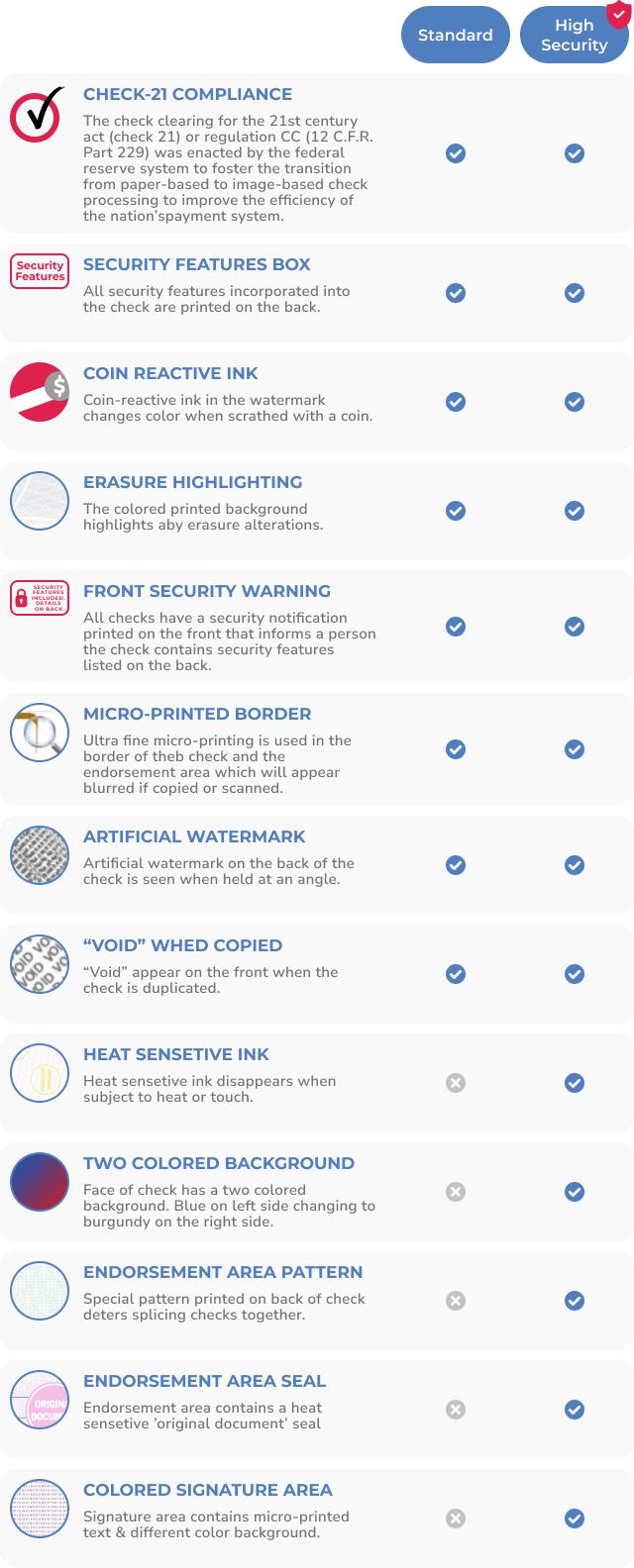
Standard check stock offers minimal built-in protection against skilled fraud. High-security business checks include physical security features baked into the check paper and printing that make alteration and counterfeiting significantly more difficult:

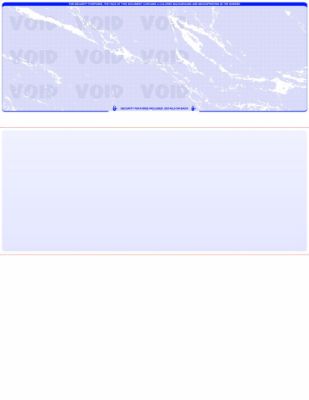
  • Void pantograph: The word "VOID" appears when the check is photocopied or scanned, making it obvious that a copy is not the original
  • Watermarks: Visible when held up to light; missing or incorrect on counterfeits
  • Microprinting: Tiny text printed along borders that blurs or disappears when photocopied
  • Chemically reactive paper: Shows staining or discoloration if someone attempts to chemically wash the ink
  • Security background: Intricate patterns that are difficult to reproduce accurately


How Should You Store and Mail Business Checks?

  • Store blank check stock in a locked location with access limited to authorized personnel
  • Track check numbers sequentially and investigate any gaps when reconciling your register
  • When mailing checks, use security check envelopes with an interior security tint that blocks the check contents from view and prevents scanning through the envelope window
  • For high-value payments, use certified mail with a return receipt to have documented proof of delivery date
  • Reconcile your bank statement against your check register at least monthly and investigate any check that cleared for an amount different from what you recorded


What Should You Do If a Business Check Is Lost or Stolen?

Contact your bank immediately to place a stop payment order on the check. You will need the check number, amount, payee name, and date. There is typically a fee for a stop payment order, and the order expires after a set period (commonly six months). See our full guide on how to stop payment on a business check for the complete process and timeline.


What Are the Most Common Check-Writing Mistakes?

Most check-writing errors fall into a small number of predictable categories. Being aware of them before writing reduces returned payments and processing delays.

  • Mismatched amounts between fields: The numeric box and the words line say different amounts. The written (words) amount controls legally, so even a small discrepancy can mean the wrong amount is paid. Verify both fields match before signing.
  • Leaving blank space on the written amount line: Blank space after your written amount can be exploited to alter the check. Always draw a line through unused space.
  • Using pencil or gel ink: Both can be altered after the check is written. Permanent-ink ballpoint pen is the only safe choice.
  • Signing before all other fields are complete: A signed blank check is essentially cash. Always fill out every field before signing.
  • Making a check payable to "Cash": This eliminates payee identity control. Anyone in possession of the check can cash it.
  • Omitting the memo: Without a memo, tracking down the purpose of a cleared check weeks or months later is difficult and can cause problems during audits or payment disputes.
  • Not recording the check immediately: Outstanding checks that are not logged can cause unexpected overdrafts when they clear days or weeks after being issued.


What Should You Do If You Make a Mistake on a Check?

Do not attempt to fix an error by crossing out, using correction fluid, or erasing. Banks are permitted to refuse altered checks, and an attempt to correct a check can look like an attempt to alter it fraudulently. The correct process:

  1. Write "VOID" in large letters across the front of the check in permanent ink
  2. Mark the check number in your register with a note explaining the void
  3. Retain the voided check in your records (it is part of your financial documentation)
  4. Write a new check from scratch

For the full process when an error has already been issued and delivered, see our guide on how to correct a mistake on a check.


Which Type of Business Check Should You Use?

The right check format depends on your payment volume, the software you use, and the level of security or documentation the payment requires. Using the correct check type streamlines your workflow and reduces the chance of formatting errors.


Check TypeBest ForKey Feature
Manual Business ChecksLow-volume payments, on-the-spot payments, field useHandwritten, immediate use, portable checkbook format
Computer ChecksBusinesses using accounting software, moderate to high volumePrints payee, date, amount, and memo directly from software
QuickBooks Compatible ChecksQuickBooks Desktop and Online usersPre-formatted to align with QuickBooks print templates, eliminates field errors
Voucher ChecksPayroll, vendor payments requiring remittance documentationAttached stub records pay period, deductions, invoice detail, or line items
High-Security ChecksLarge payments, fraud-sensitive industries, financial and legal firmsWatermarks, microprinting, void pantograph, chemically reactive paper


If you print checks from accounting software, computer checks eliminate handwriting errors in the payee, date, amount, and memo fields entirely by pulling data directly from your accounting system. This is especially valuable for businesses processing more than a handful of checks per week, where manual entry errors compound across payments.

For businesses that handle payroll in-house, voucher checks provide employees with a clear earnings statement attached to every paycheck, satisfying the pay stub requirements that apply in most states without a separate document.
 

Blue


How We Created This Guide

This guide was researched using top-ranking content on how to fill out a check, publicly available UCC Article 3 provisions, IRS payment instructions for business tax filers, and passport acceptance facility requirements from the U.S. Department of State. All claims about legal amounts, bank policies, and fraud prevention methods were reviewed against primary sources before publication. A person fact-checked every claim before this guide was published.


What to Do Next

Filling out a check correctly starts before you pick up the pen. Having the right check stock for your payment type and the right security features for your payment volume prevents errors, speeds up processing, and reduces fraud exposure.

If your business writes a moderate to high volume of checks or handles in-house payroll, printing checks directly from your accounting software with computer checks eliminates the most common manual entry errors. For high-value or sensitive payments, high-security checks provide fraud-deterrent protection built into the check stock itself.

If something has already gone wrong with an issued check, these related guides walk you through the next steps:
 

Oct 09, 2026

How to Endorse a Business Check for Deposit: Step-by-Step Guide

Endorsing a business check sounds simple. Flip it over, sign the back, hand it to a teller. But if your business name is abbreviated, if the check is made out to a DBA, if multiple people are authorized to sign, or if you are depositing by mobile app, there are real rules that can get a check rejected or held. Banks apply stricter standards to business checks than personal ones, and a wrong endorsement can delay funds by days or trigger an extended hold under federal banking regulations.

This guide covers everything your business needs to know about how to endorse a business check for deposit correctly, including endorsement types, who is authorized to sign, what to do when a bank rejects a check, and how an endorsement stamp can eliminate most endorsement errors for high-volume deposits.


What Does It Mean to Endorse a Business Check?

Endorsing a check means signing or stamping the back of it to transfer ownership of the funds from the payee to the bank. When a check is made out to your business, your signature (or your business's stamp) in the endorsement area tells the bank that you, as an authorized representative, are handing over that check and authorizing the deposit into your business account.

An endorsement is more than a formality. Under the Uniform Commercial Code (UCC), it is a legal transfer of the right to collect those funds. If no authorized person endorses the check, the bank can refuse to process it. If the wrong person endorses it, the business and that person may face legal liability.

Banks treat business check endorsements differently from personal check endorsements. Your bank must verify that the business name on the endorsement matches the account, that the signer has authority to deposit on behalf of the business, and that the check has not been altered. This is why the endorsement area, the business name used, and the information you write all matter.


Where Do You Endorse a Business Check?

Turn the check over. At one short end, you will see a shaded or marked area that reads "Endorse Here" or "Do Not Write, Stamp, or Sign Below This Line." That strip, typically 1.5 inches wide, is the endorsement area.

Write or stamp within the endorsement area only. Banks scan the back of checks during processing, and anything written outside the endorsement zone can interfere with the routing information on the MICR line and cause the check to be rejected or flagged for manual review.

If you are using a endorsement stamp, position it squarely within that strip so the full impression is captured cleanly without bleeding into the MICR area below.


Who Is Authorized to Endorse a Business Check?

Not everyone at your business can sign a business check for deposit. The authorized signers on a business bank account are the people the business officially designated when the account was opened or updated through a bank resolution or signature card. Typically, these are:

  • The business owner or sole proprietor
  • Partners listed on a partnership agreement
  • Corporate officers listed in a banking resolution (CEO, CFO, President, Treasurer)
  • Employees specifically added as authorized signers
  • Bookkeepers or office managers granted check-depositing authority

If someone who is not an authorized signer endorses and deposits a business check, the bank may refuse the deposit. More seriously, that person may face personal liability for unauthorized endorsement under the UCC. Even if the deposit goes through, the business may have grounds to reverse the transaction if the endorser was not properly authorized.

If your bookkeeper or office manager handles deposits regularly, make sure their name and signature are on file with your bank as an authorized signer. This protects both the business and the employee.

For more detail on who can sign on behalf of a business, see our guide on who can endorse a business check.


What Are the Types of Business Check Endorsements?

There are four main types of endorsements used for business check deposits. Each one serves a different purpose, and choosing the wrong type can slow down your deposit or leave your funds exposed.


1. What Is a Blank Endorsement and When Should a Business Use It?

A blank endorsement is simply the signature of the authorized signer with nothing else written. This makes the check payable to the bearer, meaning anyone holding it could theoretically cash it. For a business, a blank endorsement is the least secure option.

Never sign a blank endorsement until you are standing at the bank counter or actively completing a mobile deposit. A pre-signed blank check that is lost or stolen can be cashed by anyone. If you must use a blank endorsement, sign it at the moment of deposit only.


2. What Is a Restrictive Endorsement and Why Should Businesses Use It?

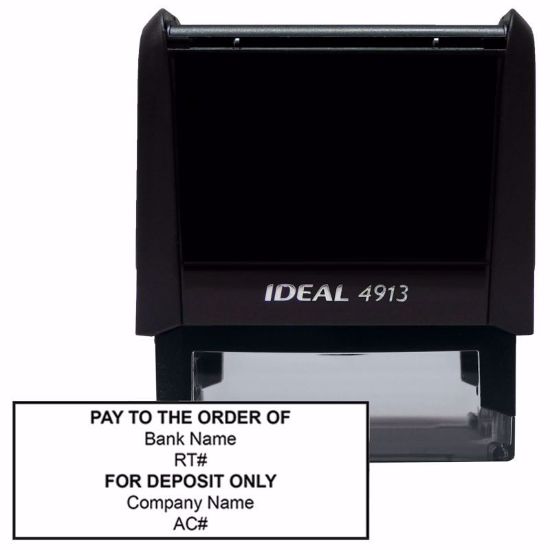
A restrictive endorsement adds the phrase "For Deposit Only" along with the business name and account number. This is the most secure and most commonly recommended endorsement type for businesses. It limits the check to a single action: depositing into the named account. A thief cannot cash a check with a restrictive endorsement.

Note on account number privacy: some businesses choose to omit the account number from their endorsement stamp, especially for mobile deposits where check images are stored digitally. If you prefer not to print your account number on every check image, write or stamp "For Deposit Only" and the business name, then add the account number separately only when required by your bank. Check your bank's policy before deciding.

The endorsement stamp is the most practical way to apply a consistent, accurate restrictive endorsement on every check without writing by hand each time.


3. What Is a Special Endorsement and When Is It Used for Business Checks?

A special endorsement (also called a third-party endorsement or "pay to the order of" endorsement) transfers the check to a specific person or entity other than the original payee. For businesses, this is occasionally used when a check needs to be signed over to a vendor, partner, or another account.

Special endorsements are harder to process for business checks. Most banks require the original payee (your business) to accompany the transaction, and some banks refuse to accept third-party business checks entirely. If you need to endorse a business check over to someone else, contact your bank first to confirm they will accept it.


4. What Is an FBO Endorsement and How Does It Work?

An FBO (For the Benefit Of) endorsement is used when a check is held or managed on behalf of another party, such as a trust, a client account, or a benefit account. The endorsement format reads: "For the Benefit Of [Beneficiary Name]." The account holder signs, and sometimes the beneficiary must also sign depending on the bank's requirements. FBO endorsements are most common in financial services, legal, and property management contexts.


How Do You Endorse a Business Check for Deposit Step by Step?

Follow these steps every time you endorse a business check for deposit. A few minutes of care upfront prevents delays, holds, and rejected deposits.


Step 1: Review the front of the check first. Check the payee name, date, amount in numbers, amount in words, and signature. Confirm the amounts match. Confirm the date is current (checks older than 6 months may be considered stale-dated and refused). If there is any discrepancy, contact the check issuer before depositing.


Step 2: Match the payee name to your business account name. The name on the front of the check should match your business name on file with your bank. If it does not, see the DBA section below before proceeding.


Step 3: Determine the correct endorsement type. For standard deposits, use a restrictive endorsement (For Deposit Only + business name + account number). For mobile deposits, check whether your bank requires "For Mobile Deposit Only" specifically.


Step 4: Endorse the check in the correct area. Write or stamp within the endorsement strip on the back. Sign as an authorized signer. If using a stamp, press firmly and evenly for a clean impression.


Step 5: Deposit the check promptly. Do not leave endorsed checks sitting in a drawer. A restrictive endorsement limits misuse, but the sooner the check is deposited, the better.


Step 6: Keep records. For your own records, note the check number, amount, date deposited, and issuer. For mobile deposits, see the mobile-specific steps below.


How Do You Endorse a Business Check for Mobile Deposit?

Mobile deposit endorsements have specific requirements that differ from in-person deposits. Many banks now require a separate notation to prevent double deposits, where the same check is deposited twice (once by mobile and once in person).


What Should You Write for a Mobile Deposit Endorsement?

Most major banks require one of the following in addition to the standard endorsement:

  • "For Mobile Deposit Only" written or stamped below the signature
  • A checkmark in the "Mobile Deposit" checkbox if the check has one
  • "For Mobile Deposit at [Bank Name]" in some cases

Check your specific bank's mobile deposit policy before depositing. Using only "For Deposit Only" without the mobile-specific notation may result in the deposit being rejected by the app or held for review.


What Should You Do with the Check After a Mobile Deposit?

After your mobile deposit is confirmed, do not immediately shred the check. Best practice is:

  1. Write the deposit date on the check once the deposit is confirmed.
  2. Store the check in a secure location for at least 30 days (some banks recommend 60 days) until the funds are fully cleared and verified on your statement.
  3. After 30 to 60 days with no issues, shred the check completely. Never simply throw it in the trash, as check washing fraud is a real threat. Check washing involves chemically altering the check to change the payee name or amount after the original check has been deposited.

For all deposit method options including ATM, mobile, and in-person, see How to Deposit a Business Check.


How Does Business Structure Affect Business Check Endorsement?

Your business structure determines who is legally authorized to endorse, and what name must appear on the endorsement.


Sole Proprietor

If you operate as a sole proprietor under your personal name, you sign your personal name. If you operate under a DBA (Doing Business As) trade name, see the DBA section below. In either case, your bank account name must match the endorsement.


Partnership

A check made out to the partnership should be endorsed with the partnership's legal name. The authorized signer is any partner listed on the bank account signature card. Multi-partner deposits may require two signatures depending on the partnership agreement and bank requirements.


LLC

Endorse using the LLC's legal name exactly as registered. The authorized signer is a member or manager listed on the business bank account. If the LLC has a separate trade name, see the DBA section below.


Corporation

Corporations must endorse using the corporate legal name, followed by the title of the authorized officer signing (for example: "[Corporation Name] by [Name], Treasurer"). Banking resolutions filed with your bank determine who is authorized to endorse.


What Is a DBA and How Does It Affect Business Check Endorsement?

DBA stands for "Doing Business As." Many businesses operate under a trade name that differs from their legal registered name. For example, a sole proprietor named Jane Smith might operate as "Jane's Bookkeeping Services."


What Happens If a Check Is Made Out to a DBA Name?

Under UCC §3-204(d), a payee can endorse a check using the name that appears on the check, their legal name, or both. In practice, banks typically want to see an endorsement that they can match to both the check and the account.

If a check is made out to your DBA name, the recommended approach is:

  1. Endorse the check using the DBA name exactly as written on the front.
  2. On the next line, sign your legal business name or your personal name as the authorized representative.

Always confirm with your bank how they want DBA endorsements formatted before depositing a large check. Some banks have specific DBA endorsement protocols.


What If the Check Has a Misspelled or Incorrect Business Name?

Clients and customers frequently write checks with minor spelling errors, abbreviations, or variations of your business name. "Smith's Consulting, Inc." may be written as "Smith Consulting" or "Smiths Consulting Inc."


How Do You Handle a Misspelled Business Name on a Check?

The standard technique is the double-sign method:

  1. First, sign or stamp the misspelled name exactly as it appears on the front of the check.
  2. Directly below, sign or stamp your correct legal business name.

This shows the bank that you are the intended recipient and you are aware of the discrepancy. Your bank may still ask for documentation connecting the two names (such as a DBA filing or business license), particularly for larger checks.

If the discrepancy is significant (completely wrong business name, wrong payee type), contact the check issuer and request a corrected check rather than attempting to deposit the original.


What Are the And vs. Or Rules for Checks Made Out to Multiple Payees?

Sometimes a check is made out to two payees. The word connecting them determines the endorsement requirement.


Check Made Out With "And" Between Two Payees

If a check reads "[Business A] and [Business B]" or "[Business Name] and [Individual Name]," both parties must endorse the check. One signature is not enough. If you cannot get both endorsements, the bank will not accept the deposit.


Check Made Out With "Or" Between Two Payees

If a check reads "[Business A] or [Business B]," either party may endorse and deposit it. Only one endorsement is required.


What If the Check Just Has Two Names With No Connecting Word?

Most banks treat an ambiguous multi-payee check (no "and" or "or" specified) as an "and" check, requiring both endorsements. When in doubt, get both signatures or contact your bank before depositing.


What Are the Most Common Business Check Endorsement Mistakes?

Even experienced bookkeepers make these errors. Here are the most common mistakes and how to avoid them.


Signing Outside the Endorsement Area

Any writing that bleeds below the endorsement strip can interfere with the MICR line on the back of the check and cause processing errors. Use a stamp that fits cleanly within the area, or practice your placement before committing to ink.


Using an Abbreviated Business Name

If your bank account says "Smith Consulting Group LLC" but you write "Smith Consulting" on the endorsement, the bank may reject the check or place a hold pending manual verification. Always match your account name exactly.


Endorsing Too Early

A signed check sitting in a drawer or briefcase is a risk. If it is stolen before deposit, a blank endorsement makes it negotiable by anyone. Endorse immediately before depositing, not when the check arrives.


Missing "For Mobile Deposit Only" on Mobile Deposits

Many bank apps will reject or hold a mobile deposit that lacks the mobile-specific endorsement text. Always check your bank's mobile deposit requirements.


Not Keeping the Check After Mobile Deposit

Destroying a check immediately after a mobile deposit removes your proof of the original instrument. Hold it for 30 to 60 days in case of any dispute.


Letting Unauthorized Employees Endorse Checks

An employee who is not listed as an authorized signer on your business bank account should never endorse a business check. Keep your authorized signer list current with your bank, and train staff on who is permitted to handle check endorsements.


Account Number Errors

Handwriting account numbers on every check by hand creates room for transposition errors. A single wrong digit can misdirect a deposit. An endorsement stamp with your account number pre-printed eliminates this risk entirely.


Can You Use an Endorsement Stamp Instead of a Handwritten Signature?

Yes, and for most businesses depositing more than a handful of checks per week, a stamp is the better option.


Why Do Businesses Use Endorsement Stamps?

A self-inking endorsement stamp applies your business name, account number, bank name, and "For Deposit Only" in a single press. It delivers a consistent, legible impression every time, eliminating the most common sources of endorsement errors:

  • Name abbreviations that do not match the account
  • Account number transposition errors from handwriting
  • Illegible signatures that cause bank delays
  • Inconsistent formatting across multiple authorized signers
  • Writing outside the endorsement area

Banks recognize stamped endorsements as valid under the UCC, and many banks actually prefer stamps for business accounts because they are more consistent and easier to verify during processing.

For businesses handling high check volumes, the time savings alone are significant. Stamping 50 checks takes seconds. Handwriting the same information on 50 checks takes considerably longer and introduces 50 opportunities for error.

Self-inking business endorsement stamp for check deposits

Checkomatic offers custom self-inking endorsement stamps built specifically for business check deposits. You choose the information to include, the stamp applies it cleanly every time. For businesses processing batches of checks regularly, see also check accessories including ink pads and replacement parts.

Learn the full process for putting your stamp to work: How to Use an Endorsement Stamp.


What Happens to Funds After You Endorse and Deposit a Business Check?

After you deposit a check, the bank does not release the funds instantly. Federal Regulation CC (Reg CC) sets the rules for funds availability.


How Long Does It Take for a Business Check to Clear?

For most business checks, banks must make the first $225 available by the next business day. The remaining funds are typically available within two business days for local checks and up to five business days for non-local checks.


What Is an Extended Hold and When Can a Bank Apply One?

Under Reg CC, banks can apply extended holds in certain situations, including:

  • Deposits exceeding $6,725 in a single day (the threshold above which banks can extend availability)
  • Checks from new accounts (accounts open less than 30 days)
  • Repeatedly overdrawn accounts
  • Checks where the bank has reason to suspect fraud or doubt collectibility
  • Emergency conditions (such as computer system failures)

If a hold is placed, your bank must give you written notice stating the reason for the hold and when the funds will be available. Keep this notice for your records.

For more on deposit methods and how holds work, see How to Deposit a Business Check.


What Happens If the Bank Rejects a Business Check Endorsement?

A rejected endorsement is frustrating, but it is fixable. Here is how to handle it depending on the situation.


The Bank Returned the Check Because the Endorsement Is Incorrect

If there is still room in the endorsement area, add the missing information (such as the correct business name or "For Deposit Only") below your original endorsement and re-present the check. Make sure any addition is clearly written and does not overlap with the MICR line.


The Endorsement Area Is Already Full

If the endorsement area is full and you cannot add anything readable, do not try to write on other parts of the check. Instead, contact the check issuer and request a new check. Mark the original as void to prevent it from being used. This is the safest approach when the endorsement area is unusable.


The Bank Rejected the Check Because Names Do Not Match

If the business name on the check does not match your account name and the bank rejected it, use the double-sign method (see the misspelled name section above) and re-present. If the bank still rejects it, ask the issuer to reissue the check with the correct payee name.


The Check Is Too Old

Checks older than 6 months are typically considered stale-dated. Banks are not required to honor them. Contact the issuer and ask for a replacement check.


How Do You Endorse a Business Check: A Quick Reference Summary

Use this reference for your most common endorsement scenarios:

SituationWhat to Write / StampNotes
Standard in-person depositFor Deposit Only + Business Name + Account Number + SignatureRestrictive endorsement; most secure option
Mobile depositFor Mobile Deposit Only + Business Name + SignatureKeep check 30-60 days after confirmation
DBA name mismatchDBA Name (as on check) + Legal Business Name + For Deposit OnlyUCC §3-204(d) allows both names; confirm with bank
Misspelled business nameMisspelled name first + Correct name belowDouble-sign technique; bank may request proof
Two payees with "and"Both parties must signOne signature is not enough
Two payees with "or"Either party may signOnly one endorsement needed
High-volume batch depositSelf-inking endorsement stampMost consistent, fastest method for multiple checks


How Can a Business Streamline the Check Endorsement Process?

For businesses that deposit checks regularly, consistency is more than a convenience. Inconsistent endorsements are one of the leading causes of deposit delays and bank holds. A simple process reduces errors and keeps cash flow moving.


What Is the Best Way for a Business to Endorse Multiple Checks Quickly?

The most efficient approach for batch deposits is a self-inking endorsement stamp. Rather than handwriting your business name, account number, and "For Deposit Only" on every check, the stamp applies all of that information in a single press. A batch of 20 or 50 checks can be processed in minutes.

The stamp also creates a consistent impression that is easier for bank processing systems to read compared to varying handwriting styles from different employees.

Custom endorsement stamp for business check deposits

What Information Should Be on a Business Endorsement Stamp?

A complete business endorsement stamp typically includes:

  • The phrase "For Deposit Only" at the top
  • Your business legal name as it appears on your bank account
  • Your bank account number
  • Optionally, your bank name and routing number

Checkomatic's endorsement stamps are fully customizable, so you include exactly the information your bank requires. Learn how to get your stamp set up correctly: How to Use an Endorsement Stamp.


What Are the Legal Rules Behind Business Check Endorsements?

Understanding the legal framework helps when you encounter unusual situations or disputes.

Business check endorsements are governed by Article 3 of the Uniform Commercial Code (UCC), which has been adopted in some form by all 50 U.S. states. Key provisions include:

  • UCC §3-204(d): Allows a payee to endorse using the name shown on the instrument, the payee's legal name, or both. This protects businesses that receive checks made out to DBA names or slightly incorrect versions of their legal name.
  • UCC §3-206: Defines what a restrictive endorsement (such as "For Deposit Only") means and limits negotiation of the check accordingly.
  • Federal Regulation CC (Reg CC): Governs funds availability timelines after deposit. Banks must follow Reg CC rules on when to make deposited funds available, with the $6,725 threshold determining when extended holds can be applied.

For specific legal questions about check endorsement in your state or situation, consult a business attorney or your bank's compliance department.


What Should You Know About Check Endorsement Fraud?

Check fraud continues to be a significant issue for small businesses. Awareness of the most common schemes helps you protect your deposits.


What Is Check Washing and How Can Endorsement Protect Against It?

Check washing is a fraud technique where a criminal uses chemicals to remove the ink on a check and rewrite it with a new payee name or amount. The original check structure (including the MICR line and the signature) remains intact, making it appear genuine.

Protecting your business: Use pens with permanent, gel-based ink for anything written on a check. Stamps with fast-drying, bank-grade ink are more resistant to washing than standard ballpoint pen ink. A restrictive endorsement does not prevent check washing, but it limits what a fraudster can do with a washed check if it already has "For Deposit Only" stamped on the back.

If you suspect a check you received has been altered, do not deposit it. Contact your bank and the issuer immediately.


How Does Blank Endorsement Create Fraud Risk?

A check with only a signature on the back is essentially cash. Anyone who has access to that check can present it for payment. For business checks representing significant amounts, this risk is substantial. Always use a restrictive endorsement for business deposits.


Oct 08, 2026

What Size Ink Pad Do You Need for a Business Check Endorsement Stamp?

Quick Answer: You do not need to buy a separate ink pad when you order a self-inking endorsement stamp from Checkomatic. The ink pad is built into the stamp housing and arrives pre-loaded, ready to use from impression one. The pad is rated for 1,000 or more impressions. The only time an ink pad purchase is needed is later, once the original built-in pad runs dry at which point Checkomatic's replacement ink pad is the correct product to order. Contact Checkomatic at sales@checkomatic.com to confirm compatibility before placing a replacement order.


Checkomatic self-inking endorsement stamp for business check deposits — black ink, 5-line design

Checkomatic self-inking endorsement stamp: 5-line custom design, black ink, rated 1,000 or more impressions, ready to use out of the box.


Does a Self-Inking Endorsement Stamp Come With an Ink Pad Already?

Yes. Every Checkomatic self-inking endorsement stamp ships with the ink pad pre-loaded inside the stamp housing. The mechanism works like this: when you press the stamp down, an internal spring flips the rubber die across the built-in pad, picks up ink, and transfers your endorsement text to the check. When you release pressure, the mechanism resets and the die returns face-down against the pad, ready for the next impression.

What this means when you are placing your first order:

  • You do not need to add an ink pad to your cart alongside the stamp
  • The stamp is self-contained and usable immediately on arrival
  • The built-in pad stays in contact with the die between uses, which maintains ink consistency impression after impression
  • You get reliable, repeatable endorsement impressions without any separate setup

Many business owners expect to buy an ink pad the same way they would for a traditional open-face rubber stamp. That approach does not apply to self-inking models. The pad is part of the product.


How Many Impressions Does the Built-In Pad Last?

Checkomatic's self-inking endorsement stamp is rated for 1,000 or more impressions. For a business depositing checks regularly, that represents a meaningful run of use before any re-inking or replacement is needed. The actual lifespan can vary depending on stamping pressure, usage frequency, and how the stamp is stored between sessions.

When the pad starts to run low, you will notice it in the quality of your impressions. The endorsement text will begin to look lighter or uneven before it fades out completely, so you have advance notice before impressions become too faint to use.


When Do You Actually Need to Buy an Ink Pad for an Endorsement Stamp?

You need to order a replacement ink pad only after the original built-in pad has run through its rated impressions. Think of it the way you would think about printer ink: the printer ships with ink installed, and you only order a replacement cartridge when that supply is used up. The ink pad on Checkomatic is a consumable refill supply, not something to add to an initial stamp order.

Signs the internal pad needs attention:

  • Faded impressions. The endorsement text appears lighter or patchy on check surfaces.
  • Inconsistent coverage. Some characters transfer cleanly while others are barely visible.
  • Incomplete text. Part of your account number or the "For Deposit Only" line is missing from the impression.

If you notice any of these, test on plain paper first. A faded impression on paper confirms the pad is the issue. If the stamp looks normal on paper but not on checks, the check paper surface may be the cause rather than the ink supply.


Can a Faded Endorsement Impression Cause Problems at the Bank?

Yes. Banks image deposited checks, and a faded or incomplete endorsement can cause delays. If the text is too light to read clearly, the deposit may be flagged for manual review. For mobile deposit, where the bank's app photographs the back of the check, a clear and complete impression is especially important. Testing impression quality every few months and ordering a replacement pad before impressions become unreadable is the simplest way to avoid disruptions to your deposit process.


What Ink Pad Do I Need for a Checkomatic Endorsement Stamp?

Checkomatic's replacement ink pad is designed for their range of self-inking stamps, including the check endorsement stamp, the custom signature stamp for checks, and the custom name and address stamp. It uses the same high-quality black ink as the original pre-loaded pad.


Checkomatic replacement ink pad for self-inking endorsement stamps — black ink

Checkomatic replacement ink pad: black ink, rated 1,000 or more impressions, compatible with the check endorsement stamp, custom signature stamp, and custom name and address stamp.

Before placing an order, Checkomatic recommends confirming that the replacement pad is the correct fit for your specific stamp model. Contact their team at sales@checkomatic.com with your original order details and they can verify compatibility before you order.


How Do I Know If the Replacement Ink Pad Fits My Stamp?

The product page for the ink pad lists the stamp models it fits: the check endorsement stamp, the custom signature stamp for checks, and the custom name and address stamp. If your stamp is one of those models, the replacement pad is designed for it. If you are unsure which stamp model you have, contact Checkomatic at sales@checkomatic.com with your original order number and they can confirm the right replacement for you.


What Ink Color Does the Replacement Pad Come In?

The replacement ink pad is available in black. Black is the standard for business check endorsements: it produces high-contrast impressions that image reliably under bank scanning systems and mobile deposit cameras.


How Do You Re-Ink or Replace the Ink Pad in a Self-Inking Endorsement Stamp?

When your stamp starts showing faded impressions, you have two options: re-ink the existing pad, or replace it entirely. The right choice depends on the condition of the pad. Re-inking works when the pad is still physically intact but running low on ink. Replacement is the better option when the pad has dried out completely, hardened, or been damaged. A pad that has been left dry for an extended period may not absorb fresh ink effectively, and a new replacement pad will give you cleaner results from the start.


Can I Re-Ink the Pad Myself?

Most self-inking endorsement stamps support manual re-inking as a routine maintenance step. The general process across self-inking stamp models involves:

  1. Locking the stamp mechanism open so the internal pad is accessible without spring tension
  2. Removing the ink pad from the housing, typically by sliding or unclipping it from a slot in the stamp body
  3. Applying compatible stamp ink evenly across the pad surface in small amounts and allowing it to absorb fully before reinserting
  4. Reinserting the pad with the inked side facing the rubber die, pressing it flat and flush in the housing
  5. Testing on plain paper before using on actual checks, to confirm impression quality and clear any excess ink through the first few impressions

Only use ink specifically formulated for self-inking stamp pads. Craft inks, printer inks, and ballpoint refill inks have different compositions that can damage the pad material and affect impression quality. Contact sales@checkomatic.com for the recommended ink type and re-inking process for your specific Checkomatic stamp model.


How Long Does a Replacement Pad Last?

Like the original pre-loaded pad, a replacement ink pad from Checkomatic is rated for 1,000 or more impressions. With proper storage and handling, you can expect the same level of consistent impression quality from a replacement as from the original.


What Are Common Mistakes When Using a Self-Inking Endorsement Stamp?

Most impression quality problems come from a small set of easily corrected issues. Knowing what to look for saves you from ordering a replacement pad when the actual issue is technique or storage.


Why Is My Endorsement Stamp Impression Smearing on Checks?

Smearing is usually caused by one of three things:

  • Excess ink after re-inking. The first few impressions after adding ink can be heavier than usual while the pad distributes evenly. Do several test presses on scrap paper before using the stamp on actual checks.
  • Tilting or dragging on the lift. Press straight down, hold briefly, and lift straight up. Any tilt or sideways movement as you lift blurs the impression.
  • An unstable check surface. Stamp on a firm, flat surface. A check resting on soft or uneven material can shift under pressure and distort the text.


Why Does My Stamp Print Faintly Even After Re-Inking?

A newly re-inked pad that still prints faintly is usually a seating issue rather than an ink problem. The pad may not be fully flush in the housing. Remove it, reseat it firmly, and test again. New or freshly maintained pads also sometimes need three to five test presses before ink transfers evenly. If faint printing continues after proper seating and test presses, contact Checkomatic at sales@checkomatic.com for guidance.


Can I Use Any Ink to Re-Ink a Self-Inking Endorsement Stamp?

No. Only use ink formulated specifically for self-inking stamp pads. Generic alternatives can damage pad materials and affect long-term impression quality. Contact sales@checkomatic.com to confirm the correct ink type for your Checkomatic stamp before re-inking.


How Should You Store a Self-Inking Endorsement Stamp to Extend Pad Life?

Proper storage between uses directly affects how long the ink pad stays in usable condition. In dry or air-conditioned office environments, storage habits matter even more.

  • Store face-down or upright in a holder. When the die rests against the pad, it helps keep the pad surface from drying out. Storing face-up exposes the inked pad surface to open air.
  • Avoid heat and direct sunlight. High temperatures and UV exposure accelerate ink drying. A desk drawer or closed supply cabinet works well.
  • Keep away from temperature extremes. Consistent room temperature protects both the pad material and the ink.
  • Use the cap or cover if your model includes one. Replacing the cover after each use slows evaporation between stamping sessions.


What Should a Business Check Endorsement Stamp Say?

The wording on your endorsement stamp affects whether deposits process without delays. The Checkomatic endorsement stamp supports five lines of custom text, which gives you enough space for everything a complete business endorsement requires.


What Is the Standard Wording for a For Deposit Only Stamp?

A standard business endorsement stamp typically includes:

  • The phrase "For Deposit Only" (or "For Deposit Only to Account of")
  • Your full business name as it appears on your bank account
  • Your bank account number

For mobile deposit, many banks now recommend or require "For Mobile Deposit Only" language to prevent a check from being deposited more than once. The 5-line design of the Checkomatic endorsement stamp gives you enough lines to include both standard endorsement wording and any mobile deposit language your bank requires. Confirm exact wording requirements with your bank before ordering the stamp.

For detailed guidance on endorsement wording and check handling, the how to endorse a check guide covers what banks accept and how to structure your endorsement correctly.


Does the Number of Lines Affect Impression Quality?

A stamp with more lines of text has a larger die surface. The replacement ink pad from Checkomatic is designed to match the die dimensions of their self-inking stamp range. Using a non-matching pad would result in partial or misaligned impressions. This is one reason why ordering the replacement pad directly through Checkomatic, or confirming compatibility with them first, is the straightforward approach.


How Do You Set Up a Checkomatic Endorsement Stamp for the First Time?

First-time setup is minimal. The stamp arrives with the internal pad pre-loaded and ready to use.

  1. Remove the stamp from packaging and check the die area for any protective film or shipping cover.
  2. Press the stamp once on plain paper to verify the full impression prints correctly.
  3. Check that all five lines of your endorsement text are visible and clearly defined.
  4. If any text is missing or light, confirm the mechanism is fully releasing on the downstroke and test again.
  5. Once a clean, complete impression appears on paper, the stamp is ready for use on actual checks.

The how to use an endorsement stamp guide covers technique and first-use details, including tips for consistent impressions across different check paper types.


What to Order Alongside Your Endorsement Stamp

If you are ordering an endorsement stamp for the first time, or restocking your deposit station, here are the related products available through Checkomatic that pair with it:


Replacement Ink Pad

The ink pad is not needed at the time of your first stamp order, but it is the right product to have on hand once your original pad has run through its impressions. Ordering it in advance means you are not without your endorsement stamp while waiting for a replacement to arrive. Compatible with the check endorsement stamp, the custom signature stamp for checks, and the custom name and address stamp.


Business Deposit Slips

If your bank requires deposit slips for in-person deposits, Checkomatic offers business deposit slips through their business check accessories section. The endorsement stamp can also be used on deposit slips in addition to checks.


Check Envelopes

For businesses mailing checks, check envelopes in double-window formats are available through the accessories section. The double-window design allows the payee and return address to show through the envelope windows without additional labels.


How Do You Order a Replacement Ink Pad From Checkomatic?

Ordering a replacement ink pad from Checkomatic is straightforward:

  1. Visit the ink pad product page on checkomatic.com.
  2. Before adding to cart, confirm that your stamp model is listed as compatible (check endorsement stamp, custom signature stamp, or custom name and address stamp). If you are uncertain, contact sales@checkomatic.com with your original order details.
  3. Add the replacement pad to your cart and complete checkout. Standard shipping and UPS 3 Day Select are available at checkout.
  4. Replacement ink pads ship within 3 to 5 business days of order.

Checkomatic has supplied business check accessories since 1997. The replacement pad stocked on the site is matched to the stamp products they sell, which means you are not left searching third-party compatibility guides or guessing on a generic pad that may not fit your stamp housing.


What Customers Say About Checkomatic

Checkomatic has been a trusted supplier of business check accessories since 1997, serving businesses across the United States. Their self-inking stamps, replacement ink pads, and business check supplies are accepted by leading banks and designed for the demands of everyday business deposit workflows.

"I ordered the endorsement stamp to match changes to check order, and they shipped it with my check order to save me even more money."

AL H Verified Customer  |  ★★★★★

The endorsement stamp is rated 3.8 out of 5 stars from verified customer reviews on checkomatic.com. For questions about any product, their team is reachable at sales@checkomatic.com.


Oct 07, 2026

How to Correct a Mistake on a Check: When to Fix It and When to Void It

Quick Answer: If you caught the mistake before handing the check over, you have two options: cross out the error with a single line, write the correction clearly above or beside it, and initial the change; or void the check and write a new one. Voiding is always the safer path. If you have already given the check to someone else, your best options are a stop payment order or writing a replacement check. White-out, correction fluid, and tape are never acceptable on a check under any circumstances.


What Counts as a Mistake on a Check?

Every field on a check is a potential place for an error. Before deciding what to do, it helps to know which field the mistake is in, because some fields carry significantly more risk than others when corrected.

A check is a negotiable instrument, and each of its fields serves a distinct legal or operational purpose. The bank treats a corrected date very differently from a corrected dollar amount. Understanding that distinction before you pick up the pen determines whether a quick fix solves your problem or creates a larger one.


The Two Things Most People Get Wrong About Check Corrections

Most general guides cover check corrections as if they are a straightforward two-step process: cross it out, initial it, done. That framing skips two realities that affect whether your corrected check actually clears.


Why Does the Field You Corrected Determine Whether the Bank Accepts It?

Bank staff and automated processing systems do not treat all check corrections equally. A correction on the memo line and a correction on the dollar amount line look identical on paper, but they trigger completely different responses.

The memo line carries no legal weight in check processing. A crossed-out memo entry, clearly corrected and initialed, almost never causes a problem. The dollar amount fields, both the numeric box and the written amount line, are the fields banks are trained to scrutinize for fraud. Any correction to those fields raises immediate concern regardless of how clearly it is initialed, because altering the dollar amount is precisely what check fraud looks like.

This happens more often than people expect. A check is written for one amount, but a mistake on the numeric line is corrected with good intentions, and then the teller or the automated deposit system flags it. The correction is honest, but the bank has no reliable way to distinguish an honest correction from a fraudulent alteration after the fact.


When Should You Correct a Check vs. Void It?

The field you made the mistake in should determine your next step. Here is how each field breaks down.


Date line mistakes

A wrong date is one of the more forgiving mistakes on a check. A corrected date, initialed by the check writer, is generally accepted by most banks, especially if the rest of the check is clean and the correction is obvious. That said, a check with a future date (post-dated) or a date more than 180 days in the past (stale-dated) can be refused regardless of corrections. If your date error involves a prior year or a date far in the past, voiding and rewriting is the cleaner option.


Payee name mistakes

A misspelled payee name requires careful judgment. A minor spelling error that is clearly the same person or business may be accepted with an initialed correction. A significantly wrong name, a name crossed out and replaced with a different person, or any change that could suggest the check was altered by someone other than the original writer will almost certainly be questioned or refused. When in doubt, void and rewrite.


Numeric amount box mistakes

The dollar amount in the small box on the right side of the check is highly visible and easy for banks to scan. A crossed-out and corrected number, initialed by the check writer, may be accepted. However, any correction to the amount field raises scrutiny immediately. Banks are trained to treat amount changes as a potential indicator of fraud. Even if the correction is entirely honest, the bank may decline the check simply because the risk is not worth taking on their end.


Written amount line mistakes

The line where you write out the amount in words is the legally controlling field under UCC Article 3-114. If the written amount and the numeric amount disagree, the written amount is what the bank is supposed to honor. This means a correction on the written amount line is even more sensitive than one in the numeric box. A mistake here, especially one that changes the dollar value, is best handled by voiding the check.


Memo line mistakes

The memo line carries no legal weight in check processing. A crossed-out and corrected memo entry is generally accepted without issue. This is the one field where a simple correction almost never causes a problem.


Signature mistakes

A signature cannot be corrected. If you signed with the wrong name, signed in the wrong spot, or the signature is unclear, the check needs to be voided and rewritten. Do not attempt to add a second signature or write over an existing one.


Can You Cross Out a Mistake on a Check and Initial It?

Yes, this is the standard accepted method for making a correction on a check, but it comes with important conditions that determine whether the bank will accept it.

Banks may accept a correction when all of the following are true: the error was crossed out with a single clean line rather than scribbled over or heavily blacked out; the correction is written clearly above or next to the crossed-out text in the same ink color; the check writer's initials appear directly next to the correction; only one correction was made on the entire check; the correction does not involve the signature line; and the check does not look altered for fraudulent purposes.

Even when all of these conditions are met, the bank still has the right to refuse the check. Every institution applies its own internal standards, and many maintain a policy of declining any check that shows signs of alteration. There is no legal requirement that a bank must accept a corrected check.


Can You Use White-Out or Correction Fluid on a Check?

No. Correction fluid, white-out, correction tape, or any product that covers original text on a check renders it invalid. This applies to every field on the check without exception.

The reason is not a bureaucratic formality. A check is a negotiable instrument. Covering original text is classified as a material alteration under UCC Article 3-407, and a fraudulently altered check may discharge the liability of the person who originally signed it. Banks are trained to identify signs of chemical alteration. Most modern business checks and personal checks include security features, VOID pantograph backgrounds, and chemically sensitive paper designed specifically to reveal tampering.

If you used correction fluid on a check, void it and write a new one. There is no other option.


How to Correct a Mistake on a Check: Step-by-Step

Use this process only for minor, non-amount errors on checks that are still in your possession. For any dollar amount correction, voiding and rewriting the check is always the right answer.


What You Need Before You Make the Correction

Before touching the check, confirm the following. The check is still in your hands and has not been given to the payee. The error is in a low-risk field such as the date, payee spelling, or memo line. Only one correction is needed. You have a pen with the same ink color you used to write the check originally.


Draw a single clean line through the error

Use black or blue ink. Draw one straight horizontal line through the incorrect text. Do not scribble, cross-hatch, or black out the original text. The original text should remain readable beneath the line. This openness is what signals to the bank that you are correcting, not concealing.


Write the correction clearly above or beside the error

Write the corrected information directly above the crossed-out text, or immediately beside it if there is not enough space. Use the same ink color you used originally. Write clearly. If the corrected text is difficult to read, the check may be refused regardless of the initials.


Initial next to the correction

Place your initials immediately beside the correction. Some banks prefer initials and the date next to the correction. Your initials confirm that you, as the check writer, authorized the change. Without initials, the bank has no way to know whether the correction was made by you or by someone who obtained the check after it left your hands.


Inform the teller when depositing

If you are depositing a check you received that has a correction, or if the corrected check will be presented at a branch, mention it to the teller before they process it. Do not attempt mobile deposit or ATM deposit with a corrected check. See the section below on why mobile deposit and corrected checks do not mix.


Update your check register

If you voided the check instead of correcting it, record the voided check in your register immediately. Use the original check number, write VOID in the payee field, enter zero in the amount fields, and add a note such as "Voided, replaced by check . See Check Register: How to Set Up and Use a Checkbook Ledger for full recordkeeping guidance.


How to Handle a Check Mistake on a Payroll Check

Payroll check errors require faster action and more documentation than standard checks because wage payment obligations do not pause while you resolve a check issue.


Why Is a Payroll Check Mistake More Complicated to Fix?

Under most state labor laws, an employer is legally required to ensure employees receive wages on the scheduled pay date. A payroll check with a wrong amount handed to an employee and then corrected or replaced puts the employer in a difficult position if any delay occurs in the employee receiving the right payment.

A payroll check with a wrong amount should never be handed to an employee in a corrected state. The stakes are too high on both sides. Void the check, generate a replacement payroll check for the correct amount, and update your payroll records immediately. When correcting a payroll check error, the standard process is: notify the employee in writing that the check has been voided and a replacement is being prepared; reissue the correct payment as quickly as possible, ideally the same business day; confirm the replacement check was received; and keep records of the void, the notification, and the reissuance date. For payroll check formats designed for fast, documented reissuance, see Business Checks Payroll.


Blue

Checkomatic payroll checks with pre-printed earnings stubs support fast, documented reissuance when a check error is discovered, giving you a clean paper trail without relying on corrected instruments.


What Happens If You Already Gave the Check to Someone Else?

Once a check leaves your hands, voiding is no longer an option. The check is a negotiable instrument that is now in someone else's possession, and you cannot physically write VOID across it. At this point, you have two primary tools.

The first is a stop payment order. Contact your bank immediately and request a stop payment on the check. You will need the check number, the exact amount written on the check, the payee name, and the date. Acting quickly matters. A check can clear within one business day of being deposited, and a stop payment request placed after clearing provides no protection. For full guidance, see How to Stop Payment on a Business Check: Full Guide.

The second option is contacting the payee directly. If the error is minor and the payee is someone you work with regularly, reach out, explain the mistake, and arrange for the original check not to be deposited. Issue a corrected replacement check and confirm the original has been destroyed. This works well for vendor payments and recurring payroll situations where you have a documented relationship with the payee.

If the check has already been deposited and cleared, a stop payment is no longer effective. You will need to work with the payee directly to resolve any overpayment or underpayment. See How to Stop Payment on a Check: Step-by-Step Guide for the full process including timeline and bank requirements.


Can a Mobile Deposit Reject a Corrected Check Even If Your Bank Would Accept It in Person?

Yes, and this is one of the most important distinctions in modern check handling that almost no one explains clearly.

Mobile deposit and ATM check deposit use automated image processing and optical character recognition to scan each check. These systems are not operated by a human teller who can apply judgment. They scan for specific patterns, and any visual inconsistency, including a crossed-out amount, an extra line of handwriting, or a corrected word, can cause the system to reject the deposit automatically without explanation.

This is a recurring issue. Customers regularly find that checks with even minor corrections fail the automated scan and are returned with no explanation beyond "deposit rejected." The safest path with a corrected check is to visit a bank branch and deposit it in person with a teller. Explain the correction upfront. The teller can apply judgment and process the deposit manually. Do not attempt mobile or ATM deposit first and then try the branch as a fallback. Once a check is rejected by a mobile deposit scan, it may carry a mark or notation that complicates the in-person transaction.


Does Correcting a Check on Your Own Count as a Material Alteration?

No, with an important distinction. Under Uniform Commercial Code Article 3-407, a material alteration is any unauthorized change to a signed negotiable instrument that modifies the obligation of any party to that instrument. Changing the dollar amount, the payee name, or the date after the check is signed all qualify as material alterations.

The legal outcome depends on whether the alteration was fraudulent. A fraudulent alteration made by someone other than the check writer discharges the check writer from liability. The person who altered it bears responsibility. A non-fraudulent correction made by the check writer, openly initialed and clearly documented, generally keeps the check enforceable under the corrected terms. The bank still has the discretion to refuse the check, but the check writer is not committing fraud by making a legitimate correction. The problem is that banks cannot always tell the difference, which is why many institutions simply decline to accept altered checks.


How Can Printing Checks Through Accounting Software Eliminate Most Correction Scenarios?

Computer checks, laser checks, and voucher checks generated through accounting software present a unique advantage. The printed fields, including payee name, date, and dollar amount, are filled by the software. Only the authorized signature is added by hand. This eliminates the majority of check writing errors before they happen.

When a computer-generated check does contain an error, the correct fix is always to reprint. Void the original in your accounting software, reverse the transaction, and reprint with the correct information. A handwritten correction over laser-printed text is visually inconsistent and raises significantly more concern during bank review than the same correction on a handwritten check. The software void also ensures your accounting records stay accurate without a gap.

See computer checks compatible with QuickBooks, Sage, and other major accounting platforms available through Checkomatic, as well as manual business checks for handwritten business check needs with clear, well-spaced fields that reduce the likelihood of errors.


Blue


Correct, Void, or Stop Payment: How to Choose

SituationBest ActionReason
Minor date error, check still with youCorrect with single line and initial, or void and rewriteDate corrections are the lowest-risk field; voiding is still the cleanest option
Wrong dollar amount, check still with youVoid and rewriteAmount corrections trigger bank fraud scrutiny; voiding eliminates the risk entirely
Misspelled payee name, minor error, check still with youCorrect if genuinely minor; otherwise voidAny name change that looks ambiguous will be questioned; voiding is safer
Correction fluid used anywhere on the checkVoid immediatelyNo bank under any circumstances accepts a check with correction fluid applied
Check already given to payee, error discoveredStop payment orderYou no longer control the check; voiding is not possible once it leaves your hands
Check mailed, not yet depositedStop payment order, then send replacement checkStop payment prevents the original from clearing before the replacement arrives
Check already deposited and clearedContact payee directly; arrange correction or refundStop payment is no longer effective after clearing; resolution requires payee cooperation


What Customers Say About Checkomatic

All reviews below are reproduced verbatim from checkomatic.com. Source: checkomatic.com/quickbooks-starter-pack-product, 4.5 stars from 166 verified reviews.

"Been with them for 15 years. Always reliable, always good quality, good service. What more can you ask for?"

ATV Inc. | ★★★★★ 5/5 | April 5, 2024 | Source: checkomatic.com/quickbooks-starter-pack-product

"We use CheckoMatic for all of our check needs! They have great prices and we receive our products in a timely manner!"

CG's Tax Service | ★★★★★ 5/5 | September 18, 2024 | Source: checkomatic.com/quickbooks-starter-pack-product

"ASJ Wilson Construction has been a client of checkomatic for some years now and they've never disappointed this company. Thank you checkomatic for all that you do."

ASJ Wilson Construction | ★★★★★ 5/5 | June 6, 2024 | Source: checkomatic.com/quickbooks-starter-pack-product

"First time ordering and I am super impressed with the quality of the checks. No issues with delivery. I will be ordering again!"

TClinton | ★★★★★ 5/5 | April 9, 2025 | Source: checkomatic.com/quickbooks-starter-pack-product

"Affordable and efficient. My go-to business check printer."

Doe | ★★★★★ 5/5 | January 24, 2025 | Source: checkomatic.com/quickbooks-starter-pack-product

"I got 500 checks for less than half of what the bank wanted for 200!"

VVA Voucher Checks (Vietnam Veterans of America) | ★★★★★ 5/5 | July 6, 2024 | Source: checkomatic.com/quickbooks-starter-pack-product


About Checkomatic

Checkomatic has manufactured business checks, payroll checks, AP checks, and business banking supplies in-house at its Monroe, NY facility since 1997. Every check order is produced on CPSA-certified security paper with ABA-compliant MICR encoding verified against the Federal Reserve E-Payments Routing Directory. Six ABA-compliant security features are standard on every order. Checkomatic is BBB Accredited and TrustedSite Certified, with a 4.5-star rating from 166 verified customer reviews. Checks are accepted by all major US banks.


Oct 05, 2026

How to Stop Payment on a Business Check: Full Guide

Quick Answer: To stop payment on a business check, verify the check has not cleared, then contact your bank with the check number, exact dollar amount to the cent, payee name, and check date. A verbal phone request lapses after just 14 calendar days under UCC 4-403 , always follow it with written confirmation to get six-month protection. Act immediately: once a check clears, a stop payment cannot reverse it. This guide covers the full bank process, the two critical rules most guides miss (oral vs written, and the exact match problem), business-specific scenarios, payroll complications, the holder in due course risk, and what to do after a stop is placed.


What Is a Stop Payment on a Business Check?

A stop payment is a formal request to your bank to prevent a specific check from being honored when it is presented for payment. When you place a stop payment order, your bank flags the check number and amount in its processing system. If that check is later deposited or presented for cash anywhere in the banking system, the bank's automated matching process identifies it as stopped and refuses payment.

Stop payments are governed by UCC 4-403, the Uniform Commercial Code provision that gives account holders the right to instruct their bank to stop payment on any item that has not yet been accepted or paid. This right applies to any authorized signer on the account. The order must reach the bank early enough, and with enough detail, that the bank has a reasonable opportunity to act before the check is processed. 


The Two Rules Most Business Owners Do Not Know About Stop Payments

Most general guides describe stop payments in three steps: verify the check is outstanding, gather the check details, and call your bank. What they leave out are two rules that cause business owners real financial losses every year. Understanding these before you make any stop payment request is essential.


Why Does the Amount on Your Stop Payment Request Need to Be Exact?

Bank processing systems match stop payment orders against incoming checks by check number and dollar amount. The match is automated. If your stop payment request states a different amount than what is printed on the check, even by a few cents, the system may not match the correct item and the check will be paid despite your active stop order.

This happens more often than most business owners realize. A check is issued for one amount, but the register was updated with a rounded figure. The stop payment is placed using the rounded figure. The bank's system does not match it precisely, and the check clears.


When Should a Business Stop Payment on a Check?

Lost or Stolen Check in Transit

A check mailed to a vendor that never arrives is the most common business stop payment scenario. Mail theft involving business checks is a documented and growing fraud risk. If a mailed check does not arrive within a reasonable window and the payee confirms non-receipt, place the stop payment immediately. Do not wait for the check to reappear. See check washing guide and check fraud prevention for the fraud context around checks stolen in transit.


Can You Stop Payment on a Range of Checks If Your Checkbook Is Stolen?

If your business checkbook or a block of pre-printed check stock goes missing, stopping one check number is not enough. Most banks offer a range stop payment, which allows you to flag all consecutive check numbers in a single request. Contact your bank immediately and ask specifically about stopping a range. Provide the first and last check number in the sequence. Confirm whether your bank supports this through online business banking or requires a branch visit or a signed request. This is not a feature most business owners know to ask for, but it is available at most institutions that serve business accounts.


Check Issued With Wrong Amount or Wrong Payee

If an AP check was printed with an incorrect amount or addressed to the wrong payee and has already been mailed, place the stop payment first, then notify the intended payee, and reissue with the correct details and a new check number. Do not ask the payee to return the incorrect check before placing the stop payment. Every minute the incorrect check is in circulation is a minute in which it could be cashed.


Vendor or AP Dispute After the Check Was Issued

If a dispute arises after a check was sent to a vendor, such as goods not delivered, services not completed, or a billing error discovered after mailing, a stop payment may be appropriate to freeze the payment while the dispute is resolved. However, read the holder in due course section below before placing a stop payment in a dispute context. The legal risks are significant and not widely understood.


Fraudulent or Unauthorized Checks

If a check is discovered to have been forged or issued without authorization, place a stop payment immediately and contact your bank's fraud department separately. The fraud remediation process goes beyond a standard stop payment order. See are business checks safe and check fraud prevention.


Uncashed Stale Business Checks

If a business check you issued was never cashed and is approaching the six-month validity window under UCC 4-404, you may need to place a stop payment and reissue. The complete workflow for this specific scenario is covered at how long do you have to cash a business check. This guide focuses on the other stop payment scenarios.


What Is a Holder in Due Course and Why Does It Matter for Business Stop Payments?

This is the stop payment risk that almost no general finance guide explains to business owners, yet it can result in paying for the same check twice.


Can a Stop Payment Fail Even After Your Bank Accepts It?

Yes. A stop payment order protects you from your bank processing the check through normal channels. But it does not automatically protect you from a holder in due course.

A holder in due course is a party that accepted a negotiable instrument in good faith, for value, and without notice of any existing claim or defect. Under the Uniform Commercial Code, a holder in due course can enforce payment on a check against the issuer even when a stop payment order is in place.

Here is how this plays out in a business context: You issue a check to a contractor for work you later dispute. You place a stop payment at your bank. Before your stop payment is processed, the contractor endorses the check to a check-cashing company and receives cash. The check-cashing company becomes a holder in due course because it accepted the check in good faith, paid value for it, and had no notice of your dispute. When your bank's stop payment flags the check and refuses to honor it, the check-cashing company has the legal right to pursue you directly for the full check amount. And your defense that the contractor's work was unsatisfactory may not be available against a holder in due course.


Who Is Authorized to Place a Stop Payment on a Business Account?

Under UCC 4-403, any customer who is an authorized signer on the bank account may stop payment on any item drawn on that account. For a business account with two or more authorized signatories, any one of them can stop payment on any check drawn on the account, including a check signed by a different authorized signatory.

This is an important internal control point for multi-signatory businesses. An authorized signer who should not unilaterally be able to void large vendor payments technically has the legal right under UCC to stop any check on the account. Banks may have their own internal policies that add further requirements for large amounts, but the statutory right belongs to any authorized signer. Review your business banking agreement and your internal check approval policy if this represents a control gap.


Blue


How to Stop Payment on a Business Check: Step-by-Step

What Information Does the Bank Need to Process a Stop Payment Request?

Before contacting your bank, pull the following details. Accuracy on every field is critical, particularly the amount.

  • Business account number
  • Check number , printed upper right on the check face and encoded in the MICR line
  • Exact dollar amount to the cent , a mismatch of even a few cents can cause the system to miss the match
  • Payee name as written on the check
  • Date on the check
  • Reason for the stop payment , some banks require this to process and track the order
 

Verify the check has not already cleared

Log into your business banking portal or call your bank to confirm the check is still outstanding. Check your recent transaction history for the check number. If it has cleared, a stop payment cannot help. You will need to work with your bank and potentially the payee to resolve the situation through other means.


Pull the exact check details from your records

Retrieve the check number and exact amount from your checkbook register, check stub, or accounting software. Do not estimate. If you use QuickBooks, Sage, or another platform to print checks, the check register will have the exact information. Confirm the amount matches the check face precisely, including cents.


Place the stop payment order through your bank's fastest channel

Contact your bank by the method available to you: online business banking, mobile banking, phone, or branch. Many business banks allow stop payments directly through their online platform without waiting for a branch visit, which is often the fastest channel. Provide all the check details. Ask for a confirmation number and note it immediately.


Confirm in writing before the 14-day oral order lapses

If your initial request was by phone, this step is not optional. An oral stop payment order under UCC 4-403 lapses after 14 calendar days unless confirmed in writing. Complete the written form, submit the online banking request, or obtain written acknowledgment from your bank before the 14-day window closes. Note the written order date, which begins a new six-month protection period.


Record the expiration date and calendar a renewal reminder

A written stop payment order expires after six months. If the stopped check could still be presented after that period, you must renew the order in writing before it lapses. Calendar the expiration date when you receive the written confirmation. If the check is still outstanding as the expiration approaches, renew promptly.


Notify the payee and reissue with a new check number

Contact the payee to confirm the original check has been stopped and a replacement will be issued. Wait for the stop payment to be confirmed by your bank before releasing the replacement. Assign a new check number to the replacement. Never reuse the stopped check number. Document the original check number as VOID in your register.


Update your accounting records

Reverse or void the original check transaction in your accounting software. Record the stop payment fee as a bank service charge. Create a new transaction for the replacement check with its new number. Reconcile against your bank statement to confirm the stopped check does not appear in cleared transactions. See business checkbook guide for checkbook reconciliation practices.


How to Stop Payment on a Payroll Check

Payroll checks require faster action and more documentation than standard AP checks because of wage payment law obligations.


Why Is Stopping a Payroll Check More Complicated Than an AP Check?

Under most state labor laws, an employer is legally required to ensure employees receive wages on the scheduled payday. If a payroll check is lost, contains a calculation error, or was issued to a former employee, the stop payment addresses the banking side of the problem but does not suspend the wage obligation. The employer must still ensure the employee is paid correctly and promptly.

Placing a stop payment on a payroll check is appropriate when the check was lost or stolen before the employee received it, when it contains an error in gross pay, deductions, or net pay, or when it was issued to a terminated employee whose final pay calculation is being reviewed. The critical steps after placing the stop payment:

  1. Notify the employee in writing that the check has been stopped and a replacement is being prepared
  2. Reissue the correct payment as quickly as possible, ideally the same business day or the next
  3. Confirm the replacement check was received by the employee
  4. Keep records of the stop payment order, the notification to the employee, and the reissuance date
  5. If your state requires same-day payment in termination situations, consult your payroll advisor before the stop payment causes a delay that creates compliance exposure

For payroll check formats with pre-printed earnings stubs that support fast reissuance, see business checks payroll.


Checkomatic business payroll checks with pre-printed earnings stubs enabling fast reissuance when a stop payment on a business payroll check is required due to loss error or termination


Checkomatic payroll checks with pre-printed earnings stubs support fast, documented reissuance when a payroll check stop payment is required.


What Happens If the Check Clears Before the Stop Payment Takes Effect?

Under UCC 4-303, a bank that has already accepted and paid a check before receiving a timely and valid stop payment order is generally not liable for processing the payment. The check has legally cleared, and the stop payment has no effect.

If this happens, contact your bank immediately. Document when you discovered the problem, when you attempted the stop payment, and the bank's response. If the payment was unauthorized or fraudulent, the bank's fraud department has separate investigation procedures that may offer remedies in some cases. If it was a payment error, your resolution will likely need to be arranged directly with the payee, since the bank's obligation is fulfilled.

This is why acting the moment a problem is identified is not optional. Checks can clear within one to two business days of deposit. The window between discovery and too late is narrow.


How Do You Release or Cancel a Stop Payment Order?

A stop payment can be released if the reason for stopping it no longer applies. For example, a lost check is found and returned by the payee, a dispute is resolved, or a replacement check was refused and the original is being accepted instead.

To release a stop payment, contact your bank through the same channel used to place it (online banking, phone, or branch) and request that the stop payment be removed. Provide the check number and amount. Some banks allow self-service release through online business banking. Others require a signed written release. Get written confirmation that the stop payment has been removed before allowing the check to be re-presented.


Does a Stop Payment Cancel the Legal Obligation to Pay?

No. This is one of the most important things business owners misunderstand about stop payments.

A stop payment prevents the check from clearing your bank account. It does not erase the underlying contract, invoice, or obligation that the check was written to satisfy. If the debt is legitimate, the payee retains all legal remedies to collect the amount owed, including small claims court, collections, or civil suit. Stopping payment on a check does not provide the same protection as disputing a charge or exercising a contractual right to withhold payment.

Stop payments are the right tool when a check cannot or should not be honored due to an error, loss, fraud, or a legitimate legal dispute where the law allows payment to be withheld. They are not a method for avoiding payment of valid debts. Using a stop payment to delay or avoid a legitimate obligation can expose the business to additional liability beyond the original amount owed.


How Can Positive Pay Prevent the Need for Stop Payments?

Positive Pay is a bank fraud-control service that requires your business to submit a list of issued checks including check numbers, amounts, and payees to your bank each time you write a batch. When checks arrive for payment, the bank's system matches them against your issued-check file. Any check that does not match is flagged for your review before the bank pays it.

Positive Pay significantly reduces the scenarios that require stop payments after the fact. A check altered in transit, a duplicate check number, or a check with the wrong amount gets caught at the authorization stage rather than after it clears. For the full explanation, see what is positive pay.

ABA-compliant security features on Checkomatic business checks protect checks from alteration during the window between issuance and stop payment processing.

 
The prevention layer: The most reliable approach to business check problems is building controls that prevent them before a check enters the banking system. Positive Pay, high-security check stock, dual-signature requirements, and regular check register reconciliation all reduce the frequency of stop payment situations. See check fraud prevention for the complete control framework.


What Customers Say About Checkomatic

All reviews below are reproduced verbatim from checkomatic.com. Source: checkomatic.com/quickbooks-starter-pack-product, 4.5 stars from 166 verified reviews.

"Been with them for 15 years. Always reliable, always good quality, good service. What more can you ask for?"

ATV Inc. | ★★★★★ 5/5 | April 5, 2024 | Source: checkomatic.com/quickbooks-starter-pack-product

"We use CheckoMatic for all of our check needs! They have great prices and we receive our products in a timely manner!"

CG's Tax Service | ★★★★★ 5/5 | September 18, 2024 | Source: checkomatic.com/quickbooks-starter-pack-product

"ASJ Wilson Construction has been a client of checkomatic for some years now and they've never disappointed this company. Thank you checkomatic for all that you do."

ASJ Wilson Construction | ★★★★★ 5/5 | June 6, 2024 | Source: checkomatic.com/quickbooks-starter-pack-product

"First time ordering and I am super impressed with the quality of the checks. No issues with delivery. I will be ordering again!"

TClinton | ★★★★★ 5/5 | April 9, 2025 | Source: checkomatic.com/quickbooks-starter-pack-product

"Affordable and efficient. My go-to business check printer."

Doe | ★★★★★ 5/5 | January 24, 2025 | Source: checkomatic.com/quickbooks-starter-pack-product

"I got 500 checks for less than half of what the bank wanted for 200!"

VVA Voucher Checks (Vietnam Veterans of America) | ★★★★★ 5/5 | July 6, 2024 | Source: checkomatic.com/quickbooks-starter-pack-product


About Checkomatic

Checkomatic has manufactured business checks, payroll checks, AP checks, and business banking supplies in-house at its Monroe, NY facility since 1997. Every check order is produced on CPSA-certified security paper with ABA-compliant MICR encoding verified against the Federal Reserve E-Payments Routing Directory. Six ABA-compliant security features are standard on every order. Checkomatic is BBB Accredited and TrustedSite Certified, with a 4.5-star rating from 166 verified customer reviews. Checks are accepted by all major US banks.


Oct 01, 2026

How to Use an Endorsement Stamp on Business Checks

Quick Answer: To use an endorsement stamp on a business check, first verify the check is valid and payable to your business name. Test the ink on scrap paper. Flip the check over, locate the 1.5-inch endorsement zone, press the stamp firmly and evenly within that zone, and lift straight up. Add an authorized signature below the stamp if your bank requires it. Deposit the check promptly. For mobile deposits, verify whether your bank requires "For Mobile Deposit Only" text. This guide covers every step, the most common mistakes that cause deposit rejections, and the fraud risks no other endorsement guide covers.


What Is a Business Endorsement Stamp and Why Do Businesses Use One?

A business endorsement stamp is a self-inking rubber stamp that prints your business name, bank account number, and "For Deposit Only" text on the back of every check your business receives. Instead of handwriting this information on each check before depositing it, you press the stamp once and all the required endorsement information appears in a clean, uniform impression.

Businesses use endorsement stamps for three main reasons. Speed: stamping a batch of 30 checks takes minutes, not the better part of an hour that handwriting the same information would require. Consistency: the stamp produces the same impression every time, with the correct account number and the exact legal business name. Security: a "For Deposit Only" stamp is a restrictive endorsement, which limits the check to deposit into your account only. This is significantly more secure than a blank signature endorsement.

For a full explanation of endorsement types and what goes on a business endorsement stamp, see endorsement stamp and how to endorse a check. To order a custom business endorsement stamp from Checkomatic, see self inking custom stamps.


Checkomatic self-inking endorsement stamp for business checks pre-printed with for deposit only business name and account number for fast batch check endorsement


Checkomatic self-inking endorsement stamps are custom-printed with your business name, account number, and "For Deposit Only" text, ready to use on every check your business receives.


What Should You Check Before Using an Endorsement Stamp?

Most endorsement guides go straight to the stamping step. The steps before the stamp are where most deposit problems actually start.


What Should You Verify on a Check Before Endorsing It?

Before you flip any check over to stamp it, confirm four things on the front:

  • Payee name matches your business: The name on the "Pay to the Order Of" line must match the business name on your stamp and your bank account. A check made out to "ABC Consulting" cannot be deposited using a stamp that reads "ABC Consulting LLC" unless your bank has accepted that DBA relationship in writing.
  • Date is within six months: A check more than 180 days old is considered stale-dated. Most banks will refuse it. Contact the issuer and ask for a replacement rather than endorsing and attempting to deposit a stale check.
  • Date is not in the future: A post-dated check cannot be deposited before its date. Endorsing does not make it valid early. If you receive a post-dated check, file it without endorsing and set a reminder for the deposit date.
  • Legal and written amounts agree: The numerical amount in the box and the written amount on the line below must match. If they differ, the bank's processing system will flag it. Ask the issuer to void and reissue the check if the amounts disagree.


Why Should You Endorse a Check Immediately After Receiving It?

This is one of the most important practices in business check handling, and it is not covered by most endorsement guides.

The moment a check arrives at your business, stamp it with your "For Deposit Only" endorsement. Do not wait until you are ready to deposit it. Here is why this matters for fraud prevention specifically:

A For Deposit Only restrictive endorsement kills the check's value to anyone who might intercept or steal it. A check endorsed with just your business name and "For Deposit Only" into account number 12345678 can only be deposited into that specific account. Even if someone takes the physical check after you have stamped it, they cannot cash it or deposit it elsewhere.

The second risk is double-deposit fraud. This is a real internal control vulnerability for businesses: an employee photographs the check to submit through the company's mobile or remote deposit system, then takes the physical check and cashes it at a check-cashing location or different bank. Because an unendorsed or blank-endorsed check can be cashed anywhere, the fraud succeeds. A "For Deposit Only" stamp applied the moment the check arrives removes this vulnerability entirely. See check fraud prevention for the broader business check fraud context.


How to Use an Endorsement Stamp: Step-by-Step

Where Do You Place an Endorsement Stamp on a Check?

Every business check has a designated endorsement area on its back. Federal Reserve Regulation CC and the ABA standard require all endorsements to be placed within 1.5 inches of the trailing edge of the check. The trailing edge is the left edge when the check is held horizontally with the front facing up. When you flip the check over, this becomes the top of the back side.

Most checks mark this zone with "Endorse Here" and a bordered box or parallel lines. This box is your target. Everything stamped or written must stay within it. The space beyond the 1.5-inch zone is reserved for the bank's own processing endorsement, which it adds when the check enters the clearing system. Overlapping into that space can cause processing delays or the Endorsement Irregular return code.


Test the ink quality on scrap paper first

Before starting any batch, press the stamp once on a blank sheet of paper. The impression must be crisp, complete, and fully dark with no faded areas, gaps, or missing characters. A partial or faint impression means the ink pad needs re-inking before you touch any check. Starting a batch with a low-ink stamp risks producing endorsements too faint for the bank to read.


Flip the check over and locate the endorsement zone

Turn the check to its back side. Find the endorsement area at the trailing edge, marked "Endorse Here" or indicated by a bordered box. This 1.5-inch zone is where the entire stamp impression must land.


Center the stamp squarely over the endorsement area

Hold the stamp directly above the endorsement zone. Align it so the impression will fall fully within the box. Do not angle or tilt the stamp; a tilted impression can push part of the text outside the zone. For standard self-inking business endorsement stamps, the stamp face typically fits comfortably within the ABA-required zone when properly aligned.


Press firmly and lift straight up

Apply firm, even pressure straight down across the full face of the stamp. Hold for one second, then lift straight up without sliding or rocking. A sliding motion smears the ink and blurs the impression, potentially making it unreadable. The self-inking mechanism re-inks the pad automatically as you lift, so the stamp is immediately ready for the next check.


Add an authorized signature below the stamp if your bank requires it

Some banks require an authorized signatory signature alongside the stamp for business check deposits. If your bank requires this, sign directly below the stamp impression, within the endorsement area, using blue or black ink. Blue or black ink is required; pencil, red ink, and gel ink that smears are commonly rejected by bank processing systems. The signature confirms you are authorized to deposit on behalf of the business.


Verify the impression before moving to the next check

Check that the business name, account number, and "For Deposit Only" text are clearly legible and fully within the endorsement zone. If the impression is faded, partial, or outside the zone, set that check aside. Re-ink the stamp before continuing. Do not re-stamp over a bad impression. Present problem checks to your bank teller for guidance.


How to Use an Endorsement Stamp for a Batch of Multiple Checks

When your business deposits multiple checks at once, a systematic batch workflow prevents errors and keeps endorsement quality consistent through the full batch.


What Is the Most Efficient Batch Endorsement Workflow?

  1. Sort and verify all checks face-up first. Confirm each check's payee name, date validity, and amount agreement before turning any check over. Catching an unacceptable check before stamping avoids wasted endorsements.
  2. Test ink on scrap paper. Always, regardless of how recently you last used the stamp.
  3. Flip the entire sorted stack face-down. Work through the full stack in sequence without flipping back and forth.
  4. Endorse each check. Position, press firmly, lift straight up. Do not rush the lift; pulling up too fast before the ink sets can smear.
  5. Cross-check the batch count against your deposit slip. The number of endorsed checks must match the number of line items on the deposit slip before leaving for the bank.
  6. Deposit the batch the same day. Endorsed checks sitting overnight in a desk drawer or envelope are still exposed checks. Your account number is now printed on each one. Secure endorsed checks immediately and deposit as soon as possible.

For completing the deposit workflow after endorsing, see how to deposit a business check and deposit slips.


How to Use an Endorsement Stamp for Mobile Deposits

Does the Endorsement Change for Mobile Deposits?

Yes, in many cases. A standard "For Deposit Only" stamp may not satisfy your bank's mobile deposit endorsement requirement.

The reason comes from the Check Clearing for the 21st Century Act, commonly called Check 21. When you submit a check through your bank's mobile app, the app creates a digital substitute check, which enters the Federal Reserve clearing system in place of the physical paper. 

The risk the bank is managing is double presentment: the physical check could be deposited a second time at a different bank after the mobile deposit is accepted. To prevent this, many banks now require "For Mobile Deposit Only" rather than just "For Deposit Only" on checks submitted via their app. This additional language signals that the physical check should not be redeposited anywhere after the mobile deposit clears.


What Should You Write on a Check for Mobile Deposit?

Requirements vary by bank. Common formats include:

  • "For Mobile Deposit Only"
  • "For Mobile Deposit at [Bank Name] Only"
  • "For Mobile Deposit Only" with the date
  • "For Mobile Deposit Only" followed by a signature

Check your bank's mobile app for specific instructions before your first mobile deposit. If your stamp says only "For Deposit Only," you may need to handwrite the mobile deposit language below the stamp impression, or order a dedicated mobile deposit endorsement stamp for checks you deposit via the app.


How to Re-Ink a Self-Inking Endorsement Stamp

A self-inking stamp lasts through thousands of impressions, but the ink pad eventually runs low. Knowing how to re-ink correctly extends the stamp's operational life.


How Do You Know When a Self-Inking Stamp Needs Re-Inking?

When the scrap paper test produces a faded, uneven, or incomplete impression. Some characters lighter than others, or text that simply does not appear, means the pad is low. Do not use a low-ink stamp on actual checks.


What Are the Steps to Re-Ink a Self-Inking Stamp?

  1. Open the stamp housing. Most self-inking stamps open by sliding or snapping open the base. Some have a removable pad that lifts out. Check the stamp's model documentation if you are unsure.
  2. Apply ink sparingly to the pad. Add stamp ink, matching the correct ink type for your stamp model, a few drops at a time directly to the pad surface. Apply to the pad surface only, not to the die or the text plate.
  3. Allow the ink to absorb for 2 to 5 minutes. Do not skip this wait. Stamping too soon after re-inking causes ink bleed-through and smearing on the check surface, potentially creating an unreadable impression or one that bleeds into adjacent check fields.
  4. Test on scrap paper before using on checks. The impression should be crisp and complete with no excess smearing. If it is still faint, apply a few more drops and wait again.


Common Endorsement Stamp Mistakes That Cause Deposit Rejections

Based on the patterns reported by small business owners and banking compliance resources, these are the most common errors that result in returned deposits or Endorsement Irregular return codes:

  • Business name on stamp does not match check payee: The most frequently cited rejection cause. The stamp must match the front of the check exactly. "ABC Inc." and "ABC Incorporated" are different names to bank processing systems.
  • Stamping outside the 1.5-inch endorsement zone: Impression bleeds into the bank's processing area. Can cause processing delays or automated rejection.
  • Using handwriting in pencil or red ink alongside the stamp: Pencil can be erased and altered; red ink and some gel inks are not read reliably by bank imaging systems. Use only blue or black ink for any handwritten additions.
  • Low-ink impressions: A partial impression that is missing characters, particularly in the account number, can cause Endorsement Irregular returns.
  • Forgetting "For Mobile Deposit Only" for app deposits: This is the leading cause of mobile deposit rejection at banks that require the specific phrase. Standard "For Deposit Only" may not satisfy the requirement.
  • Endorsing without verifying the payee name first: Stamping a check made out to an individual employee's name with the company stamp cannot be fixed after the fact. The endorsement name must match the payee before stamping.
  • Re-stamping over a bad first impression: Two overlapping impressions are harder to read than one bad one. Do not attempt to correct a misfire by re-stamping. Bring the check to a teller.


How Is an Endorsement Stamp Different From a Signature Stamp?

These are two separate tools that serve opposite functions and are not interchangeable.

An endorsement stamp goes on the back of checks your business receives, before depositing them. It contains your business name, account number, and "For Deposit Only." It is a receiving tool.

A signature stamp contains a reproduction of an authorized signatory's signature. It is applied to the front of checks your business issues, on the signature line. It is an issuing tool.

If your business needs both, Checkomatic offers both types as separate products. See self inking custom stamps for the full range.

For the checks you issue to vendors, employees, or payees, see manual business checks, business checks payroll, and how to write a business check.


What Customers Say About Checkomatic

All reviews below are reproduced verbatim from checkomatic.com. Source: checkomatic.com/quickbooks-starter-pack-product, 4.5 stars from 166 verified reviews.

"Been with them for 15 years. Always reliable, always good quality, good service. What more can you ask for?"

ATV Inc. | ★★★★★ 5/5 | April 5, 2024 | Source: checkomatic.com/quickbooks-starter-pack-product

"We use CheckoMatic for all of our check needs! They have great prices and we receive our products in a timely manner!"

CG's Tax Service | ★★★★★ 5/5 | September 18, 2024 | Source: checkomatic.com/quickbooks-starter-pack-product

"ASJ Wilson Construction has been a client of checkomatic for some years now and they've never disappointed this company. Thank you checkomatic for all that you do."

ASJ Wilson Construction | ★★★★★ 5/5 | June 6, 2024 | Source: checkomatic.com/quickbooks-starter-pack-product

"First time ordering and I am super impressed with the quality of the checks. No issues with delivery. I will be ordering again!"

TClinton | ★★★★★ 5/5 | April 9, 2025 | Source: checkomatic.com/quickbooks-starter-pack-product

"Affordable and efficient. My go-to business check printer."

Doe | ★★★★★ 5/5 | January 24, 2025 | Source: checkomatic.com/quickbooks-starter-pack-product

"I got 500 checks for less than half of what the bank wanted for 200!"

VVA Voucher Checks (Vietnam Veterans of America) | ★★★★★ 5/5 | July 6, 2024 | Source: checkomatic.com/quickbooks-starter-pack-product


About Checkomatic

Checkomatic has manufactured business checks, self-inking endorsement stamps, signature stamps, and business banking supplies in-house at its Monroe, NY facility since 1997. Every endorsement stamp is custom-printed with your exact business name, bank account number, and endorsement text. Checkomatic is BBB Accredited and TrustedSite Certified, with a 4.5-star rating from 166 verified customer reviews. Products are accepted by all major US banks including Bank of America, Chase, Wells Fargo, Citibank, TD Bank, and Capital One.


Sep 30, 2026

Business Check Printing Cost: What It Actually Takes to Print Checks In-House
Quick Answer: Business check printing cost for in-house operations involves four components: a MICR-capable printer, MICR toner, blank check stock, and check printing software. Labor is an additional factor that depends on monthly volume and your workflow. Each component has its own considerations, compatibility requirements, and ongoing demands. This guide walks through every element so you can understand what in-house printing actually involves and how it compares to ordering pre-printed checks. For pricing on ordered pre-printed checks, see the separate guide at how much do business checks cost.


What Does "Business Check Printing Cost" Actually Mean?

The phrase covers two completely different questions depending on who is asking.

The first question is what it costs to order pre-printed checks from a manufacturer, bank, or direct supplier. That question is answered in full at how much do business checks cost.

The second question is what goes into setting up and running in-house check printing, using blank check stock, MICR printing equipment, and check printing software. That is what this article covers.

These are fundamentally different decisions with different cost structures, different ongoing responsibilities, and different trade-offs. Understanding both sides of the comparison is what allows a business to make the right choice for its specific situation.


Is In-House Business Check Printing Legal?

Yes. There are no federal laws in the United States prohibiting a business from printing its own checks. In-house check printing is a standard practice across accounting firms, mid-size businesses, and organizations running high-volume AP or payroll operations.

The requirement is not about whether you print, but about whether the printed check meets Federal Reserve and ABA processing standards. The MICR line at the bottom of every check must meet ANSI X9.27 specifications for signal strength, font, and positioning. A check that fails those standards will fail automated bank processing and generate a technical return, regardless of whether everything else on the check is correct.


What Equipment Does In-House Business Check Printing Require?

Bank-compliant check printing requires four components. Each carries its own requirements and compatibility considerations. A gap in any one of them produces checks that banks cannot process reliably.


What Is MICR and Why Does It Matter for Business Check Printing?

MICR stands for magnetic ink character recognition. The MICR line at the bottom of every business check contains the ABA routing number, bank account number, and check number, printed in the MICR E-13B font using certified magnetic ink. When a check enters the banking system, automated readers detect the magnetic signal to capture those numbers without human involvement. This is how the US banking system processes billions of checks with near-zero manual handling.

ANSI X9.27 defines the minimum magnetic signal strength, font dimensions, and positioning requirements every check must meet for bank processing. Non-compliant checks generate technical returns regardless of whether the check amount, signature, and payee are correct.


Can I Use a Regular Laser Printer for Business Check Printing?

A standard office laser printer can print all the visible parts of a business check. It cannot reliably print the MICR line. Standard toner contains no magnetic material, so the printed routing and account numbers produce no magnetic signal for bank readers to detect.

To print a MICR-compliant check, you need either a dedicated MICR laser printer (hardware specifically tuned and certified for MICR toner output) or a compatible standard laser printer that accepts MICR toner cartridges. Not all laser printers accept MICR toner. Many dedicated MICR printers include a toner detection feature that prevents installation of a non-MICR cartridge, eliminating the accidental standard-toner print risk. Always verify printer-toner compatibility before purchasing any equipment.


What Are the MICR Printer Requirements for In-House Check Printing?

When evaluating MICR printers for in-house business check printing, the key factors to assess are:

  • MICR certification: The printer must be certified or confirmed compatible with ANSI X9.27-compliant MICR toner. This is the baseline requirement for producing bank-processable checks.
  • Monthly duty cycle: Every printer is rated for a maximum number of pages per month. Exceeding that rating increases maintenance frequency and accelerates drum wear, which can degrade MICR signal quality over time.
  • Locking tray availability: Many businesses store blank check stock in the printer tray. A locking paper tray controls unauthorized access to the stock between print runs.
  • Toner compatibility: MICR toner is model-specific. The printer must accept certified OEM MICR toner from a compliant supplier. Using non-certified or substitute toner risks MICR signal failure.
  • Speed and capacity: For payroll runs or AP batches, print speed and sheet capacity determine how long a print job takes. Slow throughput on large check volumes creates operational bottlenecks.

Hardware is a one-time setup investment, but its ongoing operational impact on MICR compliance, maintenance overhead, and printing reliability makes the initial selection decision consequential for years.


Is MICR Toner Required to Print Business Checks?

Yes, without exception. MICR toner is the ongoing supply requirement that makes in-house check printing different from standard document printing. It costs more than standard laser toner for the same printer model because it contains iron oxide particles that produce the magnetic signal bank readers require.


What Happens If the Wrong Toner Is Used?

Using standard toner to print the MICR line produces a check that looks visually identical to a correctly printed check but generates no magnetic signal. When that check reaches the bank's automated reader, the MICR line is unreadable and the check is returned as a technical return. The issuing business receives a return notification, incurs a bank return fee per item, and must reprint and reissue the check. The vendor or payee relationship is also disrupted.

Dedicated MICR printers with toner detection features prevent this scenario by refusing to print if a non-MICR cartridge is installed. On printers without this feature, the responsibility falls on the person loading toner to verify the cartridge type before every replacement.


How Many Checks Does One MICR Toner Cartridge Print?

This depends on which check format you print. A check-on-top format prints one check per 8.5 x 11 sheet. A 3-on-a-page format prints three checks per sheet. A cartridge rated at a given page yield produces that many checks on check-on-top stock or approximately three times as many checks on 3-on-a-page stock.

This means format selection has a significant effect on how far a toner cartridge goes. Businesses that print large volumes of AP or payroll checks on 3-on-a-page format get substantially more checks per cartridge than businesses printing check-on-top. Toner yield ratings are also based on standard 5% page coverage assumptions. MICR check printing may differ from that baseline. Always verify actual yield for your specific printer, format, and usage pattern with your toner supplier.


What Happens If MICR Toner Signal Degrades?

MICR toner quality can degrade as a cartridge ages, as drum wear accumulates, or when storage conditions affect the cartridge. A degraded MICR signal produces checks that look visually correct but fail magnetic verification at the bank. The result is technical returns: unprocessable checks returned through the banking system.

Periodic MICR signal verification using a MICR reader gauge is the standard control for this risk in high-volume check printing environments. Building verification into the AP or payroll workflow adds a step but prevents the larger disruption of returned checks and damaged vendor relationships.


What Are the Blank Check Stock Requirements for In-House Printing?

Blank check stock is pre-formatted security paper. It carries the check layout, perforations, and a security background but contains no pre-printed banking information. Your check printing software fills in the routing number, account number, and all check details at print time using MICR toner.


What Security Features Should Blank Check Stock Have?

The security level of blank check stock directly affects the fraud protection of every check you print. Basic blank stock without security features leaves printed checks vulnerable to check washing, counterfeiting, and alteration. CPSA-certified blank check stock includes security features such as chemical-reactive paper, void pantograph, microprinting, and watermark that protect the check through its full lifecycle from printing to bank processing.

Higher-security blank stock provides stronger protection but comes with a higher per-sheet investment. For businesses weighing blank stock options, see blank checks and check stock paper for format and security specifications. For a deeper look at check security risks, see check fraud prevention and check washing guide.


Does Blank Check Stock Reduce Stolen Check Fraud Risk?

Yes, in one specific direction. A stolen sheet of blank check stock is not immediately useful to someone attempting check fraud. Without MICR printing infrastructure, the routing number and account number cannot be added to the paper in a bank-processable form. Pre-printed check stock already carries that information, making it potentially more immediately usable if stolen.

The offset is that blank stock held on-site requires locked, access-controlled storage to prevent misuse by anyone who does have access to the printing setup. Internal controls over blank stock storage and access are a required part of any in-house printing security program.


Does Blank Stock Work for Multi-Account Businesses?

Yes, and this is one of the genuine operational advantages of blank check stock. A business with multiple bank accounts, multiple entities, or multiple client accounts can use a single blank stock inventory across all of them. The check printing software prints the correct routing and account number at print time for whichever account the payment is drawn on. With pre-printed checks, each account requires a separate stock order, which adds inventory management and reorder overhead.

For available blank stock formats compatible with QuickBooks, Quicken, Sage, and other accounting software, see blank checks.


Check-on-top blank check stock format for in-house MICR business check printing compatible with QuickBooks and accounting software available from Checkomatic


Check-on-top blank stock: compatible with QuickBooks and most accounting software check printing modules. Available from Checkomatic at blank checks.


What Software Is Needed to Print Business Checks In-House?

Check printing software generates the complete check layout including the MICR E-13B font at the correct position for the routing and account numbers. Without software that outputs ANSI X9.27-compliant MICR positioning, even a correctly configured printer and toner cannot produce a bank-processable check.


What Check Printing Software Options Are Available?

  • QuickBooks Desktop or QuickBooks Online: Both include built-in check printing for subscribers at no separate software purchase. QuickBooks prints the check-on-top voucher format only. This is the most common starting point for small businesses considering in-house check printing. See QuickBooks checks guide for format compatibility details.
  • Standalone check printing software: Available from multiple suppliers as one-time purchases or subscriptions. These range from basic packages to multi-user bundles with additional features such as approval workflows, audit trails, and ACH integration.
  • Other accounting platforms: Sage, Peachtree, MYOB, Xero, and other platforms include check printing for subscribers. The output format must match your blank stock format. See accounting software compatible checks for compatibility guidance.

Software compatibility with your specific printer model and MICR toner is essential to verify before committing to a setup. Incompatible software can produce misaligned MICR output or incorrect font sizing that causes bank processing failures even when hardware and toner are correctly configured.


What Are the Hidden Factors in Business Check Printing Cost?

Equipment, toner, and stock are visible inputs. The factors below are real but rarely tracked individually, and their omission is why simple in-house printing setups often involve more operational overhead than initially expected.


Staff Labor: The Largest Ongoing Variable

In-house check printing requires staff time to load check stock into the printer, run the print job, verify alignment on the first sheet, catch and shred misfeeds, reprint errors, and collect and distribute completed checks. For a small batch of vendor AP checks this might take 15 to 20 minutes. For a payroll run with a larger check count it can take significantly longer, particularly when any checks require reprinting.

The time required scales with check volume and with how smoothly the printing setup runs. A well-maintained, high-quality MICR printer with reliable stock feeding runs faster and with fewer errors than an older or lower-capacity unit. Businesses that have tracked the actual staff time involved in their check printing operations consistently find it higher than initial estimates.


Error Reprints

Check printing errors carry a higher consequence than standard document errors. A misaligned MICR line, a paper misfeed, or a sheet that loads crooked cannot be corrected manually. The sheet must be shredded and the check reprinted. Each error reprint consumes a sheet of blank stock, a share of toner, and additional staff time. Error rates are typically higher during initial setup and when stock or printer maintenance has lapsed.


What Is the Real Risk of a Printer Failure on Payroll Day?

Every in-house MICR printing operation eventually faces a printer failure, toner exhaustion, or paper jam during a time-sensitive print run. The operational impact depends on how critical the timing is. For regular AP check batches, a day's delay may be manageable. For payroll, it creates potential compliance exposure if payments are late.

Many businesses that run payroll checks through an in-house MICR setup maintain a backup supply of pre-printed manual payroll checks for exactly this scenario. That backup inventory is a real ongoing operational consideration that does not appear in basic in-house setup descriptions.


MICR Signal Verification and Printer Maintenance

Maintaining MICR compliance over a printer's useful life requires periodic verification that the magnetic signal output has not degraded below ANSI X9.27 minimums. MICR reader gauges used for this verification are specialized instruments. Printer maintenance, drum replacement, and periodic calibration add further operational overhead. These are not high-burden items at high volume when spread across many checks, but they are real responsibilities that belong in any honest assessment of what in-house printing involves.


Secure Storage of Blank Check Stock

Blank check stock stored on-site must be kept in locked, access-controlled storage. The operational overhead of managing access controls and maintaining physical security over blank stock is modest but real. Any organization that has experienced an internal control failure involving check stock understands why access management is not optional.


In-House Check Printing vs Pre-Printed Checks: How Do the Two Approaches Compare?


Pre-printed AP business checks from Checkomatic manufactured in Monroe NY with ABA-compliant MICR encoding and six security features as alternative to in-house check printing


Pre-printed AP checks from Checkomatic: MICR encoding is verified at the manufacturing facility before shipping. No printer, toner, or software required from the buyer.


When Does In-House Check Printing Make Operational Sense?

In-house MICR check printing tends to suit businesses that:

  • Already own a compatible MICR printer and check printing software
  • Print at high enough monthly volume that hardware and setup overhead is spread across many checks
  • Operate multiple bank accounts and benefit from using one blank stock inventory across all of them
  • Need on-demand printing capability without depending on order turnaround time
  • Have operational or geographic reasons that make same-day in-office print-and-distribute preferable

For businesses starting from scratch that do not own MICR equipment, the setup investment , hardware, toner, software configuration, and ongoing maintenance , requires a realistic assessment of monthly volume and operational bandwidth before committing. The only reliable way to evaluate whether in-house printing fits your operation is to map out what your specific setup would involve, including labor, and compare it to what ordering pre-printed checks would require instead.

For pricing on pre-printed checks at different quantities, see how much do business checks cost.


What Does Checkomatic Offer for Business Check Printing?

Checkomatic manufactures pre-printed business checks, payroll checks, computer checks, and blank check stock in-house at its Monroe, NY facility since 1997. Every pre-printed order is printed on CPSA-certified security paper with ABA-compliant MICR encoding verified against the Federal Reserve E-Payments Routing Directory before printing. Six ABA-compliant security features are included as standard on every order.

For businesses that choose in-house printing, Checkomatic also offers blank check stock in check-on-top, check-in-middle, check-on-bottom, and 3-on-a-page formats compatible with QuickBooks, Quicken, Sage, and other accounting software. See blank checks for the full blank stock range and check stock paper for security and MICR specifications.


Checkomatic manual business check starter pack showing pre-printed checks manufactured in Monroe NY with ABA-compliant MICR and six security features


Checkomatic's manual starter pack: a practical way to evaluate pre-printed check quality before committing to a larger order quantity.

For the full range of pre-printed formats, see business checks, computer checks, manual business checks, and business payroll checks. For ordering guidance, see how to order checks and how to order checks online. For common questions, see business checks FAQs and are business checks safe.


What Customers Say About Checkomatic

All reviews below are reproduced verbatim from checkomatic.com. Source: checkomatic.com/quickbooks-starter-pack-product, 4.5 stars from 166 verified reviews.

"Been with them for 15 years. Always reliable, always good quality, good service. What more can you ask for?"

ATV Inc. | ★★★★★ 5/5 | April 5, 2024 | Source: checkomatic.com/quickbooks-starter-pack-product

"We use CheckoMatic for all of our check needs! They have great prices and we receive our products in a timely manner!"

CG's Tax Service | ★★★★★ 5/5 | September 18, 2024 | Source: checkomatic.com/quickbooks-starter-pack-product

"ASJ Wilson Construction has been a client of checkomatic for some years now and they've never disappointed this company. Thank you checkomatic for all that you do."

ASJ Wilson Construction | ★★★★★ 5/5 | June 6, 2024 | Source: checkomatic.com/quickbooks-starter-pack-product

"First time ordering and I am super impressed with the quality of the checks. No issues with delivery. I will be ordering again!"

TClinton | ★★★★★ 5/5 | April 9, 2025 | Source: checkomatic.com/quickbooks-starter-pack-product

"Affordable and efficient. My go-to business check printer."

Doe | ★★★★★ 5/5 | January 24, 2025 | Source: checkomatic.com/quickbooks-starter-pack-product

"I got 500 checks for less than half of what the bank wanted for 200!"

VVA Voucher Checks (Vietnam Veterans of America) | ★★★★★ 5/5 | July 6, 2024 | Source: checkomatic.com/quickbooks-starter-pack-product


About Checkomatic

Checkomatic has manufactured pre-printed business checks, blank check stock, and computer checks in-house at its Monroe, NY facility since 1997. Every pre-printed check order is produced on CPSA-certified security paper with ABA-compliant MICR encoding verified against the Federal Reserve E-Payments Routing Directory before printing. Six ABA-compliant fraud-deterrent features are standard on every order. Checkomatic is BBB Accredited and TrustedSite Certified, with a 4.5-star rating from 166 verified customer reviews. Checks are accepted by all major US banks including Bank of America, Chase, Wells Fargo, Citibank, TD Bank, and Capital One.


Sep 29, 2026

Quicken Check Alignment: Why It Drifts and How to Fix It
Why Quicken checks print misaligned, why the second and third check drift, and the printer driver, port and scaling fixes that users confirmed actually worked.

Sep 29, 2026

FreshBooks Compatible Business Checks: Full Guide

Quick Answer: FreshBooks does not print checks natively. But businesses that use FreshBooks still write paper checks to vendors, subcontractors, and employees every day. Any ABA-compliant business check stock works alongside FreshBooks, because the check is a physical payment instrument and FreshBooks is the accounting record. You write the check, record it in FreshBooks as an expense or bill payment, and match it when it clears your bank feed. Standard check formats from Checkomatic, including manual AP checks, payroll checks, and computer checks, all work with FreshBooks. Start at business checks or accounting software compatible checks.


Does FreshBooks Support Check Printing?

FreshBooks is cloud-based accounting software designed primarily for freelancers, consultants, and small service businesses. It handles invoicing, expense tracking, time tracking, and basic bookkeeping. What it does not do is print checks directly from the software the way QuickBooks Desktop or QuickBooks Online does.

This is one of the clearest differences between FreshBooks and QuickBooks. When you record a bill in QuickBooks, you can print a check directly from the software onto compatible check stock. FreshBooks does not have this workflow. FreshBooks records the bill and the payment, but the check itself is written outside of FreshBooks, either by hand or through a separate check printing integration.

Despite this difference, FreshBooks has over 30 million users worldwide, and a large proportion of those users are freelancers, landlords, small service businesses, and sole proprietors who still write paper checks regularly. For these businesses, the question is not whether FreshBooks prints checks. The question is what check stock they need, which formats work for their payment types, and how to record each check correctly in FreshBooks.

This guide answers all of those questions.


Which FreshBooks Users Still Need to Write Paper Checks?

FreshBooks attracts a specific type of business owner. Most are service-based, project-driven, or solo operations who invoice clients and get paid electronically. Many of those same businesses also have outgoing payments that still happen by paper check.


Freelancers and Consultants Paying Subcontractors

Freelancers who subcontract work to other independent contractors frequently pay by paper check, particularly when the subcontractor does not use ACH, does not want to share bank account details, or simply prefers a check. A manual AP check written on pre-printed business check stock with the freelancer's business name looks significantly more professional than a personal check and provides a clear paper record for tax purposes.


Landlords Paying Property Maintenance Vendors

Property managers and landlords who use FreshBooks for rental income and expense tracking regularly write checks to repair contractors, landscapers, plumbers, and cleaning companies. Many trade contractors in these fields prefer or require payment by check. A manual business check with "For Deposit Only" recorded in FreshBooks as a property maintenance expense creates a clean audit trail at year-end. For landlords managing multiple properties, manual 3-on-page AP checks provide a stub for each property's expense records.


Small Service Businesses Paying Suppliers and Part-Time Staff

Service businesses in cleaning, landscaping, trades, and similar fields often pay their materials suppliers by check and pay occasional part-time or seasonal staff by payroll check. These businesses may use FreshBooks for invoicing and expense tracking but have no need for the more complex QuickBooks AP check printing workflow. A simple manual payroll check with an earnings stub and an AP check for supplier payments, both recorded in FreshBooks as expenses, covers their entire outgoing payment operation.


Small Retailers Making Vendor AP Payments

Small retail shops often purchase inventory from local distributors or specialty suppliers who prefer or require payment by check. Recording these as vendor bills in FreshBooks under the Bills section and issuing a paper check provides a complete AP record with a due-date reminder, a payment record, and a reconciliation against the bank feed when the check clears.


Manual 3-on-page accounts payable business checks from Checkomatic used by FreshBooks users including freelancers landlords and small service businesses for vendor supplier and contractor payments


Manual AP checks from Checkomatic: the most practical format for FreshBooks users paying vendors, suppliers, and contractors by paper check.


Is There a Check Format That Works for Both FreshBooks and QuickBooks?

Yes. Standard ABA-compliant business check stock works with both. If your business uses FreshBooks as the primary accounting tool but also runs QuickBooks for certain accounts or a separate business entity, the check-on-top voucher format is the most versatile. It is the default format for QuickBooks printing and works equally well as a manual check written by hand. One check stock order from Checkomatic covers both workflows. See check-on-top business checks for the QuickBooks-compatible voucher format.


Check-on-top computer business check from Checkomatic compatible with FreshBooks users who also use QuickBooks showing voucher format that works for both manual writing and QuickBooks check printing


Check-on-top voucher format: works for both FreshBooks manual check writing and QuickBooks check printing from a single order.


How Do I Record a Paper Check in FreshBooks?

The most common question from FreshBooks users who write paper checks is how to record each check correctly so it appears in the right expense category, does not create a duplicate entry, and reconciles cleanly when the check clears the bank.


Recording a Check for a One-Time Vendor Payment (Expense Method)

For an immediate payment where you are writing the check at the time of the purchase or service:

  1. Go to Expenses in FreshBooks and click New Expense
  2. Enter the vendor name, amount, and the date you wrote the check
  3. Select the correct expense category (for example: subcontractors, supplies, maintenance)
  4. Note the check number in the notes or description field for reconciliation reference
  5. When the check clears your bank, it appears in your bank feed. Match the feed transaction to the expense record you already created


Recording a Check for a Future-Dated Vendor Bill (Bills Method)

For a vendor invoice with a future due date, FreshBooks recommends using the Bills workflow rather than Expenses. See the FreshBooks bills guide for the full workflow. In brief:

  1. Go to Expenses > Bills and create a new bill for the vendor
  2. Enter the vendor, bill number, issue date, and due date
  3. When you write and mail the check, click Add a Payment on the bill
  4. Enter the check amount and the date you wrote the check
  5. Match the cleared bank transaction to the bill payment when it appears in your bank feed


What Happens When a Check I Wrote Clears in FreshBooks?

FreshBooks syncs your bank transactions automatically through your connected bank feed. When a check you wrote clears the bank, the transaction appears as a debit in your FreshBooks bank feed. If you already recorded the check as an expense or bill payment, you match the feed transaction to that record. If you did not record it yet, you create the expense or bill payment record at that point and match it.

One important note from FreshBooks's own documentation: check expenses in FreshBooks are not assigned to a specific bank account until the check clears and the transaction arrives via the bank feed. This is different from QuickBooks, which records the bank account debit immediately when you print the check. For FreshBooks users writing multiple checks in a period, this means the bank feed reconciliation step is essential for keeping your books accurate. See FreshBooks accounts payable process for the complete vendor bill workflow.


How Do I Handle Payroll Checks When Using FreshBooks?

Payroll check handling is the most nuanced check scenario for FreshBooks users, because getting it wrong creates a double-counted expense in your profit and loss report.


The Double-Counting Risk With Payroll Checks in FreshBooks

If your business uses FreshBooks Payroll or a payroll integration like Gusto, the payroll run creates a payroll expense record automatically when you run payroll. If you then also create a separate check expense in FreshBooks for each employee payroll check, you are recording the payroll cost twice: once when the payroll software creates the expense record, and again when you enter the check. The result is that payroll appears to cost double on your profit and loss report.


Which Payroll Check Format Works Best for FreshBooks Users?

Manual payroll checks with a pre-printed earnings stub are the most practical format for FreshBooks users paying 1 to 10 employees by paper check. The earnings stub documents pay period dates, gross wages, deductions, and net pay alongside the check itself. The employee retains the stub as their pay record and you retain one for your files. This satisfies most state pay stub requirements without requiring separate payroll stub software. See business payroll checks for available formats.


Manual payroll business checks from Checkomatic with earnings stub for FreshBooks users paying employees by paper check showing pay period gross wages deductions and net pay


Manual payroll checks from Checkomatic with earnings stub: the practical format for FreshBooks users paying employees by paper check.


What Security Features Should Business Checks Have for FreshBooks Users?

FreshBooks users who write paper checks to vendors, contractors, or employees carry the same check fraud risk as any other business. A check written on non-secure paper and mailed to a vendor is vulnerable to check washing, where the ink is chemically removed and the check is rewritten to a different payee or amount. The check's physical security features are the only protection against this.

Every Checkomatic business check includes six ABA-compliant security features at the base price on every order:

  • Chemical-reactive paper: Stains visibly if check washing solvents are applied, revealing alteration before the bank processes the check
  • Microprinting: Tiny repeating text on the signature line that blurs on any photocopy or digital scan, flagging counterfeits
  • Void pantograph: VOID appears clearly when the check is photocopied or scanned at the payee's bank
  • Thermochromic ink (heat-sensitive): Disappears when pressed with a warm thumb, a standard bank teller authenticity test
  • Coin-reactive ink: Changes appearance visibly when rubbed with a coin or metal edge
  • Genuine foundry watermark: Visible from both sides under light, absent from counterfeit check paper

For a full breakdown of how each feature protects a business check in transit and at the bank, see are business checks safe, check fraud prevention, and check washing guide.

Six ABA-compliant security features on every Checkomatic business check including chemical-reactive paper microprinting void pantograph thermochromic ink coin-reactive ink and watermark protecting FreshBooks users from check fraud and check washing

Six ABA-compliant security features on every Checkomatic check protect FreshBooks users against check washing, counterfeiting, and alteration.


Why Should FreshBooks Users Order Checks Instead of Getting Them From the Bank?

Many FreshBooks users start by using checks from their bank simply because the bank sends them when the account is opened. Bank-issued checks are more expensive and often have fewer security features than checks ordered from a direct manufacturer. Here is what the comparison typically looks like:

  • Bank check pricing: Most US banks charge $30 to $50 for a box of 100 to 150 checks with minimal customization
  • Checkomatic pricing: 500 checks at a fraction of the bank's per-check cost, with free logo printing, six security features, and pre-printed business name and address
  • Bank check security: Basic security features, often fewer than the ABA-recommended six
  • Checkomatic security: All six ABA-compliant security features standard on every order at no additional cost
  • Bank check customization: Limited , usually just business name and address
  • Checkomatic customization: Logo printing (free), format selection, custom memo lines, color options, accounting software compatibility

For FreshBooks users ordering checks for the first time, the manual starter pack lets you confirm the format and check quality before committing to a larger quantity. For ordering guidance, see how to order checks and how to order checks online.


What to Order Alongside Your Business Checks

Check Envelopes

Mailing a check to a vendor in a properly sized check envelope is the final step in a professional AP payment. Check envelopes from Checkomatic are sized to fit both manual and computer check formats and complete the professional presentation of every check you issue.


Endorsement Stamp for Depositing Received Checks

When your clients pay your FreshBooks invoices by paper check, an endorsement stamp pre-printed with your business name, "For Deposit Only," and your account number speeds up deposits and prevents misdirected funds. It covers the receiving side of your check workflow.


Business Deposit Slips

Depositing client check payments with matching business deposit slips creates an organized paper trail for each deposit that you can match against your FreshBooks income records.


How Do I Order Business Checks Compatible With FreshBooks?

Ordering from Checkomatic is simple. Since FreshBooks does not dictate a specific check print format, you choose the format that fits your payment workflow:

  1. Choose your format , Manual AP checks, payroll checks, or computer checks depending on how you pay and whether you also use QuickBooks or other software
  2. Enter your business details , Business name, address, ABA routing number, and account number exactly as they appear on your bank account
  3. Upload your logo (optional, free) , Checkomatic includes free black and white logo printing on every order
  4. Choose your quantity and place your order , Standard orders ship in 3 to 5 business days from Monroe, NY

For software compatibility questions or format guidance, see accounting software compatible checks and business checks FAQs. For the MICR line and routing number requirements, see MICR line explained and check stock paper.

If your business also uses Quicken for personal and small business finance tracking, see Quicken compatible checks. If you use QuickBooks alongside FreshBooks, see the full QuickBooks checks guide.


What Customers Say About Checkomatic

All reviews below are reproduced verbatim from checkomatic.com. Source: checkomatic.com/quickbooks-starter-pack-product, 4.5 stars from 166 verified reviews.

"Been with them for 15 years. Always reliable, always good quality, good service. What more can you ask for?"

ATV Inc. | ★★★★★ 5/5 | April 5, 2024 | Source: checkomatic.com/quickbooks-starter-pack-product

"I got 500 checks for less than half of what the bank wanted for 200!"

VVA Voucher Checks (Vietnam Veterans of America) | ★★★★★ 5/5 | July 6, 2024 | Source: checkomatic.com/quickbooks-starter-pack-product

"We use CheckoMatic for all of our check needs! They have great prices and we receive our products in a timely manner!"

CG's Tax Service | ★★★★★ 5/5 | September 18, 2024 | Source: checkomatic.com/quickbooks-starter-pack-product

"ASJ Wilson Construction has been a client of checkomatic for some years now and they've never disappointed this company. Thank you checkomatic for all that you do."

ASJ Wilson Construction | ★★★★★ 5/5 | June 6, 2024 | Source: checkomatic.com/quickbooks-starter-pack-product

"First time ordering and I am super impressed with the quality of the checks. No issues with delivery. I will be ordering again!"

TClinton | ★★★★★ 5/5 | April 9, 2025 | Source: checkomatic.com/quickbooks-starter-pack-product

"Affordable and efficient. My go-to business check printer."

Doe | ★★★★★ 5/5 | January 24, 2025 | Source: checkomatic.com/quickbooks-starter-pack-product


About Checkomatic

Checkomatic has manufactured business checks, payroll checks, computer checks, and manual checks in-house at its Monroe, NY facility since 1997. Every check order is printed on CPSA-certified security paper with ABA-compliant MICR encoding verified against the Federal Reserve E-Payments Routing Directory. Free logo printing is included on every business check order. Checkomatic is BBB Accredited and TrustedSite Certified, with a 4.5-star rating from 166 verified customer reviews. Checks are accepted by all major US banks including Bank of America, Chase, Wells Fargo, Citibank, TD Bank, and Capital One.


Accepted by the world’s leading banks

Bank of America logo
Capital One logo
Citibank logo
Wells Fargo logo
TD Bank logo
Chase bank logo
;